I spent fifteen years scouring artists' studios, contemporary art fairs, and decoration shows. Today, as a painting restorer and expert in artwork authentication, I receive disappointed clients every week who discover that their "textured canvas" purchased for 300 euros is nothing more than a sophisticated print. The difference between a genuine palette knife painting and a printed textured effect may seem subtle at first glance, but it radically changes the emotional and financial value of your acquisition.
Here's what knowing how to distinguish an authentic palette knife painting brings you: the certainty of investing in a unique work that will increase in value, the pleasure of owning a true artistic gesture, and the satisfaction of decorating your interior with a piece that tells an authentic story.
You are standing in front of this magnificent canvas with captivating reliefs in a decoration shop. The salesperson assures you that it is a palette knife painting, but something makes you wonder. How can you be sure? I perfectly understand this frustration. The wall decor industry has progressed so much that textured prints now perfectly imitate the roughness of thick paint.
Rest assured: with a few simple observation techniques that I have refined over the years, you will develop an expert eye in minutes. I am going to reveal the secrets that I use daily in my workshop to authenticate works. After this article, you will never look at a canvas the same way again.
The raking light test: your best ally
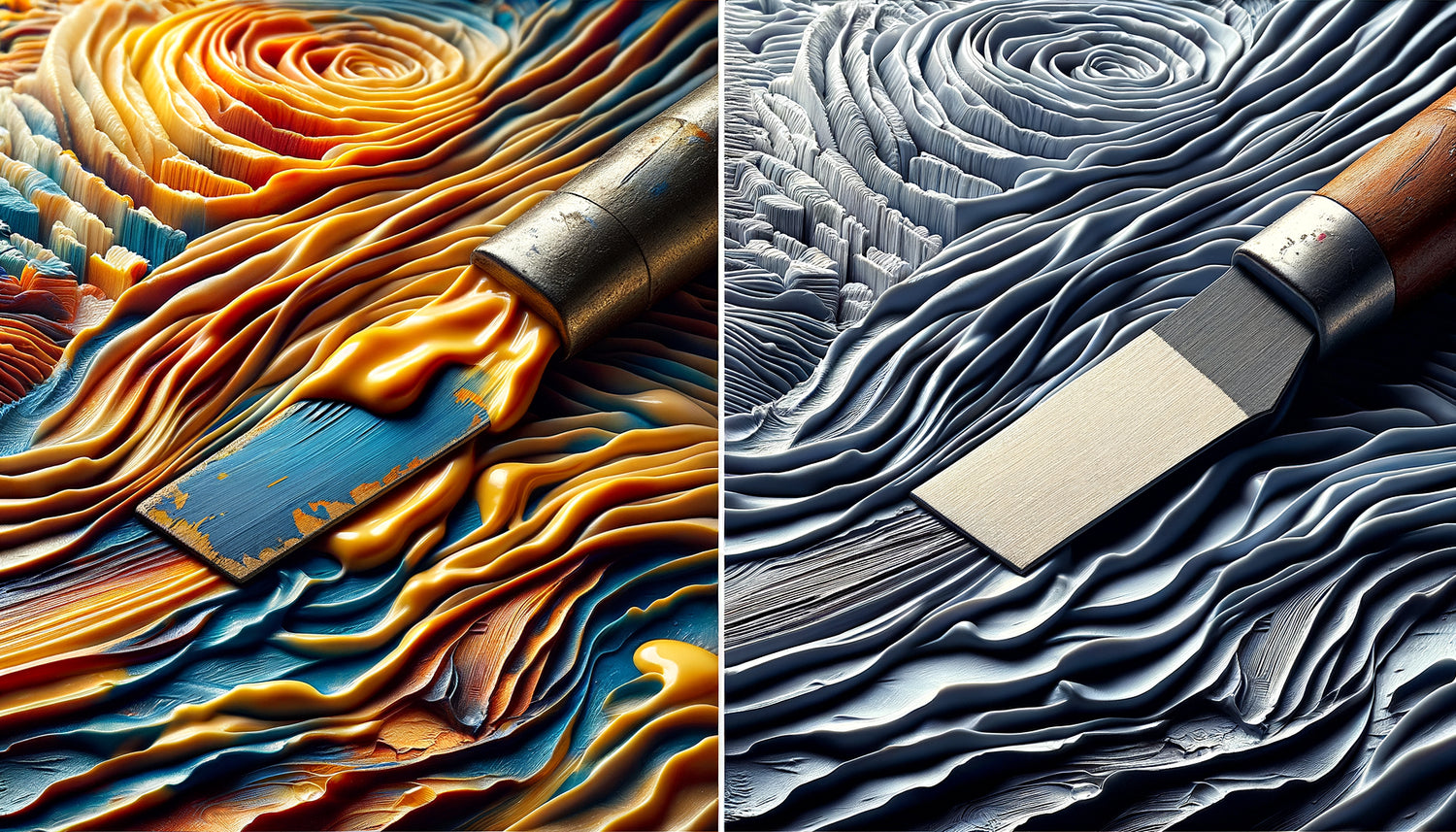
In my studio, it's always the first reflex: place the artwork under raking light. Position yourself so that the light hits the canvas almost parallel to its surface. With a genuine palette knife painting, you will observe irregular shadows, sharp ridges, deep valleys. Each knife stroke creates a unique geography, an organic relief that reacts differently depending on the angle of the light.
The textured prints, even the most sophisticated ones, exhibit a disturbing regularity. The gel or resin applied after printing create repetitive, almost mechanical patterns. I have seen industrial productions that reproduce the same “textured effect” on hundreds of canvases. Run your finger a few millimeters from the surface: can you feel these spectacular variations in thickness? A genuine palette knife painting may have reliefs of several millimeters, sometimes up to one centimeter in areas of impasto.
The revealing clues under the light
Observe the edges of the reliefs. In a true palette knife painting, you will often see small natural cracks, variations in shine depending on the thickness of the material. Paint dries differently depending on its thickness: thick areas remain matte while thin areas may have a slight sheen. This heterogeneity is impossible to reproduce industrially. Printed textured effects generally display uniform brilliance, that of the protective varnish applied as the final layer.
The tactile signature: when your fingers become experts
With the seller's or gallery owner's permission, the tactile test remains irreplaceable. I have authenticated dozens of works simply by touching them. Gently brush the surface with your fingertips. A palette knife painting has a complex texture, with sharp edges where the blade cut through the paste, and softer areas where it spread the color.
Printed textured effects offer a different feel: smoother, more homogeneous, often slightly rubbery. The acrylic gel used to create the relief has a characteristic elasticity. Press very gently with your fingernail in a discreet area: a true palette knife painting will be hard, sometimes brittle in thick impastos. A printed textured effect will yield slightly under pressure, revealing its synthetic nature.
The back of the canvas never lies
Turn the work over. The back of a palette knife painted canvas often reveals valuable clues. Look for slight distortions in the frame, micro-bumps on the back of the canvas corresponding to the front reliefs. When an artist applies a thick layer of paint, it exerts pressure on the support. I have even seen canvases where you can guess through transparency the areas of impasto. Printed textured effects generally have a perfectly flat and clean back, sometimes with a production label.

Color transitions reveal everything
Approach the work a few centimeters. In an authentic palette knife painting, observe how the colors blend together. An artist working with a palette knife creates unique transitions: the blade sometimes drags one color into another, creating accidental mixtures, traces of previous colors that show through. These « happy accidents » are the signature of the manual gesture.
Pay particular attention to the areas where two contrasting colors meet. You will often see a slight optical mixing, subtle tonal variations impossible to mechanically reproduce. Printed textured effects, even high-end ones, show distinct separations between colors. Digital printing, however sophisticated, deposits pigments uniformly. Any subsequent added relief does not alter this chromatic distribution.
The Magnifying Glass Test: For Perfectionists
In my workshop, I use a jeweler's loupe for contentious cases. Examine the texture at high magnification. A palette knife painting reveals the very structure of the paste: you will distinguish the pigments, irregularities in the material, sometimes even tiny air bubbles trapped during application. Textured prints show under the magnifying glass a regular printing grid, microscopic points aligned, characteristic of all digital reproductions.
The Price Usually Doesn't Lie
After fifteen years of expertise, I have learned that an authentic palette knife painting necessarily has a cost reflecting the creation time. An artist spends several hours, sometimes several days on a palette knife canvas. The price of professional materials – quality oil paint, premium canvas, solid frame – already represents a significant investment. A genuine medium-sized palette knife work is rarely sold for less than 300-400 euros for an emerging artist, and much more for an established creator.
Printed textured effects flood the market between 50 and 200 euros. Industrial production allows these attractive prices: the same image is reproduced in hundreds of copies, the texturing gel is applied mechanically, the whole is produced in series. If the price seems too good to be true, it's probably not an original palette knife painting.

Provenance and Documentation Authenticate the Work
Always ask for the provenance of the work. A legitimate artist will provide a certificate of authenticity, sign on the back of the canvas, give you information about their approach. I encourage my clients to search for the artist online, to visit his studio if possible, to see other works by his hand. This traceability is your best guarantee.
Textured impressions are often sold without precise information about their origin. You will find vague mentions such as “mixed technique” or “art reproduction.” Evasive sellers who cannot name the artist or explain the creation process should raise your suspicion. In my experience, transparency is the first indicator of authenticity.
Limited edition: check the numbering
Some quality reproductions are sold in limited numbered editions. This is perfectly legitimate if it is clearly announced. But be wary of vague mentions. A true impasto painting is by nature unique. If you are told about a “limited edition” for a supposedly hand-painted canvas, ask questions. I have seen clients pay the price of an original work to discover that it was copy number 47 out of 500.
Wear and aging tell the story
For works that are not recent, observe how they have aged. An impasto painting develops over time a natural patina. Oils can slightly yellow, the most exposed reliefs may show tiny chips. This organic wear is evidence of the authenticity of the material.
Textured impressions age differently. Texture gel can crack uniformly, varnish can become opaque. But you will never see this noble patina that characterizes true painting. In my restoration workshop, I immediately distinguish an authentic work from a reproduction: the material does not lie about its age and nature.
Ready to decorate your walls with authentic pieces that tell a story?
Discover our exclusive collection of fashion paintings that will transform your interior with style and character.
Your gaze transformed, your confidence restored
Next time you stand in front of a canvas with captivating reliefs, you will no longer be that hesitant visitor. You will approach with the assurance of someone who knows how to look. You will position the light, you will observe the color transitions, you will feel under your fingers the truth of the material. This skill I have passed on to you today, I myself developed over thousands of authentications.
Distinguishing an authentic palette knife painting from a printed textured effect is not just a matter of technical expertise. It's about recognizing the human gesture, honoring creation time, investing in the unique rather than the reproducible. Start today: visit a gallery, ask to touch, ask questions. Your eye will quickly become educated, and soon you will pass on this valuable knowledge yourself. True art awaits you, and you now know how to recognize it.
Frequently Asked Questions about Authenticating Palette Knife Paintings
Is it impolite to touch a canvas to verify its authenticity?
Absolutely not, provided you ask permission beforehand. In my professional experience, any serious seller or gallery owner fully understands this approach and even encourages it. It is the sign of an informed and serious buyer. Always touch with clean, dry hands, gently, on the edges or less sensitive areas of the work. If you are categorically refused this tactile examination without a valid reason, consider that as a warning signal. Honest professionals have nothing to hide and know that the tactile experience is an integral part of appreciating an authentic palette knife painting.
Can a quality textured print be a good decor purchase?
Quite right, provided you know exactly what you are buying and pay the fair price. I have clients who deliberately choose textured prints for certain spaces: children's rooms, professional offices, seasonal rentals. These reproductions offer an interesting visual impact for a controlled budget. The essential thing is transparency: buy a textured print knowingly, for its aesthetics and value for money, not believing you are acquiring an original work. A beautiful assumed reproduction is better than a fake original artwork. Find out about the quality of the printing, the durability of the materials, and consider it as a decorative element rather than an artistic investment. The fundamental difference remains the intention and honesty of the transaction.
How to develop your eye to instantly spot the difference?
Expertise comes with regular and comparative practice. I always advise starting by visiting artists' studios where you will see palette knife paintings being created. This experience is irreplaceable for understanding the process and materiality of the work. Then, visit decoration shops that sell textured prints and compare them directly. Photograph (with permission) both types of works from different lighting angles. Build up a mental visual library. With about ten attentive comparisons, your eye will automatically develop identification reflexes. Don't hesitate to join art lovers groups, participate in vernissages, and exchange with collectors. Training the eye is an exciting journey that will enrich your entire relationship with art.