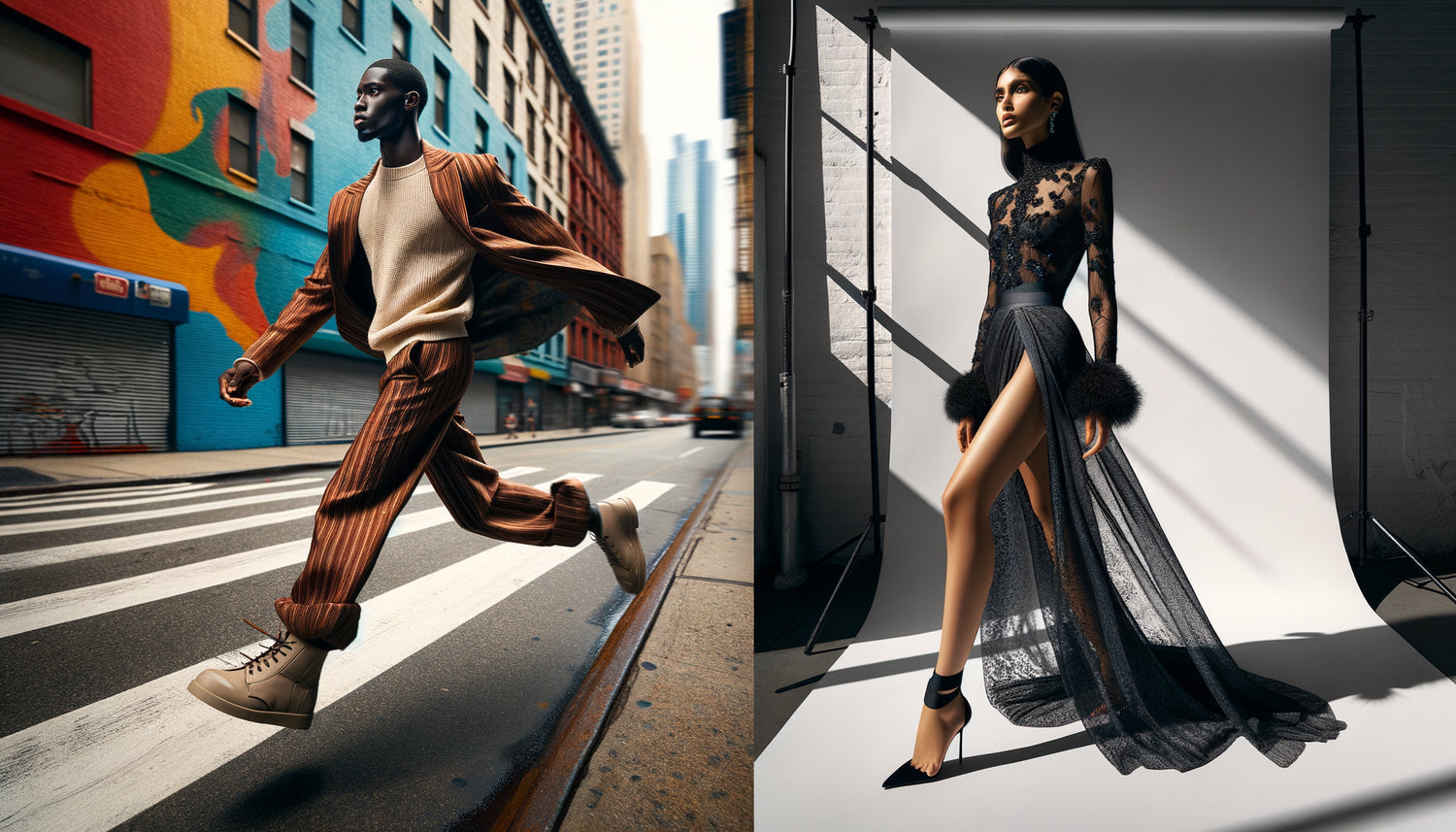
I remember this client who hesitated in front of two magnificent prints in my Parisian gallery. On the left, a silhouette captured in the hustle and bustle of Le Marais, scarf fluttering in the wind. On the right, a frozen portrait, perfect lighting, immaculate background. Two universes, two emotions, one question: which will best tell her story?
Here's what choosing between a street style photograph and a high-fashion studio portrait brings to your interior: a visual signature that reveals your personality, an atmosphere capable of radically transforming a space, and that little daily shiver when your gaze rests upon it. Because these two photographic approaches do not simply decorate your walls – they embody two radically opposed aesthetic philosophies.
You've been staring at that blank wall for weeks. You know you want a fashion photograph, something elegant, powerful. But faced with the diversity of styles, indecision sets in. Street style attracts you with its raw energy, its authenticity. The studio portrait seduces you with its timeless perfection. What if you make the wrong choice?
Rest assured. There is no wrong choice, only one that resonates – or doesn't – with your universe. After fifteen years of accompanying collectors and art lovers in their acquisitions, I have developed a simple method to guide you. In this article, I will reveal the secret codes of these two aesthetics so that you make the choice that transforms your space into a true visual manifesto.
The rebellious soul of street style: when the street becomes a gallery
Street style photography captures the unexpected, that moment when fashion meets asphalt. It's a woman in a trench coat crossing a pedestrian crossing in the rain, a model leaning against a tagged wall, an elegant silhouette lost in the New York crowd. This aesthetic, born in the 2000s with the rise of fashion blogs, revolutionized our relationship to fashion imagery.
What fascinates about a street style photograph is this constant tension between control and chaos. The clothing is impeccable, the pose studied, but the decor escapes any mastery. A yellow taxi crosses the frame, blurred passersby create movement, natural light sculpts volumes differently depending on the time.
This apparent spontaneity – often meticulously orchestrated – gives street style images an incomparable freshness. They breathe, they vibrate, they tell a story that goes beyond the simple garment. It's fashion in its urban context, accessible, almost tangible.
For which interiors does street style reveal its potential?
A street style photograph thrives in spaces that celebrate contrast. I've seen it enhance industrial lofts where raw concrete dialogues with captured elegance. It electrifies contemporary apartments with clean lines by injecting a dose of humanity and movement.
In a minimalist Scandinavian interior, it becomes that focal point that breaks the potential coldness. Against a white wall, framed in black or light wood, it creates a window onto urban effervescence. I have also seen bold collectors integrate it into classic interiors to create that aesthetic shock that makes all the difference.
Street style photography is particularly suitable for dynamic personalities, open living spaces, creative offices. It draws the eye, stimulates conversation, infuses energy. It's the choice of those who refuse decorative neutrality.
The icy perfection of the studio: the art of absolute control
At the opposite end of the creative spectrum, high-fashion studio portraiture embodies total mastery. Here, every element is orchestrated: lighting sculpts the face to the millimeter, the monochrome background eliminates all distractions, the pose is as refined as a Greek statue. It's the heritage of masters like Richard Avedon or Irving Penn, who elevated fashion photography in the studio to the rank of pure art.
What distinguishes an authentic high-fashion studio portrait is this ability to create the iconic. The model doesn't just wear clothing – they become an idea, a concept, a crystallized emotion. The gaze is magnetic, the composition geometric, the whole breathes timeless elegance.
In my gallery, studio portraits exert a different fascination. Visitors stop longer, scrutinize the details: the texture of the fabric revealed by perfect lighting, the intensity of the gaze, the purity of the lines. It's a visual meditation, an invitation to contemplation rather than action.
The sophisticated universe that welcomes the studio
High-fashion studio portraiture reveals its full power in interiors that cultivate formal elegance. I have seen it sublimate Haussmann apartments where moldings dialogue with the sophistication of the image. It brings a touch of refined modernity without breaking classical harmony.
In sleek contemporary interiors, these studio photographs function as works of art in their own right. A large format in an entrance hall, illuminated by a dedicated spotlight, transforms the welcome into a private gallery. In a bedroom, a black and white portrait creates that muffled, almost cinematic atmosphere.
Collectors of high-fashion studio photography generally seek timelessness. They prefer large formats, sophisticated frames – American box frame, fine gold baguette or deep black. It's the choice of personalities who value aesthetic rigor, discreet elegance, permanence rather than instantaneity.

The invisible criteria that reveal your choice
Beyond obvious aesthetic considerations, some more subtle factors should guide your decision between street style and studio portrait. Let's start with the natural light in your space. A room bathed in natural light magnifies street style photographs, whose tones and contrasts evolve with the hours. Conversely, controlled artificial lighting better enhances the technical perfection of a studio portrait.
The function of the space counts enormously. In a living room where you entertain, a street style photograph becomes a conversation starter, a visual icebreaker. In an office or library, a high-fashion studio portrait establishes an atmosphere of concentration and refinement.
Also consider your decorative palette. Street style images, often colorful and dynamic, naturally integrate into interiors that dare to use color and mix styles. Studio portraits, frequently in black and white or with subdued tones, suit monochromatic and streamlined palettes.
The revealing test: what emotion are you seeking?
Here's the exercise I systematically propose: close your eyes and visualize your ideal space. What sensation dominates? If you perceive energy, movement, a connection with the outside, street style is your language. If you feel calm, elegance, a form of timelessness, opt for studio.
A street style photograph says: I am alive, connected, in the movement of the world. A high-fashion studio portrait affirms: I value perfection, refinement, art as absolute. Neither is superior – they simply speak different aesthetic languages.
The technical dimension: what the print reveals
Beyond the photographic style, the quality of the print radically transforms the impact of a work. Street style photographs often benefit from being printed on supports that preserve the dynamism of the image: matte paper for a documentary approach, glossy to enhance contrasts and urban colors.
For high-fashion studio portraits, the support becomes an integral part of the artwork. A print on fine art baryta paper reveals endless shades of gray, the depth of blacks. The choice of paper influences emotion: matte evokes editorial sobriety, satin adds a touch of understated luxury.
Size also matters differently depending on style. A street style photograph retains its impact in medium format (50x70 cm), its dense composition supporting more modest dimensions. A studio portrait often requires large format (minimum 80x120 cm) for the intensity of the gaze and the perfection of details to produce their hypnotic effect.

Composing a cohesive collection: can you mix genres?
The question inevitably arises: is it possible to combine street style and studio portraits in the same space? My answer as a gallery owner: yes, but with method. Successful mixing requires a clear thread – common color palette, same photographer, or unifying theme.
I accompanied a collector who created a masterful gallery wall by alternating street style photographs and studio portraits, all in black and white, all framed identically. The contrast of styles created a fascinating visual tension, while the chromatic and formal uniformity ensured coherence.
Another approach is to dedicate specific spaces to each aesthetic. Street style images in dynamic living areas – living room, open kitchen, entrance hall. High-fashion studio portraits in more intimate spaces – bedroom, dressing room, office. Each style then fully deploys its character without dilution.
The evolution of your collection over time
Your current choice is not definitive. I regularly observe collectors starting with street style photographs, seduced by their emotional accessibility, before evolving towards more contemplative studio portraits. Others follow the reverse path, gradually finding the studio aesthetic too rigid.
This evolution often reflects changes in life. A young urban professional naturally identifies with street style. With maturity, the aspiration for calm and timelessness sometimes leads to high-fashion studio. Accept that your tastes evolve – it is a sign of a living artistic sensibility.
Ready to transform your space into a personal gallery?
Discover our exclusive collection of fashion wall art that brings together the best of urban street style and the timeless elegance of high couture studio portraits.
Your visual signature awaits
The choice between a street style photograph and a high couture studio portrait goes beyond a simple decorative decision. It's a statement of identity, a silent manifesto on what moves you, inspires you, defines you. Street style connects you to the energy of the world, its perpetual motion, that imperfect beauty born from urban chaos. Studio portrait anchors you in the quest for perfection, in refined elegance, in that suspended time where only essence counts.
Imagine yourself in six months, that first morning coffee, your gaze resting on your wall. Does the image bring you that daily spark you were looking for? That's the only question that really matters. Listen to your intuition – it already knows the answer. And if you are still hesitating, start with a piece. Live with it. Let it speak to you. Your collection will naturally build, gradually revealing your unique aesthetic signature.
The time has come to transform that blank wall into a statement of intent.
Frequently Asked Questions
Does street style become dated more quickly than studio portrait?
This concern often arises, and I understand it. Yet experience shows that artistic quality transcends trends. An excellent street style photograph, captured by a talented photographer, lasts through the decades. What becomes dated is not the urban elements or clothing, but poor execution. I have street style from the 90s in my gallery that fascinates as much as at their creation – the composition, the light, the emotion remain timeless. Conversely, a studio portrait mediocre ages badly despite its apparent neutrality. Focus on artistic quality rather than stylistic category, and your acquisition will stand the test of time.
What budget should you plan for a gallery quality photograph?
The fashion photography market covers a wide spectrum, and there are excellent works at all levels. For a limited edition from a talented emerging photographer, expect between 200 and 500 euros for a medium format. Established photographers offer editions between 800 and 2500 euros. Beyond that, you enter the realm of collectible artworks signed by recognized names. My advice: always prioritize an authentic art print from a photographer whose work touches you, rather than a valueless artistic reproduction of a famous image. The difference in quality – in the printing, the paper, the presence – amply justifies the investment in an original artwork.
How to frame to enhance each style?
Framing greatly amplifies or weakens the impact of a photograph. For street style, I generally opt for frames that respect the energy of the image: matte black frame for a clean contemporary approach, natural wood to soften and warm up, brushed metal to accentuate the urban aspect. Avoid overly ornate frames that would create dissonance. For high couture studio portraits, options widen: the white American box creates breathing space around the large formats, deep black concentrates the gaze, a fine gold baguette brings a touch of classic elegance without weighing it down. In all cases, plan for museum-quality anti-reflective glass – the difference in readability and preservation is spectacular.