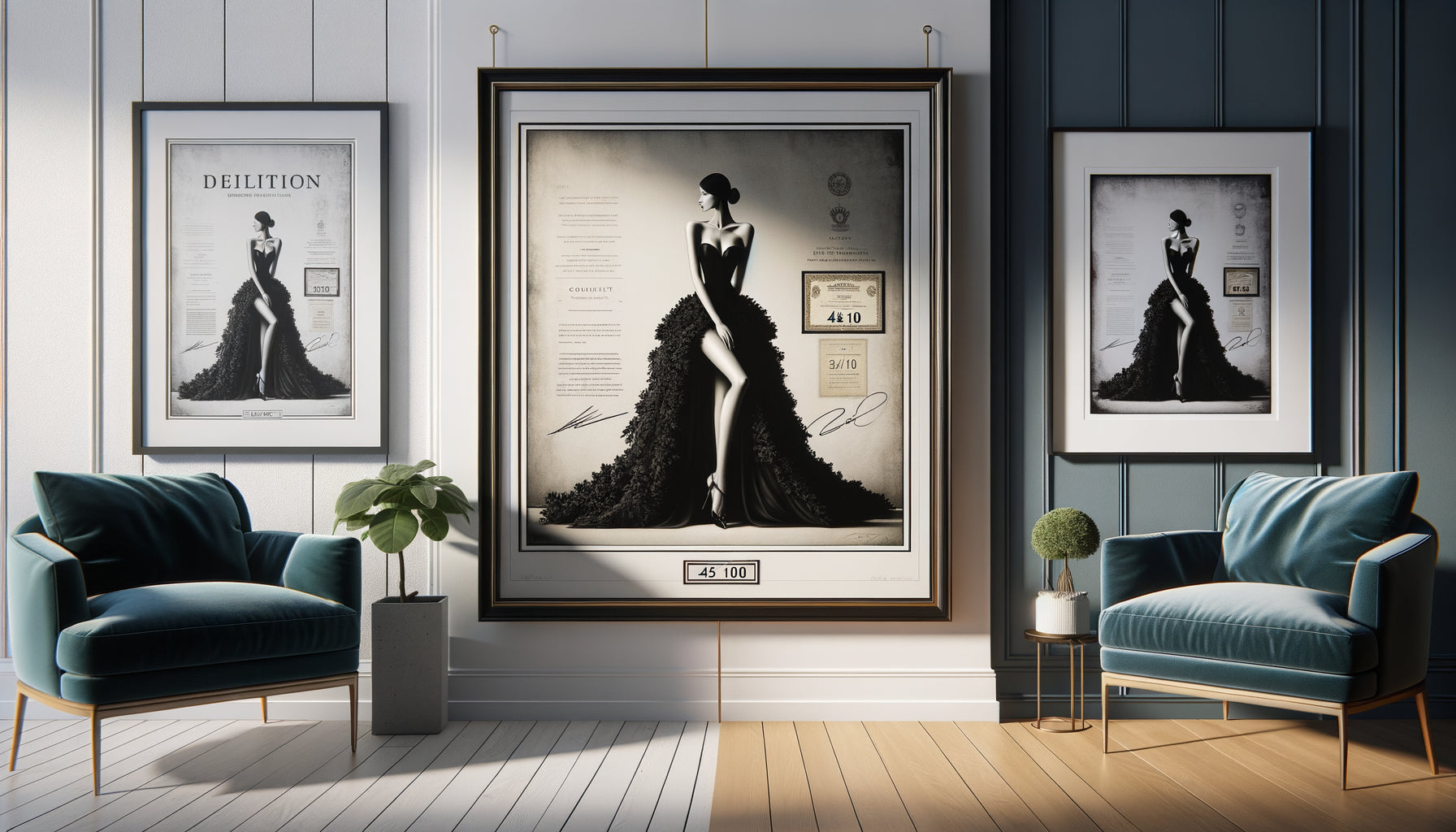
This morning, while adjusting the lighting in my gallery, I watched a customer approach a framed textile composition. Her face lit up, then darkened just as quickly. “The colors looked so different on the website...” She had just installed her artwork facing a south-facing window. After fifteen days, the nuances of her raw silks had already begun to fade. I’ve witnessed this scene dozens of times. And yet, enhancing a fashion wall art without betraying its textiles is a science accessible to all.
Here's what adapted lighting brings to your textile artworks: it preserves the chromatic authenticity of the fibers for years, reveals subtleties of texture invisible to the naked eye, and transforms your room into a scenic display case worthy of the finest Parisian showcases. Frustration often stems from a lack of knowledge: too much intensity and your precious fabrics will fade, not enough and all their depth disappears. Rest assured, the perfect balance between protection and enhancement rests on a few simple principles, which I have refined over hundreds of installations. I'm going to share with you exactly what I tell my collector clients.
Natural light: this treacherous friend of textiles
In my Marais workshop, I once displayed a 19th-century embroidered piece near a skylight. A beginner's mistake. UV rays gradually degraded the silk threads, transforming a deep burgundy into a pale pink. Natural light contains invisible but destructive ultraviolet rays for organic fibers: cotton, linen, wool, silk. Each hour of direct exposure accelerates the premature aging of your textile artwork.
For your fashion artworks, prioritize a location perpendicular to windows, never facing them. If your configuration requires it, invest in UV protective window films (blocking 99% of harmful rays) or sheer curtains. I’ve equipped my space with adjustable louvers: they diffuse soft light while filtering solar aggressions. This simple precaution extends the chromatic life of your artworks by decades.
The aluminum foil test
A technique I teach: place a strip of aluminum foil on part of your artwork for a month. Remove it. If you notice a difference in shade, your natural lighting is too aggressive. This visual diagnosis avoids irreversible regrets.
Color temperature: the secret of museum conservators
During a collaboration with the textile department of a Parisian museum, I discovered their obsession with kelvins. This unit measures the color temperature of a light source. Below 3000K, you get a warm, orange light that artificially warms tones. Above 5000K, cool, bluish light distorts warm shades.
To properly illuminate a textile artwork, aim for the neutral zone: between 3500K and 4000K. This range faithfully restores colors without introducing a parasitic hue. I systematically recommend LED bulbs with a Color Rendering Index (CRI) greater than 90. This index guarantees that your lighting reveals at least 90% of the actual color spectrum. Below, your beiges become grayish, and your reds turn orange.
In my own collection, I use museum grade LED certified for illuminating sensitive artworks. Yes, they cost 30% more than a standard LED, but they guarantee perfect color stability for 50,000 hours. A negligible investment compared to the emotional value of your fashion paintings.

The angle of illumination or how to avoid killer reflections
One Sunday, a couple came to consult me, desperate. Their magnificent textile triptych had become “invisible” due to reflections. Immediate diagnosis: spot positioned at 90° facing the painting, creating a perfect mirror. The angle of incidence determines the readability of your work, especially with glazed frames or shiny textiles.
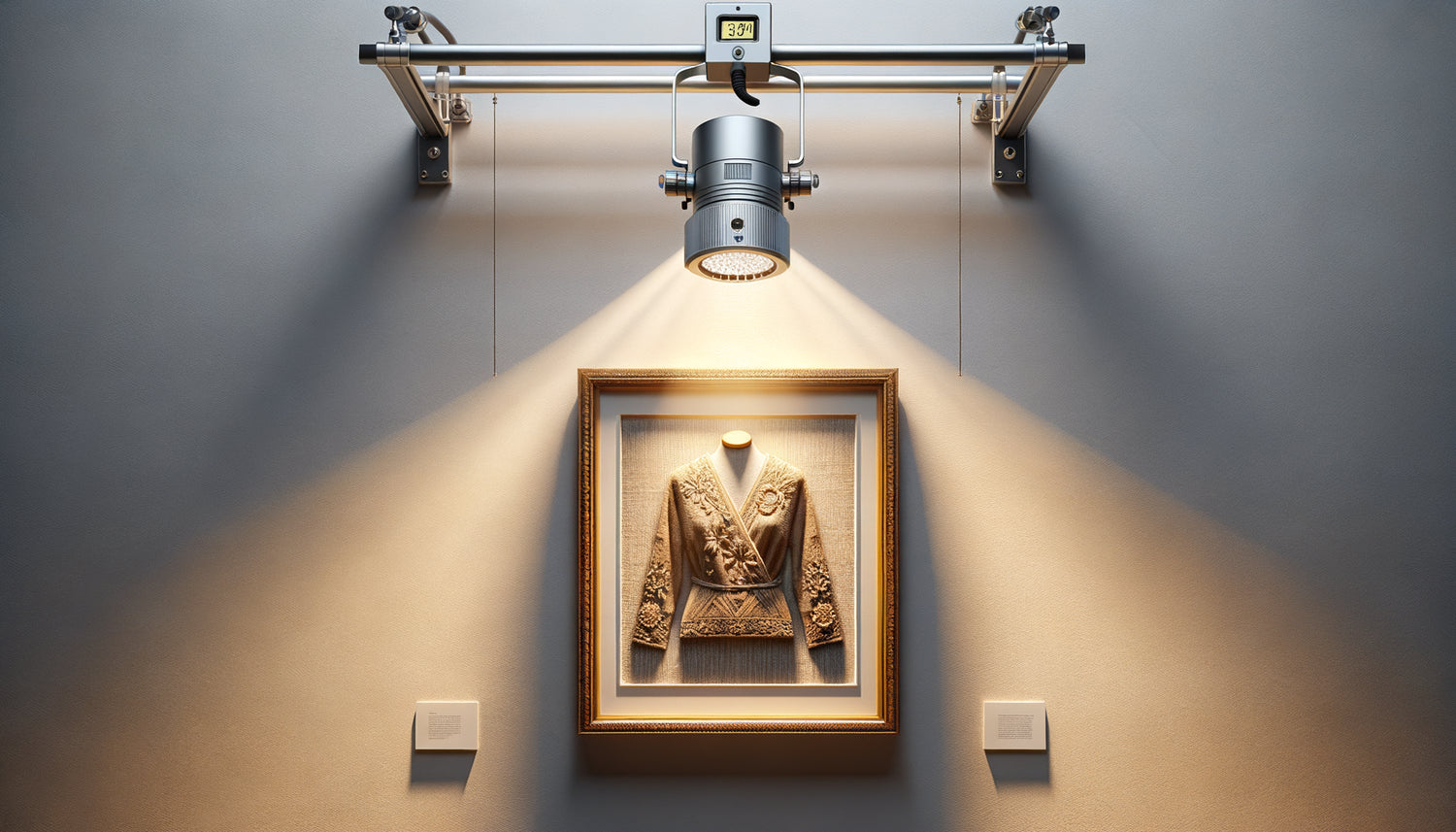
The rule of conservators: illuminate at 30° from above, never frontally. This downward inclination eliminates reflections while creating a subtle modeling that reveals the texture of the fibers. For a 60x80 cm painting, position your light source 40-50 cm from the wall, flush with the ceiling. I use rails with adjustable spotlights: this flexibility allows precise adjustment of the angle according to the texture of each piece.
The double lighting technique
For my large-format textile compositions, I install two sources at 30° on either side. This symmetry creates even illumination without shadows, revealing every detail of the material. Velvet, in particular, requires this attention: a single source accentuates the variations in fiber direction, creating inexplicably darker areas.
Light intensity: finding luxury without excess
In Parisian luxury boutiques, I often observe glaring lights on textiles. Spectacular, certainly, but disastrous in the long term. Light intensity is measured in lux, and for sensitive organic materials, conservators recommend a maximum of 150 to 200 lux. Beyond that, you accelerate photo-oxidation of fibers.
How to measure? A free smartphone app (Light Meter) is sufficient. Place your phone against the artwork: if you exceed 250 lux, reduce the intensity or move the light source further away. I personally work with dimmers, those small boxes that modulate the luminous power. They offer surgical control: bright to admire the details during the day, subdued for an intimate atmosphere in the evening.
A common mistake: multiplying sources. Three spotlights at 100 lux each create a cumulative 300 lux on your artwork. Prefer one or two well-positioned sources rather than a disordered constellation. Elegance comes from precision, not profusion.

The lighting solutions I install for my clients
After years of experimentation, I have identified three reliable systems to light textile artworks without compromising their integrity.
Adjustable LED wall lights
My first choice for intimate spaces. Mounted above the artwork, they emit a directed 30° beam. Look for models with adjustable temperature (warm-to-cool): you adapt the kelvins according to the time of day and atmosphere. Allow 80-150€ for a museum quality wall light. I particularly recommend them for textile artworks in bedrooms or dressing rooms.
Cable track with spotlights
My preferred solution for living rooms and galleries. This modular system allows you to position each spotlight exactly where you want it. I often install a 2 meter rail with 2-3 spotlights, creating an evolving museum lighting. You reorganize your artworks? You move the spots in 30 seconds. Investment: 200-400€ depending on length.
Concealed LED strips
For purists of minimalism. An LED strip (IRC>90, 3500K) installed in a cornice or flush-mounted frame creates a spectacular flat lighting effect. This technique beautifully reveals the reliefs of embroideries and thick textures. Note: it is suitable for modern compositions rather than fragile antique textiles. I use it for contemporary creations in thick linen or cotton.
Enhance your walls with textile elegance
Discover our exclusive collection of fashion wall art that transforms every glance into emotion, designed to shine under the perfect lighting you now master.
The mistakes that silently destroy your textiles
Allow me to share the disasters I have observed, so you can avoid them.
Halogens: these lamps emit intense heat which dries out natural fibers. I saw a precious linen become brittle in six months under a 50W halogen spotlight at 30 cm. Ban them definitively. Modern LEDs offer the same intensity without any thermal emissions.
Permanent lighting: even with an adapted source, 12 hours of daily exposure accelerates aging. I systematically install motion detectors or timers. Your paintings light up when you pass by, turn off when you are away. Energy saving and preservation: the winning duo.
Mixing temperatures: a 5000K (cold) ceiling light combined with a 2700K (warm) wall lamp creates a visual cacophony. Your eye struggles to interpret real colors. Harmonize all your sources within the same Kelvin zone. I regularly audit my installations with a color thermometer to guarantee this consistency.
When night falls: create atmosphere without compromise
In the evening, your textile lighting becomes a scenic element. I love that moment when artificial light takes over, transforming a simple painting into a dramatic focal point. With a dimmer, reduce intensity to 50-70 lux: sufficient to appreciate shapes and contrasts, insufficient to fatigue fibers.
A gallery tip: install an indirect ambient lighting (ceiling diffused floor lamps) combined with your direct painting lighting. This layering creates a remarkable spatial depth. Your fashion wall art stands out from the wall, as if floating in a precious halo. The museum effect without institutional austerity.
For my perfectionist clients, I program connected lighting scenarios. At 8 a.m., dynamic light at 4000K to admire the details before leaving. At 7 p.m., automatic transition to softened 3200K for an evening ambiance. At 11 p.m., gradual extinction. This automation preserves your textiles while orchestrating your daily life.
Maintenance of your textile lighting system
Perfect lighting today can become mediocre in two years without maintenance. LEDs gradually lose their intensity and color fidelity. I systematically replace my bulbs every 3-4 years, even if they are still working. This preventative renewal guarantees impeccable color constancy.
Clean your diffusers and reflectors twice a year. Accumulated dust absorbs up to 30% of the light intensity, unconsciously forcing you to increase the power. A damp microfiber cloth is sufficient. For recessed spotlights, a soft brush removes particles in the cells.
Document your installation: note the color temperature, the intensity in lux, the source-painting distance. This data becomes valuable when moving or reorganizing. I even archive reference photos, captured in calibrated light, to verify that my settings remain faithful over time.
Imagine. You come home, the sun is setting. Your fashion paintings gently light up, revealing every textile nuance exactly as you discovered them. The beiges remain warm, the blacks deep, the whites pure. This color constancy, this aesthetic durability, is the promise of controlled lighting. Start simply: measure your current lux, check your kelvins, adjust your angles. Your transformed gaze will be your greatest reward.
Frequently asked questions about textile painting lighting
Can I use my standard LED bulbs to light a textile painting?
Yes, but with precautions. Check the CRI (Color Rendering Index) on the packaging: it must be above 90 to faithfully reproduce textile nuances. Low-end LEDs (CRI<80) create greenish or yellowish dominants that distort your works. Also prefer a temperature of 3500-4000K for chromatic neutrality. I have found that even a good quality standard LED correctly preserves modern textiles (treated cotton, linen) for 5-7 years. For antique or precious pieces (silk, natural wool), invest in museum grade LEDs: their optimized spectrum eliminates harmful wavelengths while maximizing color fidelity. If your budget is limited, start with a good standard LED and add a dimmer: you will thus control the intensity, the first factor of preservation.
How many hours per day can I illuminate my wall art fashion without risk?
The museum rule recommends a maximum of 8 hours daily lighting at 200 lux for sensitive textiles. But this duration varies depending on the intensity: 4 hours at 400 lux cause as much damage as 8 hours at 200 lux. The determining factor is the cumulative light dose (intensity × duration). In my practice, I encourage intermittent lighting: turn on your artwork when you are present to admire it, and turn it off when the room is empty. A motion sensor automates this intelligent logic. For a living room occupied for 4-5 hours per day, lighting at 150-200 lux preserves your textiles for decades. Avoid the mistake of the anxious collector who turns everything off: your artworks are meant to be contemplated. The balance lies between daily appreciation and reasonable preservation. If you regularly entertain guests, install a reduced intensity (100 lux) “evening” scenario: sufficient to create ambiance, gentle on fibers.
My textile artwork is behind glazing. Should I adjust my lighting?
Absolutely. Glass creates unwanted reflections that require even more precise positioning of the light source. The 30° angle becomes critical: test by turning on your spotlight and moving in front of the artwork. If you see the reflection of the bulb, adjust the inclination until it disappears. However, glass offers an advantage: it partially filters UV rays, protecting your textile. Opt for a museum-quality anti-reflective (matte finish) glazing if you are reframing: it eliminates 99% of reflections while blocking harmful UV rays. This solution, which I systematically install for my valuable pieces, costs 40-60€ more than standard glass but radically transforms the visual experience. Regarding intensity, glass absorbs about 10% of the light: compensate slightly by increasing by 20-30 lux. Finally, regularly clean the glazing: traces and dust diffuse light in a disordered manner, creating a dull veil over your textile composition.