You want a living room where people live—not a catalog display—with a budget of 300 € all-inclusive and a simple principle: everything secondhand. It’s possible, provided you think like a set designer: first the atmosphere, then the roles (the essentials), then the casting (where to hunt for bargains and how to choose), and finally the lighting and textures to tie everything together. The good news? A successful living room doesn't depend on expensive objects, but on coherent choices and materials that tell a story.
1) Defining the atmosphere (and the rules of the game)
Before looking at any listings, take ten minutes to write down your desired atmosphere in two sentences and three keywords. For example: “soft and welcoming living room, reading + discussion, no central screen.” Keywords: light wood, warm light, natural textiles. This little framework avoids the pitfall of “love at first sight” finds that don’t know where to go.
Next, set your usage constraints: how many seating places? What floor area? Do you have a reading corner, a coffee table corner, a music corner? Also decide on a short palette: a dominant color (the “60”), a supporting color (the “30”), an accent (the “10”). With secondhand items, the palette becomes your compass: if a beautiful object doesn’t fit within the color/material card, you leave it for someone else — without regret.
Interior designer tip: take three photos of the empty room (or almost) and draw the “blocks” with felt-tip pen: seating, table, lamp, rug. This sketch will remind you that you are looking for volumes before looking for objects.
To quickly identify where to search in Europe by country and category (and save time on listing monitoring), refer to this overview of secondhand sites located around the world: useful for comparing platforms and expanding your sources from the end of this first step.
2) The essentials of a living room (secondhand version)
A functional living room consists of five roles: seating, placing, lighting, warming, storing. The idea is not to accumulate everything, but to cover each role with an object simple, solid, repairable.
Seating. Aim for a two-seater sofa in washable fabric or a pair of vintage armchairs. Wood structures (beech, oak, teak) and tubular metal legs stand the test of time. Tired foam can be replaced, a simple slipcover can be sewn or bought secondhand.
Placing. A coffee table in solid wood or rattan, just right patina; a narrow console behind the sofa if the room is long.
Lighting. A floor lamp (fabric lampshade, metal/wood base) + a table lamp on a stack of books or a wooden crate. Warm light comes first from sources (warm bulbs), not the price.
Visually warm up your space. A rug made of natural fibers (jute, wool, sisal) unifies the living room corner and adds depth to the floor, even with mismatched furniture.
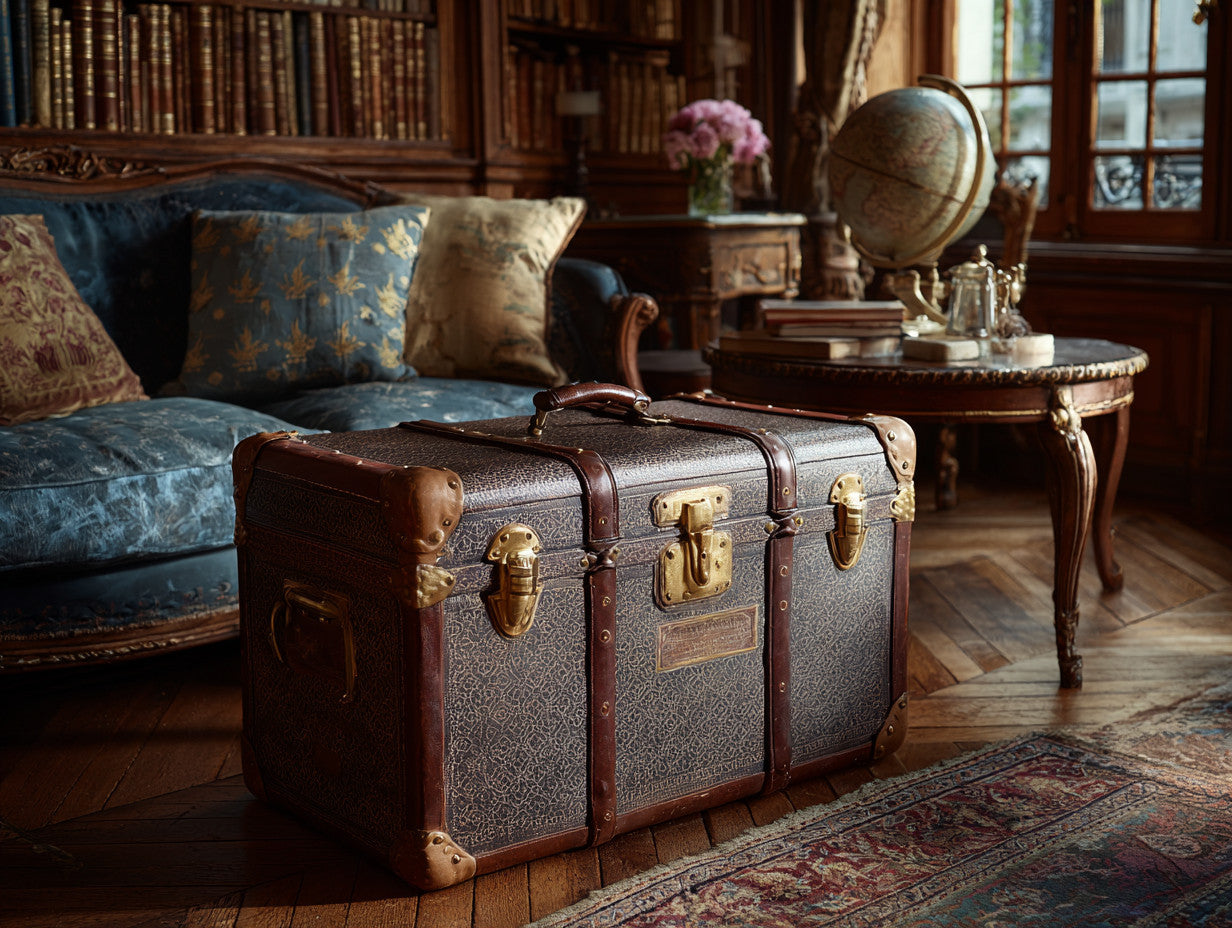
Organize. A trunk, a low cabinet or vintage lockers avoid visual clutter.
Keep in mind the rule of volume: it's better to have fewer, larger pieces than many small items that float in space. The secondhand market is full of forgotten dimensions overlooked by standard new products; take advantage of it.
3) Smart thrifting: a three-step method
Before the hunt. Set two priority targets (e.g., seating + rug) and a 20% tolerance in your budget for adaptations (slipcover, minor repairs). Prepare a mini-kit: tape measure, painter's tape (for tracing on the floor), cloth, power bank, a sturdy bag.
On site or online. First, look at the structure: on a chair, check the seat (belting/springs), the solidity of the backrest, the absence of play in the legs. On a coffee table, verify that it is level and the joints are secure (a piece of furniture that doesn't “dance” is already 80% comfortable). On a rug, scrutinize the edges and the underside: you will immediately know if it has been poorly stored. Don’t be afraid of minor cosmetic defects; rather fear structural defects (deep cracks, twisted legs, mildew).
Know how to say yes… and no. A good yes: the object respects your atmosphere, fits in with the color palette, fulfills a role and stays within budget. A good no: the object is superb but has no place in your plan. You never “miss” a deal if it doesn’t serve your scene.
Hygiene/safety parenthesis. For seat upholstery, opt for removable slipcovers or easy-to-shampoo fabric. For vintage lighting fixtures, provide for simple rewiring (by a professional if you are not comfortable). For wood, a gentle cleaning (black soap) is often sufficient; polishing with colorless wax restores depth without encasing the furniture under a thick varnish.
4) Harmonize colors and textures (the secret of “chic without new”)
The secondhand market is a playground: objects are not “born together”, it's up to you to make the connection. Two levers always work.
Color. Give the spotlight to a dominant color (e.g., sand/linen), supported by an allied color (sage green, dark blue) and reserve an accent (terracotta, brass). Specifically: a cream sofa, a jute rug, a sage green lamp base, some books with dark bindings… and an antique brass coupe that catches the light in the evening.
Texture. It is what creates the “cozy” sensation. Let an open-grain wood (oak, elm), a natural textile (linen/cotton/wool), a patinated metal (brushed steel, aged brass) and a fiber (rattan, jute) respond to each other. Three textures are enough, four at most, to avoid the “flea market” effect.
Unification tip. Repeat each material/color twice in the room. If you have an oak console, find a small wooden wall panel; if you like an ivory lampshade, look for an ivory throw. Repetition calms the eye.
5) Case study: €300 living room basket (realistic)
Imagine a living room of 12–14 m². You start with your “soft & reading” atmosphere, sand/sage palette, brass accent.
-
Main seating: a two-seater sofa with wooden frame, firm cushions, washable cotton cover. Secondhand market: €120–150.
-
Coffee table: solid wood top, light metal legs. €30–50.
-
Floor lamp: wooden or metal stem, fabric lampshade. €25–40.
-
Rug: 140×200 jute or 160×230 fine wool. €40–60.
-
Storage: old trunk (which also serves as a bench) or small low piece of furniture. €20–30.
-
Unifying details: two linen/cotton cover cushions, a brass accent. €10–20.
Total: €245–350 depending on your negotiation and the condition of the pieces. To stay under €300, focus on the sofa deal (that's the key variable). If you go over a bit, compensate by choosing an ultra-simple coffee table (raw wood top, relooked trestles) and finding the lamp at a garage sale rather than a consignment shop.
6) Staging (lighting + circulation)
A cozy living room is first read in the evening. Place the floor lamp behind the seating, slightly diagonally; place the table lamp lower, near the table. Aim for three sources total (never just a ceiling light). Leave at least 80 cm to circulate between seating and table; center the rug under the front legs of the sofa: the brain “sees” an island and relaxes.
7) Maintenance and finishing touches (that make all the difference)
Wash or air out fabrics, dust wood with a damp cloth, nourish with wax. Recast a button, add a pad under a leg that scratches, adjust a hinge that squeaks. Secondhand is not a shortcut; it's a language of care. In return, your objects age well, and your living room gains that patina that new items cannot imitate.
Warmth comes from coherence, not price
Composing a complete living room for €300 secondhand is nothing like an acrobat's number. It’s a method: a clear atmosphere, covered roles, lucid thrifting and a palette of materials that respond to each other. The result is not only economical: it is embodied. Each object has a story, and you orchestrate the whole thing. When the evening light makes the brass vibrate on the top, when the rug softens footsteps and the sofa welcomes you with just the right firmness, you will know that your living room did not cost you much — it resembles you.