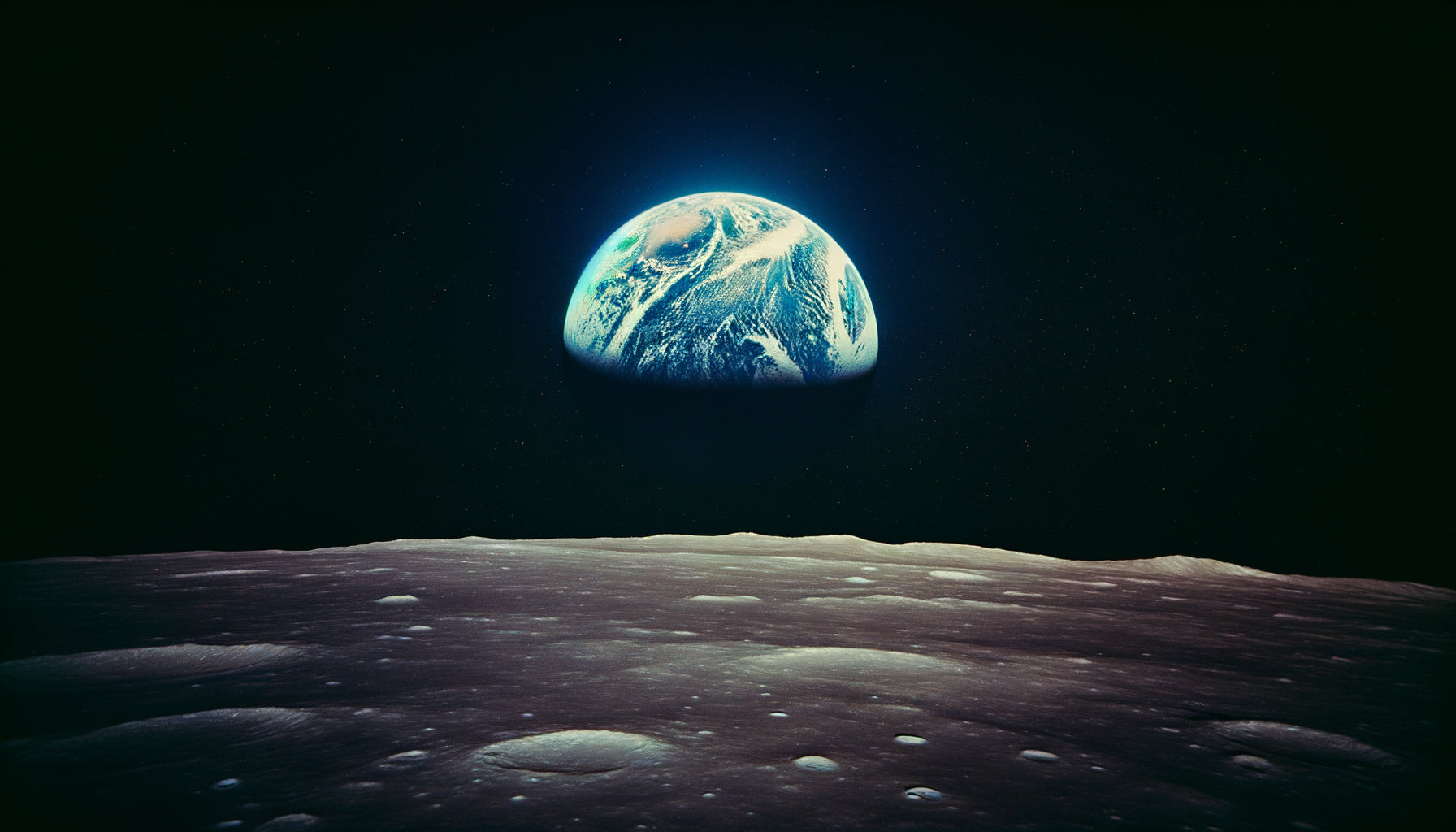
Imagine a world where no one had ever seen Saturn except through a hazy telescope. Where the surface of the Moon was just a distant mystery. Where Mars remained a cold scientific abstraction. Then, in the 1940s, a man opened the doors to the universe with a brush. Chesley Bonestell was not an astronaut, but an architect turned illustrator. His hyperrealistic paintings of the cosmos electrified the collective imagination and transformed science fiction into tangible anticipation. Here's what Bonestell’s legacy still brings today: an aesthetic vision of the cosmos that transcends science, inspiration to integrate spatial wonder into our interiors, and proof that art can shape future reality.
You may be looking at your living room searching for that touch that elevates the space, that extra soul which transforms four walls into a personal sanctuary. Trends come and go, styles are dismantled, but how to create an atmosphere that truly inspires? How to infuse your daily life with that dimension of dream and infinity that only space seems to offer?
The good news? You don't need to be an astronomer or wealthy collector to capture this cosmic magic. Space art, the kind that Chesley Bonestell practically invented, offers an accessible gateway to everyday wonder. In this article, I’ll take you to discover how this visionary revolutionized our visual relationship with the universe, and how his influence continues to nourish our living spaces today.
The architect who built imaginary worlds
Before painting Saturn's rings as seen from Titan, Chesley Bonestell drew skyscrapers. Trained as an architect in San Francisco at the beginning of the 20th century, he worked on the Chrysler Building and the Golden Gate Bridge. This technical rigor, this obsession with structural detail, would become his signature.
When Bonestell turned to space illustration in the 1940s, he brought something revolutionary: architectural precision applied to extraterrestrial landscapes. His lunar geological formations were not artistic fantasies but meticulous constructions based on the best astronomical data available. Every shadow respected the laws of physics. Each crater followed a logic of impact.
It was this unlikely alliance between poetic imagination and scientific accuracy that gave his works their hypnotic power. You weren't looking at a science fiction painting. You were contemplating a photograph of the future.
When Life Magazine opened the doors to the cosmos
1944. The world is at war. And suddenly, Life Magazine publishes a series of Bonestell’s illustrations showing Saturn from its different moons. The impact is seismic. Millions of Americans discover for the first time realistic space landscapes that give substance to cosmic abstraction.
These paintings did not depict fanciful aliens or futuristic spacecraft. They revealed the raw beauty of the real universe: the gigantic disk of Saturn suspended in the black sky of Titan, its rings slicing the horizon like a blade of light and ice. The majestic desolation of lunar craters. The sunsets on Mars, tinted with ochre and melancholy.
Bonestell understood something essential: the real universe, rendered with precision and artistic sensitivity, surpasses all fantasies. He didn't need to invent anything. It was enough to reveal.
The influence on space exploration
The impact of these illustrations extends far beyond the artistic realm. Wernher von Braun, architect of the American space program, collaborates directly with Bonestell to visualize future missions. Carl Sagan will later acknowledge that these paintings shaped his scientific vocation. Generations of engineers, astronauts and scientists will admit that Bonestell showed them space before they could go there.
His works adorned the offices of NASA. They inspired mission designers. They fueled the public enthusiasm necessary to finance space exploration. In this sense, Bonestell did not simply document the space age: he visualized it into existence.

Discover this inspiring artwork
A distinctive space aestheticHow to instantly recognize a work by Chesley Bonestell? By this unique combination of overwhelming grandeur and mineral precision. His extraterrestrial landscapes possess a photographic, almost documentary quality, but are bathed in a light that evokes both wonder and cosmic solitude.
Bonestell's palettes have become iconic: these deep blues of space, these nuanced lunar grays with mauve and ochre hues, these Martian oranges punctuated by surreal roses. He essentially created our visual vocabulary for space before probes confirmed (with a disturbing accuracy) the correctness of his intuitions.
His treatment of light remains unparalleled. The stars do not twinkle in the void of Bonestell's space, they pierce the black like fixed diamonds. The Sun, seen from the edge of the solar system, becomes just another star, reminding us of our cosmic insignificance.
Technique and creative process
A manic perfectionist, Bonestell sometimes built physical models of alien landscapes that he photographed under different lighting before painting. He consulted with astronomers, studied geological data, calculated light angles according to the distance from the Sun.
This methodical rigor distinguishes his space art from mere fantasy. Every element served a vision: to make the impossible credible, to transform science into accessible visual poetry.
Why Bonestell still resonates in our contemporary interiors
Today, as we have access to actual space photographs taken by Hubble or the James Webb telescope, why does the art of Chesley Bonestell retain its power of fascination?
Precisely because it is not simply scientific documents. Bonestell's paintings carry a dreamlike and contemplative dimension that pure photography cannot always capture. They invite reverie, mental travel, that escape which transforms a domestic space into a starting point towards infinity.
Integrating a reproduction inspired by the Bonestell aesthetic into your interior is choosing more than just a decorative element. It's installing a window to the cosmos, a daily reminder that our existence is part of something larger, more mysterious.
This approach works particularly well in minimalist contemporary spaces where every element must count. A large format representing Saturn viewed from Titan can visually anchor a living room while bringing that metaphysical depth sought by so many decorators today.

Discover this inspiring work
How to integrate Bonestell's legacy into your decor
The spirit of Bonestell is not limited to hanging a space reproduction on a white wall. It’s about creating a coherent cosmic atmosphere that dialogues with your space.
First, consider the scale. Spatial artworks work best in large formats that assert their presence and create a sense of immersion. A lunar panorama above a low sofa can literally open your room to another dimension.
The characteristic color palettes of space art – deep blues, silver grays, Martian oranges – naturally harmonize with modern interiors. They bring color without aggression, presence without clutter.
Lighting plays a crucial role. As Bonestell intuitively knew, light sculpts space. Indirect lighting, minimalist pendants create a dialogue with the light sources depicted in the artwork itself – that distant sun, those fixed stars, those alien-lit planets.
Stylistic associations
The Bonestell aesthetic works beautifully with mid-century modern furniture – logical since they share the same era of space optimism. But it also integrates well into ultra-contemporary or even industrial contexts where raw metals and concrete dialogue with the minerality of alien landscapes.
Avoid thematic overload. An interior inspired by space art should not look like a planetarium. One or two strong pieces are enough to set the atmosphere, the rest of your decor can remain neutral to let the artwork breathe.
Transform your interior into a window to infinity
Discover our exclusive collection of space paintings that capture the cosmic magic and timeless wonder that Bonestell revealed to the world.
The living legacy of a visionary
When Neil Armstrong stepped on the Moon in 1969, millions of viewers recognized that landscape. They had already seen it. Chesley Bonestell had shown it to them twenty-five years earlier.
This anecdote alone summarizes the prophetic power of his art. Bonestell did not simply illustrate space: he previewed our future, shaped our expectations, fueled our collective dreams. His paintings have functioned as self-fulfilling prophecies: by making space exploration visually concrete, they helped make it politically and technologically possible.
Today, as we talk about Martian colonies and space tourism, Bonestell's legacy remains alive. Every realistic science fiction film, every space documentary, every exoplanet visualization owes something to his pioneering approach.
But beyond this massive cultural influence, Bonestell bequeathed us something more intimate: permission to dream big. To look up. To understand that beauty and wonder are not only found in our earthly everyday life, but also in the immensity surrounding us.
Your space, your personal cosmos
Ultimately, incorporating the spirit of Chesley Bonestell into your interior is to acknowledge that our living spaces are more than functional. They are refuges, places of replenishment, anchors that should also remind us of our ability to dream.
Each morning, while having your coffee facing a Saturnian panorama, you offer yourself what Bonestell offered an entire generation: a moment of cosmic contemplation, a break from daily hustle, a connection with something greater.
This transcendent dimension of decoration, the one that transforms a simple wall into a portal to elsewhere, is precisely what today's conscious design enthusiasts are looking for. Not just beauty, but beauty that elevates.
Space art in the lineage of Bonestell responds to this contemporary need for spaces that nourish both the eyes and the mind. In a world saturated with screens and solicitations, these windows to the cosmos offer a meditative escape, an invitation to silent wonder.
So yes, you can continue to seek inspiration in ephemeral trends. Or you can choose timelessness: welcoming into your home a fragment of that infinity that Bonestell spent his life revealing. Because ultimately, perhaps this is the ultimate luxury in decoration: offering yourself daily a view of eternity.
FAQ: Everything you need to know about Chesley Bonestell and space art
Why is Chesley Bonestell considered the father of modern space art?
Chesley Bonestell literally created the genre of realistic space illustration in the 1940s. Before him, representations of space were mainly based on fanciful science fiction. Bonestell applied his architectural training and scientific rigor to create credible extraterrestrial landscapes based on available astronomical data. His paintings published in Life Magazine revolutionized our collective vision of the cosmos, directly influencing the scientists, engineers, and decision-makers who made space exploration possible. His unique approach combined technical accuracy and artistic sensibility, creating a new visual language for representing the universe. This influence continues today in all contemporary space visualization, from cinema to scientific documentaries.
How to integrate a space painting into a modern decor without being kitsch?
The key lies in balance and quality. Opt for large-format artworks that assert their presence rather than multiplying small thematic pieces. A single impactful cosmic panorama is better than a constellation of small space images. Favor sophisticated palettes – deep blues, silver grays, velvety blacks – which naturally harmonize with contemporary interiors. Avoid the accumulation of derivative objects (galaxy cushions, constellation rugs) which create a thematic overload. Space art works wonderfully in minimalist contexts where it can breathe. Pair it with refined furniture, noble materials (wood, metal, stone) and careful lighting. The goal is to create a contemplative window onto elsewhere, not a planetarium decor.
Were Bonestell's depictions truly scientifically accurate?
Remarkably, yes. Bonestell consistently consulted the leading astronomers of his time and based his paintings on available scientific data. When the first space probes photographed the Moon and Mars in the 1960s-70s, the resemblance to his paintings from the 1940s-50s stunned the scientific world. Of course, some details were corrected by direct observation – for example, his lunar formations were sometimes too rugged, and Mars turned out to be less dramatically colored. But overall, his intuition and methodological rigor produced surprisingly prophetic visions. This relative accuracy fundamentally distinguishes his work from simple artistic fantasy and explains why his works retain their power even in the age of real space photographs: they do not represent an imaginary space, but our real universe filtered through exceptional artistic sensibility.
Discover this inspiring work
Discover our exclusive collection of space paintings that capture the cosmic magic and timeless wonder that Bonestell revealed to the world.