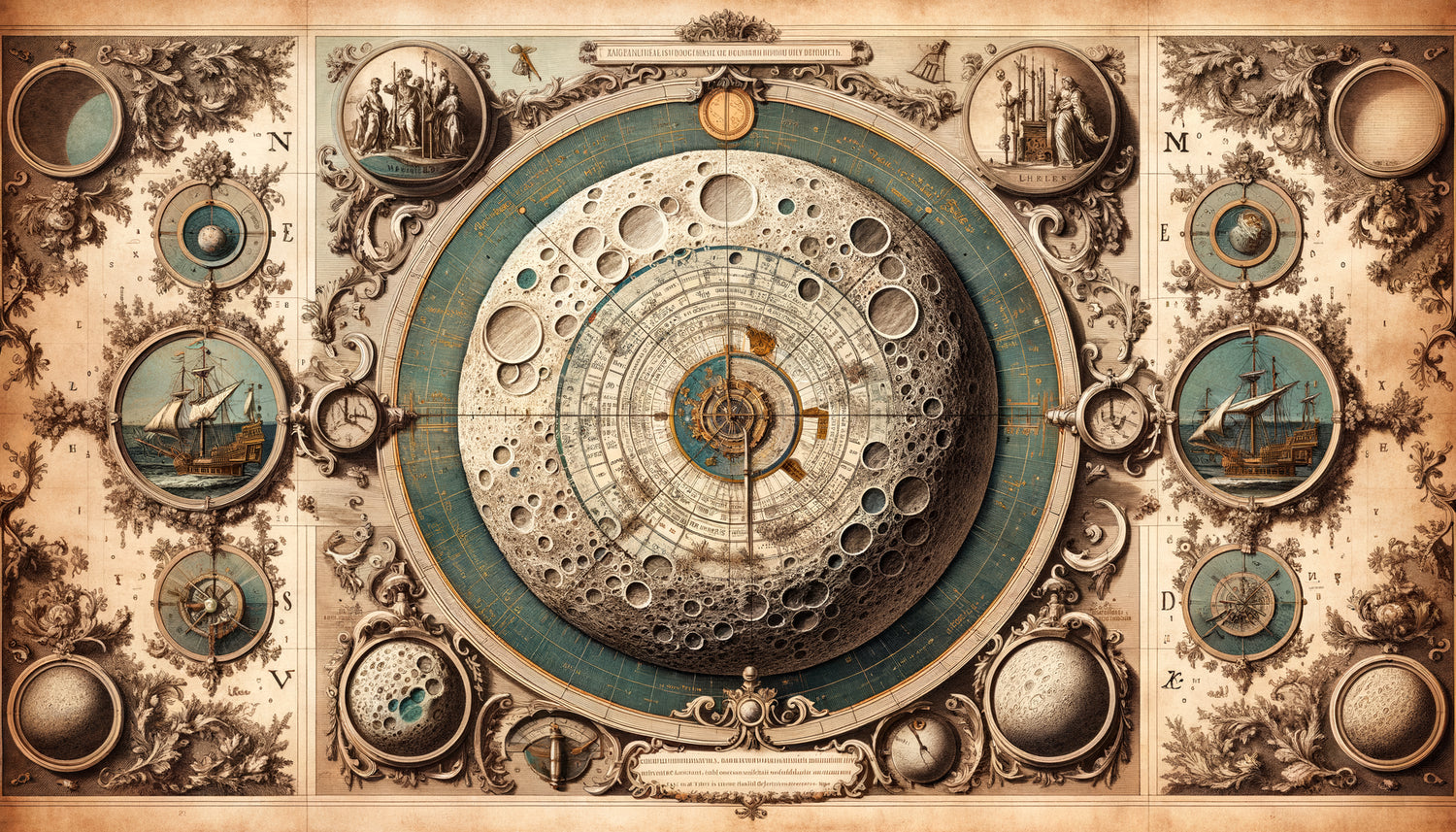
In the study of a great London collector I visited last year, my gaze froze on a monumental engraving suspended above a walnut bookcase: a Riccioli lunar map dating from 1651, framed in double gilded wood. The craters seemed almost palpable under the subdued light, creating shadows that brought this silvery surface to life. "It's the most beautiful object in my collection," he confided to me. "More precious to me than any painting."
Decorative selenography transforms the scientific study of the Moon into true wall art. Between the 17th and 19th centuries, these precise lunar maps drawn by early astronomers transcended their primary function to become prestige objects adorning the libraries, cabinets of curiosities, and refined salons of European aristocracy. They embody this rare fusion between scientific rigor and aesthetic beauty, transforming telescopic discoveries into true works of art.
Yet, many decoration enthusiasts are unaware of this fascinating period when science and art were one. We admire antique globes, celestial planispheres, but we forget these lunar portraits that revolutionized both astronomy and interior design. How did these scientific documents become coveted decorative objects? Which artisans and astronomers shaped this tradition? And above all, what can they bring to our contemporary interiors today?
I invite you to discover the little-known history of these antique lunar maps that transformed walls into windows open onto the cosmos, at a time when observing the Moon was a privilege reserved for a few.
The dawn of lunar cartography: when Galileo pointed his telescope to the sky
It all begins in 1609. Galileo, from his Venetian terrace, first points an improved astronomical telescope at our natural satellite. What he discovers overturns four centuries of beliefs: the Moon is not a smooth and perfect sphere, but a rugged world, riddled with craters, streaked with mountains and valleys.
His first illustrations, published in Sidereus Nuncius (1610), are rudimentary but revolutionary. These ink watercolors, made freehand, mark the birth of selenography – literally, the writing of the Moon. Galileo does not just observe: he interprets shadows, calculates the height of reliefs, transforms observation into cartography.
Soon, other European astronomers embark on this quest. In England, Thomas Harriot draws lunar maps of astonishing precision as early as 1609. In Belgium, Michel van Langren publishes in 1645 the first complete lunar nomenclature, naming visible formations after philosophers and sovereigns. These first scientific lunar maps circulate within scholarly circles, copied, engraved, collected.
The aesthetic revolution of copper engravings
It was the invention of copper engraving that transformed these scientific documents into true wall art objects. Flemish and Italian engravers, heirs to a centuries-old cartographic tradition, apply their expertise to these new celestial maps. Craters are rendered with delicate hatching, lunar seas are adorned with subtle textures, decorative cartouches frame the legends with baroque ornaments.
Johannes Hevelius, astronomer of Dantzig, publishes his Selenographia in 1647, a true pinnacle of decorative lunar cartography. His large-format plates (some measuring over 50 centimeters) combine rigorous observation and artistic composition. Lunar phases are arranged in a harmonious crown, topographic details rivaling the finest prints of the time. These engravings are immediately prized by discerning collectors.
Riccioli and Cassini : the golden age of baroque selenography
In the mid-17th century, decorative selenography reaches its peak with two major figures: Giovanni Battista Riccioli and Jean-Dominique Cassini. Their approach transcends simple documentation to create true visual compositions.
Riccioli's lunar map, published in 1651 in his Almagestum Novum, establishes the nomenclature that still prevails today. But beyond its scientific rigor, this antique lunar map is a graphic masterpiece: framed by mythological allegories, adorned with elaborate cartouches, it transforms the selenian surface into a painting. Great collectors hang it framed, as one would exhibit a Rembrandt.
At the Paris Observatory, Cassini perfects observation techniques and produces lunar maps of astonishing accuracy. His engravings, published in limited editions, are hand-colored by specialized illuminators. Some versions, enhanced with gold and silver, fetch considerable prices. Selenography becomes an art of court, prized by Louis XIV himself.
In curiosity cabinets : the Moon as treasure
In the 18th century, owning a decorative lunar map means belonging to the intellectual elite. In curiosity cabinets, these engravings mingle with exotic shells, scientific instruments and precious minerals. They are hung above libraries, in sumptuous frames of carved or gilt wood.
Parisian and London print merchants offer special editions: vellum papers, silk prints, personalized colorings. Some aristocrats order monumental versions to adorn their galleries. Selenography enters interior decoration as a symbol of refinement and scientific curiosity.

Discover this inspiring artwork
The 19th Century: When Photography Elevates Selenography
The invention of lunar photography in the 1840s could have signaled the end of engraved decorative selenography. The opposite happens. The first lunar daguerreotypes, created by John William Draper in 1840, reveal details invisible to the naked eye. But far from replacing artistic maps, they inspire a new generation of cartographers.
19th-century engravers fuse photographic precision and artistic tradition. Lunar maps by Johann Heinrich Mädler and Wilhelm Beer (1837) achieve unparalleled accuracy while retaining that aesthetic dimension which makes their decorative value. Printed in large format on exceptional papers, they adorn Victorian libraries and Haussmannian living rooms.
In 1878, amateur astronomer James Nasmyth published The Moon: Considered as a Planet, a World, and a Satellite, containing lunar maps based on plaster models photographed. The result is striking: almost three-dimensional images that transform cartography into photographic art. These plates, printed in photogravure, become sought-after collector's items.
The Chromolithographic Zenith
Chromolithography, a color printing technique developed in the 19th century, offers new possibilities for decorative selenography. Scientific publishers produce lunar atlases with subtle hues: deep blues to suggest the cosmic night, ochres and browns for illuminated reliefs, silver and white for highlands.
These chromolithographed lunar maps achieve considerable commercial success. They decorate not only the interiors of enlightened enthusiasts but also classrooms, public observatories, world exhibitions. The mapped Moon becomes accessible, democratized, while retaining its aesthetic prestige.
Why Antique Selenography Fascinates Contemporary Decorators
Today, collecting and exhibiting antique lunar maps is experiencing a spectacular resurgence of interest. In specialized auctions, original engravings by Hevelius or Riccioli fetch four-figure prices. But beyond the market value, these objects respond to a deep aspiration of our time.
First, they embody this fusion between science and beauty that our hyper-specialized era tends to separate. A 17th-century selenographic map recalls that rigorous observation and artistic creation can nourish each other. In a contemporary interior, it brings an immediate intellectual depth.
Next, their timeless aesthetic harmonizes remarkably with current styles. The black and white of antique engravings integrates perfectly into a Scandinavian minimalist decor. Nineteenth-century chromolithographs bring subtle touches of color to an industrial interior. Carefully framed, these decorative lunar maps become master pieces that attract the eye without ever overwhelming it.
The contemplation effect: invite the cosmos into your living room
Unlike modern photographic reproductions, ultra-detailed but often cold, antique selenographic maps retain a poetic dimension. The imperfections of the line, the variations in ink, the handwritten annotations create a particular intimacy. Observing these maps is to connect with the gaze of that 17th-century astronomer who, night after night, patiently scrutinized the Moon to capture its mysteries.
In an office, library or reading space, an antique decorative lunar map creates an atmosphere of meditative concentration. It invites slow contemplation, scientific wonder and intellectual curiosity. Interior designers use it to create "contemplation corners" in urban apartments, bringing a symbolic window to infinity.
Transform your walls into portals to the infinite cosmic
Discover our exclusive collection of space paintings that captures the timeless magic of antique celestial maps in refined contemporary creations.

Discover this inspiring artwork
How to integrate antique selenography into a modern decor
Are you charmed by the idea of hanging an antique lunar map in your home? Achieving this requires finesse and reflection to avoid a "dusty museum" effect, and instead create a harmonious dialogue between old and contemporary.
The choice of location is crucial. A monumental selenographic map naturally finds its place above a desk, bookcase or in a hallway that transforms it into a gallery. Avoid overly sunny spaces which risk altering the antique inks. Favor neutral-toned walls – off-white, pearl gray, navy blue – which highlight the contrasts of the engraving.
The framing determines the visual impact. For a classic approach, opt for a dark wood frame (walnut, stained oak) with cream matting that respects the heritage character of the object. For a more daring contemporary version, choose a minimalist black matte aluminum frame or even a magnetic hanging system that allows the engraving to "float" against the wall.
Compositions and associations
Decorative selenography lends itself wonderfully to wall compositions. Combine several lunar phases in a linear arrangement to create a dynamic visual rhythm. Combine a large map with enlarged details of specific regions (Tycho crater, Sea of Tranquility) for a scientific gallery effect.
Don't hesitate to combine your lunar maps with other elements: antique scientific instruments (telescope, decorative sextant), framed herbariums, or even black and white contemporary photographs. The contrast of eras creates a fascinating visual tension.
For more daring interiors, consider the "reinterpreted large format": have an antique selenographic map digitized and printed in monumental dimensions (120x180 cm) on matte canvas. The result, between respect for the original and contemporary boldness, can transform an entire living room.
The living heritage: from historical selenography to current creations
The influence of antique selenography extends far beyond the circle of collectors. Contemporary graphic designers constantly draw on this visual repertoire: space agencies, scientific book publishers, creators of high-end wallpapers, all reinterpret the aesthetics of classic lunar maps.
Artists like Katie Paterson or Vija Celmins create works that directly dialogue with the selenographic tradition. Their contemporary "lunar portraits", drawn in graphite or laser engraved, extend the fascination born four centuries ago. Some contemporary art galleries even organize themed exhibitions confronting antique engravings and current creations.
In the world of interior design, this influence is everywhere: textile patterns inspired by lunar craters, luminaires whose shapes evoke mapped lunar phases, panoramic wallpapers reproducing selenographic maps in XXL version. Decorative selenography is not a relic of the past, but a living and renewed source of inspiration.
Where to find these cartographic treasures
For enthusiasts wishing to acquire original antique lunar maps, several options are available. Auction houses specializing in old books and scientific instruments regularly offer engravings from the 18th and 19th centuries. Expect to pay between 200 and 2000 euros depending on rarity, condition and provenance.
Flea markets and antique shops can reveal unexpected finds, especially plates from dismantled atlases. Specialist old bookstores in cartography and astronomy are a reliable source, with the advantage of expert advice on authenticity and dating.
For more modest budgets, high-quality reproductions allow access to the selenographic aesthetic. Some art printers offer remarkable facsimiles of Riccioli or Hevelius maps, on aged paper, sometimes artificially aged. The result, well framed, offers 80% of the charm of the original at 5% of the price.
Imagine: every evening, as you return to your office or library, your gaze rests on this antique lunar map. The craters patiently engraved three centuries ago seem to vibrate under the light of your lamp. You then connect to this unbroken chain of sky observers, from Galileo to today, all fascinated by this satellite that dances around our planet. Decorative selenography does not simply adorn your walls: it opens a window to infinity, transforms your interior into an intimate observatory, makes your living space a place where science, history and beauty converse silently.
Start modestly: one well-chosen engraving, well framed, well placed. Let it dialogue with your space, with your gaze, with your intrigued guests. You will see that it will not remain alone for long. Antique lunar maps have this magnetic power to call other celestial companions, to create wall constellations, to gradually transform your interior into a contemporary cabinet of curiosities. And each new acquisition will be a journey through time, a meeting with these astronomer-artists who, armed with their rudimentary telescopes and engraving talent, transformed scientific observation into visual poetry.
Frequently asked questions about decorative selenography
How to authenticate an antique lunar map?
Authenticating an antique lunar map relies on several observable criteria. First, examine the paper: authentic engravings from the 17th-19th centuries are printed on linen paper (made from flax or cotton), identifiable by its irregular texture and laid lines (parallel lines visible through transparency). Modern wood pulp paper, smooth and uniformly white, betrays a reproduction. Next, observe the printing technique: antique copper engravings have a slight ink relief that is palpable to the touch, sometimes with plate bite marks on the margins. Handwritten annotations in brown ink, age spots (foxing), and old folds are encouraging signs, although they can be imitated. For significant acquisitions (over 500 euros), do not hesitate to consult an expert in antique cartography or request a certificate of authenticity from the seller. National libraries sometimes offer free identification services. Remember that a beautiful reproduction is nothing to be ashamed of: well framed, it offers the same aesthetic pleasure as an original for a fraction of the price.
Does antique selenography suit modern minimalist interiors?
Absolutely, and that's where one of the strengths of decorative selenography lies! Antique lunar maps, particularly black and white engravings from the 17th century, have a graphic purity that perfectly dialogues with contemporary minimalist aesthetics. Their reduced palette (black, gray, off-white), their geometric composition, and their universal subject – the Moon – transcend decorative trends. To successfully integrate this, prioritize a minimalist frame: matte black aluminum frame, thin, without matting, or even simple plexiglass with invisible fixing system. Hang the map on an immaculate white wall, with no other decorative elements in the immediate vicinity, to create a "unique artwork" effect. The visual impact will be powerful: the scientific detail of the engraving contrasts with the surrounding purity, creating a magnetic focal point. Some decorators even combine several lunar phases in a strict linear composition, like a minimalist and poetic frieze. The secret lies in confidence: let the map breathe, surrounded by emptiness, and it will reveal all its contemplative power.
What is the difference between lunar maps from different centuries?
Each period has produced lunar charts with distinct characters, reflecting technical and aesthetic evolution. The 17th-century charts (Galileo, Hevelius, Riccioli) are characterized by their pioneering aspect: sometimes approximate but charming tracings, elaborate baroque cartouches, fanciful nomenclatures (one finds « Sea of Troubles » or « Ocean of Storms »). Their decorative value lies in this combination of scientific naivety and artistic sophistication. 18th-century charts (Cassini, Tobias Mayer) gain precision while preserving the elegance of rococo frames; some versions are hand-watercolored, adding subtle hues. The 19th century marks the peak of accuracy with Beer and Mädler, whose 1837 chart remains a reference. The invention of chromolithography introduces realistic colors. Charts based on photographs (such as those by Nasmyth) offer a striking realism. For decoration, engravings from the 17th century seduce with their historical dimension and baroque aesthetics; those from the 18th century offer a perfect balance between precision and elegance; 19th-century chromolithographs bring color and visual impact. It all depends on the desired atmosphere: intimate and scholarly (17th), refined and enlightened (18th), or scientific and Victorian (19th).