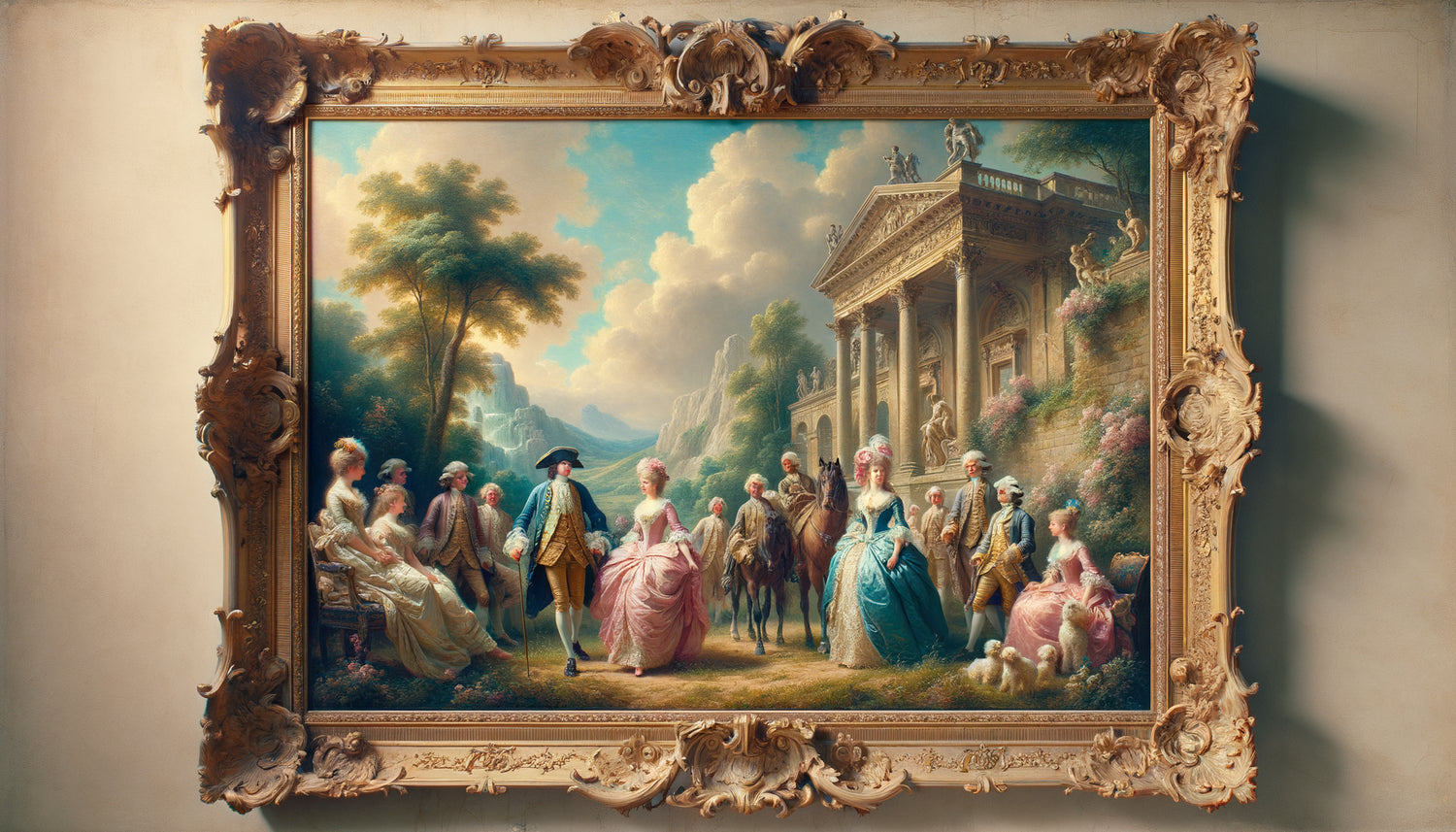
I still remember the moment when a couple of enlightened enthusiasts crossed the threshold of my auction house for the first time. Their dream? To acquire an authentic 18th-century painting for their Parisian living room. Their question was simple, but fundamental: what budget should they expect?
Here's what a historical painting from the 18th century brings to your collection: a window into the golden age of European painting, a tangible heritage investment, and that unique presence that no reproduction can ever match. But let’s be frank: the opacity of the antique art market often discourages newcomers.
Price ranges vary from a few thousand euros to several million, depending on criteria that few people truly master. How do you distinguish an opportunity from an overpriced price? What are the real factors that determine the value of an old canvas?
After twenty-three years spent between auction houses and restoration workshops, I have accompanied hundreds of collectors in their acquisitions. Let me guide you through the financial realities of the market, with transparency and precision.
Main price ranges according to pictorial school
The budget needed to acquire a historical painting from the 18th century depends primarily on its geographical origin. The French school dominates the market with works ranging from €8,000 for a small format by a secondary artist to several hundred thousand euros for a Boucher or Fragonard.
The Italian school, particularly prized for its Venetian vedutisti, presents a similar range. A small architectural caprice by a follower of Guardi starts around €5,000, while an authentic Canaletto easily exceeds one million euros.
More accessible, the Flemish and Dutch school offers excellent opportunities. Genre scenes, winter landscapes or still lifes by less famous artists are negotiated between €3,000 and €15,000. I recently saw a delightful Flemish peasant scene, oil on oak panel, sold for €6,500—an excellent entry point to start a collection.
The British school: a surprising value for money
Paradoxically, the British school of the 18th century remains undervalued. Portraits of small English masters, technically impeccable, are acquired for €4,000 to €12,000. These historical paintings possess that aristocratic elegance so characteristic of the Georgian era.
Beyond the brush: the criteria that drive up bids
The artist's reputation is obviously the first factor in value. A painting signed by a recognized master such as Watteau, Tiepolo or Gainsborough reaches peaks. But signature isn’t everything.
Condition dramatically influences the price. An 18th-century historical painting that has retained its original varnish, intact glazes and its period frame will be worth 40 to 60% more than a restored work invasively. Experienced collectors scrutinize restoration certificates before bidding.
Provenance dramatically alters valuation. A canvas from a documented aristocratic collection, having been featured in museum exhibitions or mentioned in specialist literature, can multiply its estimate by two or three. I have seen a small French landscape go from €8,000 to €22,000 once its provenance was established from a princely collection.
Format and subject matter: determining variables
Dimensions significantly impact the budget. A bust portrait (55 x 46 cm) generally costs 30 to 40% less than a full-length portrait by the same artist. Urban collectors also prefer medium formats, which are more suitable for contemporary interiors.
As for subjects, certain themes remain perpetually sought after: French gallant scenes, Italian views, elegant female portraits. Conversely, religious subjects or complex allegories, though technically remarkable, stagnate at more accessible prices—sometimes 50% less expensive for equal quality.

Where and how to acquire: purchasing channels and their budgetary impacts
The place of acquisition directly influences your budget for an 18th-century historical painting. Major Parisian auction houses (Drouot, Christie's, Sotheby's) apply buyer's fees of 20 to 28%. A painting sold for €10,000 will actually cost you between €12,000 and €12,800.
Specialized galleries offer fixed prices, generally 30 to 50% higher than the low estimates of auction sales, but include authenticity guarantees, detailed appraisals, and sometimes a restoration service. This security comes at a cost, but eliminates unpleasant surprises.
Provincial sales are full of opportunities. In the rooms of Aix-en-Provence, Bordeaux or Lyon, I have regularly identified historical paintings estimated 40% below Parisian prices. The downside? Less competition also means less prior expertise.
Online sales: democratization or minefield?
Digital platforms have revolutionized the market. You can find 18th-century paintings from as little as €2,000. But be careful: the inability to physically examine the artwork before purchase represents a real risk. I recommend this channel only for purchases under €5,000, where the financial risk remains manageable.
Hidden costs: budget beyond the hammer price
Too many first-time buyers forget about ancillary expenses. For a historical painting from the 18th century, systematically budget 15 to 25% additional beyond the acquisition price.
Prior expertise costs between €150 and €500 depending on complexity. Essential investment if you buy outside of a certified gallery. Specific insurance for artwork represents 0.15 to 0.3% of the declared value annually.
Secure transport of an antique painting requires a specialist carrier: count €200 to €600 depending on distance. Period or custom framing respecting conservation standards varies from €300 to €1,500.
Finally, potential restoration: a light cleaning oscillates between €400 and €800, while a complete restoration (filling, retouching, new varnish) easily reaches €2,000 to €5,000. On an €8,000 painting, these cumulative costs can add €2,000 to €3,000 to your initial investment.

Starting a collection: smart acquisition strategies
For a first purchase, I systematically advise a total budget of €5,000 to €15,000, including fees. This range allows you to acquire an authentic and decorative 18th-century historical painting without taking disproportionate risks.
Prioritize schools from the North (Flemish, Dutch) and small French formats. These segments offer the best value for money and correct liquidity in case of resale. A Dutch portrait of a child or a Flemish rural scene constitutes a stable safe haven.
Build a network: attend previews of sales, talk to experts, visit specialized galleries. The antique art market still functions a lot on relationships. Some of the best opportunities are never publicly announced.
Thematic approach rather than the race for big names
Rather than aiming for an unaffordable master, build a coherent thematic collection. Four historical paintings of secondary quality but harmonious (Arcadian landscapes, period portraits, intimate scenes) for €25,000 will create a superior visual and cultural impact to a single mediocre painting by a famous artist at the same price.
The heritage investment: return and prospects
Let's be realistic: an 18th-century historical painting is not a classic financial investment. The market remains illiquid and cyclical. Nevertheless, over twenty years, works of museum quality progress regularly from 3 to 5% annually, sometimes more for rediscoveries.
Tax benefits exist: the taxation on capital gains from works of art remains favorable in France (5% of the sale price or 36.2% of the capital gain). For transmissible assets, antique paintings benefit from an attractive inheritance tax rate.
But the real return is elsewhere: in the daily pleasure of living with an authentic work, a witness to a bygone era. This presence in your interior is priceless. An 18th-century painting dialogues with you every day, tells a story, anchors your space in an irreplaceable temporal depth.
Ready to cross the threshold of discerning collectors?
Discover our exclusive collection of historical paintings that will transform your view of antique art and enhance your interior.
The time to acquire your first window onto the 18th century
Each 18th-century historical painting carries within it decades of silent stories. The collectors I accompany often tell me the same thing: their first purchase transformed their relationship with art, from occasional spectators to true guardians of heritage.
Your budget will determine the school, format and prestige of the artist, but not the aesthetic emotion. I have seen enthusiasts moved by a modest Italian landscape at €4,000 and remain unmoved by a great name at €80,000. The essential thing lies in this intimate connection, that moment when you know that this painting must join your home.
Start modestly if necessary, but start. The market for antique paintings rewards patience, curiosity and measured boldness. Your first 18th-century painting is not an end in itself, but the opening of a fascinating journey through the centuries.
Frequently Asked Questions
Can you really find an authentic 18th-century painting for less than €5,000?
Absolutely. Small formats from Flemish, Dutch or minor French schools are regularly negotiated between €3,000 and €5,000 in provincial sales. These are generally scenes of genre, landscapes or portraits by artists who are less famous but technically competent. The key is to prioritize pictorial quality and condition over a prestigious signature. These works constitute excellent entry points for starting a collection, with controlled financial risk. However, it is advisable to be accompanied by an expert for your first purchase in order to avoid incorrect attributions or excessive restorations that would devalue your investment.
How can you be certain of the authenticity before buying a historical painting?Authentication relies on several complementary examinations. First, stylistic analysis by a recognized expert who verifies the technique, style and signature. Then, the examination of the support (canvas, panel) and materials must correspond to the assumed period. Serious galleries systematically provide a detailed certificate of authenticity. For salesroom purchases, consult the artist's raisonné catalogue if available, and do not hesitate to request a condition report. Scientific analyses (pigments, radiography) remain possible for important works, costing between €500 and €1,500. Always favor established sellers who stake their reputation and offer contractual guarantees. Beware of abnormally low prices, often synonymous with optimistic attribution or undeclared conservation problems.
Does an antique painting require regular costly maintenance?
Contrary to popular belief, a well-preserved 18th century historical painting requires little maintenance. The essential precautions are free: avoid direct exposure to sunlight, maintain stable humidity (45-55%), and keep the work away from heat sources. A delicate dusting with a soft brush once or twice a year is sufficient. Professional interventions remain spaced out: a surface cleaning every 15 to 25 years (€400 to €800) and a complete restoration potentially never necessary if the work is properly preserved. Insurance represents the only significant recurring cost, approximately €200 to €300 annually for a work worth €10,000. Ultimately, owning an antique painting proves less expensive than many contemporary works requiring complex display conditions or unstable materials.