November 2019. I push open the door of the Fondation Louis Vuitton for the exhibition
Here's what backlit Halloween paintings bring: a visual depth comparable to professional installations, a theatricality that transforms the domestic atmosphere, and a contemplative experience worthy of contemporary galleries.
You have probably accumulated garlands, luminaries, perhaps even invested in elaborate decorations. Yet, the result remains flatly decorative. The elements are added without creating this visual coherence, this presence that emanates from carefully staged cultural spaces.
This frustration is legitimate. For fifteen years as an exhibition designer, I have studied how light sculpts perception. What distinguishes a simple decoration from a true visual experience lies in a few precise principles, now accessible to individuals.
In this article, I reveal how backlit Halloween paintings replicate museum techniques, what their honest limitations are, and how to integrate them to create an atmosphere worthy of the best contemporary installations.
The silent revolution of domestic backlighting
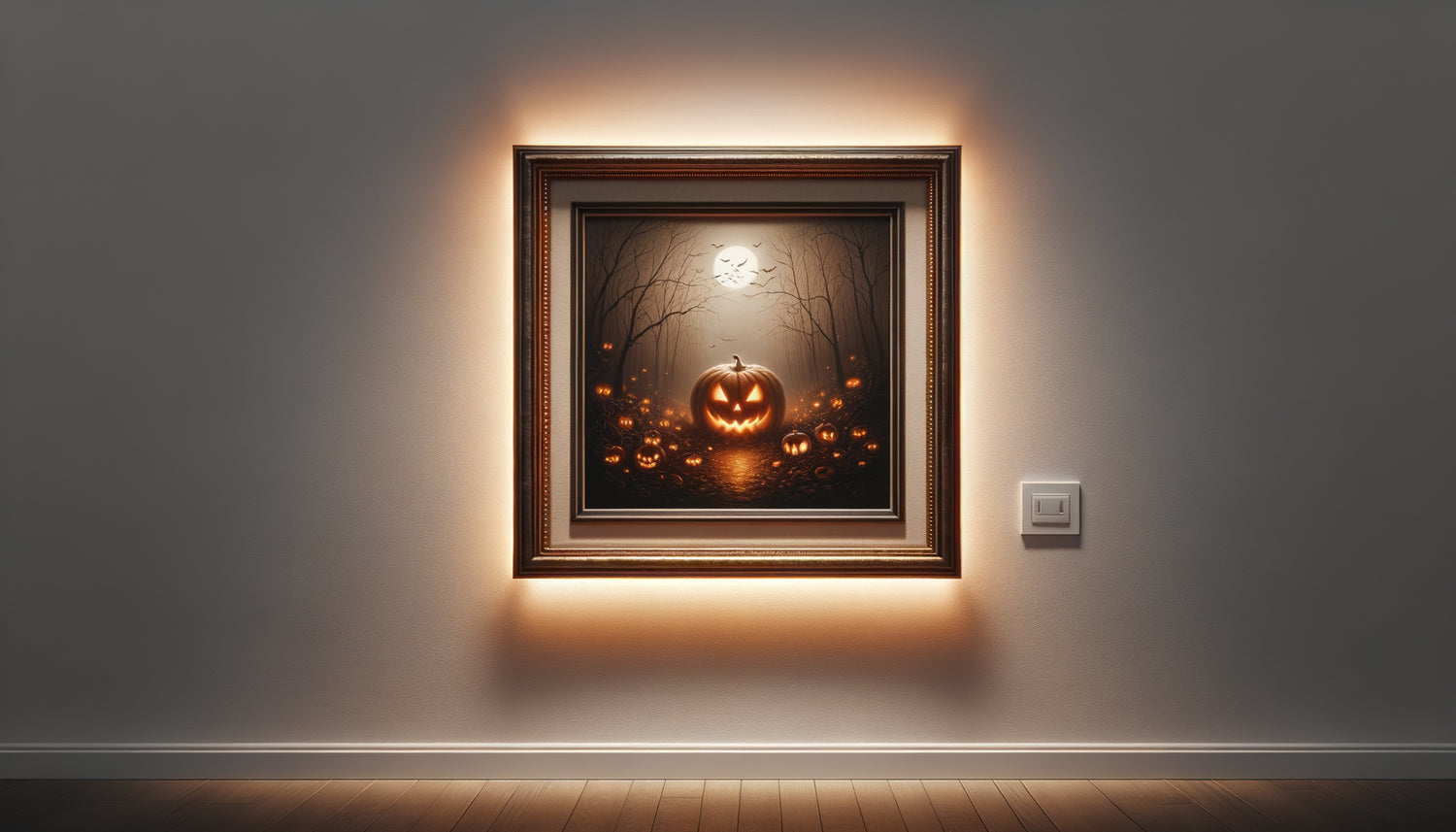
Backlit Halloween paintings are not simple framed prints. Their construction is based on an integrated LED diffusion system that illuminates the image from behind, creating a three-dimensional depth. Unlike frontal lighting which flattens reliefs and creates reflections, backlighting traverses the material.
This technique borrows directly from lightboxes used in contemporary photographic exhibitions. At the Centre Pompidou, at the Palais de Tokyo, curators now prefer this process for works requiring a strong presence. The difference? Backlit Halloween paintings democratize technology once reserved for institutional budgets.
The translucent support – usually a high-density acrylic or polyester film – allows for homogeneous diffusion without visible hot spots. The dark areas of a gothic manor house retain their mystery while revealing unsuspected details. Incandescent pumpkins gain a natural halo, as if the light really emanated from within.
This perceptive depth radically transforms the experience. Your gaze no longer slides over a flat surface, it penetrates the image. It is exactly the sensation sought by set designers: to create a threshold between the domestic space and the represented universe.
Why Your Brain Perceives a Qualitative Difference
Our visual system has evolved to interpret light as an indicator of reality. An self-illuminating object – a candle, a screen, a window – activates different brain areas than an object simply lit. Neuroscience of perception has demonstrated it: we unconsciously give more attention, more presence, to light sources.
The backlit Halloween artworks exploit this cognitive peculiarity. Your brain categorizes them not as passive decoration, but as an active element of the environment. That's why they capture the eye from a distance, creating natural focal points in your arrangement.
In museums, this visual hierarchy is calculated to the millimeter. Major works benefit from privileged lighting that unconsciously guides the visitor's path. By integrating a Halloween wall art backlit, you reproduce this spatial dramaturgy. Your living room or entrance acquires an intentional scenography, exactly like an exhibition hall.
The Gallery Effect: Contrast and Purging
Curators know it: a work never exists in isolation. It dialogues with its environment. The backlit Halloween artworks operate according to the same principle. Their maximum effectiveness is achieved in a purged context, where the contrast between the illumination of the artwork and the relative darkness of the space creates visual tension.
I experienced this approach during an exhibition on German Expressionism in Brussels. By reducing ambient lighting by 40%, we multiplied the average contemplation time by three. The visitor was no longer distracted by the periphery, their attention naturally focused on the illuminated works.
Transpose this principle to your home: a Halloween wall art backlit in a dimly lit hallway produces an infinitely superior impact than the same object drowned in aggressive general lighting. The museum quality is born from this economy of means, this intentional direction of the gaze.

Honest Limitations: What Backlighting Doesn't Replace
Let's be clear. A backlit Halloween painting doesn't replicate the monumental scale of a James Turrell installation, nor the tactile materiality of an oil painting. Its strength lies elsewhere: in accessibility, modularity, and the ability to create a consistent atmosphere without technical expertise.
Purists might object that digital reproduction lacks aura, to borrow Benjamin's concept. It is partially true. But Walter Benjamin did not anticipate the evolution of printing and backlighting technologies. A quality backlit Halloween painting, with a minimum resolution of 300 DPI and variable temperature LED backlighting, produces a visual experience that Benjamin himself would have questioned.
The real limit lies elsewhere: in potential uniformity. Museums vary color temperatures, intensities, lighting angles. A backlit Halloween painting generally offers constant illumination. To circumvent this constraint, some informed collectors install external dimmers or alternate several works depending on the time of day.
Create your own contemplative journey
The museum experience is not just about looking at artworks. It relies on a path, a narrative progression that gradually builds an atmosphere. Backlit Halloween paintings allow you to design this choreography on a domestic scale.
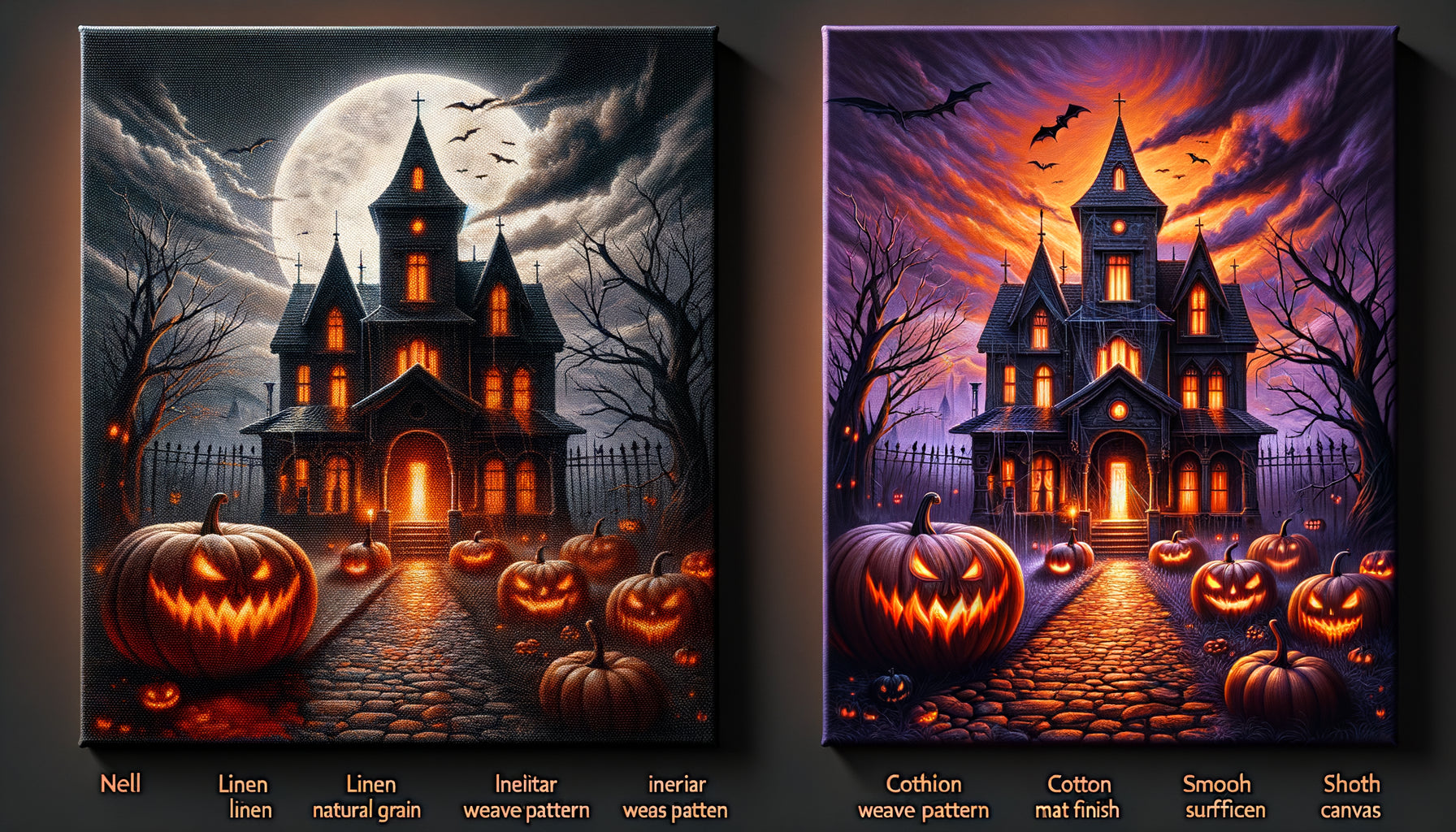
Imagine a sequence: in your entrance hall, a first subdued backlit Halloween painting, perhaps a silhouette of a raven against a twilight background. It announces the theme without aggression. In the hallway, a second more narrative painting: a Gothic manor under the full moon. The dramatic intensity increases. Finally, in your living room, the apotheosis: a complex scene of spectral masked ball or enchanted forest, maximum color richness.
This increase in intensity exactly replicates the curatorial logic of major thematic exhibitions. You are not juxtaposing decorative objects, you are composing a spatial narrative. The visitor – your guest – traverses a progressive experience, just like in a carefully orchestrated gallery.
The circadian rhythm of your collection
Museums have their hours. Your backlit Halloween paintings can too. Some collectors I have advised program their lighting according to the time of day: discreet during the day when natural light dominates, fully activated at dusk when their magic operates maximally.
This temporal variation adds an extra dimension: the artwork is never identical, it dialogues with the natural cycles of light. It's a subtlety that even cultural institutions struggle to implement, constrained by their rigid opening hours.
Ready to transform your interior into a contemporary gallery?
Discover our exclusive collection of Halloween wall art that combines museum sophistication with seasonal theatricality.

Beyond Halloween: Thinking like a Collector
True collectors don't decorate, they build. A quality backlit Halloween painting shouldn’t end up in a box in late November. It becomes a reference piece around which your collection evolves.
I accompanied a Parisian collector who started with a single backlit Halloween painting depicting a gothic library. She kept it all year round, gradually adding other thematic works: antique botanical engravings, photographs of Scottish castles, rare editions of fantasy tales. The backlit Halloween painting became the visual anchor of a coherent aesthetic universe, far beyond seasonal decoration.
This approach transforms your relationship with the object. It's no longer a temporary accessory, but a foundational piece that defines the visual identity of your space. Exactly like a museum builds its temporary exhibitions around its permanent collections.
Is Museum Emotion Reproducible?
Let's return to the initial question: do backlit Halloween paintings really offer a museum experience? The answer is nuanced but fundamentally positive.
They don’t reproduce the scale, nor the rarity, nor the historical context that envelops a work in an institution. But they capture something more essential: the moment of contemplation, that temporal suspension where your attention focuses entirely on a visually magnified object by light.
It's exactly this moment that visitors to museums subconsciously seek. Not institutional prestige, not market value, but that intimate connection with an image that temporarily transcends everyday life. Well-chosen and intelligently integrated backlit Halloween paintings create these moments at home.
In our age of visual saturation, where every screen demands our attention, having at home an object that truly deserves a look, which rewards contemplation with increasing visual richness, becomes a precious luxury. This is perhaps the modern definition of the museum experience: not to accumulate, but to choose intentionally, then create the conditions for repeated wonder.
Conclusion : The invisible gallery
Your home already contains a potential gallery. These neutral walls, these functional corridors, these transitional spaces that you pass through without seeing them. Backlit Halloween paintings reveal this invisible gallery, transforming the utilitarian into the contemplative.
The at-home museum experience is not an imitation; it's a reinterpretation. It borrows techniques – backlighting, visual hierarchy, spatial dramaturgy – but adapts them to your rhythm, your desires, your sensitivity. No waiting lines, no imposed schedules, just you and a work that dialogues with your daily life.
Start simply. A single backlit Halloween painting, placed intentionally, illuminated carefully. Observe how it transforms the space, how your gaze naturally returns to it. You will then understand that the museum experience does not depend solely on location, but on the quality of attention we give to the images around us.
FAQ : Your questions about the at-home museum experience
Does a backlit Halloween painting consume much electricity?
Absolutely not, and that's one of its often underestimated qualities. Backlit Halloween paintings use low-consumption LEDs, typically between 5 and 15 watts depending on the size. For comparison, it’s less than a standard domestic bulb. If you turn it on for four hours each day throughout October, total consumption is about 2 kWh, or less than 50 cents of electricity. Museums have adopted this technology precisely because of its durability: LEDs last between 20,000 and 50,000 hours, potentially decades of reasonable domestic use. It's an energetically responsible investment, much more efficient than the old halogen solutions found in galleries.
Can you really keep a Halloween painting all year round without getting tired?
It’s a matter of aesthetic sophistication rather than theme. An overtly festive backlit Halloween artwork – smiling pumpkins, cartoon witches – certainly has a marked seasonality. However, more artistic interpretations – gothic landscapes, neo-gothic architecture, baroque still lifes, portraits with Victorian aesthetics – transcend the season. I have clients who keep backlit Halloween artworks representing old libraries or mysterious forests all year round. These works engage with a timeless romantic imagination. The secret: choose compositions whose visual richness reveals new details with each contemplation. Exactly like the works of Caspar David Friedrich in Romantic museums: technically dark landscapes, but their emotional depth justifies a permanent presence.
How to integrate a backlit artwork into a bright contemporary interior?
Contrast is not a problem, it’s an opportunity to create sophisticated visual tension. Scandinavian galleries excel at this juxtaposition: clean white spaces punctuated by dark and dramatic artworks. The trick lies in the scale and placement. In a bright contemporary interior, a backlit Halloween artwork becomes a deliberate focal point, a disruptive element that prevents monotony. Prioritize a strategic location: facing the entrance to create an effect of surprise, or in a recess to visually delimit spaces. Avoid multiplying decorative elements around it: let the artwork breathe, surrounded by neutral surfaces. It’s exactly the principle of white cubes in contemporary galleries: the surrounding cleanliness amplifies the impact of the work. Backlighting naturally creates its own frame of light, no gilded frame or decorative overload is necessary.