In my workshop in Mexico City, amidst watercolor sketchbooks and collections of antique engravings, I have for years contemplated these two fascinating figures that dance between our worlds: the Mexican Catrina, elegant in her lace, and the European Grim Reaper, somber in his shroud. Two icons of death, two radically opposed philosophies that completely transform the atmosphere of an interior.
Here's what understanding the difference between the Catrina and the Grim Reaper brings you: A unique perspective on death as a decorative element that celebrates rather than frightens, the ability to create interiors rich in cultural meaning, and the opportunity to bring a sophisticated and symbolic touch to your decor.
Many hesitate to incorporate these figures into their decoration, fearing a morbid or inappropriate atmosphere. This confusion often stems from a deep lack of understanding of the cultural roots that separate these two representations. Rest assured: understanding their essence will allow you to choose the one that resonates with your vision of existence and enrich your space with authenticity. I guide you today through fifteen years of exploration between Europe and Latin America to decode these powerful symbols.
The Catrina: when death wears a floral hat
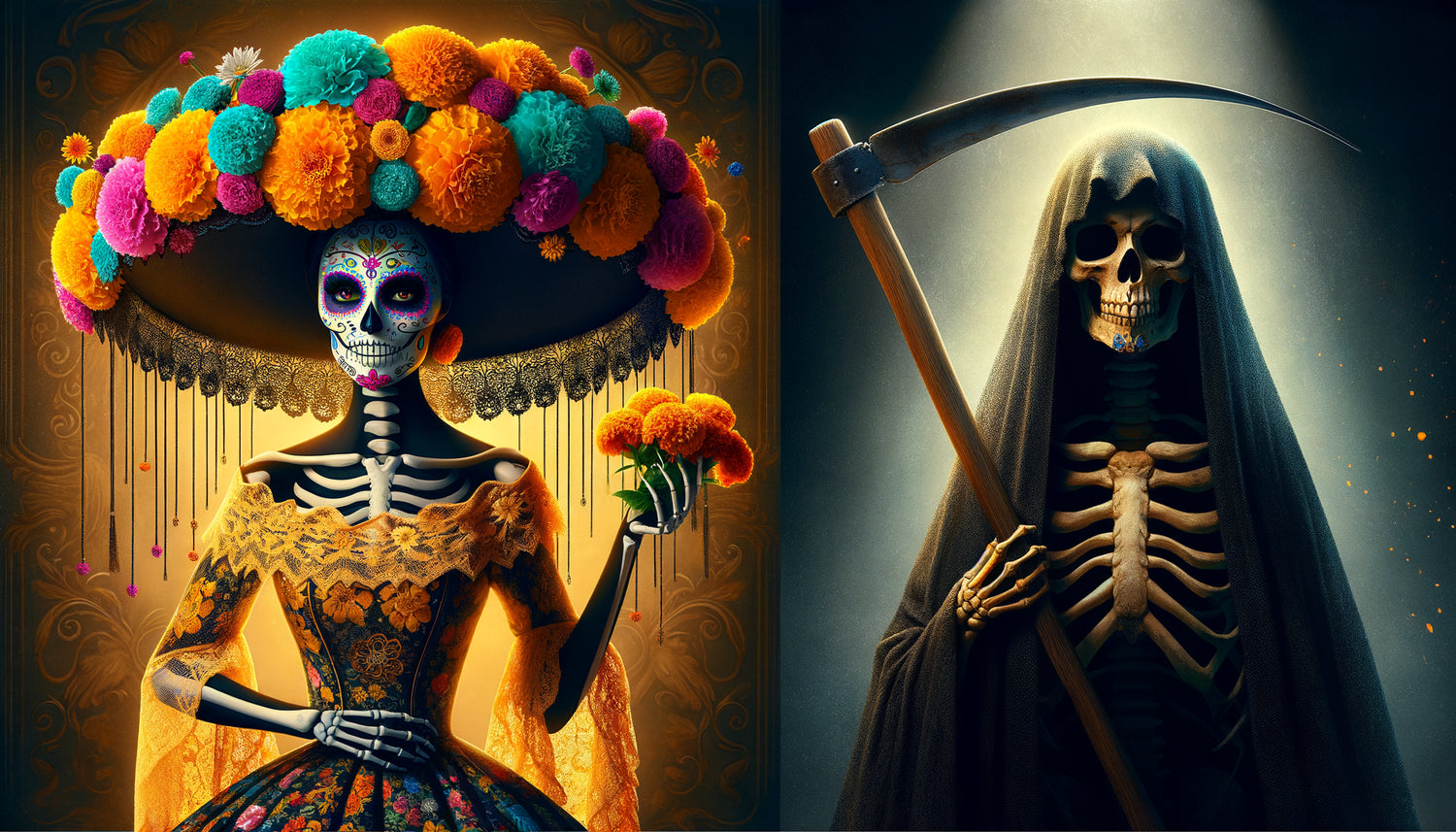
The Mexican Catrina was born from the satirical pencil of José Guadalupe Posada in 1912, before being immortalized by Diego Rivera in his monumental frescoes. This elegant skeleton represents much more than just death: she embodies a biting social critique of Mexicans who rejected their indigenous roots to imitate the European aristocracy.
In my research through Oaxaca and Mexico City, I discovered that the Catrina always wears sophisticated clothing: Victorian dresses, extravagant hats adorned with feathers and flowers, precious jewelry. This festive representation reflects the philosophy of Día de Muertos, where death is not a terrifying end but a natural, almost joyful passage.
What particularly fascinates me about the Catrina is her permanent smile. Unlike the menacing Grim Reaper, she laughs at human vanity and reminds us with humor that rich or poor, we will all become skeletons. This democratization of death radically transforms its decorative impact.
The colors of life in death
The Catrina is surrounded by an explosion of color: vibrant oranges of marigolds, vivid pinks, deep purples, bright yellows. These vibrant colors reflect the Mexican celebration of death as a continuation of life. In an interior, a Catrina brings this festive energy, this warmth that transforms a space into a place of joyful memory.
The Grim Reaper: the shadow that reaps the living
The European representation of death dates back to the Middle Ages, a period of devastating plagues and apocalyptic famines. The Grim Reaper, also called the Great Reaper or Death, appears as a hooded, anonymous figure holding his scythe to harvest souls.
This European iconography conveys a radically different philosophy. Death does not laugh, dance, or adorn herself with jewels. She represents the inevitable, the unpredictable, the absolute end. Her face remains hidden under a black hood, accentuating her impersonal and terrifying nature.
I studied medieval dances of death in French and German churches: Death leads kings, peasants, bishops in a fatal round. This equality before death also exists, but tinged with terror rather than serene acceptance.
Black as a visual signature
European Death is exclusively dressed in black or gray. No flowers, no colors, no embellishments. This austere sobriety reflects a Judeo-Christian vision of death as punishment, a dreaded passage to a final judgment. Unlike, it creates a gothic, mysterious, sometimes unsettling atmosphere.

Opposing philosophies: celebration versus fear
The fundamental difference between La Catrina and Death lies in their emotional relationship to death. La Catrina Mexican is part of a pre-Hispanic tradition where the dead remain present among the living. The altars of Día de Muertos are overflowing with photos, favorite foods, personal items: death prolongs ties rather than breaks them.
Death, on the other hand, cuts radically. Her scythe symbolizes the definitive separation, the rupture between our world and the afterlife. This vision stems from a long Christian history where death represents the moment of judgment, reward or eternal punishment.
In my cultural decoration consulting work, I observe that these philosophies profoundly influence the atmosphere created. A Catrina inspires gentle nostalgia, joyful memory, family continuity. Death evokes mystery, existential reflection, sometimes a dark rebellious or romantic aesthetic.
Cultural contexts: festivity versus solemnity
La Catrina appears mainly during the Día de Muertos (November 1st and 2nd), a festival inscribed on the UNESCO Intangible Cultural Heritage List. The streets are filled with smiling skeletons, elaborate make-up, musical processions. It is a community celebration, family, where laughter and tears blend naturally.
The European Grim Reaper doesn't have a specific celebration. It emerges in the imagination at Halloween, certainly, but also in medieval representations, baroque allegories, contemporary gothic culture. Its context remains more individual, introspective, sometimes artistic or literary.
This contextual distinction explains why a Catrina integrates beautifully into a warm, eclectic, colorful interior, while a Grim Reaper finds its place in more dramatic, minimalist spaces or those inspired by dark romanticism.
Revealing floral symbolism
The Catrina wears orange marigolds (cempasúchil), traditional flowers that guide the dead to family altars. These flowers symbolize the path, connection, light. The Grim Reaper, when surrounded by plants, is surrounded by black roses, funeral lilies, dead branches: symbols of end, mourning, silence.

Decorative applications: which figure for what interior?
After fifteen years of advising collectors and decorators, I have identified specific interior profiles particularly suited to each figure.
The Catrina enhances spaces that celebrate multiculturalism, craftsmanship, color. It dialogues beautifully with Mexican textiles, Talavera ceramics, cut paper (papel picado). In a bohemian living room, a family kitchen or a creative office, it brings warmth and character without ever weighing down the atmosphere.
The Grim Reaper, on the other hand, enhances gothic, industrial interiors, minimalist monochrome spaces. It resonates with black metal, dark velvet, libraries filled with old books. In a cabinet of curiosities, a dark romantic bedroom or a meditation space, it creates a contemplative depth.
I have also noticed that the Catrina particularly appeals to families, people attached to their roots, those who seek to honor their ancestors lightly. The Grim Reaper attracts more philosophical souls, lovers of symbolism, those who explore the shadows of existence.
Ready to integrate these powerful symbols into your decor?
Discover our exclusive collection of Halloween wall art that captures the essence of these fascinating iconographies to transform your interior.
Beyond clichés: contemporary reinterpretations
What particularly excites me today is the way artists and designers reinterpret these ancestral figures. I see Catrinas revisited in punk, steampunk, even futuristic versions, retaining their festive spirit while dialoguing with other visual cultures.
The Grim Reaper also undergoes creative metamorphoses: sensual feminine representations, poetic versions with wildflowers, abstract interpretations that keep the iconic silhouette while softening the message.
These evolutions show that understanding the difference between the Catrina and the Grim Reaper does not limit your decorative options: on the contrary, it gives you the symbolic keys to create personal hybridations, cultural dialogues that truly enrich your living space.
Imagine your interior transformed by one of these symbolic presences. Visualize the Catrina smiling near your bookcase, reminding you daily that life is worth celebrating in all its fragility. Or contemplate the Grim Reaper watching over your meditation space, inviting you to depth and authenticity. Whatever your affinity, these millennial figures offer more than just decoration: they propose a philosophy of life embodied in your daily life. Start today by identifying the one that resonates with your vision of the world, and let this symbolic presence enrich every day your relationship with existence.