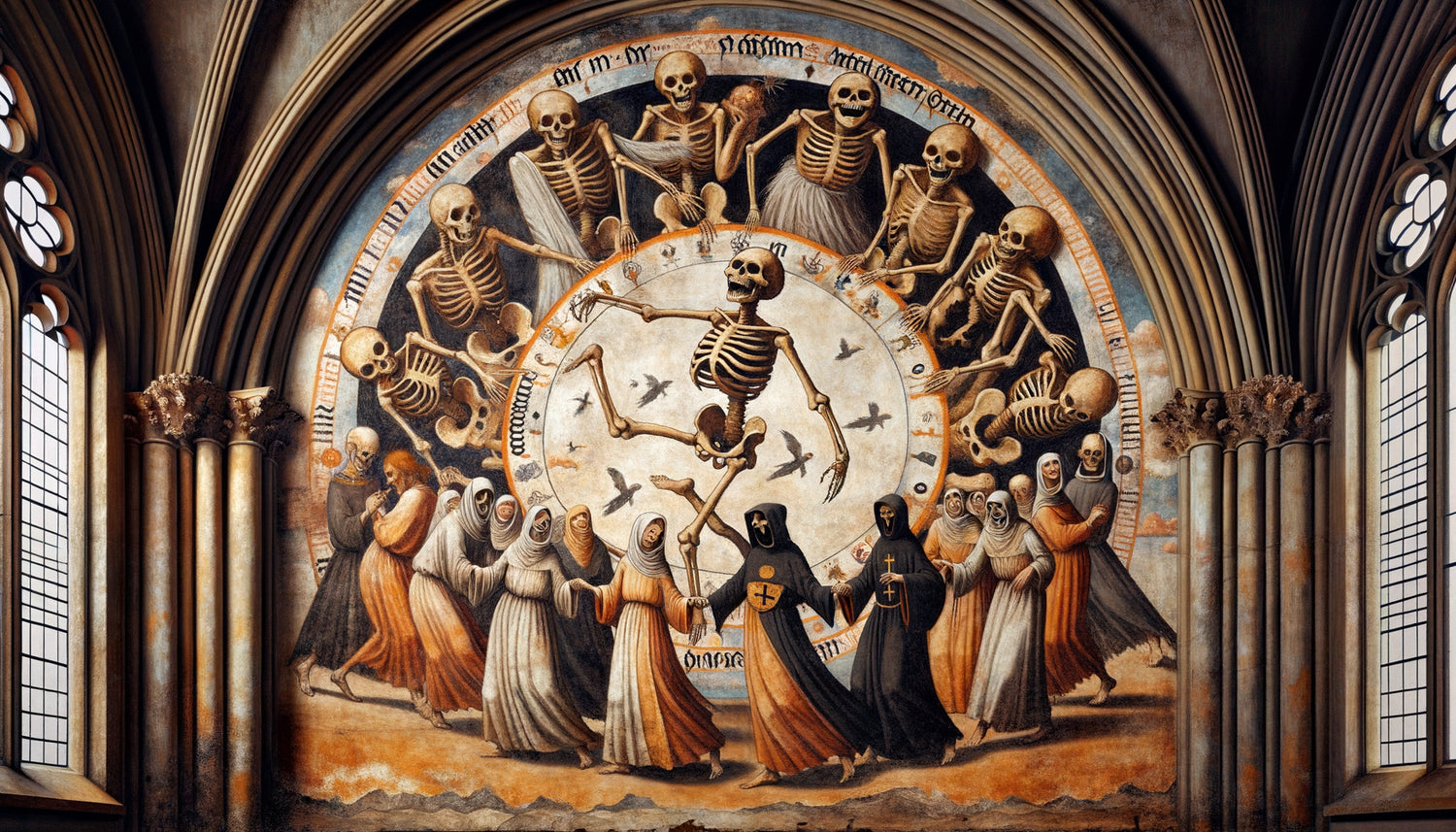
In the dimness of a 15th-century church, I discovered what would shake my vision of Halloween. On the walls of the Chapel of Innocents in Paris, now disappeared, grinning skeletons spread out, leading kings, popes and beggars in an infernal dance. This vision struck me: our modern Halloween aesthetic, with its dancing skeletons and macabre garlands, draws directly from these medieval frescoes of dances of death. Here's what this artistic lineage brings us: an unsuspected historical depth that transcends simple decoration, a universal visual language on mortality that still resonates today, and an aesthetic richness that transforms every Halloween into a journey through time. Did you think your decorations were just American commercial folklore? Are you looking for more authentic atmospheres, full of meaning? Rest assured: by understanding the heritage of medieval dances of death, you will discover how to create sophisticated Halloween atmospheres, rooted in five centuries of European artistic history.
Medieval dances of death: when death invited everyone to his party
The frescoes of dances of death appear in the 14th century, in the wake of the devastating Black Death which carries a third of Europe. In this apocalyptic context, artists develop a revolutionary pictorial genre: the dance macabre, where personified Death, often represented by a skeleton, leads the living of all social ranks in a funeral round. I studied the most famous examples – the fresco of Basel, that of La Chaise-Dieu, the Parisian engraving of Guyot Marchant – and a motif is obsessively repeated: the grinning skeleton, gesticulating, almost joyful in its macabre work.
What fascinates me about these works is their deeply egalitarian and transgressive dimension. The skeleton mocks earthly power: it grabs the pope by his tiara, the king by his scepter, the coquette by her finery. This disturbing vision had a precise social function: to remind the powerful of their mortality, to comfort the miserable by showing them that death levels all conditions. But it also contained an extraordinary aesthetic dimension: a troubling mixture of macabre and festive, horror and celebration, which foreshadows exactly the modern Halloween atmosphere.
The stylized anatomy of the medieval skeleton
Medieval artists developed a specific visual vocabulary to represent these dancing skeletons. Far from being anatomically accurate, they create expressive figures, almost caricatural: prominent ribs, gaping orbits, jaws frozen in an eternal grimace. The skeletons sometimes wear scraps of flesh, torn shrouds, symbolic attributes. I found this stylization intact in our contemporary Halloween decorations: articulated cardboard skeletons, garlands of smiling skulls, dancing silhouettes that we hang on windows reproduce exactly this medieval aesthetic.
From religious memento mori to popular celebration: a fascinating transformation
How did these moralizing medieval frescoes become the festive aesthetics of Halloween? The answer lies in a slow secularization of symbols. In the 16th century, dances macabres gradually left the walls of churches to invest popular engravings, almanacs, theater sets. The religious message fades as the spectacular dimension amplifies. Skeletons become almost comical characters, fairground figures that frighten and amuse simultaneously.
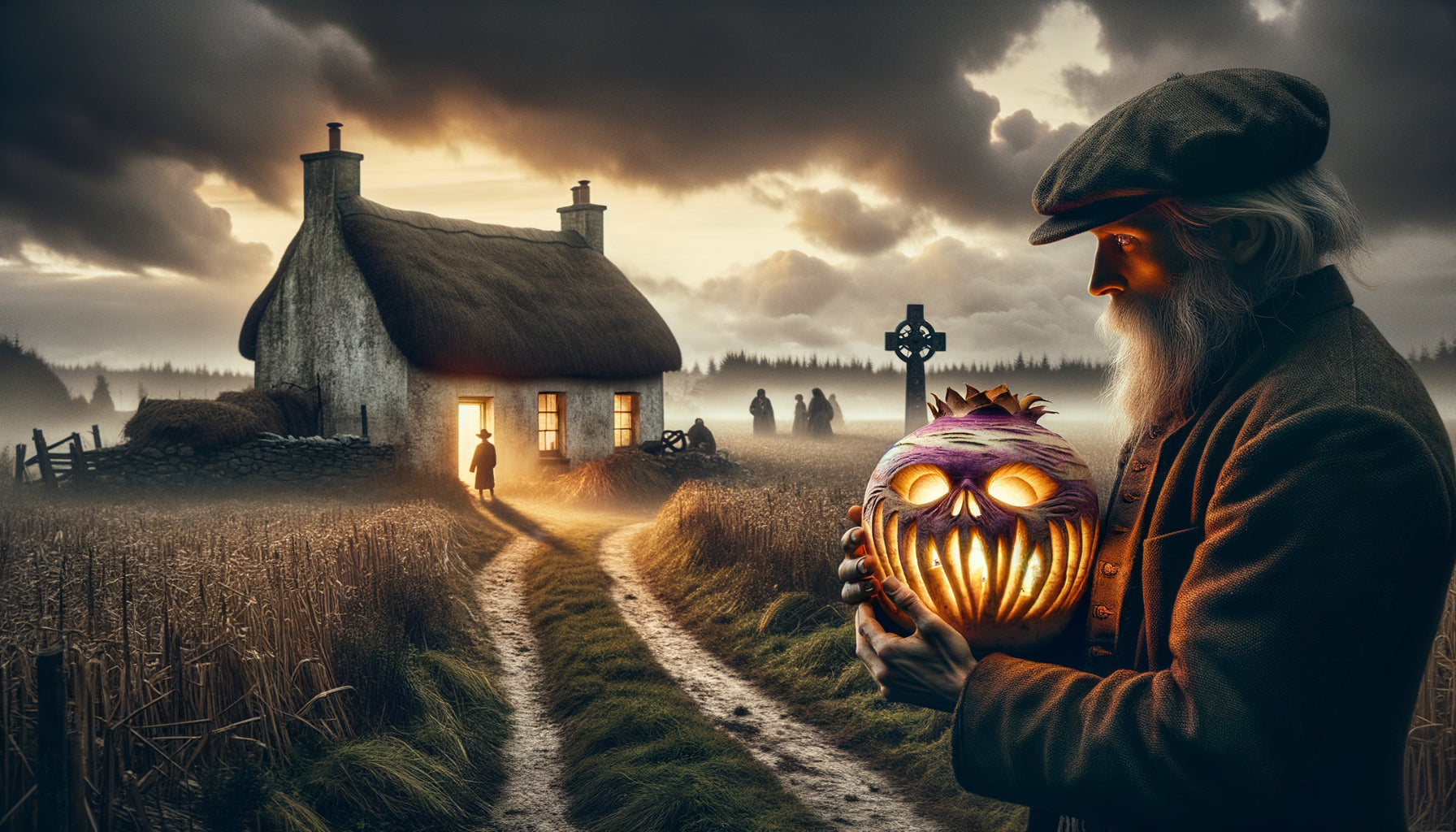
This transformation accelerates with Celtic traditions of Samhain and All Saints' Day celebrations. In Ireland and Scotland, disguises intended to deceive the spirits of the dead naturally integrate skeletal imagery from dances macabres. When these traditions migrate to the United States in the 19th century, they merge with European visual culture. Victorian chromolithographs of Halloween explicitly take up motifs from dances macabres: skeleton musicians, joyful funeral processions, ghostly rounds. I compared an engraving of Holbein's dance macabre (1538) with a 1910 Halloween greeting card: the similarities are astonishing.
The colors of the macabre: from medieval black to festive orange
The chromatic aesthetic has evolved but retains its medieval roots. Dances macabres frescoes mainly used ochres, deep blacks, bone whites on dark backgrounds – creating this striking contrast between the darkness of death and the pallor of skeletons. Modern Halloween has enriched this palette by adding the orange of pumpkins and the mystical purple, but retains this black and white foundation inherited directly from medieval frescoes. Observe your decorations: this white skeleton standing out against a black background perpetuates exactly the visual code developed six centuries ago in European chapels.

The iconic motifs that span the centuries
Some elements of medieval dances of death are almost intact in our Halloween decorations. The round or procession remains the central motif: think of the garlands of skeletons adorning our interiors, the processions of trick-or-treaters disguised, costumed parades. This circular or linear movement exactly reproduces the choreography of medieval frescoes.
The skeleton musicians are another direct legacy. In dances of death, Death often plays instruments – vielle, flute, tambourine – to lead the living away. Today, skeletons playing violin or trumpet adorn greeting cards, printed fabrics, wall decorations. This association between music, dance and death crosses the centuries without losing its evocative power.
The mixture of social conditions also persists. Modern Halloween is the most democratic party: children and adults, rich and poor participate in the same ritual. This social horizontality, this moment when hierarchies disappear behind masks, exactly reproduces the egalitarian message of medieval frescoes where pope and peasant danced side by side.
Black humor: the continuity of a transgressive tradition
What strikes me most about this lineage is the persistence of macabre humor. Medieval dances of death were not only gloomy: they contained a satirical, almost comical dimension. Skeletons grimace, mock, adopt grotesque postures. This tradition of joyful memento mori totally permeates Halloween: our smiling skeletons, our decorations that mix horror and fantasy, our way of playing with fear exactly reflect this medieval attitude towards death – recognizing it while defying it with laughter.
Creating a Halloween decoration inspired by medieval frescoes
How to translate this heritage into your decor? I would first recommend prioritizing graphic silhouettes: dances of death work on contrast, stylization, repetition. Create friezes of skeletons in black and white, use stencils to reproduce medieval motifs on your walls, prioritize clean lines and recognizable shapes.
Next, consider narration and procession. Instead of scattering your decorative elements, organize them in sequence, create a visual path. Arrange your skeletons as if they were participating in a dance, position them in interaction. This narrative staging significantly amplifies the aesthetic impact while paying homage to the choreographic dimension of medieval frescoes.
Integrate textual elements: macabre dances were often accompanied by verses, dialogues between Death and its victims. You can create speech balloons, quotes, Gothic inscriptions that enrich your decor with a literary dimension. This approach transforms your interior into a true artistic installation, far beyond simple seasonal decoration.
Dramatic lighting: recreating the atmosphere of chapels
Lighting plays a crucial role. Medieval frescoes were discovered in the flickering light of candles, creating moving shadows that animated the painted skeletons. Recreate this effect with candles (real or LED), lanterns, indirect lighting that creates areas of mystery. Avoid harsh and uniform light: favor dramatic contrasts, areas of darkness crossed by wavering glows. This lighting approach radically transforms the atmosphere, creating an ambiance that is both sophisticated and authentically unsettling.
Transform your interior into a Gothic art gallery
Discover our exclusive collection of Halloween wall art that captures the timeless aesthetic of medieval macabre dances while seamlessly integrating into your contemporary decor.

When decoration becomes meditation: rediscovering the original meaning
Beyond aesthetics, understanding the origin of macabre dances enriches our Halloween experience with philosophical depth. These frescoes were not mere ornaments: they were memento mori, reminders that life is precious precisely because it is ephemeral. By consciously integrating this heritage into your decor, you transform Halloween into a moment of reflection, a paradoxical celebration of life through contemplation of its finitude.
This contemplative dimension does not detract from the festive aspect – on the contrary, it enriches it. The medieval people understood this: one can dance with death, play with it, defy it with joy and creativity. Your Halloween decor then becomes a form of joyful resistance, an affirmation of vitality that honors its historical roots while celebrating the present.
Imagine your interior transformed: skeletal silhouettes dance on your walls in dramatic chiaroscuro, garlands tell centuries-old stories, each element dialogues with five centuries of artistic history. Your guests do not discover a seasonal decoration, but a true cultural journey, an aesthetic experience that transcends commercial folklore. This year, for Halloween, become the curator of your own ephemeral museum. Consciously choose each element, think narrative and depth, create atmospheres that blend contemporary sophistication and historical richness. Medieval frescoes of macabre dances are not a bygone era: they live in every smiling skeleton, in every ghostly round, in every decoration that celebrates life while contemplating its inevitable end.
Frequently asked questions about macabre dances and Halloween
Why are skeletons so prevalent in Halloween decorations?
This omnipresence stems directly from medieval frescoes of macabre dances which popularized the image of a skeleton as personification of death as early as the 14th century. Unlike other funerary representations, these frescoes showed skeletons active, dancing, almost joyful – creating a striking contrast between the horror of death and the vitality of movement. This imagery gradually secularized and integrated into popular traditions, notably Celtic, before establishing itself as a central symbol of Halloween. The skeleton perfectly embodies the spirit of this celebration: it frightens while reassuring with its stylization, it reminds us of mortality while inviting us to celebrate. It is this ambivalence, inherited directly from macabre dances, that explains its persistence in our contemporary decorations.
How to integrate this medieval aesthetic without falling into the gloomy?
The secret lies in the balance mastered by medieval artists: blending the macabre and festive. Prioritize stylization over realism first: graphic, almost caricatured skeletons remain visually interesting without becoming oppressive. Then, think movement and narrative: arrange your elements as if they were telling a story, create dynamic scenes rather than static accumulations. Play with scales and proportions to introduce a touch of humor. When it comes to colors, don't hesitate to add metallic touches – gold, silver, copper – which evoke medieval illuminations while bringing warmth. Finally, alternate dramatic areas and breathing spaces: as in chapels where frescoes of dances macabre coexisted with other decorations, create visual contrasts that allow the eye to rest.
Are there differences between European dances macabre and American Halloween imagery?
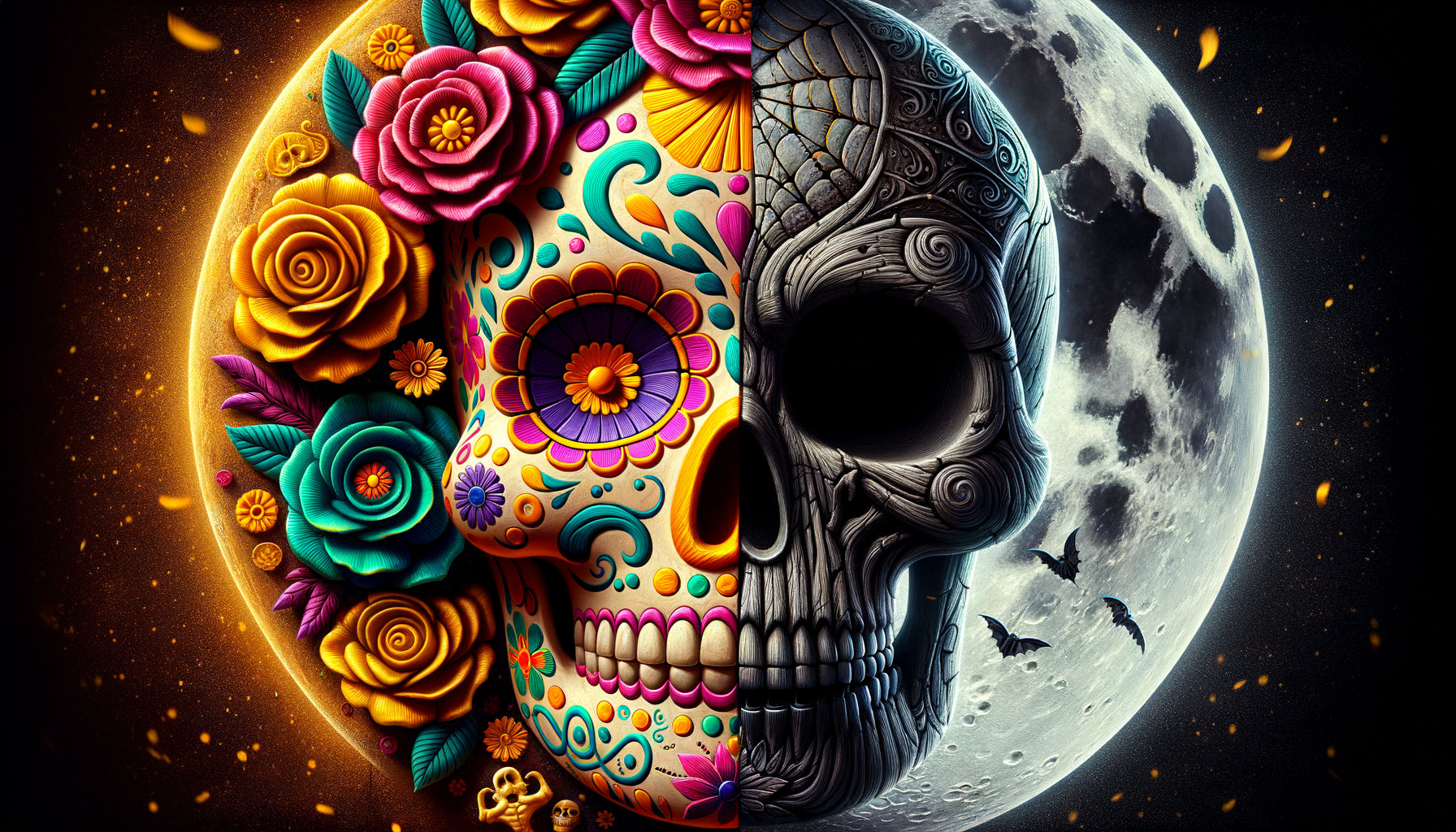
Absolutely, and these differences are fascinating. European dances macabre carried an explicitly moral and religious message: they reminded of equality before death and invited spiritual preparation. The imagery was hierarchical, narrative, often accompanied by texts. American Halloween has retained the visual motifs – skeletons, processions, festive and macabre mix – but largely evacuated the religious content in favor of a playful and commercial dimension. American skeletons are more cartoonish, more smiling, less threatening. However, Mexican traditions of Día de Muertos, which have also influenced contemporary Halloween, have maintained more of the spiritual and community dimension of the original dances macabre. For authentic decoration, you can draw on these different traditions: European graphic sophistication, American joyful irreverence, and Latin American symbolic depth.