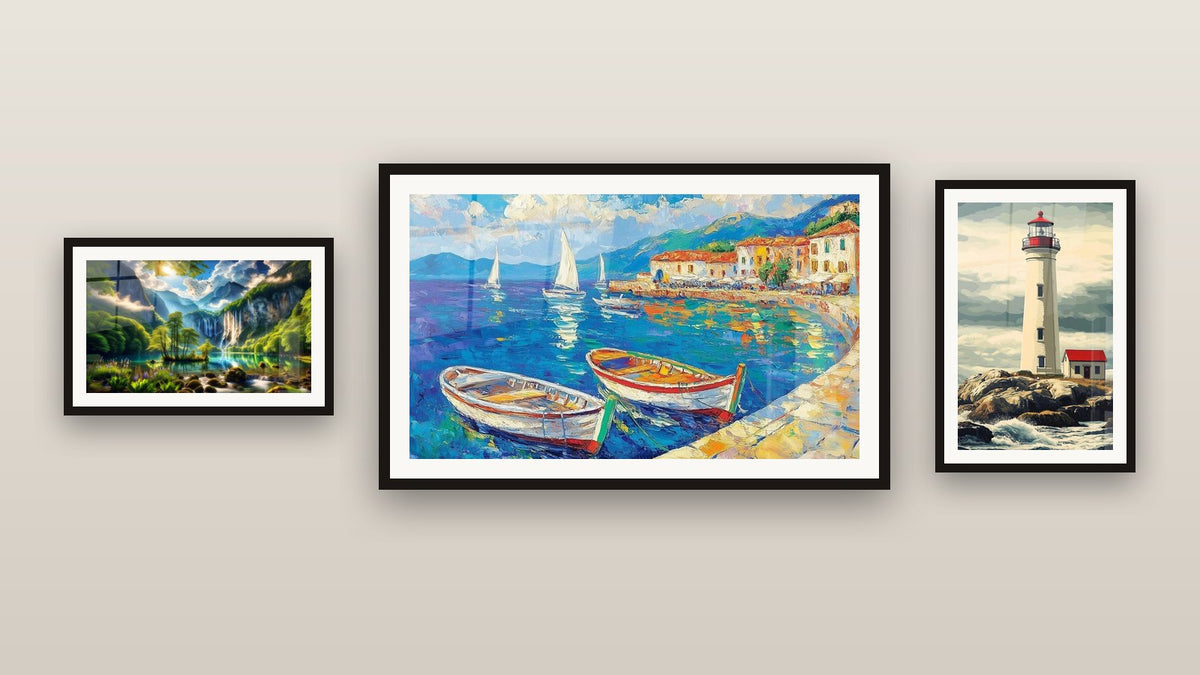
Mini Format Wall Art: Small Size, Big Decor Impact
October 11, 2025 · 16 min read · by Walensky
You’re looking at that blank wall in your entryway, that alcove near the staircase, or that restricted space above your desk, and you sigh with exasperation. Another corner of your interior that remains sadly bare because you never seem to find the perfect piece that fits those particularly unique dimensions.
You can already imagine the frustration: browsing stores, measuring, re-measuring, only to discover that the painting you like systematically measures 10 cm too wide or too high. Or worse still, buying something that is too small which literally disappears on your wall, giving the impression of a lost postage stamp in the ocean.
You’ve probably already tried multiple small photo frames, hoping to create a harmonious composition. Result? A disjointed patchwork that visually clutters the space instead of embellishing it. Or you have given up, leaving these strategic areas of your home in a state of permanent incompletion.
This difficulty is perfectly normal and does not reveal any lack of taste on your part. The real reason for these repeated failures? Standard dimensions of wall decor are designed for conventional spaces, completely neglecting the decorative richness of small formats.
By the end of this article, you will master the subtle art of mini-format paintings and know how to transform any nook and cranny of your interior into a captivating focal point that reveals your refined personality.
Why are small spaces the true hidden gems of your decor?
In the world of interior decoration, small spaces possess an unsuspected power that most people neglect. Unlike large wall surfaces which impose their presence, these intimate zones create moments of discovery and surprise for your guests. It's like offering a precious jewel rather than a showy adornment: the emotional impact comes from the delicacy and accuracy of the choice, not from a display of force.
🏠 Customer testimonial: Marie-Claire, an interior architect in Lyon, recently confided to us: "I installed a 20x25 cm painting in the hallway leading to the bedrooms. My guests consistently stop to admire it, while they didn't even notice my large canvas in the living room. Small formats create intimacy, a private dialogue with the artwork."
Conversation with a decor expert
The golden rule of mini formats: A well-chosen small painting transforms a space in less than 24 hours, creating a focal point that reveals your aesthetic sense without visually cluttering the environment.

Diagnose your relationship with small spaces: what do your hesitations reveal?
You probably recognize yourself in one of these three situations: you systematically avoid small works for fear that they will appear "insignificant", you multiply tiny decorative objects hoping to create a coherent ensemble, or you leave these spaces empty waiting to find "the" perfect piece that doesn't exist in the exact desired dimensions.
These reactions actually reveal a lack of knowledge of the visual codes specific to small formats. The problem is not your taste or your means, but an unsuitable approach that applies the rules of large spaces to intimate areas.
It's exactly like trying to wear an XXL-size coat when you’re a size S: the garment isn't faulty, but it's simply not suitable for your build. Small spaces have their own decorative grammar, their own rules of harmony and visual impact.
The first hidden cause: the illusion of proportional scale
Contrary to popular belief, a small space doesn't necessarily require a small painting. This popular belief generates catastrophic errors in proportions. The real rule concerns the balance between visual density and breathing room, not the mathematical correspondence of dimensions.
Imagine two people in an elevator: even if the space is restricted, they don't need to be smaller to coexist harmoniously. They just need to respect the right distance that allows each person to fully exist without hindering the other.
This understanding radically transforms your approach: instead of desperately searching for a miniature painting, you can select the artwork that dialogues perfectly with the architecture of your space, creating an enriching visual tension rather than a bland correspondence.
🔍 Quick test: Place your open hand against the wall you want to decorate, then step back two meters. If your hand "disappears" visually, it means that the space can accommodate a more generous format than you might imagine.
The error of decorative multiplication
Many people try to compensate for the "smallness" of a painting by accompanying it with multiple decorative elements. This strategy generates the opposite effect desired: instead of creating richness, it produces visual chaos and dilutes the impact of each element.
It's like trying to enhance a violin solo by simultaneously adding piano, drums, and trumpet. Beauty is born from precision, not accumulation. A mini-format painting draws its strength from its ability to exist alone in its environment.
This revelation frees you from an exhausting chase after decorative accessories and allows you to focus your budget on a higher quality piece that will truly transform the atmosphere of your space.
The trap of searching for the "perfect" piece
The wait for the piece with the exact dimensions keeps you in decorative inaction. In reality, visual harmony tolerates and even appreciates subtle variations that create dynamism and personality.
Look at your face in a mirror: your eyes are not perfectly symmetrical, and it is precisely this slight asymmetry that creates your unique charm. Decoration works on the same principle: mathematical perfection often generates coldness, while intuitive precision creates emotion.
This awareness allows you to trust your aesthetic instinct and choose the work that moves you, even if its dimensions do not exactly correspond to your initial calculations.
🎯 3 signals that reveal a successful choice:
- The "visual magnet" effect: Your gaze naturally returns to the work several times a day, a sign that it creates a real emotional connection
- Visitors' curiosity: Your guests spontaneously approach to examine the details, revealing the work's attraction power
- The feeling of obviousness: The space finally seems "complete" without appearing cluttered, as if the work had always belonged in that place
The trigger factor: emotional density
What truly distinguishes a successful mini-format painting is its ability to concentrate an intense emotional charge within a limited space. It's the effect of a "concentrated perfume": a few drops are enough to transform an entire atmosphere. You will recognize this quality by the intensity of your first reaction to the work and the richness of the details that are revealed during successive contemplations.
Rule of optimal density: A successful mini-format painting must be able to captivate your attention for at least 30 seconds with each observation, revealing new details with each look.
| ❌ Traditional approach | ✅ New approach | 💡 Why it changes everything | 🎯 Immediate benefit |
|---|---|---|---|
| Searching for the exact dimensions | Prioritizing aesthetic emotion | Harmony is born from precision, not mathematics | Freedom of choice and optimized budget |
| Fill the available space | Create visual breaths | Modern luxury values selection | Sophisticated and timeless elegance |
| Multiply small elements | Focus on a statement piece | Impact comes from intensity, not quantity | Captivating and memorable focal point |
| Avoid out of fear of "cheap" | Embrace refined delicacy | The miniature reveals a affirmed aesthetic sense | Distinctive decorative personality |

The progressive method to master the art of mini-formats
Rassurez-vous : transforming your small spaces into true decorative showcases does not require any particular artistic gift. This progressive method guides you step by step, like a chef who teaches you the basic gestures before letting you create your own recipes. In three weeks maximum, you will develop the eye and instinct necessary to reveal the potential of each corner of your interior.
🗺️ Overview of your transformation : Step 1 - Identify your areas with potential (week 1), Step 2 - Master specific hanging rules (week 2), Step 3 - Create sophisticated compositions (week 3). Each step generates an immediate visible result while preparing the next.
Step 1 : Reveal the hidden treasures of your interior
Starting with this step avoids the costly mistake of impulsively buying a work that will never find its ideal place. Identifying your strategic spaces first then allows you to choose precisely and obtain an optimal decorative impact from the first attempt. This methodology also gives you the immediate satisfaction of discovering unsuspected possibilities in your own habitat.
Tools needed for exploration
- Metal measuring tape : Choose a model of 3 meters minimum with automatic locking to precisely measure vertical and horizontal spaces. Avoid fabric tapes that deform: precision conditions the success of your future hangings.
- Camera or smartphone : The lens captures the real proportions that your eye unconsciously distorts. Photographing your spaces from different angles reveals compositional possibilities invisible during direct observation.
- Pocket notebook : Immediately note your impressions and measurements to avoid approximations that generate purchase errors. Memory distorts, writing reveals the true decorative opportunities.
Now let's move on to systematic exploration of your interior
Instructions for decorative inventory
Systematic scan of each room: Position yourself in the center of each space and perform a complete 360° rotation, stopping every 45° to observe the walls. This technique reveals decorative blind spots that you usually neglect by visual automatism.
⏱️ Time: 15 minutes per room | ✅ Successful when: You have identified 3-5 potential areas per space | ⚠️ Attention: Don't limit yourself to the most obvious walls - corners, gaps between furniture and shelf heights often offer the best surprises
Test of the "natural gaze rule": Sit in your usual positions (sofa, table, desk) and note where your eye naturally rests. These natural visual anchor points are your priority locations to maximize daily decorative impact.
⏱️ Time: 5 minutes per position | ✅ Successful when: You have mapped out your usual lines of sight | ⚠️ Attention: Vary the lighting (day/evening) as perception of spaces changes drastically depending on available light
Measurement and photographic documentation: Accurately measure each identified area and photograph it from your usual observation position. This double documentation allows you to visualize at a distance the proportions and make informed choices when searching for artworks.
⏱️ Time: 10 minutes per area | ✅ Successful when: You have accurate measurements + quality photo | ⚠️ Attention: Photograph without flash to respect the natural lighting of the space
✨ Validation of step 1: You should have identified between 10 and 15 potential areas in your home, each with: precise dimensions, representative photo and note on your personal level of interest. If some areas seem "average", that's normal - keep them as they will sometimes reveal their qualities in the following steps.
— Our selection


OUR RECOMMENDED PRODUCTS
Step 2: Master the visual codes of mini-formats
This step takes you from a simple "amateur decorator" to an "experienced eye" who understands why certain arrangements instantly create an impression of sophistication while others fall flat. The specific rules for small formats differ fundamentally from those of large works, and mastering this will save you months of costly trial and error.
Precision equipment for hanging
- Professional 40 cm spirit level: The accuracy of the horizontal is essential to the final elegance of your installation. Mini-formats mercilessly reveal any misalignment because the eye has fewer elements to visually compensate for approximations. Laser pointer or line pointer: This tool projects a perfect straight line to visualize alignment before drilling. Essential for creating harmonious multi-panel compositions where each element dialogues with precision.
- Assortment of suitable wall plugs: Opt for self-drilling wall plugs for dry walls and chemical wall plugs for solid walls. A secure hanging secures your investment and allows for serene manipulations during adjustments.
Applying mini-format proportion rules
Calculation of optimal height: Position the center of your artwork between 57 and 61 inches from the floor, slightly lower than for large formats. This height creates a specific visual intimacy for small works and facilitates observation of fine details.
⏱️ Time: 5 minutes per location | ✅ Successful when: The optical center of the work naturally sits within your field of vision | ⚠️ Attention: Adjust according to your usual height and that of your family - the optimal varies by 4 inches between a person 1.60m and 1.80m
Management of breathing space: Maintain a free perimeter of at least 8 inches around each mini-format artwork. This "visual silence zone" allows the work to express itself fully without decorative competition and reveals its intrinsic sophistication.
⏱️ Time: 10 minutes per installation | ✅ Successful when: The artwork "breathes" without appearing lost | ⚠️ Attention: Furniture located below counts towards the space calculation - a painting above a cluttered console will lose its impact
Step 3: Create exceptional compositions
You have now reached the level of mastery that transforms your interior into a sophisticated personal gallery. This step reveals the secrets of professional decorators to create stunning visual effects with seemingly modest means. The final result is a refinement that impresses visitors durably.
Advanced composition techniques
Creation of visual dialogues: Install your mini-format artworks in "echoes" of themes or colors throughout the rooms. This technique generates a subtle decorative thread that unifies your habitat without redundancy.
⏱️ Time: 30 minutes per series | ✅ Successful when: The visual journey between artworks creates a coherent narrative | ⚠️ Attention: Limit yourself to 3-4 echoes maximum to avoid the "gallery shop" effect that dilutes the impact of each piece
Exploitation of light effects: Orient your mini-formats to capture and subtly reflect natural or artificial light. A well-positioned artwork becomes an emotional mirror that animates your space according to daily lighting variations.
⏱️ Time: 20 minutes of observation per artwork | ✅ Success when: The artwork reveals different facets depending on the time of day | ⚠️ Attention: Avoid direct light which may discolor certain artistic techniques - favor soft lateral lighting
Personalized progression rule: Move to the next step only when you feel a lasting satisfaction with your current installations and your surroundings spontaneously notice the improvement in your decor.
Congratulations! You now master the professional subtleties that distinguish a thoughtful decoration from a simple space filler. This expertise gives you a decisive advantage to create memorable interiors that authentically reflect your refined personality.
💎 Pro tip - Private gallery effect: Install a discreet directional mini LED spotlight above your favorite miniature artwork. This museum technique instantly transforms any work into a collector's item and creates a sophisticated nighttime ambiance that impresses at your receptions.
Frequent question from our readers
"I am afraid of making holes in my walls to eventually change my mind about the location, especially with small pictures that may seem botched if poorly placed..."
This hesitation reveals a certain decorative wisdom and testifies to your desire to do well. The professional solution is to first use temporary repositionable adhesives to test your locations for a week. You will then be able to observe how your visual habits adapt and refine your choice before final installation. This method avoids the stress of the "definitive choice" and allows you to experiment serenely.
🎯 Immediate reassuring action: Create paper templates with the exact dimensions of your future paintings and temporarily fix them with masking tape. Live a week with these "ghosts" to validate your locations before any purchase.
— You may also like


Avoid these pitfalls that spoil the sought-after sophisticated effect
After supporting hundreds of decoration enthusiasts, we have identified the recurring mistakes that compromise the elegance of miniature installations. These pitfalls are all the more frustrating as they often occur after initial relevant choices, ruining considered investments by execution details.
- 🚫 Scattered collection syndrome: Multiplying mini formats in the same room to "create atmosphere" generates a cluttered effect that dilutes the impact of each artwork. Focus your attention on 1-2 rooms maximum per living space. Better one exceptional painting than an accumulation of average choices.
- 🚫 Neglecting the frame and matting: Saving on the framing of a mini-format is like serving a fine wine in a plastic cup. The setting conditions the perception of the work: invest in a quality frame that reveals the value of your artistic selection.
- 🚫 Placement in a "transit zone": Installing a delicate artwork in a heavily trafficked hallway or near a door exposes the work to impacts and prevents contemplative observation. Prioritize natural stopping areas where the eye can linger serenely.
- 🚫 Ignoring ambient lighting: Positioning a mini-format in a perpetually dark area condemns it to invisibility, wasting its decorative potential. Assess the lighting at different times of the day before any final installation.
- 🚫 Competition with parasitic decorative elements: Maintaining minor decorative objects near a mini-format painting creates a visual cacophony that detracts from the appreciation of the main work. Purge the environment to allow art to fully express itself.
🛡️ Pre-installation verification system: Photograph your temporary installation and observe the result on screen - balance defects appear more clearly in image. Ask for the spontaneous opinion of a friend without influencing their response. Live with the test installation for 48 hours before validation. Monitor these warning signs: persistent feeling of "emptiness", need to regularly readjust the position, or mixed comments from your visitors.
— In the same vein


Essential questions before you start
A budget of €80-150 allows you to acquire your first quality mini-format artwork with professional framing. Always prioritize quality over quantity: a single exceptional painting transforms your interior more than three average purchases. Save on temporary accessories but invest in the work and its setting for lasting impact.
The first positive effects appear with the first successful installation, usually within 2-3 hours after hanging. Complete mastery of subtleties develops over 3-4 weeks of regular practice. Start with an obvious and non-critical location to develop your confidence before tackling more delicate areas.
Your decorative transformation begins now
In three weeks, you will walk through your interior with a new and discreet pride. These small artistic treasures that you have created will testify to your developed aesthetic sensitivity, attracting spontaneous compliments from your guests who will discover unexpected details on each visit. Your habitat will finally reveal this refined personality that you carried within you without knowing how to express it.
Mastery of mini formats also develops your general decorative confidence and ability to transform any space with accuracy and creativity. The observation, composition, and installation skills you have acquired will serve you for all your future decorative projects, from the most modest to the most ambitious.
Understanding proportions and visual balances was indeed the missing element of your previous attempts. Now that you possess this key, your first step will be to revisit these suspended spaces with a new eye and concrete solutions. The decorative adventure that awaits you will transform not only your habitat but also your daily relationship with beauty.
✨ Your first step towards excellence:
Choose today the space that inspires you most and apply the analysis method you have just discovered. Your discerning eye will finally be able to express itself and create those moments of daily beauty that truly enrich a life.Also read: 📖 Read more articles on table formats
</div
Explore our collections