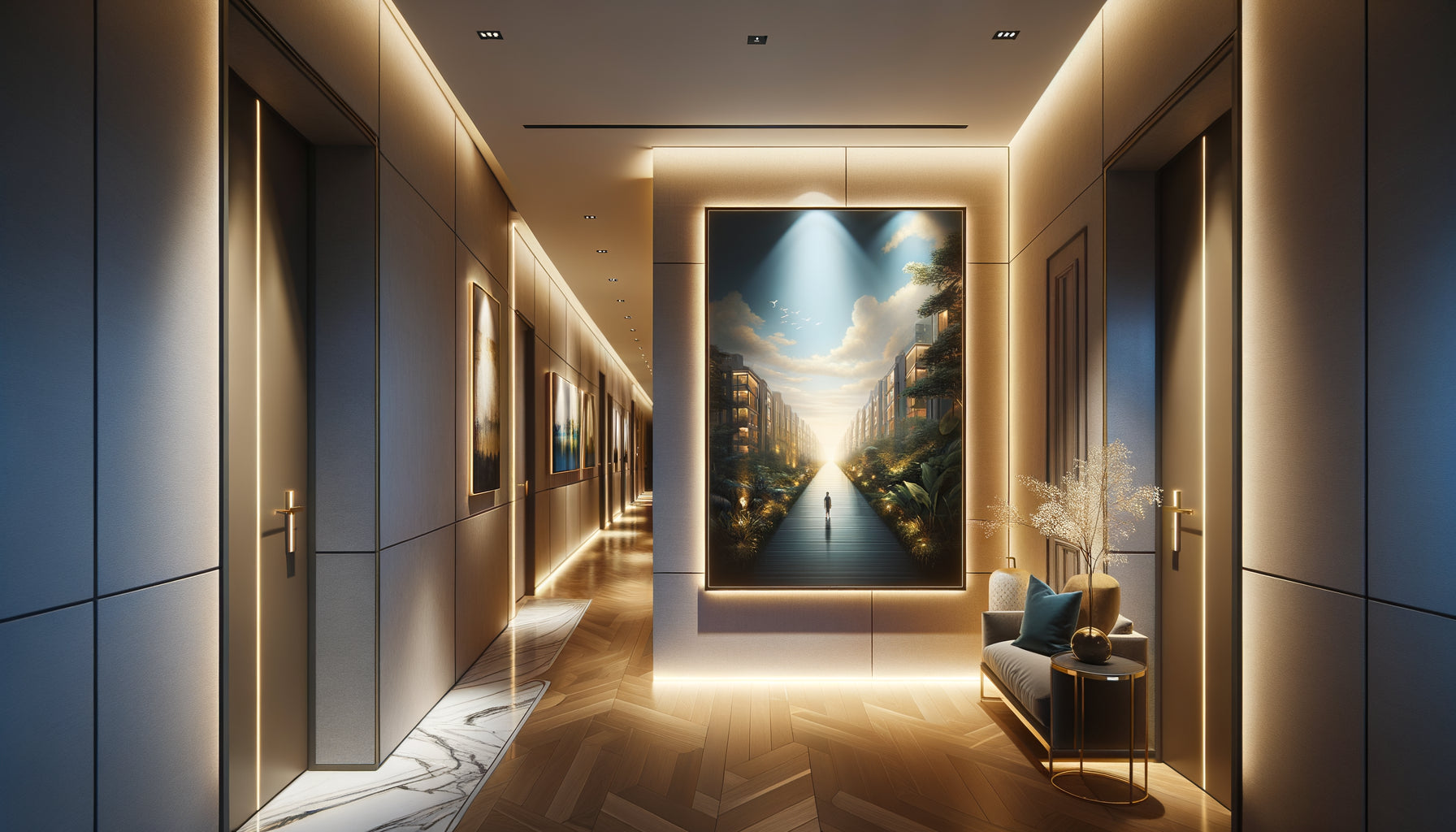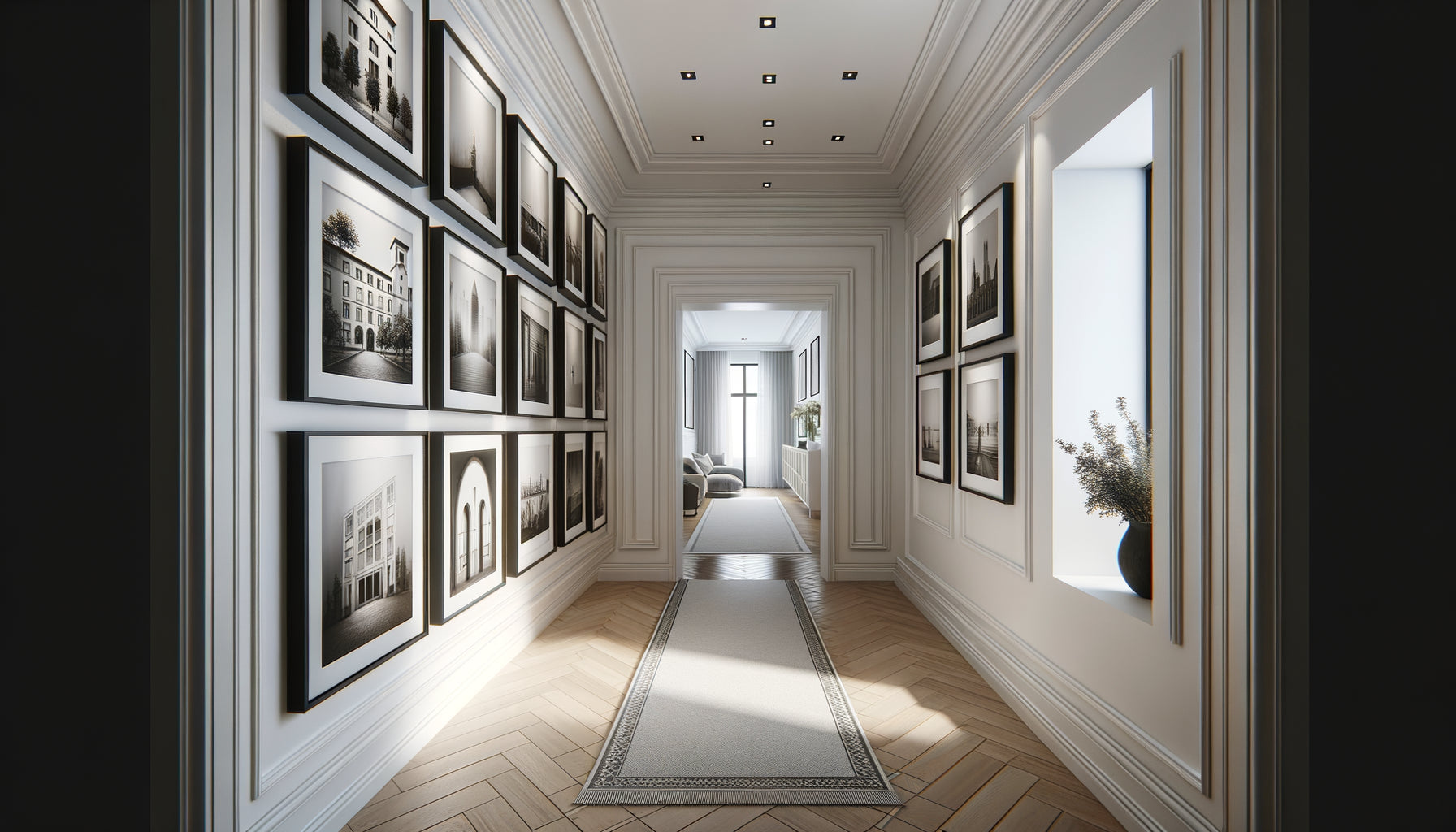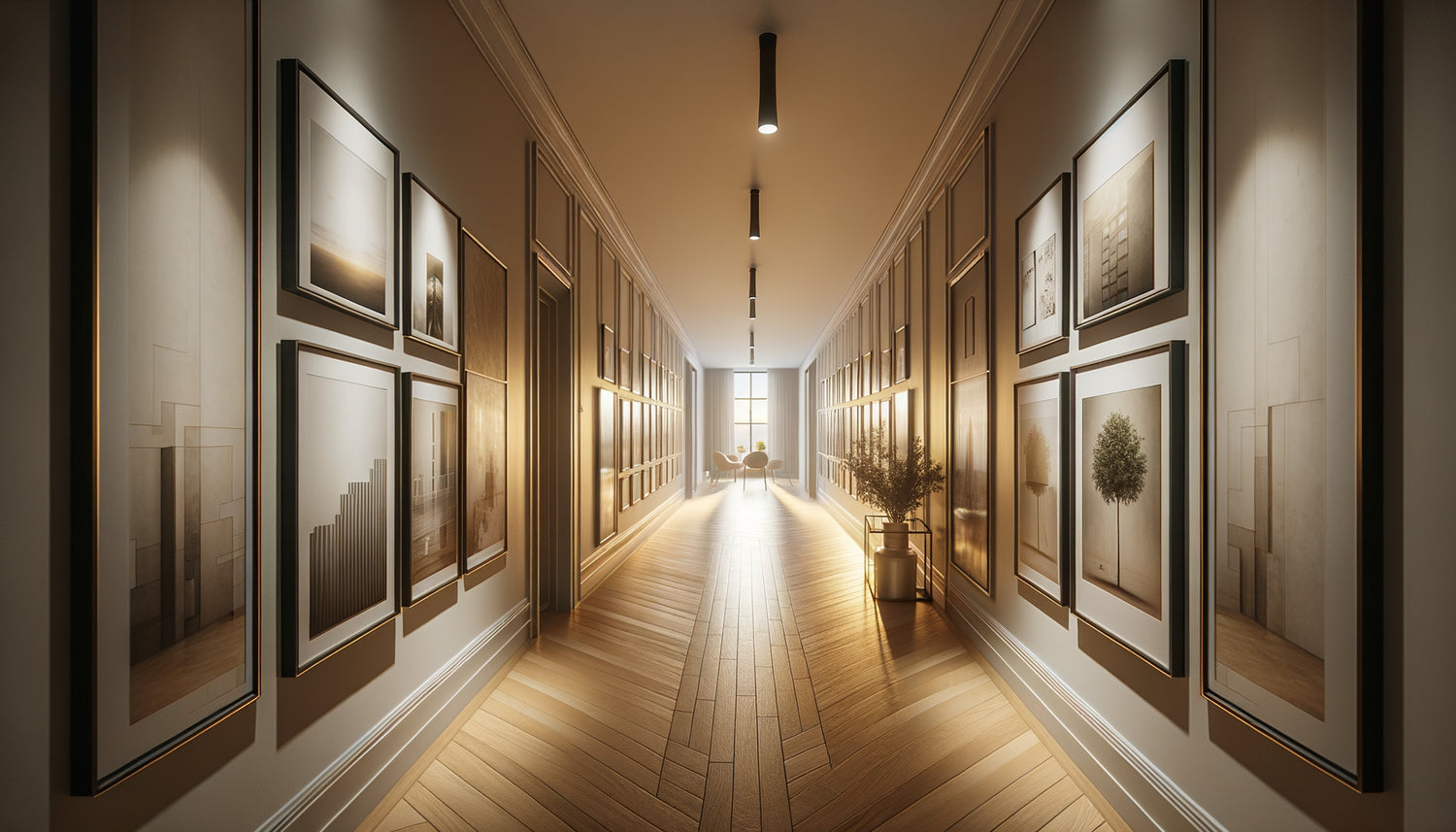
For a long time, I've observed how visitors move through the spaces I design. Some hallways seemed to naturally draw the eye, while others left guests hesitant, lost in a maze of identical doors. The revelation came during a renovation of a mansion in Le Marais: it wasn't the architecture that guided footsteps, but the way artworks created an invisible visual path. Paintings, strategically positioned, acted as luminous beacons intuitively directing towards spaces to discover.
Here’s what strategic painting placement brings to your interior: it transforms your hallways into fluid and engaging journeys, highlights the rooms you want to showcase, and creates a consistent spatial experience where each visitor moves naturally without ever feeling directed. It's the subtle art of orientation through aesthetics.
You may have felt it: that moment when your guests stop in the hallway, look around, search for clues about which way to go. Or worse, when your magnificent living room remains ignored while everyone crowds into the entrance. This frustration of seeing your favorite spaces neglected, these dead zones that no one spontaneously explores.
Rest assured, you don't need to rethink your entire architecture or install unsightly signage. The secret lies in a simple but precise visual choreography: positioning your paintings like musical notes composing a spatial melody. Each artwork becomes a stage of a narrative journey that the eye follows naturally.
In this article, I will reveal the exact techniques I use to create these visual paths that guide without constraint, attract without force, and transform your spaces into a fluid and intuitive experience.
The rule of magnetic gaze: how the eye naturally follows paintings
Our brain functions according to fascinating perception principles. When you enter a space, your gaze doesn't wander randomly: it seeks visual anchor points, elements that capture attention and create a guiding thread. Strategically positioned paintings become these anchor points that draw an invisible route.
I discovered that the human eye follows a predictable trajectory: it first settles on the most contrasting or colorful element within its immediate field of vision, then seeks the next in a natural continuity. This is exactly the principle we will exploit to visually guide towards a specific room.
The first step is to identify the starting point of the visual journey: generally the main entrance or the beginning of a hallway. That's where you position your first painting, the one that will capture initial attention. Choose a work with bright colors or an imposing format that naturally asserts itself within the field of vision upon arrival.
The principle of the visual cascade
Once this first artwork is in place, imagine that the gaze of your visitor must bounce from work to work like a stone skipping on water. The second artwork is positioned approximately 3 to 5 meters from the first, slightly offset towards the direction you want to prioritize. This progressive shift creates a subtle orientation without the visitor being consciously aware of it.
I often use a technique I call chromatic progression: successive artworks share a common dominant color that creates a natural visual continuity. For example, if your first artwork features touches of deep blue, the next will also incorporate blue, creating a thread – or rather blue – that the eye will instinctively follow.
The art of creating a visual corridor to your target room
To effectively guide towards a specific room, you must understand that each artwork functions as a disguised directional arrow. The trick is not in artworks literally shaped like arrows, but in their positioning and compositional orientation.
Carefully observe the internal composition of your artworks. Many works present natural guidelines: a path leading into a landscape, a portrait gaze oriented in a specific direction, geometric shapes pointing to one side of the frame. Position these artworks so that their internal guidelines point towards your target room.
In a hallway leading to multiple rooms, I often position the most captivating artworks on the side where the room to be enhanced is located. If your living room is on the left at the end of the hallway, create a progressive concentration of artworks on the left wall, with works becoming increasingly larger as you approach the entrance to the living room.
The power of variable height
Here's a technique that few people exploit: play with the height positioning of artworks to create an ascending or descending dynamic. To guide towards a room located in height, such as a staircase leading to the upper floor, position your artworks progressively higher, visually creating an ascent that the eye anticipates naturally.
Conversely, to attract attention to a room at the same level, maintain a constant height – approximately 1.60 meters at the center of the artwork – which creates a stable and reassuring horizon line. This visual consistency guides the gaze horizontally, exactly what you are looking for in a ground-level course.

The formats and spacing that accelerate or slow down the journey
The size and spacing of your artworks control the speed at which the eye – and therefore the steps – move through space. Small-format artworks, spaced regularly, create a sustained rhythm that accelerates movement. Larger works, generously spaced, invite contemplation and slow down the journey.
To guide towards a room you want to highlight, I often use a progression of formats: start with medium-sized artworks in the entrance or at the beginning of the hallway, then gradually increase the dimensions as you approach the target room. This progressive growth creates anticipation, an increasing intensity that subconsciously signals: 'something important awaits you here'.
Spacing also plays a crucial role in visual continuity. For effective guidance, maintain regular intervals between your artworks – between 60 and 100 cm depending on the length of your hallway. This regularity creates a predictable rhythm that the eye follows naturally, like the steps of a dance where each movement logically follows the previous one.
The doorway framing effect
A particularly effective technique is to position two artworks of similar format on either side of the entrance to your target room, creating a visual frame that acts as a symbolic portal. This symmetry naturally attracts attention and subtly signals: 'cross this threshold, discover what lies behind'.
I like to combine this technique with dedicated lighting on these two framing artworks. The spotlights create pools of light that, especially in the evening, become irresistible luminous beacons guiding visitors towards the illuminated room.
When the subject matter of the artworks tells the story of the journey
Beyond physical positioning, the thematic content of your artworks can powerfully reinforce your visual guidance. This is a narrative dimension that I particularly appreciate: creating a sequence of works that tell a logical progression towards the destination room.
Imagine you want to guide towards your library. Start with abstract or landscape paintings in the entrance, then gradually introduce works featuring cultural elements: a reading scene, still lifes with books, portraits of writers. This thematic progression prepares the visitor mentally for the experience that awaits them.
For a route leading to a dining room, I have already orchestrated a sequence going from countryside landscapes to market still lifes, then more elaborate culinary compositions. Each painting subtly prepared the mind for the gastronomic experience to come, creating increasing anticipation.
Chromatic consistency as a thread
The color palette of your paintings can also serve as a visual guide. Choose a dominant color that is present in the destination room – let's say an ocean blue for an office with nautical accents. Gradually integrate this shade into the paintings lining the path, starting with simple touches and then more pronounced dominants.
This chromatic continuity acts as a visual thread: even without consciously noticing it, the brain registers this color progression and naturally associates the direction to follow. It is an extremely subtle but remarkably effective guidance technique.

Mistakes that break the visual path
After years of correcting layouts that didn't work, I have identified recurring errors that sabotage a visual guidance through paintings. The first: create points of visual competition. If you position paintings of similar size or impact in several directions, you create confusion where the gaze hesitates, not knowing which direction to prioritize.
The opposite error is just as damaging: creating a too literal path with perfectly aligned works that transform the hallway into a rigid museum gallery. Visual guidance must remain natural and organic, with slight variations that maintain interest without creating chaos.
Also be careful of the overload trap: too many paintings kill the guidance. If every centimeter of wall is covered, the eye doesn't know where to settle and the visual path dissolves into visual noise. Maintain breathing spaces between your works, these neutral zones that allow the eye to move from one painting to another without fatigue.
The importance of lighting in guidance
A poorly lit painting, even perfectly positioned, loses its power of attraction. Invest in dedicated lighting for each work in your visual path. Rails with adjustable spotlights offer perfect flexibility to create these pools of light that line the way to your target room.
Especially in the evening, these illuminated paintings become lanterns intuitively guiding visitors. I particularly appreciate dimmers which allow modulation of intensity: brighter on paintings close to the target room, creating a gradient of intensity that reinforces directional guidance.
Ready to transform your spaces into captivating visual journeys?
Discover our exclusive collection of wall art for Hallway that will naturally guide your visitors to your favorite rooms while enhancing your walls.
Visualize your transformed interior
Imagine your guests stepping through your front door. Their gaze is immediately captured by the first painting with its vibrant colors, then slides naturally to the next, and the next. They move smoothly, without hesitation, instinctively drawn to that living room you have so carefully curated, that library which reflects your personality.
No more visitors lost in the hallway, no more of that beautiful room remaining unnoticed. Your interior becomes a fluid spatial experience where each space is discovered at the right time, in the right order, creating an impression of harmony and coherence that lingers in the mind.
Start today: identify the room you want to enhance, mentally trace the route from your entrance, and position your first painting. Then the second. Step back, observe how your gaze naturally travels. Adjust, refine, until you create that invisible but irresistible visual corridor. Your walls will no longer be simple decorated surfaces, but the subtle architects of the experience you offer those who cross your threshold.