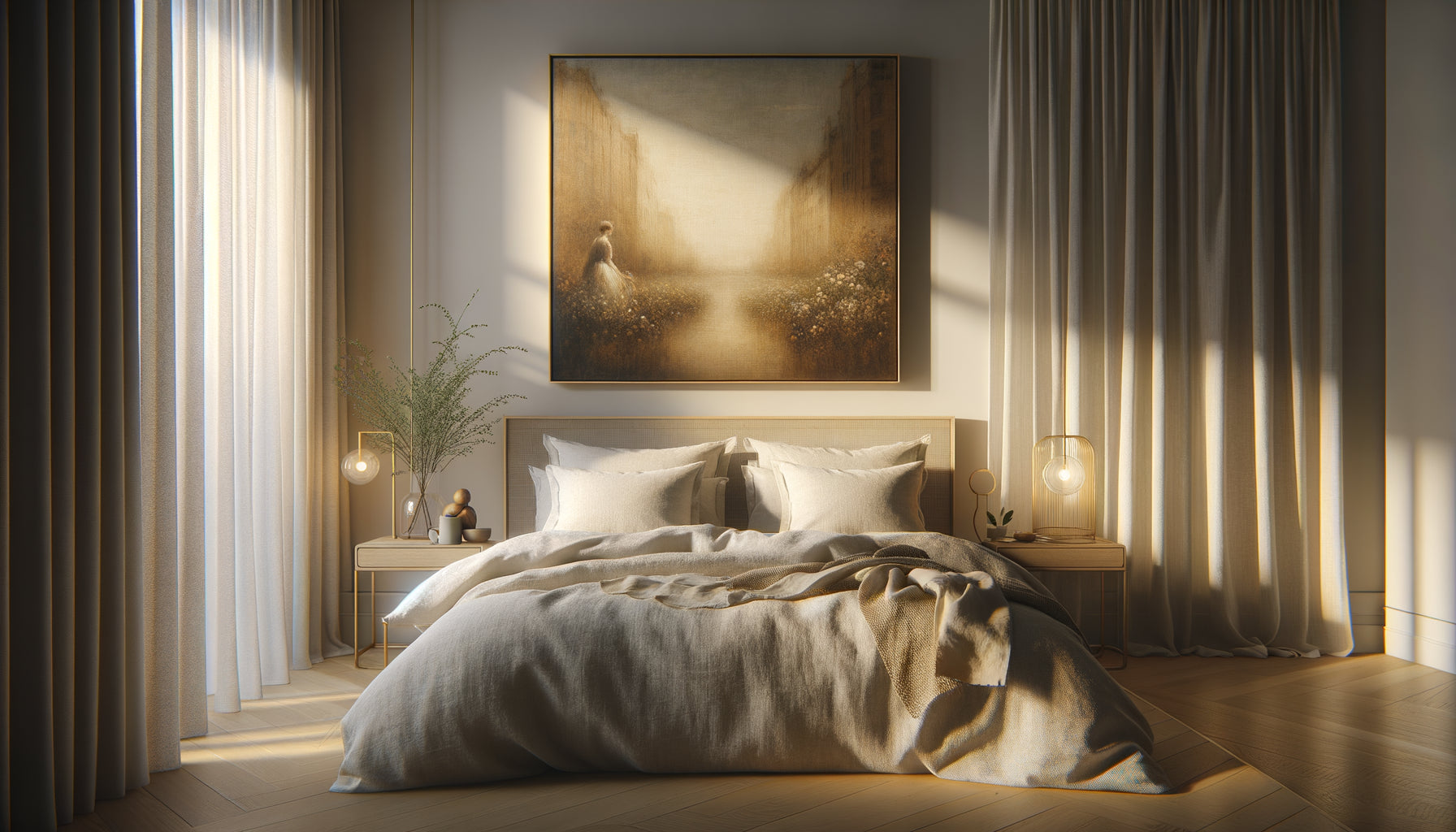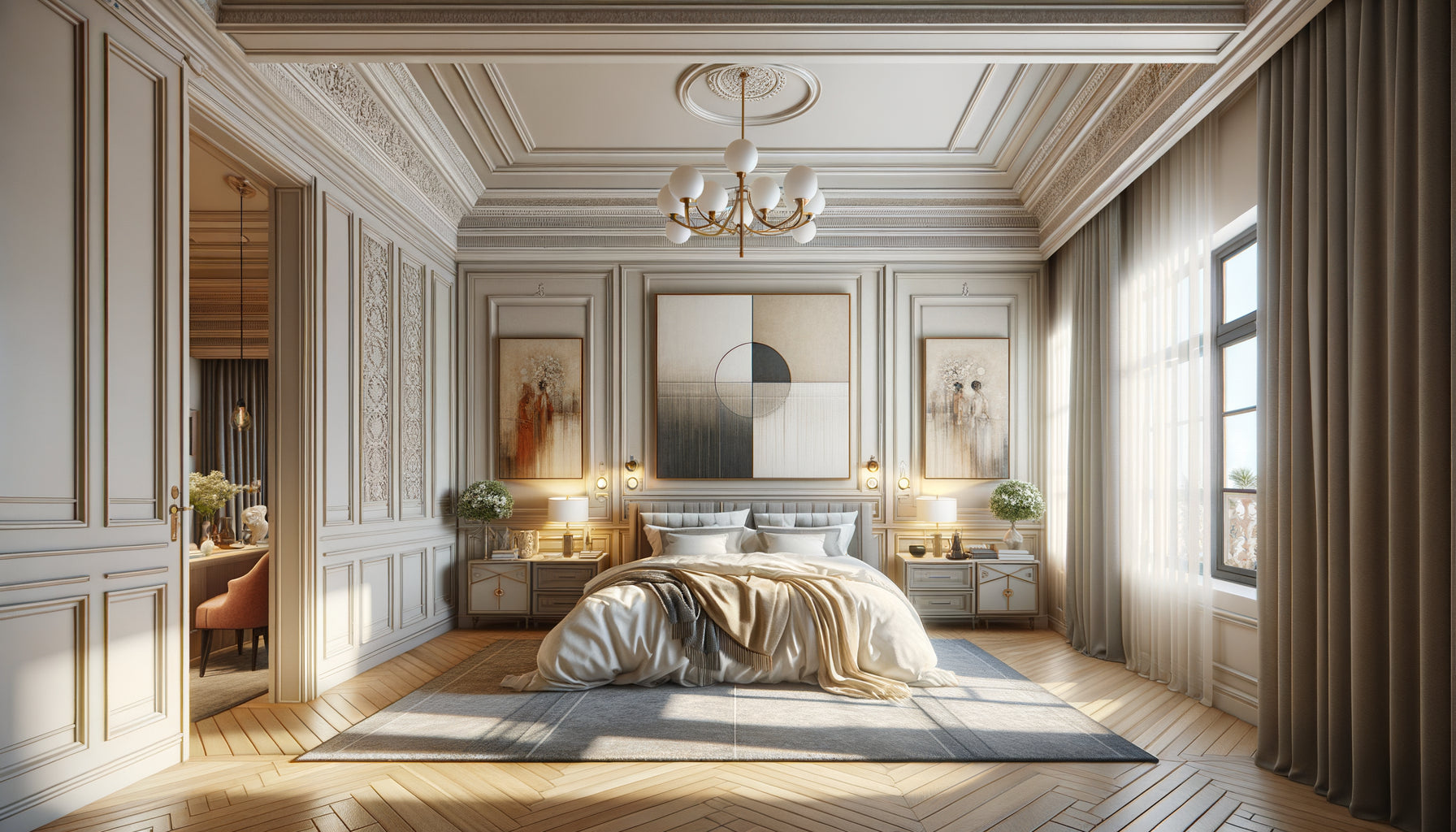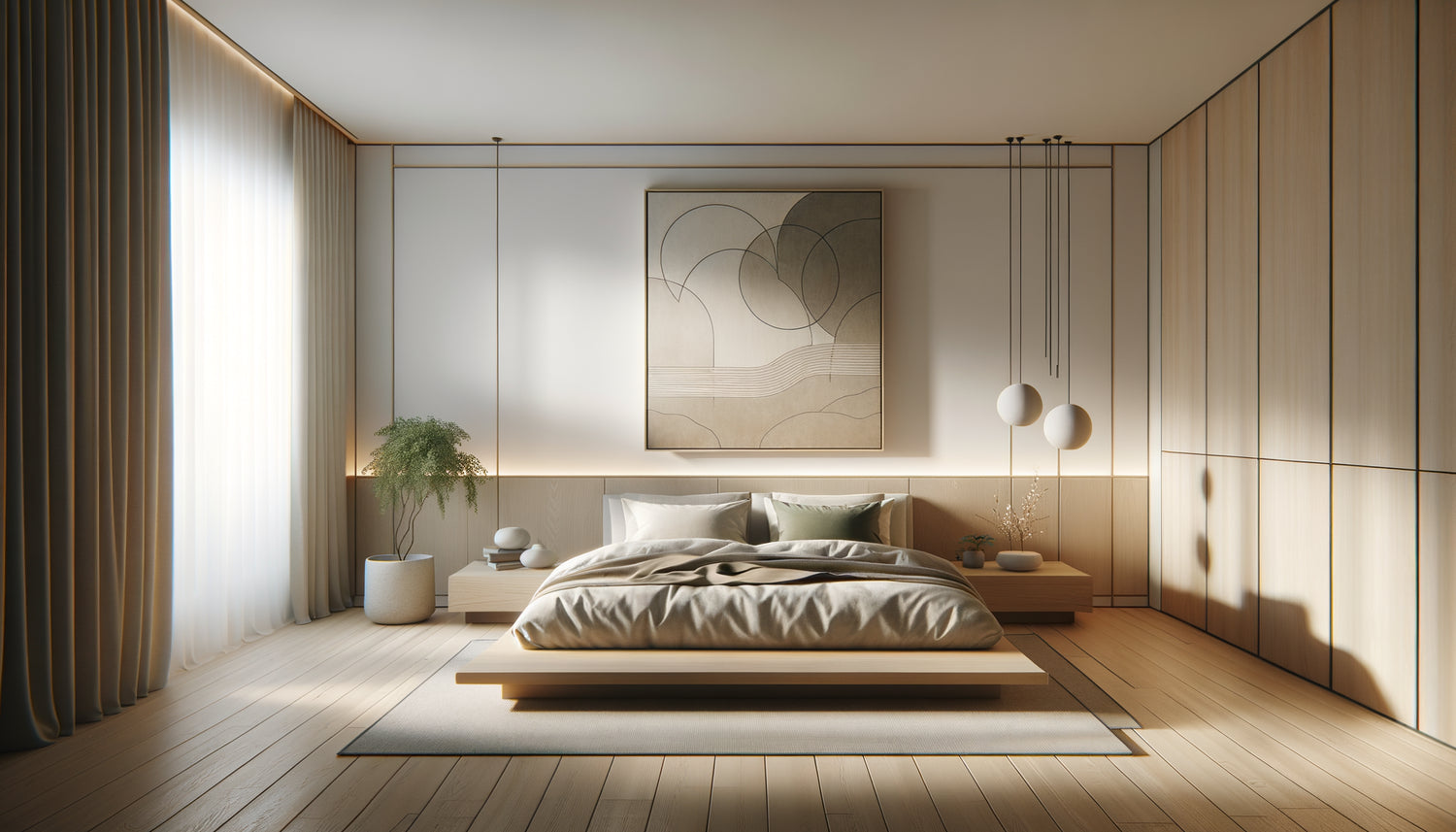
The first time I installed a simple, clean horizon line above a king-size bed, my client burst into tears. Not of disappointment, but of relief. “It’s the first time my bedroom breathes,” she confided to me. After years of decorative multiplication – layered frames, complex wall compositions, busy reproductions – this minimalist black line on an ivory background had freed up her sleeping space.
Here's what minimalist artworks bring to modern bedrooms: a visual breath that soothes the mind before sleep, timeless elegance that transcends trends without ever aging, and decorative flexibility that adapts to all your future changes.
The problem? Many still hesitate in front of these clean compositions. Too simple? Too cold? Not personal enough? These concerns are legitimate when investing in a space as intimate as your bedroom. Yet, after transforming more than two hundred sleeping spaces, I can assure you that a well-chosen minimalist artwork possesses a soothing power that overloaded works cannot match.
In this article, I reveal why these clean compositions dominate contemporary bedrooms today, how they transform your sleep quality, and above all, how to choose the one that will sublimate your nocturnal sanctuary.
Minimalism responds to the visual exhaustion of our time
We live in a world of saturation. Ubiquitous screens, incessant notifications, aggressive advertising – our brains process the equivalent of 174 newspapers' worth of visual information daily. When it’s time to sleep, our eyes and mind instinctively seek calm.
Minimalist artworks offer this essential cognitive break. Unlike complex figurative works that solicit our analytical attention – Who is this character? What are they doing? What is this scene? – a minimalist composition simply invites contemplation. A golden circle on a navy background. Two beige rectangles superimposed. An anthracite organic curve.
This visual simplicity is not emptiness, it's a mental decompression space. In a modern bedroom, where the clean lines of architectural design often meet discreet technology (integrated screens, smart lighting), a minimalist artwork naturally extends this philosophy of intentional sobriety.
I have noticed a recurring phenomenon: my clients who opt for minimalist artworks in their bedroom report a smoother transition to sleep. Their gaze rests on the work before turning off the light, and instead of stimulating thought, it gradually soothes it.
The perfect alliance between art and interior architecture
Modern bedrooms are characterized by pure geometric lines, neutral palettes, and thoughtful spatial organization. Introducing a baroque, impressionistic, or surreal painting into this environment often creates an aesthetic dissonance – like wearing hiking boots with a bespoke suit.
Minimalist paintings, on the other hand, harmonize beautifully with contemporary architecture. Their simple geometric shapes—circles, squares, horizontal lines—echo the clean structures of modern furniture. Their reduced palettes—often monochromatic or bichromatic—amplify rather than compete with the room's color choices.
The Rule of Visual Extension
A principle I consistently apply: the minimalist painting should seem to have always belonged in the room. Not as a decorative addition, but as an architectural element in its own right. To achieve this, I seek subtle echoes:
- Echo of Form: If your headboard features pronounced horizontal lines, a minimalist composition with horizontal bands creates an organic continuity. Echo of Color: A painting with shades of warm gray can enhance the polished concrete of an adjacent wall without exactly duplicating it. Echo of Texture: A matte minimalist canvas harmonizes with natural textiles (linen, cotton), while a version with metallic touches dialogues with brushed brass lighting fixtures.
This approach transforms the minimalist painting into a visual bridge that unifies all elements of your modern bedroom in a consistent aesthetic conversation.

Contrary to popular belief, a minimalist painting is not devoid of emotion—it is simply freed from anecdote. This distinction is fundamental to understanding their success in modern bedrooms.
A study in environmental neuroscience has shown that our brains process uncluttered spaces differently than cluttered environments. Faced with a complex scene, our prefrontal cortex remains active to analyze, categorize, and interpret. Faced with a minimalist composition, this analytical activity decreases significantly, giving way to a state of active cognitive rest—exactly what we need before sleep.
I tested this principle with a client who suffered from chronic insomnia. We replaced her large, highly detailed floral canvas with a simple triptych of minimalist gradients in navy blues. Three months later, she contacted me not to change it again, but to thank me: "I don't know if it's psychological, but I fall asleep staring at these fading blues and slip into sleep without realizing it."
The meditative power of simple forms
Minimalist paintings for the bedroom function as visual mantras. An abstract horizon line can evoke the calm of a twilight ocean without imposing a specific vacation memory. A golden circle on a dark background suggests a soothing full moon without representing it literally.
This abstraction allows each observer to project their own serene associations, creating a universal personalized experience – a paradox that only minimalist art manages to resolve with elegance.
Timelessness: A lasting decorative investment
Let's talk pragmatism. A modern bedroom evolves – new sheets, changing rugs, rotating cushions. Trends come and go: burnt terracotta gives way to sage green, which will likely be replaced by natural stone tones.
A minimalist style painting transcends these fluctuations. Its formal simplicity confers exceptional adaptable neutrality. This rose gold circle that enhanced your current blush textiles will harmonize just as naturally with graphite tones when you replace them in two years.
I have clients who have kept the same minimalist painting for eight years, through three complete bedroom renovations. The artwork has never seemed out of place – it has simply reinvented itself in each new palette, like an elegant chameleon revealing a new facet with each transformation.
This aesthetic longevity transforms the purchase of a minimalist painting into an investment rather than a one-off decorative expense. Calculate the cost per year of use, and these clean pieces become surprisingly economical.

How minimalism amplifies space and light
Modern bedrooms, particularly in urban environments, often lack spatial generosity. A minimalist painting well chosen then becomes a strategic architectural ally.
Compositions with low horizons create an illusion of depth. Your eye naturally follows the line to an imaginary vanishing point, which perceptually widens the space. I used this technique in a 11m² attic room: a minimalist painting with a single gold horizontal line placed facing the bed literally « opened » the room visually.
Minimalist paintings as light reflectors
Unlike saturated works that absorb light, minimalist paintings with light backgrounds or metallic touches subtly redistribute it. A large format with a pale white background facing a window becomes a secondary reflector that softens and diffuses natural light throughout the room.
This dynamic interaction with brightness transforms the painting into a living element. It appears slightly different at dawn, midday, and under nighttime lighting – three works in one, which maintain your visual interest without ever tiring.
Ready to transform your bedroom into a soothing sanctuary?
Discover our exclusive collection of bedroom paintings that combine minimalist aesthetics and museum quality to enhance your sleeping space.
Mistakes to avoid with minimalist paintings
Despite their apparent simplicity, minimalist paintings require thoughtful installation. Here are the pitfalls I regularly observe:
The scale error : A small 30x40cm minimalist painting above a queen-size bed literally disappears. The composition's minimalism does not compensate for an unsuitable size. For a 160cm headboard, aim for a minimum width of 100cm (diptych or triptych if necessary).
Minimalist overload : Yes, it is possible! Three different minimalist paintings on three walls create a silent cacophony. The principle of minimalism also applies to quantity: one powerful focal point is better than several scattered accents.
Forgetting the frame : A poorly framed minimalist painting loses all its strength. Opt for thin and discreet frames (light wood, brushed metal, matte black) or choose a thick canvas on stretcher bars without a frame for a contemporary gallery effect.
The haphazard placement : Height counts enormously. The center of the painting should be at eye level from your seated position on your bed – generally 120-130cm from the floor. Too high, it becomes decorative but loses its daily soothing power.
Conclusion: When less becomes infinitely more
Minimalist artworks dominate modern bedrooms because they solve the complex equation of our time: how to create a visually rich space without sensory saturation? How to personalize your intimacy without sacrificing serenity? How to invest in art without getting caught up in a fleeting trend?
Imagine your bedtime ritual transformed. You turn off your phone, your gaze naturally settles on this clean composition on the wall – perhaps a simple earthy gradient, or those three geometric shapes that seem to float. Your breathing slows down. Your thoughts stop whirling. The space breathes, and you breathe with it.
Start simple: identify the main wall of your bedroom, observe the light that crosses it at different times, note the dominant colors of your bedding. Then look for the minimalist artwork that will naturally dialogue with these elements – not the one that screams to attract attention, but the one that whispers a daily invitation to calm.
Your modern bedroom deserves more than decoration. It deserves an artwork that transforms every night into a soothing parenthesis.
Frequently Asked Questions
Won't a minimalist artwork risk making my bedroom too cold or impersonal?
This is the number one fear I hear, and it is perfectly understandable. But here’s the crucial nuance: minimalist does not mean sterile. A well-chosen minimalist artwork adds warmth through its materials (textured canvas, golden touches), its nuances (soft beiges, terracotta, deep blues rather than clinical white), and above all through the visual space it creates. In my practice, I observe the opposite effect: bedrooms with minimalist artworks seem more welcoming because they are less visually cluttered. The key is to choose compositions with a warm palette – prioritize natural tones (sand, ocher, moss green) over cold grays. Combine your minimalist artwork with rich textured textiles (velvet, crinkled linen, bouclé wool) and the perfect balance between simplicity and comfort will naturally be created. Think of it this way: the minimalist artwork allows your bedroom to breathe so that your other personal decorative elements (photos, plants, precious objects) shine more without visual competition.
How to choose the right colors for a minimalist artwork that will harmonize with my current and future bedroom?
Excellent question that reveals a long-term reflection! My infallible method: first identify your "structural colors" – those of the permanent elements you won't change for years (walls, main furniture, flooring). These are your chromatic anchors. Then, choose a minimalist artwork that contains at least one shade of these structural colors, even subtle. For example, if your bedroom has off-white walls, a light oak bed and warm parquet flooring, a minimalist artwork combining beige, pale gold and a touch of anthracite will work today with your current gray linens, and tomorrow with terracotta or olive green textiles. Avoid minimalist artworks dominated by a single very saturated trendy color (millennial pink, intense Klein blue) in favor of multi-layered compositions with predominantly neutral tones and a discreet accent. This strategy guarantees adaptability for 5-10 years minimum. If you are hesitating between two options, photograph them in your space with different lighting – your instinct will guide you to the one that seems « to have always been there ».
What size of minimalist artwork should I choose for a small bedroom without overwhelming the space?
Counterintuitively, a large minimalist artwork often enlarges a small bedroom rather than shrinking it! This is one of the most surprising revelations in my profession. Here's why: several small frames create visual fragmentation that fragments the perceived space, while a large format minimalist artwork with plenty of « void » (plain background, airy composition) creates continuity that widens the wall. For a bedroom of 10-12m², dare to go for a minimum size of 80x120cm above the bed. The golden rule: the artwork should cover 60-75% of the width of your headboard to create a balanced impact. If your ceiling is low (less than 2.40m), prioritize a horizontal format that visually widens rather than a vertical format that accentuates compression. For very small spaces, a minimalist triptych offers a clever alternative: three thin panels (30x90cm each) spaced 5cm apart create rhythm and lightness while covering a beautiful wall surface (100cm in total). Last tip: in a small bedroom, choose a minimalist artwork with a light or bright background that « opens » the wall rather than a very dark background that closes it. Test mentally: if your artwork were a window, would it bring light or shadow?