Gustave Courbet: The Revolutionary Realist Who Transformed French Art
Imagine a man defying his era's art by painting stonebreaker peasants with the same dignity reserved for the gods of Olympus. A painter daring to expose the raw reality of the working classes in Paris’ gilded salons, provoking scandals and aesthetic revolutions.
Gustave Courbet didn’t just paint: he shattered conventions, transforming each brushstroke into a political manifesto. In his workshops in Ornans and Paris, works were born that would redefine art for centuries to come.
Behind the provocateur lay an exceptional technical genius, capable of capturing human truth with a startling intensity. But who was this man who dared proclaim: "Show me an angel and I will paint it." ?
Discover the man behind the legend, his revolutionary aesthetic battles, and the timeless legacy that continues to inspire contemporary art - a comprehensive biography of the master of French realism
Gustave Courbet: The Revolutionary of Realism Who Transformed French Art
Understanding Gustave Courbet means grasping the essence of an artistic revolution that goes far beyond simple pictorial technique. This man literally democratized art, tearing it away from noble subjects to confront it with the social reality of his time.
| Biographical Highlights | Artistic Legacy |
|---|---|
|
Full name: Jean Désiré Gustave Courbet Birth: June 10, 1819 in Ornans (Doubs) Death: December 31, 1877 in La Tour-de-Peilz (Switzerland) Nationality: French |
Movement: Realism (founder) Style: Painting of social reality Key work: The Burial at Ornans Innovation: Dignifying popular everyday life |
The impact of Courbet still resonates today in every work that dares to show the unvarnished truth. His legacy transcends centuries, from the Impressionists to contemporary artists who draw on his revolutionary sincerity.
Gustave Courbet: From Peasant Origins to the Formation of an Artistic Genius
In the Franche-Comté region in the early 19th century, a child grew up whose keen eye for nature would forge his revolutionary artistic vision. Ornans, with its limestone landscapes and authentic inhabitants, becomes the breeding ground for a unique sensibility.
The revelation of the cliffs of Ornans: At twelve years old, young Gustave discovers the play of light on the rocks of his native region. This daily contemplation develops in him an exceptional perception of volumes and atmospheric effects that will later characterize his painting.
His father, Éléonor Régis Courbet, a prosperous landowner, encourages this nascent vocation. In Besançon, then in Paris from 1840, Gustave rejects the academic teaching of the School of Fine Arts. He prefers to learn by copying the masters at the Louvre: Rembrandt, Caravaggio, Velázquez.
The revolutionary autodidact: Courbet develops from the beginning of his career the principle that will guide all his work: "One must be of one's time." This conviction transforms his training into a permanent laboratory of experimentation.
This free education explains the technical singularity that will distinguish Courbet from his contemporaries. His brush acquires an unparalleled expressive power, capable of translating the materiality of the world with a striking truthfulness.
Gustave Courbet and 19th Century France: Art and Social Revolutions
The time of Courbet is bubbling with political and social transformations. The July Monarchy, the Revolution of 1848, then the Second Empire create a context of democratic effervescence that nourishes his artistic vision.
In mid-19th century Paris, official art still favors mythological and historical subjects. The annual Salons consecrate an idealized painting, far from the concerns of the French people undergoing industrial change.
Courbet rubs shoulders with progressive intellectuals: Charles Baudelaire, Émile Zola, Jules Champfleury. These meetings at the Guerbois café forge his social conscience and strengthen his conviction that art must bear witness to its time.
While his contemporaries Ingres and Delacroix perpetuate the tradition, Courbet senses that art must evolve. The nascent industrialization and the workers' demands call for a new pictorial language.
Art as a mirror of society: Courbet intuitively understands that political democratization requires an aesthetic democratization. His realism becomes the artistic expression of popular aspirations.
This historical consciousness explains why Courbet transcends simple technical innovation to become an aesthetic revolutionary whose influence extends far beyond his time.
Gustave Courbet : The Years of Struggle and Artistic Affirmation (1840-1849)
Courbet’s early Parisian years reveal an artist determined but confronted with general incomprehension. His first canvases, rejected by the official juries, already bear witness to a revolutionary vision that disturbs the artistic establishment.
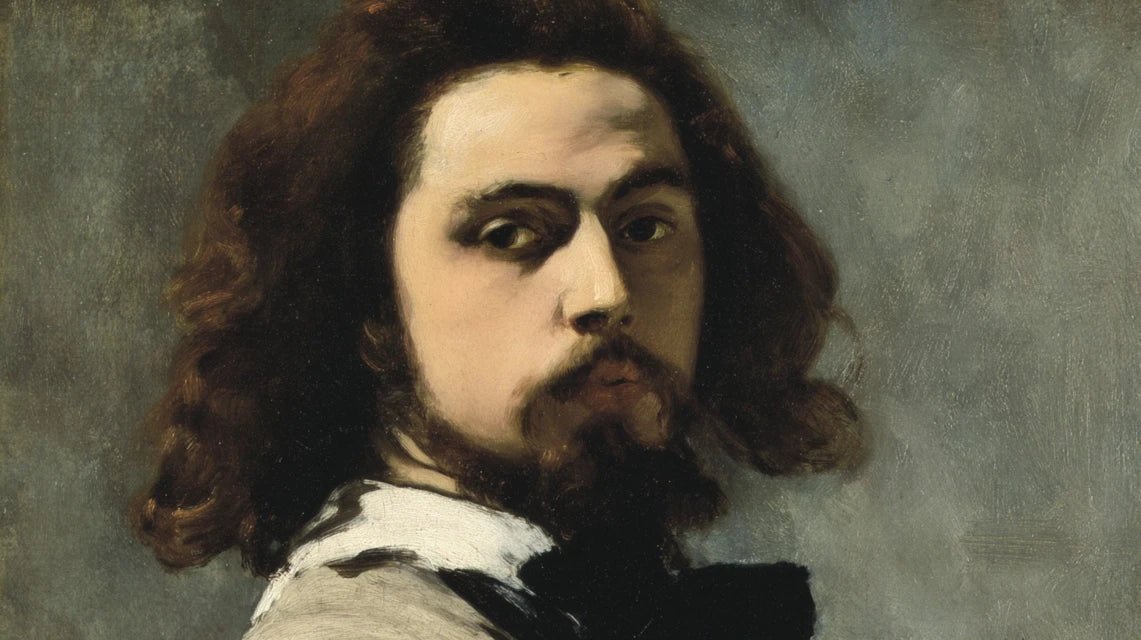
In 1844, "The Man with the Pipe" marks a turning point. This self-portrait without concessions shows a man of the people with the same pictorial dignity traditionally reserved for notables. The official Salon categorically rejects it.
The meeting with Champfleury in 1847 transforms his artistic vision. This progressive art critic reveals to him the importance of painting the "truth of the moment". Courbet finally finds the words to theorize his instinctive practice.
These years of lean times forge his character. Refusing official commissions that would oblige him to betray his vision, he develops a fierce independence that will characterize his entire artistic career.
The public's incomprehension and the criticism’s attacks paradoxically strengthen his conviction. Each rejection confirms that he is on the path of a necessary but painful aesthetic revolution.
Gustave Courbet and the Scandal of A Burial at Ornans (1849-1855)
1849 marks an explosion. "A Burial at Ornans" provokes a general outcry at the Salon of 1850. This monumental canvas (3.15 × 6.68 meters) treats a popular scene with the dimensions reserved for history paintings.
The Parisian bourgeoisie feels insulted. How dare present mourning peasants with the same pictorial solemnity as an imperial coronation? The conservative press denounces a "revolutionary vulgarity".
Courbet fully embraces this calculated provocation. For him, a peasant funeral possesses the same human dignity as a historical battle. This aesthetic equality translates his deep democratic convictions.
The revolutionary manifesto: "Show me an angel and I will paint it," Courbet says to his detractors. This formula summarizes his artistic philosophy: only observable reality deserves to be painted.
These controversies transform Courbet into a leading figure of a new aesthetic. "Realism" becomes a structured artistic movement, defended by a generation of artists eager for social truth.
Far from hindering his creation, these controversies stimulate his creative genius. Each new work becomes an aesthetic manifesto that pushes the boundaries of art deemed socially acceptable.
The Revolutionary Art of Gustave Courbet: Technique and Vision of Realism
The 1850s-1860s establish Courbet as the undisputed master of French realism. His painting technique reaches an exceptional level of maturity, capable of translating the materiality of the world with a shocking truthfulness.
"The Stone Breakers" (1849) reveals his technical mastery. This work, lost in 1945, showed two anonymous workers at work, painted with striking documentary precision and a contained emotion.
The Burial at Ornans: Masterpiece of Gustave Courbet's Social Realism
This monumental work transcends the simple genre scene to become an aesthetic manifesto. Courbet displays a gallery of portraits of his contemporaries with ruthless psychological truthfulness and technique of unparalleled power.
The revolutionary composition avoids all idealization. Each face bears the marks of time and social condition. This brutal sincerity transforms a local event into a universal meditation on the human condition.
The Technical Innovations of Gustave Courbet: Matter and Expressiveness
Courbet develops a revolutionary technique based on impasto and material effects. His brush literally sculpts the paint paste, creating tangible reliefs that reinforce the impression of physical reality.
Gustave Courbet facing Ingres and Delacroix: Aesthetic Revolution
While Ingres favors idealized drawing and Delacroix romantic emotion, Courbet invents a third way: material truth. His painting combines documentary precision and expressive power.
Compared to Delacroix's "Women of Algiers", Courbet paints his "Bathers": real bodies, without exotic idealization. This confrontation perfectly illustrates the generational opposition that runs through art in the mid-19th century.
OUR RECOMMENDED PRODUCTS
This technical revolution prepares the dawn of Impressionism. Renoir, Monet and Cézanne will explicitly acknowledge their debt to the master of Ornans.
Gustave Courbet: The Man Behind the Revolutionary Artist
Behind the aesthetic revolutionary lies a man with contradictory passions. Courbet cultivates the image of the "good-living Franco-Comtois" while nurturing a devouring artistic ambition that guides each of his personal choices.
His liaison with Virginie Binet reveals his sentimental complexity. Refusing bourgeois marriage, he assumes this free union which scandalizes respectable society. Their son Désiré is born in 1847 without official recognition.
This assumed marginality nourishes his creation. Courbet translates into his self-portraits an image of the modern artist: independent, provocateur, refusing social compromises. His thick features and his direct gaze defy the conventions of the aristocratic portrait.
His generous temperament shines through in his lasting friendships with the progressive intellectuals of his time. These relationships nourish a constant reflection on the social role of the artist in a changing society.
Gustave Courbet: From Polemic to Artistic Consecration (1855-1870)
The Universal Exhibition of 1855 marks a decisive turning point. Rejected by the official jury, Courbet organizes his own exhibition: the "Pavilion of Realism". This revolutionary initiative transforms failure into media triumph.
Forty paintings exhibited reveal the extent of his creative genius. The public discovers a coherent artistic universe, carried by an aesthetic vision of rare power. This gradual recognition attracts the first enlightened collectors.
The Value of Gustave Courbet: Evolution of the Market and Sales Records
The financial evolution of Courbet's work reflects his progressive artistic consecration. From cursed painter, he gradually becomes a safe value of the French art market.
| Period | Average Value | Sales Record |
|---|---|---|
| 1850-1870 (during his lifetime) | 500-3000 francs | 8,000 francs ("La Source", 1868) |
| 1880-1950 (posthumously) | 5,000-50,000 francs | 200,000 francs ("The Studio", 1919) |
| Contemporary market | 100,000-2 million € | 7.4 million € ("The Trout", 2012) |
This spectacular progression confirms the historical accuracy of his artistic vision. International museums are now competing for his major works, definitively establishing his status as a universal master.
Gustave Courbet: The Last Years and Death in Exile (1871-1877)
The Paris Commune of 1871 transforms Courbet into a political revolutionary. Appointed president of the Arts Commission, he participates in the destruction of the Vendôme column. This militant commitment will cost him his freedom and his homeland.
Condemned to six months in prison and the reimbursement of the reconstruction of the column, Courbet goes into exile in Switzerland in 1873. These last years reveal an artist physically diminished but creatively intact.
The Influence of Gustave Courbet on Contemporary and Modern Art
The legacy of Courbet permeates all modern art. The Impressionists recognize his liberation of color and his direct approach to nature. Cézanne proclaims him the "greatest painter".
In the 20th century, Picasso and the Expressionists draw from his revolutionary sincerity. Contemporary art regularly rediscovers its social vocation and its rejection of established aesthetic conventions.
Recognizing Courbet's legacy today: Look for this willingness to show social reality without embellishment, this dignification of popular everyday life that characterizes his aesthetic revolution, in current art.
The Musée d'Orsay in Paris holds his major masterpieces: "Burial at Ornans", "The Painter's Studio". The Courbet Museum in Ornans offers a complete immersion into his creative universe. Internationally, the Metropolitan Museum and the National Gallery possess exceptional collections.
This worldwide distribution testifies to the universality of his artistic message. Courbet transcends national borders to become a heritage of humanity.
🎁 Special offer for readers
Because you took the time to inform yourself, enjoy 10% discount on your first order :
⏰ Valid 72h after reading • Applicable to all our products
Frequently Asked Questions about Gustave Courbet : Biography and Complete Work
Jean Désiré Gustave Courbet (1819-1877) is the founder of the realist movement in French painting. Born in Ornans to a family of landowners, he revolutionizes art by painting the social reality of his time with a shocking sincerity. His childhood in contact with Franche-Comté peasants shapes his popular sensibility which characterizes all his work.
Courbet is essentially self-taught. Refusing the teaching of the School of Fine Arts, he learns by copying the masters at the Louvre : Rembrandt, Caravaggio, Velázquez. This free training allows him to develop an original technique based on direct observation of nature and the impasto of pictorial matter.
Courbet develops a revolutionary impasto technique where the paint paste creates tangible reliefs. He paints directly from nature, without preparatory sketch, building his compositions with colored masses. This materiality of painting reinforces the impression of physical reality and profoundly influences the emerging Impressionism.
Courbet scandalizes by applying to popular subjects the painting treatment traditionally reserved for history paintings. "The Burial at Ornans" treats a peasant scene with the dimensions of a historical painting. This aesthetic equality questions the social hierarchy of official art and expresses his democratic convictions.
Courbet's influence crosses all artistic movements to this day. The Impressionists inherit his color liberation, Cézanne his pictorial construction, the Expressionists his revolutionary sincerity. Contemporary art regularly finds its social vocation and its rejection of established aesthetic conventions.
Gustave Courbet: The Eternal Revolutionary Who Continues to Inspire Art
More than a century after his disappearance, Gustave Courbet remains an essential reference for any artist concerned with truth and authenticity. His lesson goes far beyond technique: it touches on the very essence of the creative act.
His aesthetic courage resonates particularly in our era when art still questions social relationships and established conventions. Courbet teaches us that authentic beauty is born from the sincerity of the gaze rather than conventional idealization.
Discovering Courbet means understanding that art can be both revolutionary and eternal, engaged and universally moving. His painting reminds us that true beauty lies in shared humanity rather than the artifices of power.
The living legacy of a master: Let yourself be inspired by this lesson of creative freedom which still transforms our perception of art and enriches our understanding of the world.