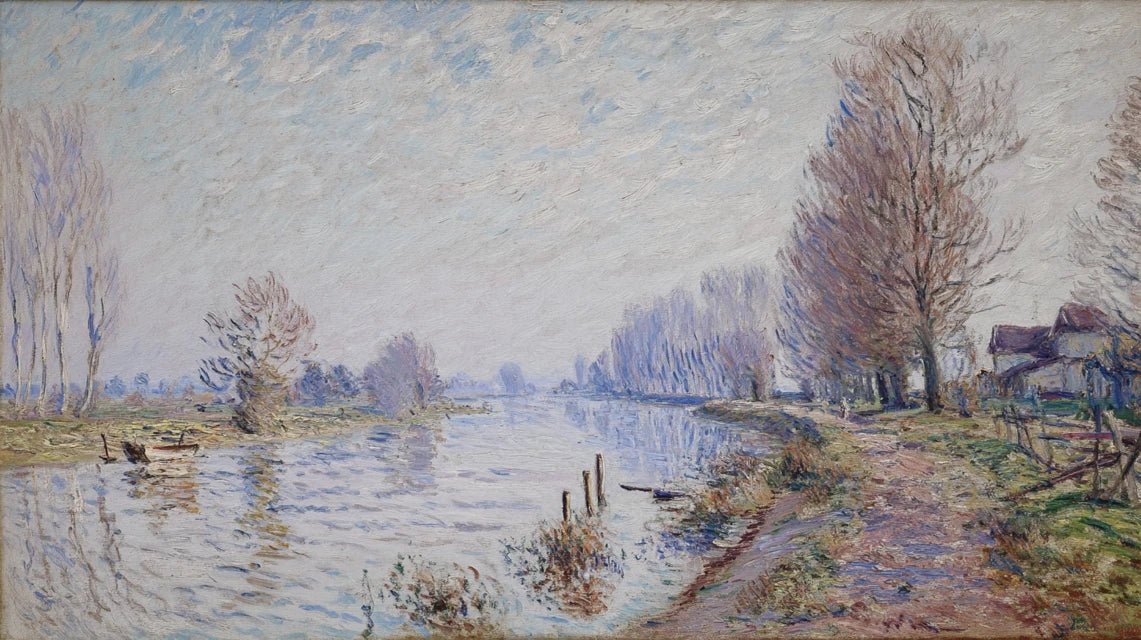
Imagine a man standing in the snows of Louveciennes, his easel planted in the biting cold of winter 1874, capturing with infinite delicacy the blue-rose reflections on the pristine powder.
This man is Alfred Sisley, the least known of the Impressionist masters, the one who sacrificed family fortune and social recognition to pursue his obsessive quest: to reveal the hidden poetry of French landscapes.
Neither a media darling like Monet nor a fashionable portrait painter like Renoir, Sisley deliberately chose the shadows, dedicating his entire life to this mission: transforming the Île-de-France countryside into pure pictorial emotion.
Discover the fascinating story of the man who, in anonymity and poverty, created some of the finest works of Impressionism - a lesson in artistic authenticity that still resonates today
Alfred Sisley: The English Gentleman Who Became a Brilliant French Painter
Understanding Alfred Sisley means grasping the paradox of an artist who lived his entire life in France while retaining his British nationality, and who painted French landscapes with such authentic sensitivity that he became its purest representative.
| Biographical Highlights | Artistic Legacy |
|---|---|
|
Full name: Alfred Sisley Born: October 30, 1839, Paris Died: January 29, 1899, Moret-sur-Loing Nationality: British |
Movement: Impressionism
Alfred Sisley: From a Golden Childhood in Paris to an Artistic Revelation in London
Born in the 9th arrondissement of Paris to wealthy English parents, Alfred grew up in bourgeois comfort: his father William Sisley runs a thriving business of artificial flower trading between Manchester and Paris.
Revelation in London museums: In 1857, sent to London to study commerce, young Alfred discovers the works of Turner and Constable. These hours spent in galleries rather than accounting classes seal his artistic destiny.
The spirit of creative freedom : From his earliest artistic steps, Sisley reveals a discreet but determined personality, prioritizing personal authenticity over academic conventions.
Together, these four friends quickly abandon traditional teaching to explore plein air painting in the Fontainebleau forest, laying the foundations for what will become Impressionism.
Alfred Sisley and his time: the revolutionary years of French art (1860-1870)
When Sisley begins his artistic career, France under the Second Empire is experiencing a period of profound transformation: Baron Haussmann redesigns Paris, industry develops, and official art reigns supreme.
The official Salon of the Academy of Fine Arts dictates artistic taste with its neoclassical history paintings and its ostentatious portraits. Painting a simple landscape is almost a social provocation.
Sisley frequents the Café Guerbois with all the young artistic guard: Édouard Manet, Camille Pissarro, Edgar Degas, Émile Zola. These intellectual encounters nourish his reflection on modern art.
Unlike his contemporaries often from modest backgrounds, Sisley benefits from the family fortune which allows him to paint freely, without immediate commercial constraints.
A quiet revolutionary : Sisley embodies this generation of artists who, without a noisy manifesto, quietly revolutionizes art by prioritizing the sincerity of emotion over official grandiloquence.
This initial financial freedom shapes his artistic approach: unlike his friends forced to sell to survive, he can focus exclusively on his personal aesthetic research.
Alfred Sisley facing adversity: the family bankruptcy and learning artistic survival (1870-1875)
The year 1870 marks a dramatic turning point: the Franco-Prussian War causes the collapse of his father's company. Overnight, Sisley loses his bourgeois comfort and must live off his painting.
Installed in Louveciennes with his companion Marie-Eugénie Lescouezec and their children Pierre and Jeanne, he discovers daily precariousness. His paintings sell poorly, often for derisory sums.
This period forges his character: the former son of a wealthy family learns humility and perseverance. He develops a more intimate relationship with the nature of Ile-de-France, obsessively painting the seasonal changes of his new region.
Meeting the art dealer Paul Durand-Ruel in 1872 offers a first commercial outlet. This visionary regularly buys his works, although Sisley's financial situation remains precarious throughout his life.
These trials paradoxically transform his painting: the need to paint to live sharpens his sensitivity, giving him this emotional authenticity that characterizes his best masterpieces.
Alfred Sisley and Impressionist controversies: the revolutionary exhibition of 1874
Contrary to the image of a discreet man that he cultivates, Sisley actively participates in the Impressionist revolution. In 1874, he is one of the founders of the Anonymous Society of Painters, Sculptors and Engravers.
The exhibition at 35 Boulevard des Capucines provokes a resounding scandal. The Parisian press denounces these "daubers" who dare to show unfinished paintings to the public. Sisley presents five landscapes that deeply divide.
Louis Leroy, an influential critic, mocks the "impression" given by these works, inadvertently inventing the term "Impressionism". For him, these artists “don’t know how to draw” and “ignore composition”.
The philosophy of authenticity: "I want my canvases to breathe the sincerity of a lived moment, not the perfection of an idealized world," Sisley declares in response to the attacks, fully embracing his revolutionary vision.
This controversy reinforces his conviction: art must capture the truth of the moment rather than perpetuate academic conventions. He will participate in the exhibitions of 1876 and 1877, maintaining his artistic line despite general incomprehension.
His friends Renoir and Monet will eventually adapt their style to public tastes, but Sisley remains faithful to his principles, assuming the misunderstanding and poverty that result from it.
Alfred Sisley and the art of Impressionist landscape painting: mastering light and atmosphere
The 1870s-1880s mark the creative peak of Sisley. Freed from family and financial constraints by his precarious situation, he develops a style of remarkable Impressionist purity.
His series of snowy landscapes in Louveciennes revolutionizes winter representation. Where academic art saw only sadness, Sisley discovers a palette of unsuspected richness: opalescent blues, pearly pinks, subtle violets.
The Flood at Port-Marly (1876): masterpiece of Impressionist poetry
This iconic canvas captures an extraordinary moment: the floods of the Seine transform Port-Marly into a ephemeral Venice. Sisley deploys all his colorist genius, transforming a natural disaster into a visual symphony.
The reflections in the floodwater create a play of mirrors between reality and illusion. The trees emerge like aquatic ghosts, and the sky blends with the waters in a total poetic communion.
Alfred Sisley and his technical innovations: the revolution of plein air
Sisley perfects the technique of plein air painting: portable paint tubes, lightweight easel, direct observation of changing light effects. He often paints the same scene at different times of the day.
Alfred Sisley compared to Monet and Renoir: the uniqueness of the pure landscape artist
While Monet explores systematic series and Renoir favors the human figure, Sisley remains faithful to the landscape contemplated in its immediate truth.
Camille Pissarro will say of him: "Sisley is the purest of us all." This purity stems from his refusal of compromises: no portrait commissions, no decorative concessions, only the truth of the French landscape.
OUR RECOMMENDED PRODUCTS
This artistic integrity comes at a high price: while his friends know commercial success, Sisley remains in the shadows, recognized only by his most demanding peers.
Alfred Sisley: the man behind the artist, between English discretion and French passion
The personality of Sisley reflects his dual culture: British reserve and French sensibility balance in a temperament of great emotional delicacy. His contemporaries describe him as an affable but secretive man.
His relationship with Marie-Eugénie Lescouezec, Breton model and florist, lasts more than thirty years before their late marriage in 1897 in Wales. This late union reveals a man faithful to his commitments but little concerned about social conventions.
Pere attentive de Pierre et Jeanne, he passes on to his children his love of the French nature while preserving his English roots. This cultural duality nourishes his unique artistic vision: the English eye observing French light.
His correspondence reveals a cultivated man, an avid reader of English and French poetry, capable of discussing both Wordsworth and Baudelaire. This literary culture enriches his pictorial sensitivity.
Alfred Sisley and late recognition: from contemporary contempt to posthumous triumph
Paradoxically cruel in the history of art: Sisley, now recognized as one of the absolute masters of Impressionism, never knew success during his lifetime. His first critical recognition came only in 1897, two years before his death.
The Georges Petit exhibition of 1897 presented 146 paintings and 6 pastels: a complete commercial failure, no sales. This disappointment broke the heart of the aging artist, who left for his last trip to England a few months later.
Alfred Sisley on the art market: posthumous record prices
The irony of the art market struck Sisley full force: his works, unsaleable during his lifetime, today reach staggering heights. Recognition finally arrives, but too late for the man who lived in poverty.
| Period | Average value | Record sale |
|---|---|---|
| During his lifetime (1870-1899) | 50 to 500 francs1,000 francs (1874 exhibition) | |
| First half of the 20th century | 5,000 to 50,000 francs | 100,000 francs (1950s) |
| Current market (2020-2025) | 100,000 to 2,000,000 € | 8,609,737 € ("Effect of snow at Louveciennes", 2017) |