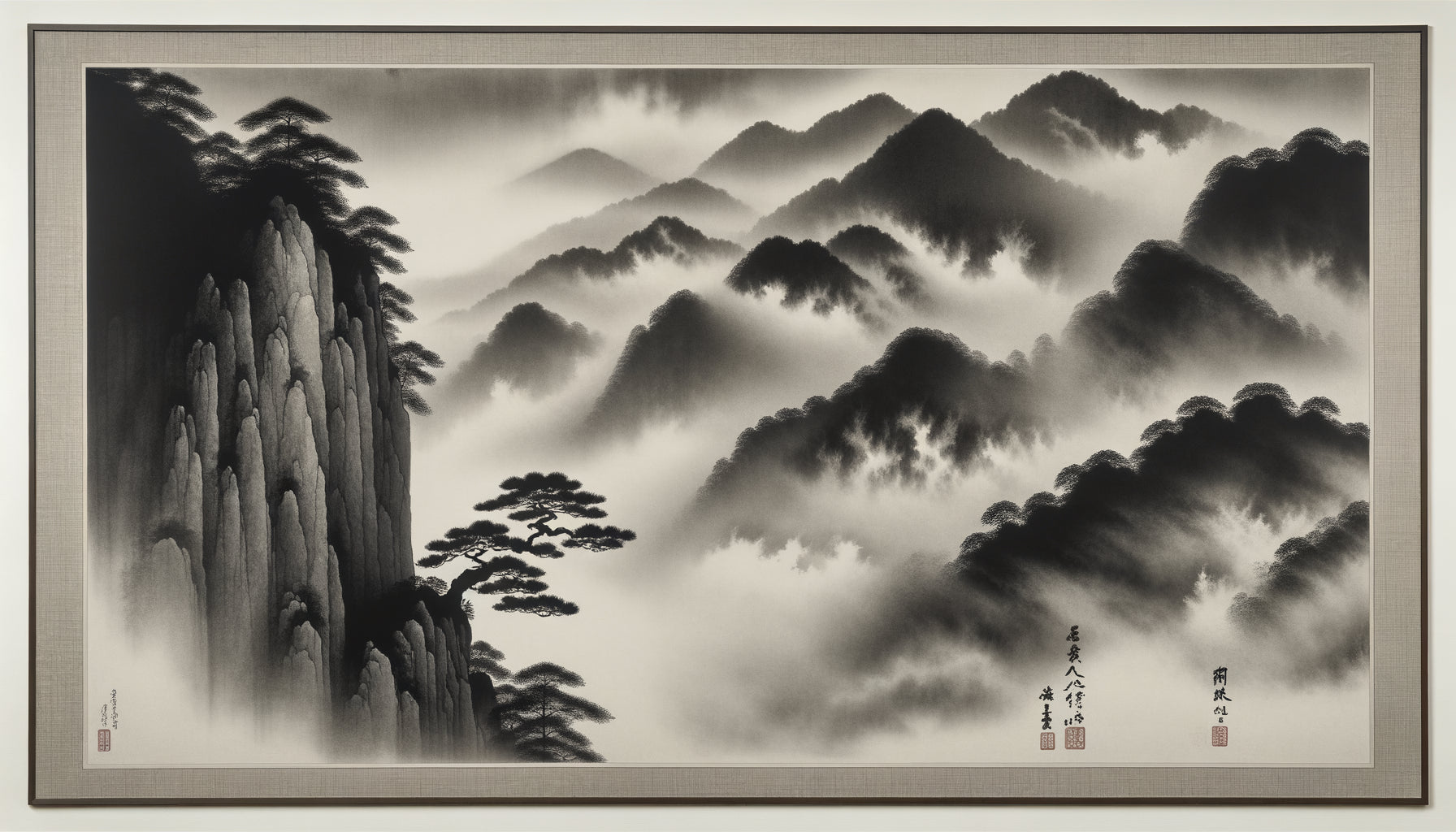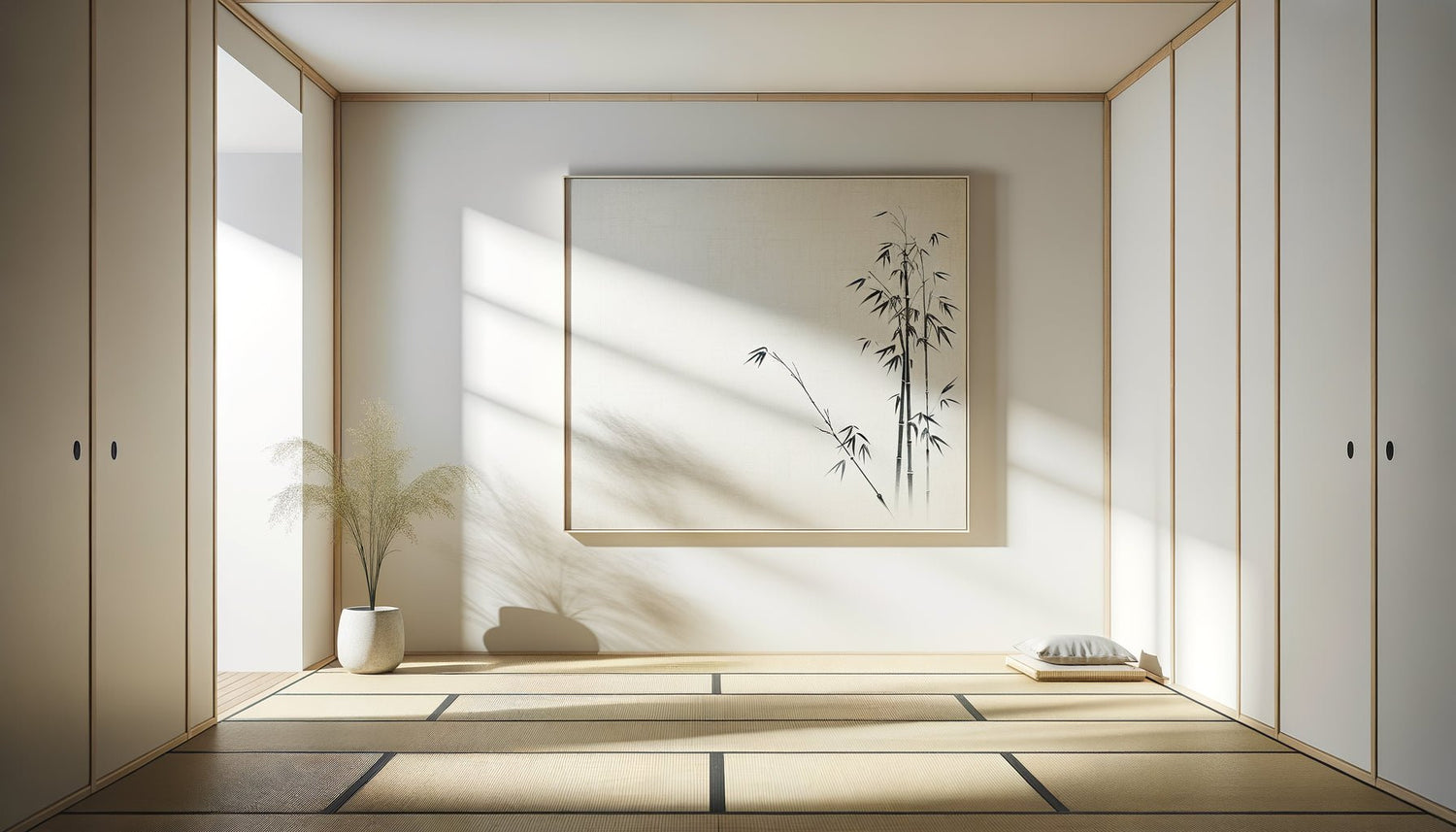
I understood this revelation while contemplating a tokonoma alcove in a traditional Kyoto home. A single scroll hanging. A simple vase. And that strange feeling of being surrounded by something invisible yet profoundly tangible: inhabited emptiness. It wasn't absence, but a silent presence that radically transformed my perception of space.
Here’s what the concept of Ma (間) brings to your modern wall composition: a visual breath that allows each element to converse, an emotional depth created by interval rather than accumulation, and a timeless elegance that transcends ephemeral trends. For fifteen years of practice in interior space design between Tokyo and Paris, I have observed how our Western walls suffocate under excess, while Japanese philosophy of Ma offers a revolutionary alternative.
You've probably felt this frustration: despite all your efforts to harmonize your frames, your artworks, your wall shelves, something is off. The whole looks cluttered, anxiety-inducing, visually noisy. It’s not your taste that’s at fault, it’s your approach to negative space.
I'm going to reveal how to integrate this millennial Japanese principle into your contemporary wall compositions, with concrete applications tested in my projects. You will discover why emptiness is never empty in the Japanese aesthetic, and how this understanding will radically transform your relationship with the wall.
Ma: when the interval becomes the invisible hero of the composition
Ma (間) is not simply translated as 'space' or 'void'. This compound kanji literally represents the sun (日) visible through a door (門): the interval that allows light, connection, passage. It’s the space between two notes of music that creates the melody, the silence between two words that gives meaning to the sentence, and in our context, the negative space between two wall elements that generates the composition.
In Japanese tradition, Ma is never considered as void to be filled, but as an active element of creation. It’s this principle that fundamentally differentiates a Western gallery overloaded with an exhibition where each work breathes within its own spatial territory. Negative space becomes protagonist.
I applied this philosophy in a Parisian loft in 2019: instead of aligning seven photographs on a six-meter wall, we only arranged three, separated by generous intervals of 80 to 120 centimeters. The result? Each image gained presence, dignity, emotional power. Japanese emptiness paradoxically amplified the visual richness.
The three dimensions of Ma in wall composition
The concept of Ma operates on three simultaneous levels. First, physical space: the measurable distance between your wall elements. Japanese designers generally recommend that negative space occupies 40 to 60% of your total wall surface - a ratio that seems radical in the West but creates that characteristic breathing room.
Next, temporal space: Ma includes duration, the rhythm of visual reading of your wall. A modern wall composition integrating Ma guides the gaze according to an intentional choreography, with pauses, accelerations, silences. Your eyes do not rush frantically from one frame to another but travel gracefully.
Finally, relational space: the invisible dialogue between the elements. In a Ma approach, two works separated by a generous void converse more intimately than ten images glued together. It is the interval that creates the relationship, like two friends separated by the ocean can share a deeper connection than two strangers in a crowded elevator.
The Western mistake that stifles your walls (and how to fix it)
Our Western culture has developed a problematic relationship with void. Horror vacui, this ancestral fear of emptiness, compulsively pushes us to fill every available square centimeter. On our walls, this translates into overloaded galleries where frames, mirrors, shelves and decorations desperately compete for attention.
This accumulative approach transforms your wall composition into a visual inventory rather than a coherent experience. Each element screams to be noticed, creating a cacophony where ultimately nothing really stands out. The paradox? The more elements you add, the less individual impact they have.
The revolution of Japanese Ma proposes the opposite: fewer elements, but each magnified by the surrounding negative space. I dismantled this principle with an art collector client. Her twelve-meter hallway exhibited twenty-three works. We removed seventeen. The remaining six pieces, spaced according to the principles of Ma, literally came back to life. Visitors who passed by without looking now stopped, contemplated, questioned.
The rule of asymmetrical intervals
Unlike classic Western symmetry, Ma favors asymmetrical negative spaces that create dynamism and naturalness. In a modern wall composition inspired by Japanese void, the intervals vary intentionally, following an organic harmony rather than a rigid geometry.
Specifically: if you arrange three elements on a wall, the space between the first and second could be 90 cm, while that between the second and third would be 120 cm. This slight asymmetry avoids monotony while preserving overall balance. The eye subconsciously perceives this variation as more natural, more alive.

Discover this inspiring artwork
Four Concrete Applications of Ma to Transform Your Walls Today
Application 1: The zone of silence around the main work
Identify your masterpiece - the one that deserves maximum attention. Create around it a void area of at least 50 cm in all directions. This Ma territory acts as an invisible frame that proclaims the importance of the central element. In a living room I designed in Lyon, a simple framed Japanese print, surrounded by 80 cm of negative space, dominated a four-meter wall with masterful authority.
Application 2: The decomposed triptych
Rather than three frames aligned mechanically, fragment your wall composition by playing on different heights and horizontal spacing. The Ma between the elements then becomes an active component of the total work. I often use this technique with nature photographs: three forest images separated by intervals of void suggest the passage of time, the movement of the wind, the breath of nature.
Application 3: Balanced asymmetry
Mentally divide your wall into three vertical zones. Place a strong element in the left zone, leave the central zone largely empty (intentional negative space), then a smaller element in the right zone but vertically offset. This asymmetrical composition creates a dynamic tension typical of Japanese Ma, where balance emerges from apparent irregularity.
Application 4: The diagonal dialogue
Position two elements diagonally opposite, connected by a generous corridor of void. The eye naturally establishes an invisible connection between the two points, and the intermediate negative space becomes the place of this silent conversation. This technique works beautifully in stairwells or double-height walls.
The void that speaks: how Ma transforms the emotional experience of space
Beyond pure aesthetics, the concept of Ma profoundly changes our physiological and psychological experience of habitat. Neuroscience of perception confirms what the Japanese intuitively knew: our brain processes negative space as actively as positive objects.
A wall composition generously integrating the reduced Japanese void reduces cognitive load. Your eyes and mind can rest, breathe, contemplate rather than frantically scan. In my residential projects, clients consistently report a heightened sense of calm after applying the principles of Ma to their walls.
This philosophy of negative space resonates particularly today, where our oversaturated digital lives demand sanctuaries of simplicity. A wall designed according to the Ma becomes a visual antidote to contemporary chaos, a place of deceleration where the gaze can finally stop without being immediately solicited elsewhere.
Ma and minimalism: crucial similarities and differences
Be careful not to confuse Japanese Ma with Western minimalism. Minimalism removes to achieve geometric essentials. The Ma preserves negative space to reveal the relationship and dialogue. It's a subtle but fundamental distinction.
A wall composition can seem cold, clinical. A composition integrating the Ma remains warm, alive, breathing. The void is not austerity but generosity - the space given to elements to fully exist, to resonate, to touch.

Discover this inspiring artwork
Your action plan: integrate Ma this week
Start modestly with a single wall. Photograph its current configuration, then remove half of the elements. Yes, half. Put them away without throwing them - it's an experiment, not a definitive decision. Live with this new composition for five days. Observe how your gaze interacts differently with the negative space.
Measure the intervals between your remaining elements. Are they less than 30 cm? Gradually increase them until you reach a minimum of 60-80 cm. You will probably find that what initially seemed 'too empty' quickly becomes 'exactly balanced'. It is your perception that adjusts to the Ma.
For your new acquisitions, first buy the negative space. Before adding an element to your wall composition, identify where its zone of Ma, its breathing territory, will be. If this space doesn't exist, don't force the addition. It’s the discipline of Japanese void: every presence must justify and honor its surrounding absence.
Let Japanese art breathe on your walls
Discover our exclusive collection of Asian art that naturally embodies the principles of Ma, creating wall compositions where emptiness magnifies presence.
The lesson of the Zen garden: when void becomes landscape
I always conclude my modern wall composition consultations by mentioning Japanese Zen gardens. In these contemplative spaces, raked gravel is not 'filler' between the rocks - it’s the ocean, the clouds, the movement of time. The negative space is fully meaningful.
Your walls can access this same poetry. This large white expanse between two frames isn't a decorating failure, it’s a breath of intention. It’s the silence that gives power to the notes. It’s the Ma that transforms a collection of objects into a coherent, emotional, memorable composition.
Start tomorrow. Remove an element. Widen an interval. Let the Japanese void enter your space. You will never see your walls the same way again. The negative space will cease to be what remains after placing your decorations - it will become your first choice, your foundation, your silent revolution.
Frequently asked questions about Ma and wall composition
Does the principle of Ma work in small spaces?
Absolutely, and that’s where it reveals its greatest power. In a small apartment or a reduced room, the temptation is to maximize every wall centimeter, paradoxically creating an even more oppressive feeling of narrowness. Ma performs the magic inverse: by generously letting the negative space breathe, you create an illusion of amplitude. A single element perfectly positioned with 70 cm of void around in a small bedroom will give a feeling of much more space than five frames squeezed together. The negative space doesn't 'waste' the available surface - it perceptually amplifies it. I have transformed Parisian studios of 25m² by rigorously applying this principle: fewer wall elements, more negative space, spectularly more spacious visual result.
How to convince my spouse that the wall isn't 'too empty'?
This resistance is normal - we are culturally conditioned to perceive emptiness as a deficiency to be filled. My approach: propose a limited-time experiment. 'Let's try this composition inspired by Ma Japanese for two weeks, then we will re-evaluate.' Photograph the before and after. Generally, after five to seven days, the eye adjusts and what seemed empty becomes balanced. Explain that negative space is not absence but enhancement - like a precious jewel presented on velvet rather than piled with others. Show visual references from prestigious art galleries or high-end decor magazines: they all generously use Ma, because it conveys elegance and sophistication. Emptiness is not poverty, it's refinement.
Can I apply Ma with a non-Japanese decorative style?
The concept of Ma completely transcends specific decorative styles - it is a universal principle of composition that enriches any aesthetic. I have successfully applied Ma in Scandinavian, industrial, French classic, bohemian, contemporary interiors. A farmhouse American wall with vintage signs gains immensely in impact when the pieces are spaced according to the principles of Japanese emptiness. Golden Baroque frames in a Haussmannian apartment become more majestic surrounded by generous negative space. Ma does not impose a Nipponese aesthetic - it optimizes the visual reading of any style. It's like the rule of thirds in photography: it works whether you photograph a Zen temple or a Gothic cathedral. Negative space is the visual grammar that makes any decorative sentence more eloquent, whatever its stylistic vocabulary.