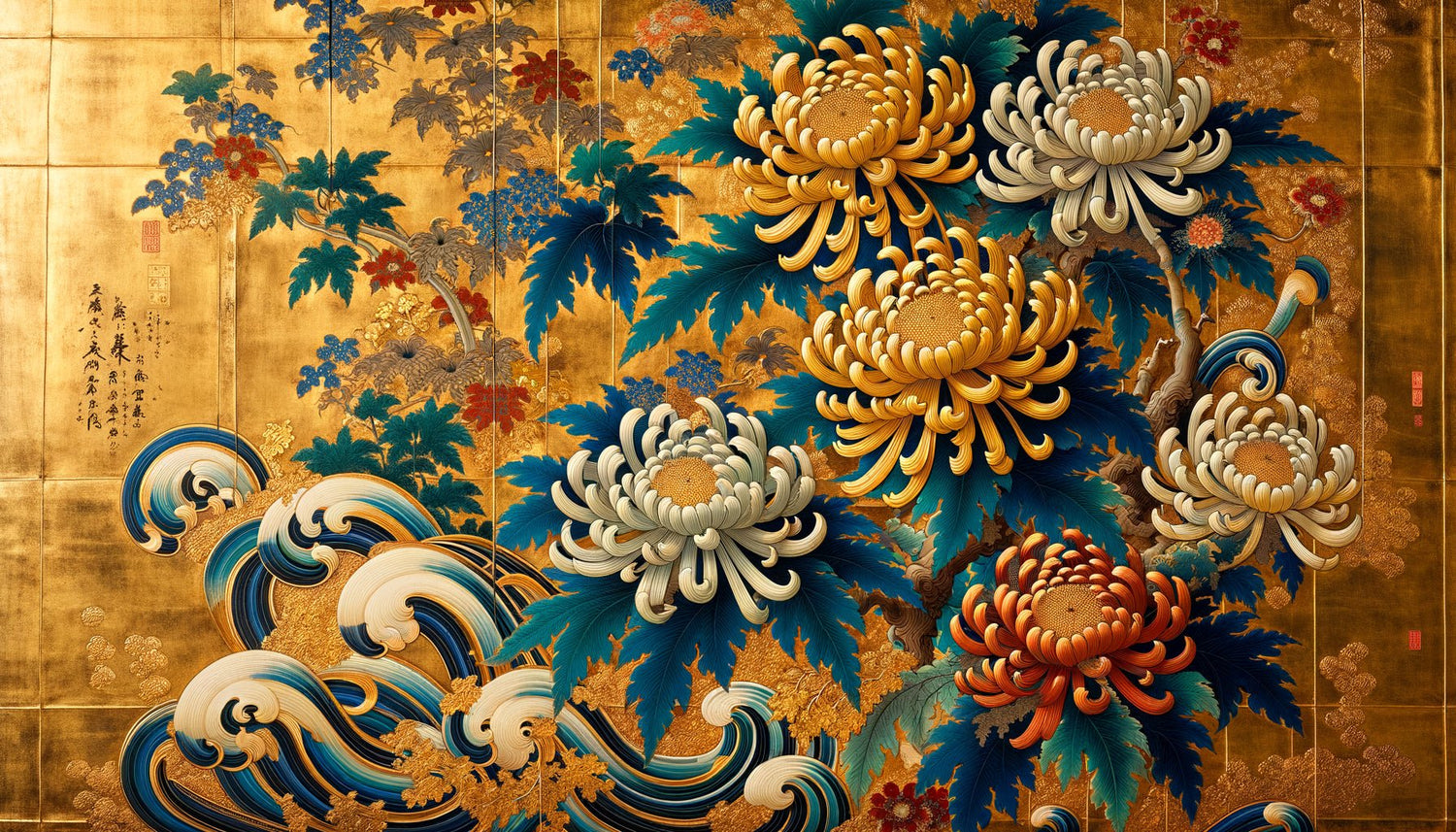
Imagine a gilded screen transforming daylight into precious radiance, violet irises seeming to ripple under an invisible breeze, waves of pure gold capturing and redistributing every sunbeam in your interior. That's exactly what the Rinpa school offered to 17th-century Japanese elites: an aesthetic revolution where opulent wall art became luminous sculpture.
Here’s what the Rinpa school brings to our contemporary interiors: refined opulence that never shouts, a celebration of stylized nature in timeless decorative motifs, and this bold use of gold that transforms a wall into a source of living light. Three centuries later, these aesthetic principles remain strikingly modern.
Are you looking to create a luxurious atmosphere without falling into excessive Baroque? Do you want to integrate Japanese decorative motifs without creating a touristy pastiche? The Rinpa approach solves this difficult equation. Unlike European ornamentation of the same era, the Rinpa school mastered the art of elegant emptiness, calculated asymmetry, and organic curves that breathe.
You don't need to transform your living room into a Japanese museum. The visual codes developed by Rinpa masters adapt perfectly to contemporary interiors. I invite you to discover how this 17th-century artistic revolution can inspire your decorative choices today, first by understanding its fascinating historical context, then its applicable aesthetic principles.
Kyoto, early 1600s: when merchants reinvent luxury
While Europe plunged into the Thirty Years' War, Kyoto experienced an extraordinary cultural renaissance. The Rinpa school was born in this particular context: the Tokugawa peace had just been established, and a new class of prosperous merchants sought to assert their refined taste against traditional aristocracy.
Hon'ami Kōetsu and Tawaraya Sōtatsu, the pioneers of the movement, were not simply painting: they were creating complete sensory environments. Their monumental screens transformed interior architecture. Imagine gold leaf applied to surfaces of several meters, creating a play of light that changed according to the time of day and the position of the viewer.
What distinguished the Rinpa school from previous schools? Its categorical rejection of meticulous realism in favor of bold stylization. The irises of Ogata Kōrin, perhaps the movement's most iconic work, reduces the flower to its essential curves. No superfluous botanical details, just the decorative quintessence of the plant, amplified by a gold background that literally makes it float in space.
Gold as an architectural material
The use of gold in the Rinpa school was nothing gratuitous. These artists intuitively understood the physics of light. In traditional Japanese interiors, lit naturally by limited openings, gold leaf acted as strategic reflectors.
The Rinpa masters applied gold using various techniques: kirikane (gold cut into geometric patterns), sunago (sprinkled gold powder), or haku (whole leaves). Each method created a specific luminous texture. On a six-panel screen, they could combine these techniques to create subtle variations in brilliance that guided the eye.
This approach resonates particularly today, as we rediscover the importance of natural light in our interiors. A painting inspired by Rinpa principles, even of modest dimensions, can amplify a room’s brightness organically, without resorting to harsh artificial lighting.
The gold background: much more than a backdrop
In Rinpa art, the golden background is never neutral. It actively participates in the composition. Observe Sōtatsu’s golden waves: they create an ambiguous space, neither completely abstract nor totally figurative. This spatial ambiguity generates a meditative depth, as if the motif existed in a parallel dimension.

Discover this inspiring work
Decorative motifs: nature as a formal vocabulary
The Rinpa school developed a precise iconographic repertoire: irises, pines, plums, chrysanthemums, waves, waterfowl. But these natural elements underwent a radical stylistic metamorphosis. Rinpa artists isolated, enlarged, repeated and stylized these motifs to create a universal decorative language.
Take the motif of Ogata Kōrin’s stylized irises: he reduces the plant to vertical bands of deep blue and green, punctuated by touches of gold. This simplification creates a powerful visual rhythm, almost musical. Arranged on a screen, this motif generates a sensation of lateral movement, as if the viewer were walking along a pond.
The Japanese decorative motifs of the Rinpa school possess this rare quality: they are immediately recognizable as Japanese, while transcending their cultural origin. A Rinpa composition dialogues equally well with a Scandinavian minimalist interior, an industrial loft or a Haussmann apartment.”
Asymmetry as a Guiding Principle
Unlike classical European symmetry, the Rinpa school systematically exploited dynamic asymmetry. On a six-panel screen, the composition could occupy only four panels, leaving a large expanse of gold space empty. This emptiness was not absence, but visual breathing room, allowing the eye to rest before returning to the motif.
Rinpa and Contemporary Decoration: Transferable Codes
How to integrate the spirit of the Rinpa school into a contemporary interior without creating a frozen museum? Several principles remain surprisingly relevant.
First, the strategic use of gold or metallic surfaces. A painting with touches of gold, positioned perpendicularly to a window, will capture and redistribute natural light throughout the day. The effect changes according to the weather, creating a living decoration.
Next, the bold stylization of natural elements. Rather than realistic botanical reproductions, prioritize graphic representations that reduce nature to its essential lines. This approach creates a timeless elegance that transcends trends.
Finally, calculated asymmetry. In a wall composition, dare to leave significant empty spaces. The Western gaze has long considered emptiness as a failure of filling, whereas Rinpa aesthetics makes it an active element of the composition.
Rinpa Color Palette for Today
The artists of the Rinpa school worked with a restricted but sophisticated palette: gold, indigo blue, malachite green, vermilion red, ink black. These intense colors, applied in contrasting blocks, created maximum visual impact. Transposed into a contemporary interior, this palette offers a refined alternative to neutral beige shades.

Discover this inspiring artwork
The Rinpa Legacy: From Screen to Textile
The influence of the Rinpa school extended beyond painting. The decorative motifs created by Sōtatsu, Kōrin and their successors quickly migrated to textiles, lacquerware, ceramics. This permeability between the arts was part of the Rinpa philosophy: a beautiful motif should be adaptable to different supports.
Ogata Kenzan, younger brother of Kōrin, applied Rinpa aesthetics to ceramics, creating bowls and plates where gold motifs and colored glazes dialogued with the shape of the object. This holistic approach to design resonates strongly with our time, where boundaries between art, craft and design blur.
In the 19th century, the Rinpa school directly influenced the European Arts & Crafts movement and Art Nouveau. Gustav Klimt, in particular, was inspired by the bold use of gold and stylized decorative motifs. This circulation of influences demonstrates the universality of Rinpa aesthetic principles.
Creating a Rinpa atmosphere: beyond the decorative object
Embracing the spirit of the Rinpa school is not about accumulating Japanese objects. It's more about adopting a philosophy of composition.
Prioritize bold statement pieces rather than multiplying elements. A single painting inspired by Rinpa aesthetics, with its gold background and stylized motifs, can define the atmosphere of an entire room. The Rinpa masters understood the power of singularity: one exceptional screen was better than a profusion of minor decorations.
Play with material contrasts: smooth and textured surfaces, glossy and matte, warm and cool. Rinpa wall art juxtaposed smooth gold leaf with mineral pigment impasto, creating a tactile richness visible even from afar.
Finally, consider the changing luminosity. An interior inspired by the Rinpa school should never look identical in the morning and evening. Reflective surfaces capture and transform changing light, creating an ever-evolving decoration.
Let the gold and poetry of Japanese motifs transform your space
Discover our exclusive collection of Asian paintings that capture the refined essence of the Rinpa school: golden light play, stylized motifs and timeless elegance to create an interior that breathes natural sophistication.
Opulence that whispers rather than shouts
The Rinpa school teaches us that authentic luxury never shouts. Unlike cluttered interiors that confuse abundance with refinement, the Rinpa approach creates a meditative opulence. Gold is present, colors are intense, but the whole breathes thanks to these strategic empty spaces.
By incorporating these principles into your decor, you create an environment that evolves with you. Every change of light reveals new nuances. Each season dialogues differently with the stylized natural motifs. Your interior becomes a living work, like those gilded screens that transformed Kyoto palaces into spaces of active contemplation.
Start modestly: a single piece inspired by the Rinpa aesthetic, positioned with intention. Observe how it interacts with your space, your light, your daily life. The opulent wall art of the Rinpa school is simply waiting for you to offer it a wall to unleash its timeless magic.
Frequently Asked Questions
Does the Rinpa school suit modern interiors or does it require a traditional Japanese decor?
The Rinpa school adapts remarkably well to contemporary interiors, precisely because it is based on universal aesthetic principles: dynamic asymmetry, graphic stylization, play of light. A work inspired by the Rinpa aesthetic dialogues as well with an industrial loft as with a classic apartment. The key lies in the selection of a quality piece and its thoughtful placement. Avoid multiplying Japanese references in the same room: one strong Rinpa artwork is enough to define the atmosphere, surrounded by neutral elements that let it breathe. The contrast between a clean white wall and a stylized golden motif creates precisely this aesthetic tension sought by the Rinpa masters.
How to maintain a work with gold or metallic elements?
The gold or metallic surfaces require minimal but specific maintenance. Absolutely avoid aggressive cleaning products or abrasive cloths that would scratch the surface. Gentle dusting with a soft duster or dry microfiber cloth is usually sufficient. If necessary, use a slightly damp cloth (pure water only), without rubbing, gently blotting. Position the artwork away from excessive humidity and prolonged direct sunlight, which can alter certain pigments over time. The real gold leaf, as traditionally used in the Rinpa school, is remarkably stable and does not tarnish like silver. For modern reproductions using metallic leaves, a protection under glass or varnish guarantees their durability.
Which areas of the home are best suited to Rinpa wall art?
Rinpa art excels in spaces where you want to create a contemplative atmosphere or impress with understated elegance. The living room is the classic location, ideally on the main wall visible from the entrance to the room. The bedroom also lends itself beautifully: stylized natural motifs and soothing golden tones create an ambiance conducive to relaxation. A hallway or entryway particularly benefits from the luminous effect of gold surfaces that capture natural light. On the other hand, avoid very humid rooms like the bathroom. Collector's tip: position the artwork perpendicular to a window rather than facing it, to maximize changing light reflections throughout the day, just as screens were arranged in traditional Japanese interiors.