Every evening, it's the same struggle: your child turns in their bed, incapable of finding peace in their room. The white and cold walls seem to agitate them even more, and you feel helpless facing the growing anxiety that disrupts their nights.
No matter how many colorful nightlights and comforting stuffed animals you provide, it doesn't work. The atmosphere in the room remains tense, as if the space itself fueled their agitation instead of soothing them.
You’ve tried classic advice: soft music, bedtime routine, iddeal temperature... But the problem may come from what you haven't thought to look at: the visual impact of the walls on your child's emotional state.
This difficulty in creating a soothing cocoon is more common than people think. The real reason? The visual environment plays a major role in children’s emotional regulation, and few parents are aware of it.
By the end of this article, you will know exactly which artworks to choose to transform your child's room into a true haven of peace, and you’ll finally be able to see their tension evaporate in contact with their new visual environment.
Why wall art can revolutionize your child's sleep?
The impact of colors and shapes on our nervous system is no longer scientifically proven. For an anxious child, each visual stimulus can either trigger a cascade of stress, or conversely activate their natural calming mechanisms. Now is the time to act, because the more you wait, the more likely these patterns of nighttime agitation are to become permanently ingrained.
🏠 Real-life testimonial: Sarah, mother of 6-year-old Léo, replaced the loud superhero posters with three pastel watercolors depicting clouds and stars. Result: in fifteen days, her son fell asleep alone and slept through the night, whereas before he would ask for her presence three times a night.
💬 Conversation with a decor expert
The golden rule of calming wall art: Choose visuals that naturally slow the heart rate, like a deep breath translated into an image. The result? Faster sleep onset and deeper sleep, noticeable within weeks.
Understanding What Really Agitates Your Child at Night
Observe your child in their room: are their eyes constantly darting from one element to another? Are their drawings particularly agitated or dark? Do they avoid looking at certain corners of their room? These signals reveal that their visual environment is overstimulating them rather than soothing them.
What's really happening is that your child’s brain is constantly processing the visual information in their environment. Too bright colors or complex patterns keep their nervous system on alert, exactly as if you asked an adult to fall asleep in a nightclub.
Imagine your own bedroom wallpapered with colorful posters and aggressive geometric patterns. Even exhausted, your brain would continue to "scan" these stimuli, preventing the natural descent into sleep.
The mistake of "energizing" colors in a relaxation space
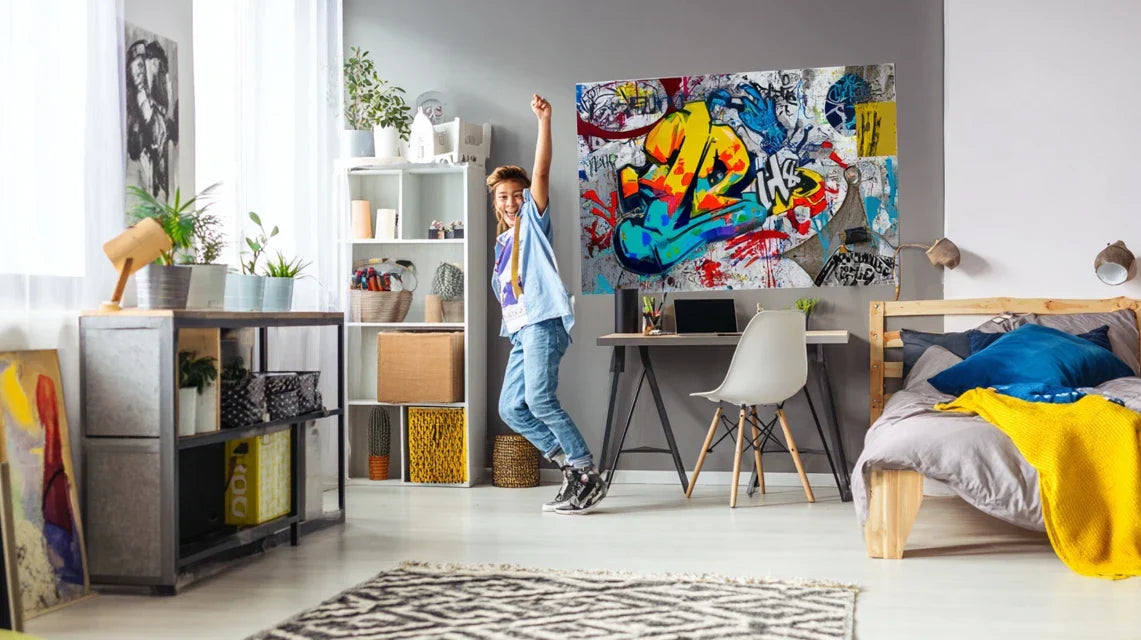
Contrary to popular belief, bright colors do not develop a child's intelligence - they simply activate their sympathetic nervous system, the one for stress and vigilance. True cognitive stimulation comes from the quality of interactions and activities, not the chromatic intensity of the walls.
It’s like playing rock music during a massage: even with the best intentions, the result will be exactly the opposite of the desired effect. The brain cannot distinguish between "positive" overstimulation and negative stimulation.
Result: your child accumulates visual tension throughout the day which explodes at bedtime. By changing their wall environment, you are finally offering them a real emotional decompression chamber.
🔍 Quick test: Look at your child’s room and count how many different colors your eyes capture in 10 seconds. More than 6-7 distinct colors? The environment is probably too stimulating to promote natural soothing.
The trap of overly complex details
Overloaded patterns or action scenes in paintings create what’s called “cognitive fatigue.” Your child's brain subconsciously tries to decode each element, maintaining a mental activity level incompatible with relaxation.
Think about the difference between looking at a mountain landscape at sunset and trying to solve a complex puzzle. One naturally soothes, the other solicits and keeps attention awake.
Your child is therefore living a permanent contradiction: their body needs rest, but their visual environment sends them signals of constant stimulation.
The little-known impact of lighting on wall art
Might even a calming artwork become unsettling since the lighting creates reflections or moving shadows. The combination of light and color determines the final atmosphere far more than the choice of artwork alone.
You can easily check this: observe the same artwork under different lighting conditions during the day. Some hours will make it soft and reassuring, while others will create a tense atmosphere.
This interaction explains why some children are complaining that "the drawings move" or "are scary" in the evening, while everything is fine during the day.
The 3 signals of an unsuitable wall environment:
- Child avoids looking at certain walls: Their instinct tells them that these visuals disrupt their well-being, just as we instinctively avoid bright lights
- Asks to sleep with their back to the main wall: This position reveals unconscious discomfort with visual stimuli; their body naturally seeks to protect itself
- Their drawings reproduce the agitation of their room: A child exposed to an overstimulating environment will tend to reproduce this chaotic energy in their creations
The trigger factor: day-night transition
The critical moment occurs when natural lighting decreases and artificial lighting takes over. An unsuitable artwork then becomes a disruptive element that prevents the natural secretion of melatonin. It's a domino effect: no visual soothing = no neurological preparation for sleep = restless night for the whole family.
The 20h rule: If an artwork is pleasant to look at during the day but becomes "strange" or "worrying" in the evening under artificial lighting, it is not suitable for a bedroom. Always test your decor choices under nighttime lighting.
| ❌ Overstimulating environment | ✅ Soothing environment | 💡 Why it works | 🎯 Observable benefit |
|---|---|---|---|
| More than 7 bright colors per wall | Maximum 3-4 soft colors | Less information to process for the brain | Faster falling asleep (10-15 min) |
| Complex patterns or action scenes | Simple and flowing shapes | No cognitive decoding required | Decreased nightmares |
| Aggressive contrasts | Smooth transitions between shades | Activation of the parasympathetic nervous system | Deeper and more restorative sleep |
| Lighting creating reflections | Diffuse and stable light | Consistent ambiance day/night | Fewer nighttime awakenings |
The gentle method: transform the bedroom into a soothing cocoon
Rest assured: creating a visually soothing environment does not require a large budget or a complete upheaval. The transformation happens in stages, like planting a garden: first you prepare the ground (choice of base colors), then you add soothing elements (suitable paintings), and finally you adjust the atmosphere (lighting and layout). In three weeks, you will see a noticeable improvement in your child's nighttime behavior.
🌱 Overview of the transformation: We will first identify the colors that naturally soothe your child, then choose paintings with simple and reassuring patterns, and finally optimize their placement to create a gentle visual flow. Each step adds an extra level of serenity, until you achieve a room that automatically becomes synonymous with relaxation.
Step 1: Identify Your Child's Soothing Color Palette
Starting with colors is essential because they form the emotional foundation of the environment. Like the foundations of a house, if this base isn’t solid, even the most beautiful paintings won’t be able to create the desired soothing effect. This step will already give you a noticeable feeling of calm for your child.
What you need to test colors
- Gentle color chart: Get a fan of pastel shades (sky blue, aquamarine, powder pink, warm beige, light mauve). Avoid classic paint charts that are too saturated - opt for manufacturers' "cocooning" ranges. These colors naturally activate the production of serotonin, the well-being hormone. Soft fabric samples: Velvet, organic cotton, natural linen in the selected shades. These materials allow you to see how colors react to different textures and lighting. The tactile quality unconsciously influences our visual perception and reinforces the soothing effect. Soft reading lamp: Warm lighting (2700K maximum) to test the colors under real evening conditions. Cool lighting transforms even soothing colors into anxiety-inducing shades - this is why this test is essential.
Now, let's move on to observing your child
How to proceed
Instinctive reaction test: Present the samples to your child one by one, observing their micro-expressions and posture. Note which colors they naturally reach for, and which ones make them recoil or frown. Their body intuitively tells you what soothes them.
⏱️ Time: 15 minutes | ✅ Successful when: You have identified 2-3 colors that visibly relax their shoulders | ⚠️ Attention: Do not ask direct questions like "which one do you prefer?" - just observe their spontaneous reactions
Evening test: Place the selected samples in their bedroom an hour before bedtime, under usual nighttime lighting. Observe whether these colors retain their soothing effect or become dull and unsettling. A truly suitable color remains soft even in dim light.
⏱️ Time: 20 minutes | ✅ Successful when: Colors retain their warmth under artificial lighting | ⚠️ Attention: A color that becomes grayish in the evening will create a depressing atmosphere - eliminate it even if it is pleasing during the day
Emotional association test: Ask your child to tell you what their favorite colors evoke: "What does this color make you think of?" The answers reveal positive (clouds, cuddles, softness) or negative associations that must be avoided.
⏱️ Time: 10 minutes | ✅ Successful when: Associations are linked to comfort and security | ⚠️ Attention: If a color evokes something worrying (storm, illness), abandon it even if it seems technically soothing
✓ Validation of step 1: You must have identified 2-3 colors that visibly relax your child, remain warm in the evening, and evoke reassuring images. If any of these conditions are missing, repeat the tests - this base condition determines everything else. Congratulations if it's good: you have just decoded your child's unique "color language"!
OUR RECOMMENDED PRODUCTS
Step 2: Choosing soothing patterns and themes
Now that you know the color palette that relaxes your child, you will select visuals telling a reassuring story. This step is more intuitive and rewarding, as you will immediately see the effect on your child's expression. The goal: create a collection of images that become like old familiar and protective friends.
Elements to look for in patterns
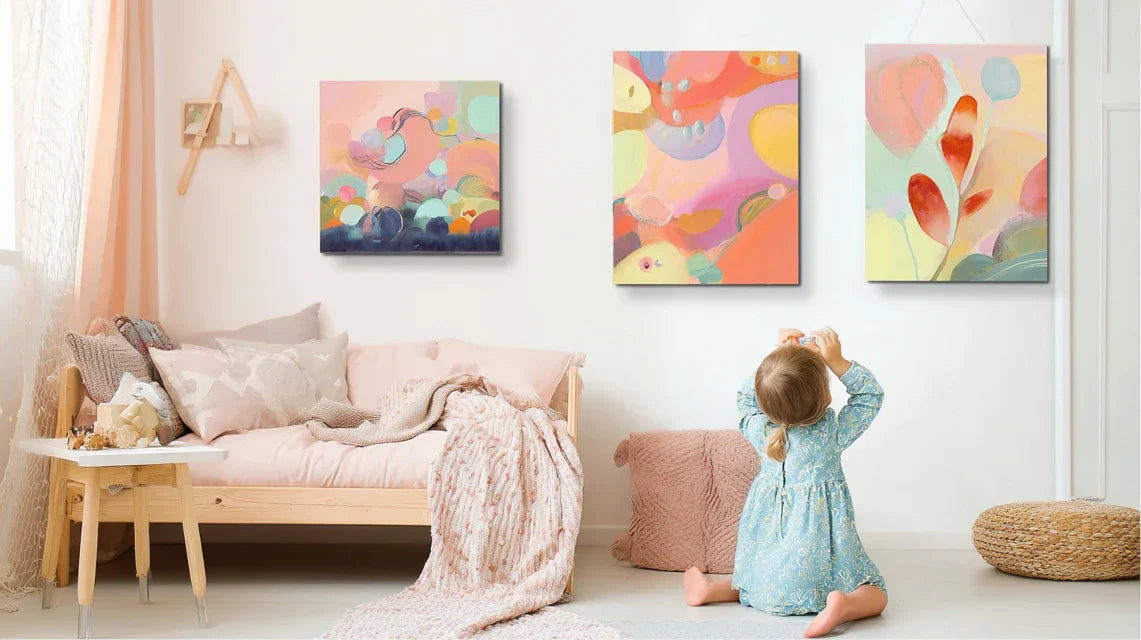
- Rounded and flowing shapes: Circles, waves, clouds, bubbles, soft spirals. These shapes mimic the natural movements of the body at rest (breathing, slow heartbeats) and unconsciously activate relaxation mechanisms. Absolutely avoid sharp angles and rigid geometric shapes that keep the mind alert. Soothing nature scenes: Sunsets, flower meadows, sleeping animals, trees with supple branches, starry skies. These images reconnect the child to natural rhythms and subconsciously remind them of primal security. Prefer stylized representations over photo-realistic ones. Characters in resting situations: Children reading, animals sleeping, meditative figures, cuddling scenes. These images subtly "give permission" to relax and normalize a state of calm. The child naturally identifies with the peaceful characters.
Method for selecting artworks
"Deep breath" test: Show each visual to your child and observe whether their breathing naturally slows down. A truly soothing artwork triggers immediate physical relaxation - their shoulders drop, their jaw relaxes. This is the infallible sign that the image has a positive effect on their nervous system.
⏱️ Time: 5 minutes per artwork | ✅ Successful when: Slower breathing and relaxed posture | ⚠️ Attention: If the child squints or steps back, even imperceptibly, the image contains a hidden stressful element invisible to the adult
Narrative coherence test: Check that the chosen artworks together tell a harmonious story. For example: a rabbit preparing to sleep + a smiling moon + benevolent stars = a coherent story of transitioning into the night. Contradictory elements create disturbing emotional confusion.
⏱️ Time: 15 minutes | ✅ Successful when: The visuals naturally flow together in the mind | ⚠️ Attention: Avoid mixing different universes (space + forest + ocean) that disperse attention instead of channeling it
This final step transforms your selection of artworks into a true therapeutic environment. You now master the "ingredients" perfect for your child - colors and patterns adapted. Remaing to orchestrate them in space to create a visual flow that naturally guides towards relaxation. This is where the magic truly happens.
Strategic placement for soothing
Gentle transition zone: Place the main artwork facing the bed, at eye level of the lying child. This position creates a "soothing visual anchor" where the gaze can naturally settle without effort. The image then becomes the last visual stimulus before falling asleep, programming the brain for relaxation.
⏱️ Time: 20 minutes | ✅ Successful when: The child can comfortably see the image without turning their head | ⚠️ Attention: Placement that is too high forces you to look up, creating tension in the neck incompatible with falling asleep
Indirect and adjustable lighting: Install lighting that caresses the artwork without creating direct reflections. The ideal: a soft light coming from the side that reveals the colors without dazzling. Test with a simple floor lamp directed at the wall next to the artwork - the effect should be like a sophisticated candle glow.
⏱️ Time: 30 minutes | ✅ Successful when: Colors remain warm without harsh shadows | ⚠️ Attention: Direct lighting can turn even the softest artworks into an aggressive element - always prefer reflected light
The rule of progression towards rest: You know the arrangement works when your child naturally transitions from agitation to contemplation of the artworks, then to calm, in less than 15 minutes. If this transition takes longer, adjust the lighting or reposition the elements.
You now master the fundamentals of soothing wall art. But knowing expert subtleties will allow you to further refine the effect on your child and adapt the environment to their evolution. These details make the difference between a satisfactory result and a true transformation.
🎨 Specialized decorator's tip: Create an "emotional gradient" by arranging artworks from the most dynamic (near the door) to the most soothing (near the bed). This subtle progression guides the child from the energy of the day to the tranquility of the night, like a visual path to rest. The effect is striking as it naturally accompanies the necessary psychological transition.
🤔 A thoughtful parent's question
"My 4 year old often changes their mind about what they like... How can I be sure that the chosen artworks will appeal to them durably?"
This is a very understandable concern, and it reveals your excellent knowledge of your child! The key is not to guess their future tastes, but to choose visuals timeless and soothing enough to transcend fleeting trends. A gentle sunset or benevolent clouds speak to the human soul regardless of age. Moreover, the soothing effect of a well-chosen artwork strengthens over time - it becomes associated with moments of relaxation and gains emotional power. Start with one or two "test" artworks in their current favorite colors. If you see a noticeable improvement in their sleep, you will know that you are on the right track for the following ones.
💡 Practical tip: Temporarily print some visuals on photo paper and fix them with adhesive putty. Observe which ones still attract their gaze after a week - these are those that have a real soothing impact, beyond the novelty effect.
The pitfalls to absolutely avoid (even with the best intentions)
Before finalizing your choices, let's take a moment to identify the most common mistakes. These traps are tempting because they come from excellent intentions, but they can negate all your efforts. Better to know them now than to have to start over later.
- ⚠️ Wanting to absolutely include your favorite heroes: It's tempting to choose paintings with your adored characters, but these images activate excitement and the desire to play rather than soothing. The brain associates these characters with action and entertainment. Reserve them for the playroom and keep the bedroom emotionally neutral. It’s normal to feel this urge - all parents go through it!
- ⚠️ Multiplying paintings to "make it prettier": More than 3 paintings per wall create a stimulating gallery instead of a soothing cocoon. The brain can no longer settle down and flits from one image to another. It's better to have one perfectly chosen painting than several that compete with each other. Sobriety is your ally for relaxation.
- ⚠️ Choosing according to your own adult tastes: Your personal aesthetic may be very different from what soothes your child. A painting that you find sophisticated may seem cold or incomprehensible to them. Always get their emotional validation of your choices, even if they seem perfect to you rationally.
- ⚠️ Neglecting harmony with existing furniture: A soothing painting can become disturbing if it completely clashes with the overall atmosphere. The eye immediately picks up these dissonances which create a subliminal tension. Make sure there is at least one colored bridge between the painting and an element of the furniture.
- ⚠️ Installing paintings too quickly without testing: The definitive placement of a painting can totally change its effect. A position that's too high, too low, or poorly lit transforms a soothing visual into a neutral or even annoying element. Take the time to test several positions before drilling permanently.
🔍 Verification checklist before installation: Does your child naturally smile when they see the painting? Can they look at it comfortably from their bed? Do the colors remain soft under evening lighting? Are there no more than 3 visual elements per wall? These 4 points guarantee a successful choice. Warning sign: if your child avoids looking at the painting or seems tense after installation, change the location or visual immediately.
🎁 Special readers offer
Because you took the time to inform yourself, enjoy 10% discount on your first order:
⏰ Valid 72h after reading • Applicable to all our products
❓ Your most frequently asked questions about soothing paintings
Most parents observe a noticeable improvement within the first week, with peak effectiveness around the third week. The initial signs: the child spends more time calmly contemplating their surroundings and asks less for your presence to fall asleep. To accelerate the process, involve your child in the selection and explain that these images are there to help them sleep well - their conscious adherence multiplies the soothing effect.