The first time I had to authenticate a mural for a Singaporean collector, I almost made a fatal mistake. What appeared to be a traditional Asian dragon revealed, under my spectral analyses, a 19th-century Western reinterpretation. This confusion cost me two weeks of verification and taught me a valuable lesson: dragons Chinese and European embody two radically opposed symbolic universes, and their mural representations never lie.
Distinguishing a Chinese dragon from a European dragon in wall art allows you to: understand the deep symbolism of your decor, avoid aesthetic misinterpretations in your compositions, and master the energetic impact of these mythical creatures on your space. Many enthusiasts confuse these two iconographies and end up with pieces that tell contradictory stories. Rest assured, a few morphological and symbolic clues are enough to differentiate these legendary creatures. I am going to pass on to you the keys of analysis that I have been using for fifteen years to authenticate and contextualize these extraordinary works.
The serpentine morphology versus the reptilian silhouette
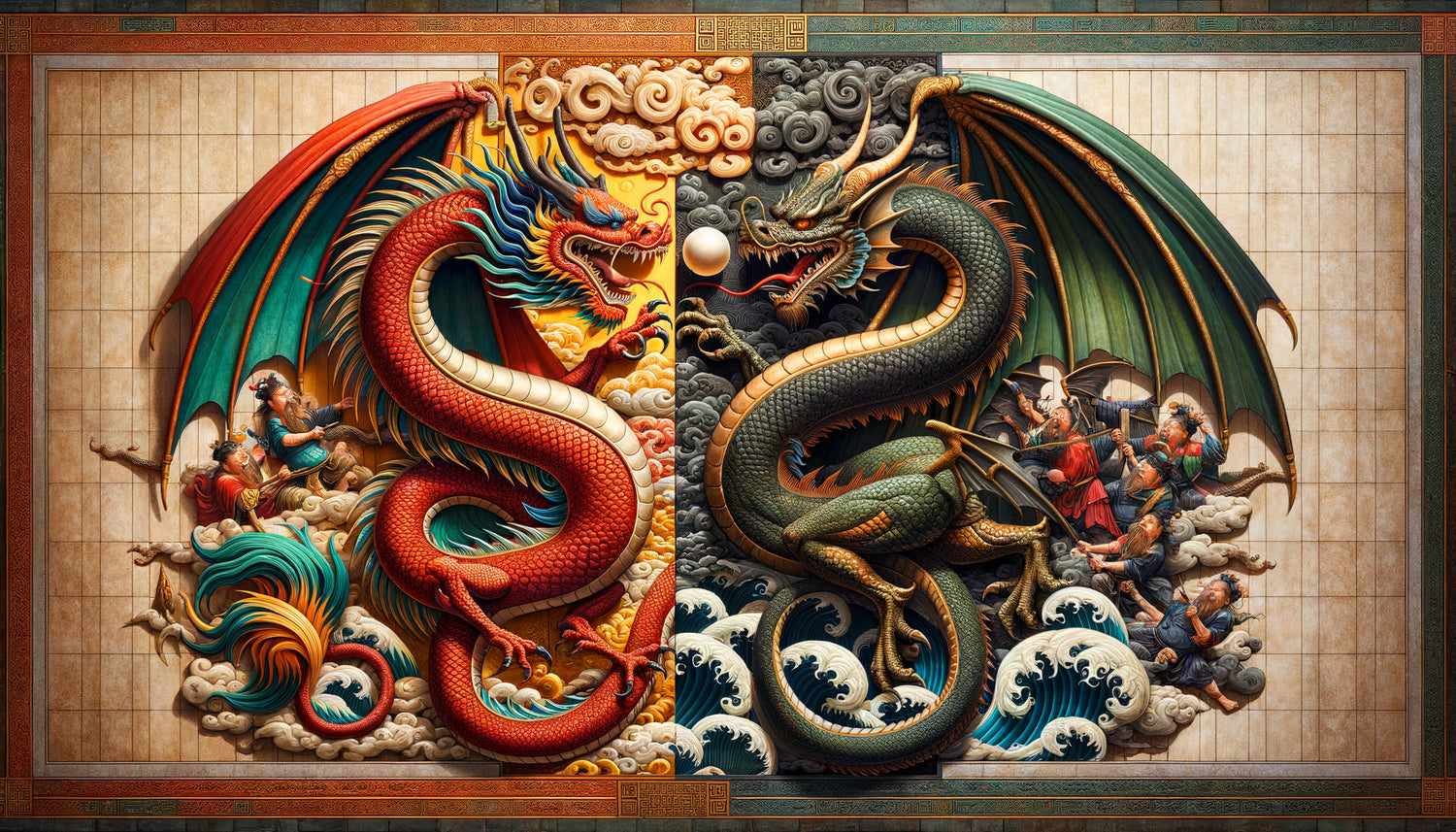
The Chinese dragon is immediately recognizable by its infinitely long and undulating body, evoking the perpetual movement of a celestial river. In traditional wall art, this creature often stretches for several meters, composed of articulated segments that create harmonious curves. Its head is generally that of a camel according to tradition, with deer antlers, rabbit eyes, and a beard of wisdom floating around its jaw. The legs are short, clawed, often numbering four or five depending on the imperial rank represented.
The European dragon, conversely, adopts a more massive and compact anatomy. Its body resembles that of a giant lizard or crocodile, with powerful and visible musculature. Membranous wings, absent in its Asian cousin, constitute its major distinguishing feature. These massive appendages, often chiropteran, occupy a central place in the wall composition. The head is resolutely reptilian, with an elongated snout, prominent fangs, and generally an aggressive expression.
The legs tell a different story
I always pay particular attention to the limbs in my expertise. A Chinese dragon has short paws ending in powerful talons, often depicted holding a sacred pearl or emerging from clouds. They seem almost decorative as the serpentine body dominates the composition. The European dragon, on the other hand, relies on muscular and clawed legs that ground it to the earth or its treasure. These limbs bear the weight of the creature and convey an impression of brute force and earthly anchorage.
The aquatic element versus the fiery element
In Chinese wall art iconography, the dragon consistently evolves within or above water. Stylized clouds, frothy waves, and shimmering pearls compose its graphic universe. This creature embodies benevolent hydraulic forces: fertilizing rain, nourishing rivers, cosmic balance. Frescoes depict it emerging from the depths or riding celestial vapors, always in an upward movement, a symbol of positive transformation.
The European dragon, by excellence a chthonic creature, breathes fire and jealously guards caves. Medieval and Renaissance wall art portrays it in rocky, dark, volcanic environments. Flames burst from its mouth, smoke blackens the stones around it. When it flies, it is to attack, never to bring prosperity. This elemental opposition is immediately apparent in the color palette and accompanying motifs of a wall mural.

When colors reveal cultural origin
After fifteen years of expertise, I can often identify the origin of a wall dragon solely from its color range. The Chinese dragon displays imperial colors: brilliant gold, vermilion red, azure blue, jade green. These saturated and luminous hues reflect its celestial and benevolent nature. Golden yellow remains the preserve of five-clawed dragons, reserved for the emperor, while four-clawed dragons can adopt more varied greens and blues.
The European dragon drapes itself in dark and earthy tones: sickly scale green, rust brown, charcoal black, blood red. Even in medieval manuscript illuminations where precious pigments abound, these creatures retain a threatening palette. Medieval illuminators used gold for the halos of saints, rarely to glorify the vanquished dragon. This chromatic opposition is never insignificant in ancient wall art.
Accompanying motifs as contextual clues
A Chinese dragon in wall art is systematically surrounded by propitious symbols: phoenix (perfect union), peonies (wealth), stylized clouds, undulating currents, flaming pearls. These elements create a harmonious universe where the creature integrates naturally. The European dragon, on the other hand, is embedded in a conflict narrative: armored knights, chained princesses, villages ablaze, heaps of gold soaked in blood. Even isolated, it carries this belligerent narrative burden.
Opposite symbolism: protector versus adversary
This fundamental distinction explains why confusing these two iconographies in the same space creates an energetic dissonance. The Chinese dragon embodies benevolent imperial power, wisdom, prosperity, protection against harmful forces. In feng shui, it directs positive energy flows and symbolizes male yang accomplishment. Placed to the east of a room, it activates the health and family sector.
The European dragon represents chaos to be overcome, the initiatory ordeal, the hostile guardian. In medieval Christian imagination, it even embodies the demon. This creature tests the hero, guards cursed treasures, and terrorizes populations. No positive connotation is traditionally associated with it before 19th-century romantic reinterpretations. Integrating this iconography into an interior therefore requires a fine understanding of what you want to express.

Contemporary hybridizations that blur the lines
My authentication work has become more complex with the emergence of urban art and fusion creations. Since the 2000s, many mural artists have deliberately mixed codes. A Chinese dragon with a serpentine body can sport European wings, or vice versa. These contemporary hybridizations create fascinating works but require an informed reading.
When I evaluate these modern pieces, I always examine which element symbolically dominates. A winged dragon surrounded by clouds and holding a pearl remains fundamentally Chinese in its message. Conversely, a serpentine dragon breathing fire on a ruined city borrows the European narrative despite its Asian morphology. The artist's intention and the narrative context take precedence over pure anatomy in these hybrid creations.
The technical clues that don't deceive
Beyond style, some technical details reveal cultural origin. Chinese dragons in traditional mural art are painted or sculpted according to strict canons: nine resemblances with other animals, a specific number of scales (81 or 117 depending on the sources), codified position of the pearl. European dragons benefit from greater morphological freedom, each artist reinventing them according to their imagination, hence their extraordinary regional diversity.
Compose your decoration with symbolic awareness
With this knowledge, you can now orchestrate your spaces with intention. A Chinese dragon in an office activates the energy of professional success and benevolent authority. In a meditation room or living room, it promotes harmony and spiritual protection. However, avoid placing it in the bedroom where its overly powerful yang energy disrupts rest.
A European dragon is suitable for creative spaces where you want to evoke heroic quests, self-improvement, and the achievement of ambitious goals. A private gym, an artist's studio, a gaming space can accommodate this combative iconography. Its visual power also makes it a remarkable conversation starter in a hallway or entrance, provided that you fully embrace its symbolic charge.
Transform your walls into mastered mythological narratives
Discover our exclusive collection of animal paintings that celebrate the symbolic power of legendary creatures with aesthetic and cultural awareness.
Distinguishing a Chinese dragon from a European dragon in wall art transcends simple visual recognition. It's accessing two mythological universes, understanding how civilizations have projected their aspirations and fears onto these extraordinary creatures. You now possess the keys to read these works, consciously integrate them into your decor, and tell your guests the fascinating stories they carry. Start by observing the dragons that already surround you: in Asian restaurants, museums, urban murals. Your gaze will never be the same, and each creature will reveal its cultural origin in seconds. This skill will transform your relationship with wall art and profoundly enrich your future decorative choices.