Prehistoric megafauna fascinates us today as it fascinated our ancestors. These giants of the past, mammoths with imposing tusks, tigers with terrifying teeth and fur-armored rhinoceroses, come back to life under the brush of artists thanks to modern paleontological reconstruction.
Imagine a world where creatures weighing 6 tons dominated the frozen steppes. That was only 11,000 years ago! Paleoartists tell us this extraordinary time by bringing these sleeping fossils to life. This fascination crosses centuries and continues to inspire artists, scientists and the general public.
When art meets prehistoric science
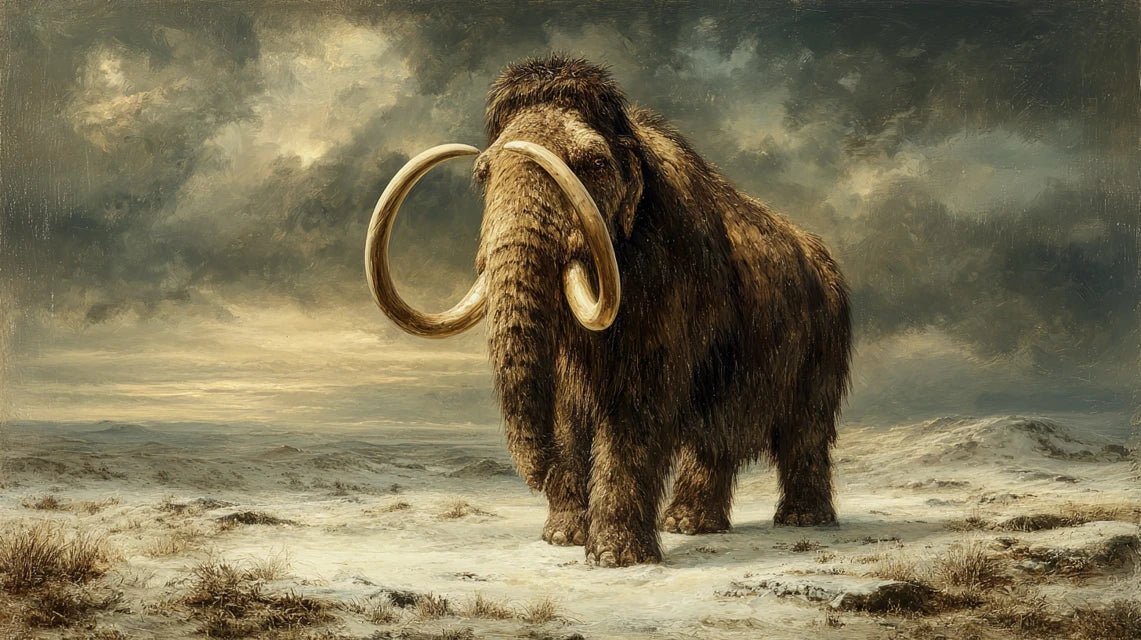
Paleontological art transforms each fossil into a living history thanks to modern scientific illustration. Take the woolly mammoth: only its bones have come down to us, but artists give it back its thick fur, its mischievous little eyes and its majestic gait. How do they do it? They study today's elephants, analyze each fossil bone and imagine the complete creature.
Charles R. Knight, a legend of paleoart, was already painting these scenes at the beginning of the 20th century. His mammoths seemed so real that you could almost hear their roars! His works have influenced generations of artists and shaped our collective vision of prehistory. Today, modern animal paintings perpetuate this remarkable artistic tradition.
These reconstructions follow precise rules established by the scientific community. The artist must respect anatomy, the environment of the time and the latest paleontological discoveries. But he can give free rein to his imagination for colors, attitudes and emotions. This creative freedom brings extinct creatures to life.
Collaboration between scientists and artists proves essential to create authentic works. Paleontologists bring their anatomical expertise, while artists master visual representation techniques.
Symbols of power in a lost world
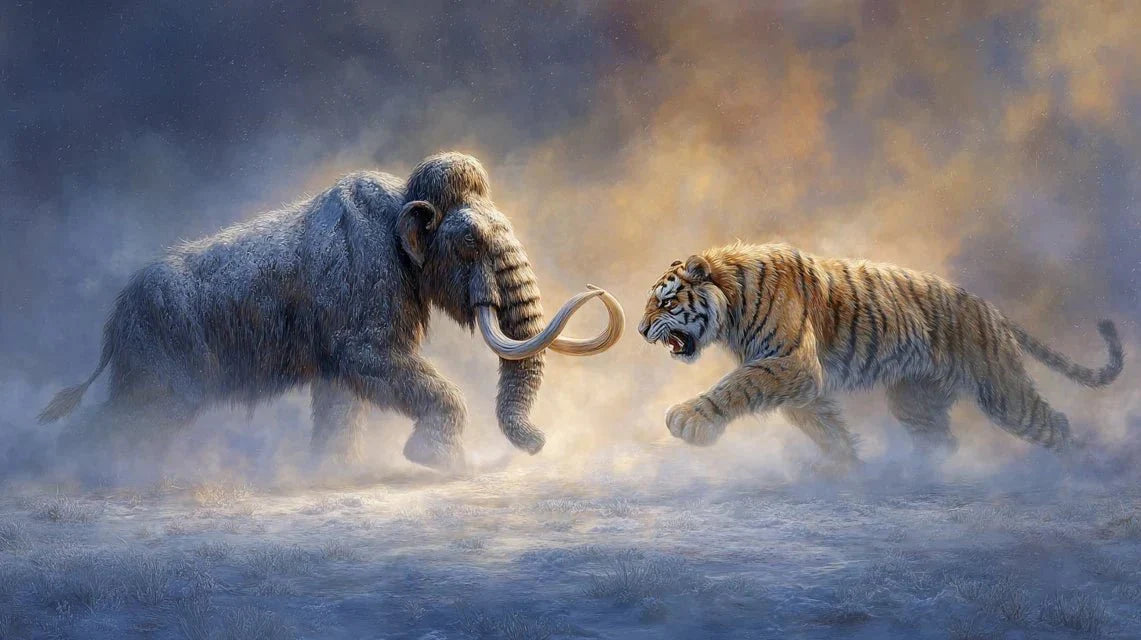
The symbolism of these creatures goes beyond their mere physical appearance. The Smilodon, this feline with 18-centimeter canines, embodies pure predation in all its splendor. When an artist paints it leaping on its prey, he reminds us of a disturbing truth: primitive man was not the king of nature but a simple survivor.
This era refers us to our own vulnerability facing the quaternary extinction. 80% of North American megafauna disappeared when our ancestors colonized the continent (Source: Society of Vertebrate Paleontology). Troubling coincidence? Scientists are still debating this dramatic synchronization.
Mammoths, with their 3-meter tusks (Source: National Museum of Natural History), symbolize heroic resistance to climate change. They survived several major glaciations before finally going extinct. Their story strangely resonates with our current environmental challenges and our questions about the future.
The Glyptodon, a veritable prehistoric tank with its bony carapace, represents extreme adaptation to difficult conditions. These extraordinary creatures teach us the importance of adaptation in species survival.
The art of bringing giants back to life
How do you give an authentic soul to a skeleton thousands of years old? Paleoartists master specific scientific illustration techniques to faithfully reconstruct the paleoenvironment of these majestic creatures. They skillfully play with contrasts in light to create narrative suspense. A simple shadow can transform a peaceful herbivore into a mysterious and imposing creature.
Staging is enormously important in the final emotional impact. Representing a solitary mammoth in the snow evokes poignant solitude and the tragic end of an era gone by. Showing it surrounded by its family herd tells the moving story of solidarity in the face of climatic adversity.
The extraordinary discoveries of La Brea Tar Pits have inspired thousands of stunning works of art. These fossils trapped in tar reveal dramatic scenes of predation frozen for eternity. Contemporary artists are constantly inspired by them to reconstruct these authentic prehistoric dramas.
Modern techniques used by paleoartists include several complementary approaches:
- Comparative anatomy: study of related current species to deduce body structure
- Biomechanical analysis: reconstruction of movements and postures from fossil joints
- Paleoenvironment: research on the climates and ecosystems of the time
- 3D modeling: creation of virtual mockups to test different hypotheses
- Scientific colorimetry: deduction of probable colors thanks to fossilized traces
The modern impact of these ancient creatures
Today, megafauna massively invades our popular culture and effectively raises awareness of prehistoric biodiversity. Spectacular films, scientific documentaries, immersive video games: these iconic creatures are omnipresent. Why such global success? They connect us deeply to our distant origins while entertaining us.
New technologies are completely revolutionizing contemporary paleontological art. Ultra-realistic 3D modeling allows these disappeared animals to be virtually "resurrected." Artificial intelligence even helps reconstruct their probable colors by meticulously analyzing the fossilized structure of their feathers or fur.
This rapid technological evolution significantly amplifies their emotional symbolic charge. Seeing a mammoth "alive" in a 4K ultra-high definition documentary creates a striking emotion that a simple traditional drawing did not provide. Art gets dangerously close to reality without ever fully reaching it.
From yesterday to today: evolving symbolism
Henry De la Beche was already masterfully painting marine megafauna as early as 1830. His terrifying creatures seemed to emerge directly from a gripping romantic nightmare! The Victorian era passionately loved the spectacular and frightening in the artistic representation of reconstructed Pleistocene ecosystems.
The 20th century brought more methodological scientific rigor. Visionary artists like Zdeněk Burian obsessively sought perfect anatomical accuracy. Their animals looked remarkably more like the presumed reality of extinct creatures.
Our contemporary era profoundly transforms this established symbolism. Megafauna is gradually becoming a universal symbol of mass extinctions and effectively raises awareness about the urgent protection of threatened biodiversity. These disappeared creatures constantly remind us of the dramatic fragility of life on our planet.
Artistic evolution continues inexorably. Tomorrow, perhaps we will see these legendary animals miraculously "revive" thanks to revolutionary advances in modern genetics? In the meantime, they continue tirelessly to make us dream through eternal art.
FAQ: The symbolism of megafauna in paleontological art
What exactly is prehistoric megafauna?
The megafauna refers to the entire set of large animals weighing more than 44 kg that lived during the Pleistocene, from 2.6 million to 11,700 years ago. It includes mammoths, saber-toothed tigers, woolly rhinoceroses, giant sloths and other now extinct giants. These creatures dominated Pleistocene ecosystems before the great Quaternary extinction.
How do paleoartists recreate these disappeared animals?
Artists rigorously combine scientific data and creative interpretation to reconstruct the appearance and behaviors of megafauna. They rely on comparative anatomy, recent fossil discoveries, and modern scientific illustration to create realistic works charged with emotional symbolism.
Why does megafauna fascinate so much in contemporary art?
The megafauna embodies the raw power of a nature that has now disappeared forever. Its symbolism evokes a prehistoric world where primitive humanity was vulnerable, creating a fascination mixed with respect and nostalgia for this bygone era. This paleontological reconstruction also reminds us of our impact on current mass extinctions.