Imagine stepping into the depths where total darkness reigns. Suddenly, points of light dance around you like underwater stars. Painting the bioluminescence of marine animals is capturing this natural magic on canvas.
This living light has fascinated for centuries. In the ocean, 76% of creatures (Source: MBARI Monterey Bay Aquarium Research Institute) produce their own lighting. A phenomenon that art can now reproduce thanks to modern techniques of marine phosphorescence.
Understanding bioluminescence to better paint it
Nature offers us a unique spectacle. Luciferin meets luciferase and instantly produces this particular cold light. No heat, just a pure glow in the blue-green tones that cross the water with remarkable efficiency.
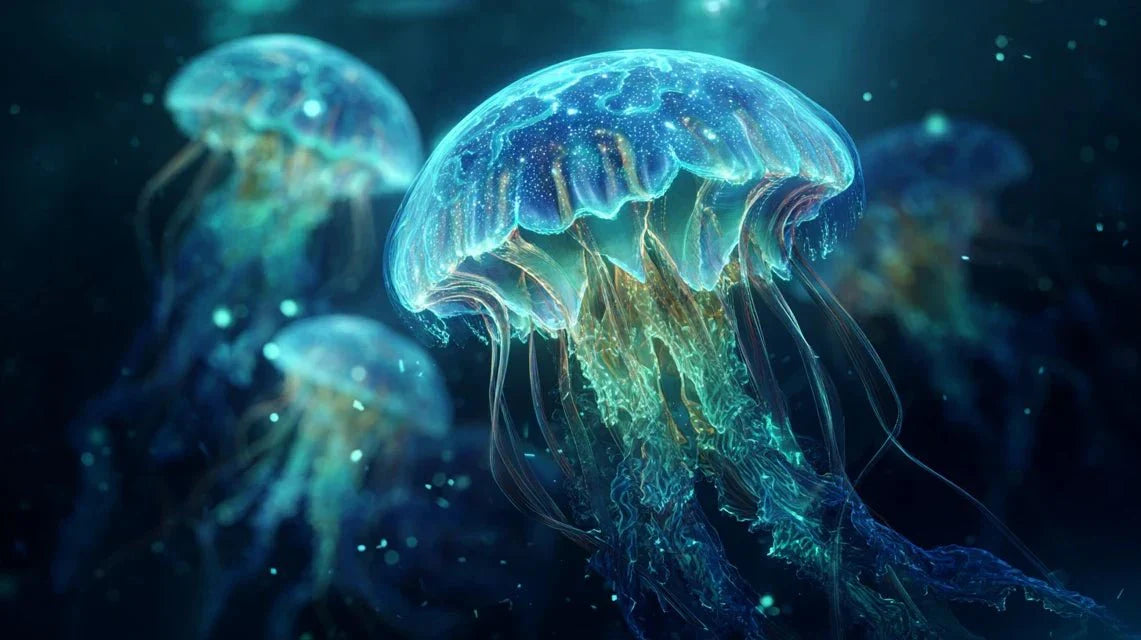
Each species has developed its own "style" of light. The jellyfish Aequorea victoria pulses an emerald green thanks to its famous GFP protein. The anglerfish waves its lure like a patient fisherman. These unique patterns directly inspire brushstrokes and reveal the secrets of sea fireflies.
Mastering pictorial techniques of marine glow
Reproducing this glow requires a methodical approach. The glazing becomes your best ally. This ancestral technique superimposes transparent colored veils, creating this luminous depth impossible to achieve otherwise.
Start with a deep black background. Diluted watercolor allows these first diffuse halos that surround your creatures. Then acrylic takes over for areas of maximum intensity. Patience remains essential: each layer must dry perfectly before the next.
The phosphorescent paint brings the final magical touch. These strontium aluminate pigments store light from the day to release it in the dark for more than 10 hours, creating a true artistic biomimicry.
Chromatic palette of the depths
The colors of the abysses follow strict rules. 90% of emissions (Source: Institute of Marine Biology of Louvain) are concentrated in cold blues and greens. This apparent restriction hides an infinite wealth of nuances analyzed by colorimetric spectroscopy:
-
Electric cyan of stressed
- Jade green of fluorescent proteins
- Sapphire blue of ostracode microcrustaceans
- Nacreous white of giant siphonophores
These shades blend according to exponential gradients. The intensity drops abruptly from the emission center, creating these characteristic halos. Your brush must reproduce this natural mathematics of abyssal luminance.
Explore our collection of marine animal paintings to fuel your bioluminescent inspiration.
Equipment adapted for luminous effects
The material conditions the final result. Invest in synthetic brushes that resist the solvents of specialized paints. Natural bristles degrade when exposed to phosphorescent mediums.
Professional paints are available according to your needs. Acrylic is suitable for beginners, epoxy for durable works, and polyurethane for outdoor supports. Each formulation offers a different intensity and duration of phosphorescence.
Your supports deserve special attention. Black papers or canvases with dark primer maximize the contrast effect. This fundamental opposition amplifies the luminous perception of your marine creatures.
Professional application methods
Application follows a rigorous protocol. Your base coat must be perfectly opaque and uniform. This foundation determines the final quality of the light effect.
Progressive layering builds intensity in stages. Each colored glaze optically transforms the previous ones without physically mixing them. This alchemy produces colors impossible to obtain on a palette.
Feathering with a fan brush reproduces the natural diffusion of light in water. Your circular movements start from the luminous center towards the outside, imitating the physical propagation of photons and revealing the beauty of luminous photophores.
Finalization and lighting optimization
The final phase reveals the potential of your work. Exposure lighting charges your phosphorescent pigments. Exposure to natural light for 30 minutes guarantees several hours of effect in the dark.
Respect the actual anatomy of photophores. These luminous organs are positioned precisely according to each species. This scientific accuracy reinforces the visual impact and artistic credibility.
Intensity balance between light sources follows a natural hierarchy. The anglerfish's lure dominates its body lighting, while the jellyfish's bell radiates uniformly. These subtleties distinguish an amateur work from a professional creation.
Frequently asked questions
How long does the phosphorescent effect last?
Professional paints maintain their luminescence between 6 and 12 hours depending on their concentration of photoluminescent pigments.
Can different brands of phosphorescent paint be mixed?
Mixing brands is not recommended as the chemical bases may be incompatible and reduce light efficiency.
On which supports can these techniques be applied?
Canvas, paper, wood, metal and plastic accept these specialized paints, provided with appropriate primer.