I spent six months in Ethiopia, climbing cliffsides to reach churches carved into the red rock of Tigray. Each time I entered these sanctuaries suspended between heaven and earth, the same question haunted me before the frescoes with angelic faces: where does this strange familiarity with Eastern Christian art come from that I know so well? These Ethiopian frescoes hold a mystery that art historians have debated for decades: that of an unsuspected artistic dialogue between two Christian worlds separated by thousands of kilometers.
Here's what the rock churches of Tigray reveal: an extraordinary synthesis between local traditions and Eastern Mediterranean influences, a unique testimony to the circulation of artistic knowledge in the first millennium, and perhaps tangible proof of links between Christian communities in Armenia and Ethiopia. If you are looking to understand how sacred art transcends borders, this silent dialogue between Ethiopian and Armenian frescoes offers a fascinating window into the hidden history of Eastern Christianity.
Many admire Ethiopian Christian art without perceiving the cultural strata that compose it. These frescoes seem to spring from nowhere, frozen in their African splendor, as if they had never known external influences. Yet, when one observes the details of iconography, painting techniques, stylistic choices, another story emerges.
Rest assured: recognizing these Armenian influences does not diminish Ethiopian originality. On the contrary, it reveals the sophistication of a culture capable of absorbing, transforming and reinventing distant artistic currents to create something absolutely unique. It is this creative alchemy that I invite you to discover.
The enigma of faces with huge eyes
In the church of Abuna Yemata Guh, perched at 2580 meters above sea level, I photographed a Virgin and Child whose features immediately reminded me of Armenian manuscripts from the 10th century. The faces in the frescoes Ethiopian present this same hieratic frontality, these oversized eyes that gaze into eternity, this thin and elongated nose characteristic of medieval Armenian iconography.
This is not a coincidence. The rock churches of Tigray date mainly from the 4th to the 15th centuries, a period during which the kingdom of Aksum maintained diplomatic and commercial relations with the Byzantine world and its peripheries. Armenia, the first official Christian kingdom as early as 301, then shone as a major center of artistic production.
Ethiopian painters adopted this Armenian convention: enlarging the eyes to express spiritual vision, access to the divine. But where Armenian art remains restrained, the frescoes of Tigray push expressiveness to its paroxysm. The eyes sometimes occupy one third of the face, creating a purely Ethiopian emotional intensity.
The Routes of Faith: How Influences Circulated
How did Armenian influences reach the Ethiopian highlands? The answer lies in the trade and religious routes that connected Jerusalem to the entire Christian Orient. Ethiopian pilgrims regularly traveled to the Holy Land, where they mingled with Armenian, Syriac, and Coptic monks.
Manuscripts traveled, techniques circulated. I discovered in the archives of Debre Damo monastery Gospels whose illuminations present striking similarities to Armenian manuscripts preserved in Yerevan. Even color palette dominated by red ochres and deep blues, same geometric borders, same treatment of draped folds in angular pleats.
The rock-hewn churches served as libraries as much as places of worship. Copyist monks studied these manuscripts from elsewhere, drawing inspiration to decorate their own sanctuaries. This transmission was not a servile copy but an artistic conversation spanning centuries.
The Little-Known Role of Syriac Communities
Between Armenia and Ethiopia were the Syriac communities, veritable cultural bridges. These Eastern Christians speaking Aramaic maintained ties with Aksum as early as the 4th century. Several Ethiopian liturgical traditions bear their mark, and with them, artistic conventions shared with Armenia. Ethiopian frescoes probably owe as much to the Syrians as to the Armenians themselves.

The Language of Colors and Symbols
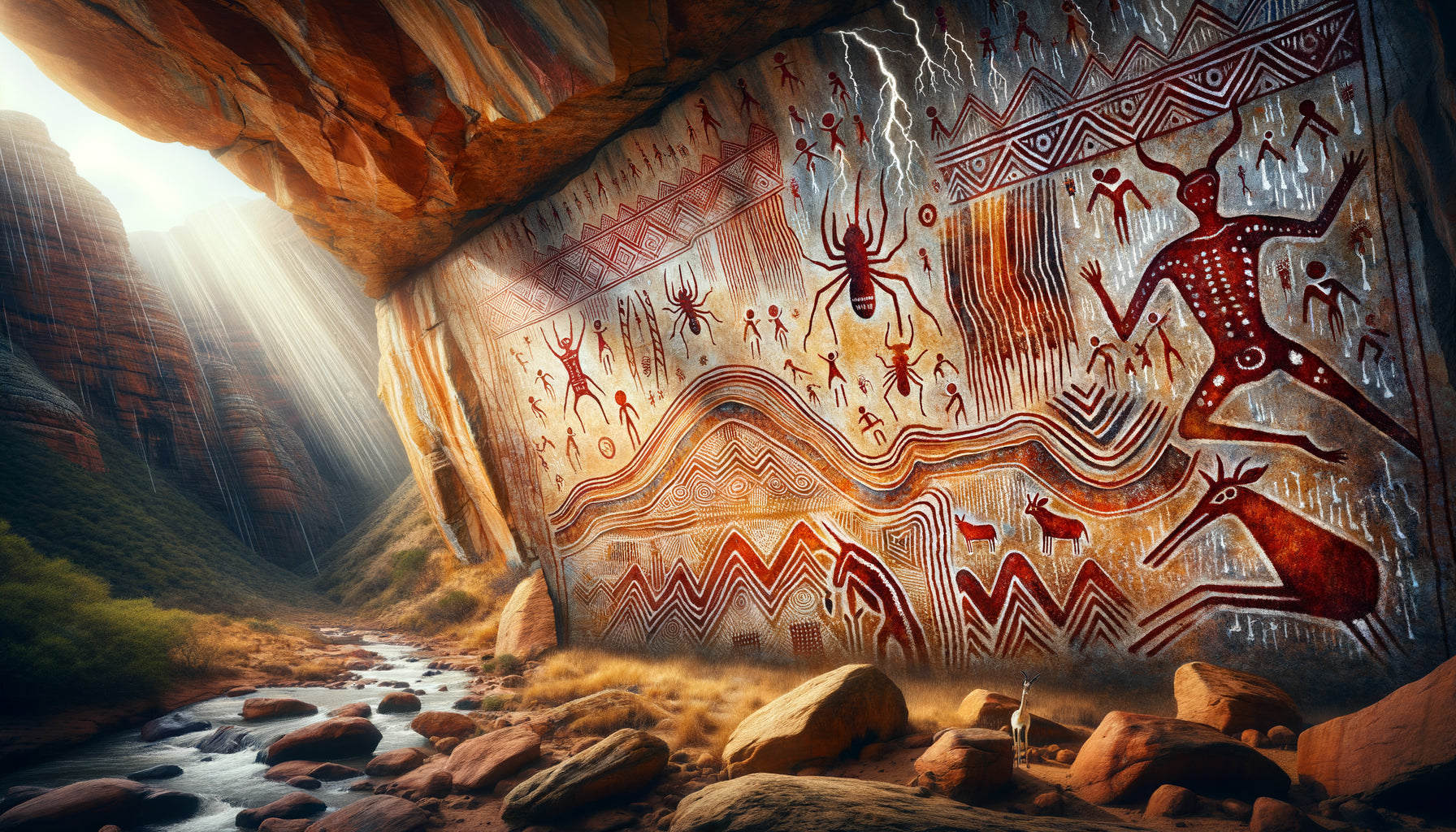
In the church of Maryam Korkor, I spent hours analyzing the color palette of the frescoes. Red dominates, omnipresent as in medieval Armenian art. But it is not just any red: it is that obtained from local ochres mixed according to techniques that Armenian painters already used in the 7th century.
The Armenian influences are also reflected in the symbolic use of colors. Ultramarine blue, rare and precious, reserved for the garments of the Virgin. Pure white for the angels. Gold absent, replaced by bright yellows that create the illusion of divine light – exactly as in Armenian manuscripts where gold was too expensive.
The geometric symbols that border the Tigray frescoes tell a similar story. These cross pattens, these interlacings, these stylized floral motifs are found in Armenian art of the khatchkars, these carved stone steles. Nature abhors a vacuum: this maxim applies as much to Ethiopian as it does to Armenian frescoes, where every centimeter of surface is worked, adorned, spiritualized.
When Ethiopia reinvents what it receives
But be careful: recognizing Armenian influences does not mean that the Tigray rock-hewn churches are copies. On the contrary, they bear witness to an extraordinary creative genius. Ethiopian painters took what spoke to them in Armenian aesthetics and blended it into their own visual universe.
The African saints appear with Ethiopian features, the clothing incorporates traditional local motifs, biblical scenes take place in landscapes that evoke the highlands of Tigray. The architecture itself of the rock-hewn churches has no Armenian equivalent: these sanctuaries entirely carved out of rock are a purely Ethiopian innovation.
I was particularly struck by the treatment of equestrian scenes. Saint George slaying the dragon appears in both traditions, but in the Ethiopian frescoes, the saint often carries local weapons and harnesses. The horse itself resembles the small, sturdy horses of the highlands, not the slender mounts of Byzantine or Armenian iconography.
A synthesis rather than an imitation
What the frescoes of Tigray truly reveal is the ability of a culture to create an original synthesis. Ethiopian artists did not import a ready-made style: they absorbed multiple influences – Armenian, Byzantine, Coptic, Syriac – to forge something radically new. This artistic creolization is what makes Christian Ethiopian art so rich.

What art historians say today
The debate about Armenian influences in Ethiopian art has fascinated researchers since the pioneering work of Jules Leroy in the 1960s. Some, like Emmanuel Fritsch, insist on undeniable iconographic similarities. Others, more cautious, recall that similar artistic conventions can emerge independently in Eastern Christian contexts sharing common roots.
What is certain is that the rock-hewn churches are part of a much broader network of cultural exchanges than we previously imagined. Recent pigment analyses have revealed the use of pictorial techniques first documented in Armenia and Cappadocia. Comparative iconography studies show motifs traveling from monastery to monastery, from manuscript to fresco.
Personally, after comparing hundreds of images, I believe that Ethiopian frescoes indeed bear the imprint of Armenian influences, likely transmitted through several vectors: manuscripts circulating between monasteries, itinerant artists, pilgrims returning from the Holy Land with mental images of the churches they visited. But this influence was exerted on an already rich artistic soil, creating something entirely new.
Why this story matters to us today
You may wonder why these questions of Armenian influences in rock-hewn churches in Ethiopia matter beyond the circle of specialists? Because they tell a universal story: that of cultures nourishing each other without ever dissolving.
At a time when some speak of clashes of civilizations, the Tigray frescoes bear witness to a medieval world where ideas, techniques, and aesthetic visions circulated freely between Christian communities in the East. Armenians, Ethiopians, Syriacs, Copts considered themselves members of the same spiritual family, and their arts dialogued across mountains and deserts.
These frescoes also remind us that cultural purity does not exist. Every great artistic tradition is the result of crossbreeding, borrowings, and reinterpretations. The Ethiopian identity of the rock-hewn churches is not weakened by Armenian influences: it is enriched, complicated, deepened.