


Impressionist Provence Painting
Our Painting Provence Impressionistic collection celebrates the timeless beauty of Southern France. Each artwork captures the essence of Impressionistic Provence landscapes with their lavender fields, perched villages and golden light so characteristic. These artistic creations sublimate Provencal Impressionistic art through vibrant and poetic compositions. Perfect for bringing warmth and authenticity to your interior, these paintings transform your spaces into real windows open onto the Mediterranean and its natural treasures.
 Field of Poppies and Olive Trees Wall Art - Eternal Provence - Provence Edition273,90 €
 Starlit Café Terrace Wall Art - Swirling Provençal Night - Provence Edition273,90 €
 Provençal Monastery - Starry Night Over Cloister - Provence Edition273,90 €
Explore further
In Impressionist Provence Painting



All about Impressionist Provence Painting
- Impressionist Provence Painting Presentation
- Mediterranean Light and Colors
- Provençal Landscape Compositions
- Large-Scale Decorative Integration
An impressionist Provence painting captures the luminous essence of southern France through the spontaneous and vibrant brushwork characteristic of the impressionist movement. These large-scale works translate Mediterranean warmth, undulating lavender fields and perched villages beneath an azure sky with free and expressive pictorial gestures. Unlike academic representations or Provence watercolor paintings with delicate transparencies, the impressionist approach favors generous impasto, brilliant chromatic contrasts and the instantaneous capture of changing light effects in the Provençal landscape. Perfect for adorning a large living room wall, these imposing formats transform your space into an open window onto landscapes immortalized by masters of color and light.
The Impressionist Transcription of Provençal Light
An impressionist Provence painting distinguishes itself by its unique ability to capture the intense luminosity characteristic of Mediterranean climate. Impressionist artists developed a particular technique to translate this exceptional luminosity: juxtaposed touches of pure color that blend optically at a distance, creating chromatic vibrations impossible to achieve through traditional mixing. This approach revolutionizes the representation of burnt ochres of Provençal soil, deep blues of the southern sky and intense violets of lavender fields in full bloom.
Simultaneous contrasts in Mediterranean landscapes
Impressionist technique masterfully exploits simultaneous contrasts specific to Provençal landscapes. Shadows are never rendered in black or neutral gray, but in violet blues, deep mauves or cool greens that create dynamic opposition with brilliant yellows, saturated oranges and luminous pinks of sunlit areas. This chromatic approach truthfully conveys the vibrant atmosphere of Provence where light reverberation creates fascinating optical phenomena. An imposing format significantly amplifies this visual effect, allowing colored touches to fully play their role in overall perception.
How does impressionism capture Provençal golden hours?
Privileged moments of sunrise and sunset in Provence offer light spectacles particularly prized by impressionist aesthetics. During these golden hours, raking light transforms bastide facades into iridescent surfaces, sets cypress trees aflame and magnifies the reliefs of the Alpilles or Luberon massifs. The impressionist Provence painting translates these ephemeral instants through an explosion of orange, pink, mauve and gold touches that overlap and dialogue. The generous application of pictorial matter creates reliefs that physically capture ambient light in your interior, prolonging the initial luminous effect of the depicted scene.
The specific chromatic palette of the Mediterranean South
The color range of an impressionist painting devoted to Provence is built around dominant warm colors: yellow ochre, natural and burnt Siena earth, cadmium yellow, luminous oranges. These tones are punctuated by cool complementaries – cobalt blue, ultramarine blue, cobalt violet – that structure the composition and accentuate the sensation of warmth. This warm-cool opposition characterizes the Provençal atmosphere where intensely blue sky contrasts with reddish clay soils. In a large decorative format, this chromatic richness becomes an architectural element in its own right, bringing warmth and character to the space.
Emblematic Landscape Motifs of Impressionist Provence
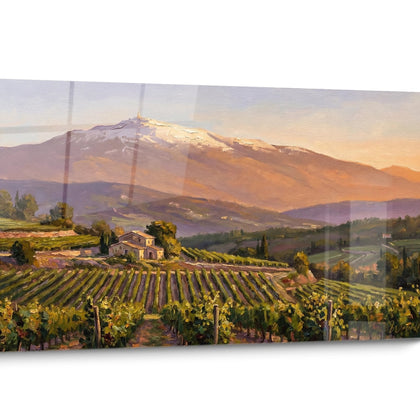
The impressionist Provence painting privileges certain landscape motifs that have become emblematic of this encounter between a territory and an artistic movement. Lavender fields in undulating rows offer an ideal subject for the impressionist approach: the rhythmic repetition of plant lines is translated by violet and mauve directional touches that create sensation of movement and atmospheric depth. Perched villages – Gordes, Roussillon, Bonnieux – with their terraced architectures in ochre and terra cotta tones, allow play on contrasts between cool shadowed areas and dazzling light-filled surfaces.
What are the typical compositional elements of an impressionist Provençal landscape?
The composition of an impressionist Provençal painting often organizes around characteristic vertical elements: soaring cypress trees serving as dark punctuation marks, Romanesque church steeples, bastide chimneys. These verticals structure space and guide the eye through the composition. Successive planes scale from detailed foregrounds – gnarled olive trees, dry stone walls, vines – toward simplified backgrounds where mountain massifs blend into bluish atmospheres. This spatial construction through superimposed colored planes creates specifically impressionist depth, without recourse to academic linear perspective.
The importance of skies in Provençal impressionist painting
The sky frequently occupies a substantial portion of the surface in a large-format impressionist Provence painting. This importance given to the celestial vault is not incidental: it allows translation of the spatial amplitude characteristic of southern panoramas and the particular quality of Provençal atmosphere. Clouds – rare but spectacular – are treated as white masses slightly tinted pink or gold depending on the hour, contrasting with intense blues. Subtle tonal variations in the sky create harmonious transition toward the horizon where earth and atmosphere meet in delicately nuanced intermediate values.
Provençal rural and agricultural scenes
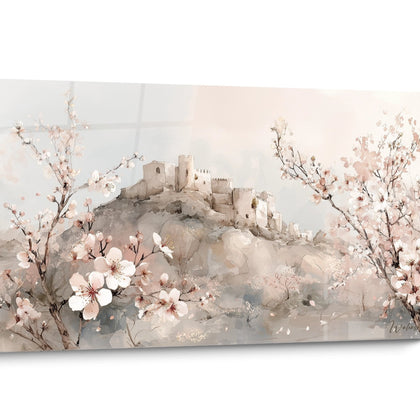
Beyond spectacular panoramas, Provençal impressionism also explores intimate agricultural scenes: isolated farmhouses amid fields, stone huts surrounded by almond blossoms, winding paths bordered by plane trees. These subjects allow exploration of shadow and light games filtered through foliage, creating mosaics of light and dark touches. Terraced crops, typical of Provençal relief, offer natural geometric patterns that impressionist brushwork fragments and recomposes into a vibrant whole. In contemporary interior spaces, these representations of Provençal rurality bring authentic and timeless dimension.
Showcasing a Large-Format Impressionist Provence Painting
Acquiring a large-scale impressionist Provence painting constitutes a major decorative investment that deserves careful presentation. These imposing works function ideally as unique focal point in a main living space. Unlike multipanel compositions, a large-format Provençal impressionist offers complete immersion in Mediterranean atmosphere, creating the illusion of architectural opening toward southern landscapes. The generous pictorial matter characteristic of impressionist approach reveals its full dimension when it can be appreciated both closely – for the richness of individual touches – and from afar – for the harmonious overall effect.
In which interior environments should a large Provençal impressionist painting be installed?
Spaces with generous volumes – cathedral-like living rooms, open-plan living areas, spacious entry halls – constitute the ideal setting for a large-format Provençal impressionist. These works dialogue particularly well with décor in natural tones: light wood, exposed stone, raw linen or undyed cotton textiles. Contemporary Mediterranean style, which blends form simplicity and material authenticity, creates natural harmony with these pictorial representations. Conversely, in a resolutely modern interior with streamlined lines and neutral colors, the impressionist Provence painting brings the touch of warmth and vitality essential to humanizing the space.
Lighting adapted to large-scale impressionist works
The textured relief characteristic of an impressionist painting reacts particularly well to indirect or lateral lighting that highlights impasto and creates micro-shadows that enhance the matter. Soft overhead lighting, close to natural southern light (color temperature around 4000-5000K), faithfully restores warm color nuances. Avoid direct overly powerful spotlights that create distracting reflections and alter color perception. Changing natural light throughout the day animates the work fascinatingly, with colored touches reacting differently according to light incidence angle, thus recreating the effect sought by impressionists: capturing light variability.
Decorative associations with an impressionist Provence painting
A large-scale impressionist Provence painting benefits from being accompanied by sober decorative elements that don't compete with its strong visual presence. Favor furniture with simple lines, possibly antiqued, evoking Provençal craftsmanship without falling into the folksy. Textiles with nature-inspired patterns – quilted boutis, Souleiado fabrics with discreet prints – extend the southern ambiance. On the botanical side, Mediterranean species in pots – olive, laurel, dried lavender bouquets – establish continuity between the represented universe and real space. Glazed Provençal ceramics in colors harmonized with the painting's palette complete this atmosphere without clutter.
Why choose an impressionist painting rather than another technique to evoke Provence?
The impressionist approach possesses particular affinity with the very essence of Provence: the celebration of light and color. Where other techniques may seem too descriptive or static, impressionism conveys the vibrant energy of the South, the physical sensation of heat, the movement of air in lavenders. The apparent spontaneity of impressionist brushwork communicates freshness and immediacy that correspond to sensory experience of the Provençal landscape. In imposing format, this pictorial vitality transforms your wall into daily immersive experience, far beyond the simple decorative function of standard reproduction.
How does an impressionist Provence painting transform a room's ambiance?
A large-format Provençal impressionist profoundly modifies spatial perception and emotional atmosphere of an interior. Dominant warm tones – yellows, ochres, oranges – visually warm the space and create sensation of welcome. The dynamic of colored touches generates stimulating visual energy without aggressiveness, ideal for shared living spaces. Psychologically, these evocations of sunlit landscapes bring dimension of daily escape particularly appreciated in less clement climates.
What is the difference between an impressionist Provence painting and a classical Mediterranean scene?
The fundamental distinction lies in pictorial treatment rather than subject. A classical painting privileges descriptive precision, sharp contours, faithful architectural or botanical details. The impressionist approach dissolves these certainties into color vibration where forms suggest rather than describe themselves. Provençal impressionists voluntarily sacrifice topographic accuracy for luminous intensity and atmospheric truth. This interpretive freedom confers superior poetic and emotional dimension that transcends simple documentary representation.
Is a large-scale impressionist Provence painting suitable for professional spaces?
Absolutely, these works find their place in various professional contexts seeking welcoming and quality ambiance. Reception areas – hotel halls, prestige establishment lounges, cabinet waiting rooms – benefit from the peaceful and refined atmosphere brought by a large impressionist Provence painting. Executive offices gain character with these Mediterranean landscape evocations that simultaneously communicate cultural seriousness and openness. Restaurants and fine dining establishments with southern-inspired cuisines find thematic coherence in these works that enriches overall client experience.
Further reading


