

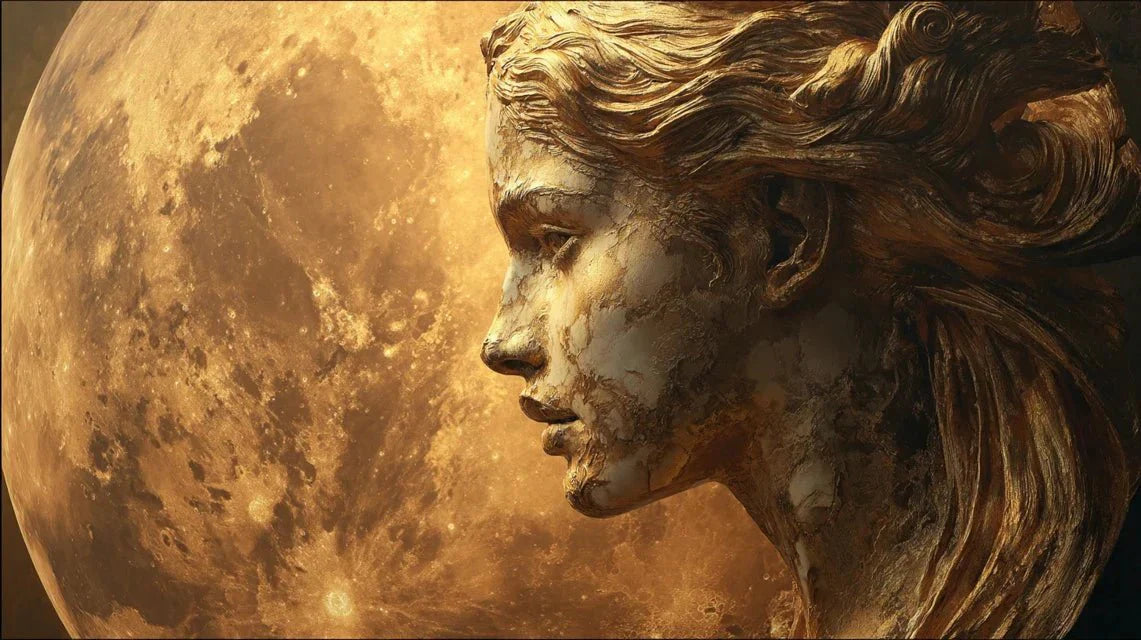
In the golden light of a Florentine morning in 1485, Botticelli dips his brush into a mixture of lead white and vermilion. On his canvas takes shape a woman emerging from a shell, her hair waving like copper ribbons. Five centuries later, a space telescope captures the brilliance of the planet Venus crossing the night sky, inspiring a new generation of artists. Between these two moments, a golden thread: the timeless fascination with Venus, a mythological figure turned celestial symbol. Here's what Venus brings to our artistic culture: a universal symbolism of beauty, a bridge between mythology and science, and an inexhaustible source of inspiration for our interiors. You may be looking to understand why this figure crosses the ages without ever losing its power of attraction, or how to integrate this cultural richness into your living space. This quest for aesthetic meaning is nothing trivial. I promise you a journey where each era reveals a new facet of Venus, from the ancient goddess to the shepherd's star that illuminates our contemporary works.
The birth of an icon: Venus in Antiquity
In the marble temples of Ancient Rome, Venus reigned as the goddess of love and beauty. The Greeks had first known her as Aphrodite, born from sea foam according to Hesiod's legend. This aquatic origin permeates all artistic representations of Venus: the fluidity of the draperies, the softness of the curves, the impression of perpetual movement. The Venus de Milo, sculpted around 130 BC, embodies this perfection of proportions that classical artists sought. Her missing arms have never diminished her evocative power, on the contrary.
The Romans adopted this Greek goddess by conferring an additional dimension upon her: Venus also became a protector of gardens and a symbol of fertility. In the frescoes of Pompeii, she appears surrounded by roses and doves, attributes that will cross the centuries. This double nature - celestial and earthly, spiritual and sensual - makes Venus a subject of artistic complexity. Artists were not simply depicting a beautiful woman, but an incarnate idea of universal harmony.
Renaissance: when Venus is reborn on canvases
The Italian Quattrocento marks a major turning point in the representation of Venus. Sandro Botticelli paints in 1485 The Birth of Venus, a work that will become one of the most reproduced images in art history. This Florentine Venus stands out from medieval canons: she assumes her nudity without shame, carried by the wind Zephyr towards the shores of Cyprus. The pastel colors, the gold of the hair, the pearly pink of the flesh create a dreamlike atmosphere that continues to inspire contemporary interior designers.
Titian, a few decades later, offers a radically different Venus. His Venus of Urbino (1538) languidly rests on a sumptuous bed, with a direct, almost provocative gaze. This Venetian Venus is earthy, sensual, domestic. She transforms the pictorial space into a bedroom, introducing the goddess into the intimacy of everyday life. This humanization of Venus opens the way to centuries of personal interpretations where each artist projects their own vision of beauty and desire.
The hidden symbolism of Venusian attributes
Carefully observe a painting of Venus: each element carries a meaning. The scallop shell evokes maritime birth and spiritual pilgrimage. Roses, often present, symbolize love but also the ephemeral nature of beauty. The mirror, a frequent attribute of Venus, represents both vanity and self-knowledge. Doves and swans, her sacred animals, suggest purity despite sensuality. Understanding these iconographic codes considerably enriches our reading of works and their integration into a cultivated interior.

Discover this inspiring work
From mythology to astronomy: the planet Venus
In the 17th century, Galileo pointed his telescope towards the sky and observed the phases of Venus, that star so bright that it is called the shepherd's star. The planet bears the name of the goddess for its incomparable brilliance in the night sky. This scientific discovery does not diminish the poetic charge of the name: it transforms it. Romantic artists of the 19th century integrate this cosmic dimension into their representations. Venus then becomes a symbol of union between earth and sky, between human sensuality and cosmic mystery.
The Impressionists, fascinated by light, capture the brilliance of Venus at dawn or dusk in their landscapes. The planet appears as a luminous point that structures the composition, creating a spiritual verticality in the earthly horizontality. This fusion of scientific observation and aesthetic quest characterizes artistic modernity. Venus ceases to be a simple mythological figure to become a natural phenomenon charged with cultural meaning.
Venus reinvented: modern and contemporary interpretations
The 20th century revolutionizes the representation of Venus. Salvador Dalí fragments and distorts her in his surrealist compositions. *Venus with Drawers* (1936) transforms the female body into an anthropomorphic piece of furniture, questioning notions of desire and objectification. Modern artists deconstruct the myth to better reinvent it. Venus becomes a pretext for exploring identity, gender, and the body in contemporary society.
Andy Warhol silkscreened Botticelli's *Birth of Venus* in pop colors, democratizing it as he had done with Marilyn Monroe. This artistic gesture poses an essential question: Can Venus survive mass reproduction? The answer seems to be yes. The more she is reproduced, the more she becomes a universal archetype, a common visual language that we all share. In our contemporary interiors, a representation of Venus functions as a cultural anchor, a reminder of our millennial artistic heritage.
Spatial aesthetics: when Venus inspires cosmic decoration
Contemporary space exploration renews our fascination with the planet Venus. Images sent by space probes reveal a hostile and magnificent world, enveloped in toxic clouds but of hypnotic beauty. This spatial aesthetic strongly influences current design. The ochre and orange hues of the Venusian atmosphere, the cloudy textures, the diffused light inspire color palettes and atmospheres for our living spaces. Associating the mythological figure with its astronomical counterpart creates a unique narrative depth in an interior.

Discover this inspiring artwork
Integrating Venus into your decorative universe
How to welcome this cultural richness at home without falling into academic pastiche? The balance lies in the dialogue between eras and styles. A minimalist reproduction of Botticelli's Venus in black and white integrates perfectly into a Scandinavian interior. A photograph of the planet Venus captured by telescope brings a cosmic touch to a contemporary office. The important thing is to create a personal resonance with the chosen artwork.
Consider the materials: marble evokes ancient statuary, copper recalls the color of Venus's hair in Botticelli, pearlescent hues echo her marine birth. An iridescent cushion, a hand-blown glass vase with organic shapes, a lamp diffusing golden light - all elements that subtly invoke the Venusian universe without literal illustration. This suggestive approach is often more elegant than a direct representation.
Let the radiance of Venus illuminate your daily life
Discover our exclusive collection of wall art that captures the celestial magic of Venus and transforms your walls into windows on the universe.
The timeless power of Venus in our lives
Why does Venus traverse the centuries without ever losing her aura? Because she embodies universal questions that each generation reformulates: What is beauty? How to reconcile desire and spirituality? What place for the body and emotion in our rationalized lives? A work representing Venus is never simply decorative: it is an invitation to contemplation, a reminder that aesthetics nourishes our humanity as surely as daily bread.
In a world saturated with ephemeral images, hanging a representation of Venus at home is an act of gentle resistance. It's choosing depth over superficiality, timelessness over trends, meaning over decor. Whether you opt for a classic interpretation or a modern cosmic vision, you enroll your interior in a cultural conversation that has been going on for three millennia. And somewhere, between the ancient goddess and the shepherd’s star, you find your own definition of beauty.
Imagine yourself in a few days, contemplating this Venusian presence on your wall. The morning light caresses the curves or reveals the atmospheric nuances of the planet. You no longer see just an image, but a thread woven through the history of art, connecting your intimate space to the workshops of the Renaissance, ancient temples, and the confines of our solar system. Start today: observe Venus in the twilight sky, virtually visit the galleries that preserve her representations, or choose the work that will dialogue with your daily life. Venus awaits, timeless and renewed, ready to enrich your universe with her millennial light.


