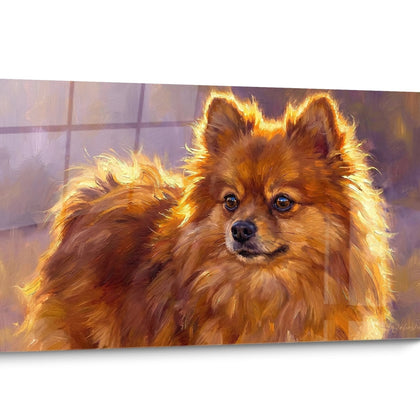
The Baroque Pomeranian Spitz dog painting transcends mere canine representation to embody the decorative opulence of European aristocratic courts. This monumental artwork captures the very essence of the Pomeranian as it was revered in 18th-century salons, adorned with virtual lace and golden ornaments reminiscent of royal portraits commissioned by nobility. Every detail evokes the rococo aesthetic where these diminutive companion dogs mingled with queens and duchesses, their vaporous coats sublimated by arabesques and volutes characteristic of the baroque style. Acquiring such a painting allows you to introduce into your contemporary interior this historical grandeur, transforming a simple space into a gallery worthy of Venetian or Versailles palaces where the Spitz was a symbol of extreme refinement.
Rocaille Ornamentation in Service of Canine Splendor
The Baroque Pomeranian Spitz dog painting inscribes itself in the tradition of ceremonial animal portraiture where each decorative element responds to precise symbolism inherited from the rococo movement. The golden volutes framing the Pomeranian's silky coat are not mere embellishments: they recall the sculpted frames of great Italian and French masters who immortalized the canine companions of Marie-Antoinette or Catherine II.
What baroque characteristics distinguish this representation of the Pomeranian Spitz?
Baroque aesthetics manifest through an abundance of asymmetrical ornaments, counter-curves and stylized vegetal motifs that create perpetual movement around the central subject. The Pomeranian thus becomes the focal point of a theatrical composition where each golden arabesque draws the eye toward its immaculate fur, while dark backgrounds recall the chiaroscuro favored by Flemish painters. This approach transforms the domestic animal into an aristocratic icon, draped in a staging worthy of baroque equestrian portraits.
Integration into Spaces with Historic Moldings
For owners of Haussmann apartments or heritage residences equipped with original woodwork, this painting establishes a natural dialogue with existing architecture. Ornate cornices, ceiling rosettes and sculpted wainscoting find their echo in the volutes surrounding the Spitz, creating a stylistic continuity rarely achieved with minimalist contemporary art. The great dimensions of the artwork allow it to dignify vast wall expanses between two mullioned windows or above a marble fireplace—traditional locations for family portraits in European nobility.
Animal Symbolism in European Aristocracy
The Pomeranian Spitz was not chosen by royal courts by chance: its small size facilitated transport in carriages, while its immaculate white coat symbolized moral purity. By opting for a Baroque Pomeranian Spitz dog painting, you perpetuate this centuries-old tradition where the companion animal reflected its owner's social status. Baroque iconography amplifies this dimension by associating the dog with elements such as precious fabrics, jewelry or exuberant floral décors that constituted the visual vocabulary of wealth.
How to create a coherent gallery around this theme?
Association with other canine representations in historical styles enriches visual narrative. Notably, exploring variations such as the golden Pomeranian Spitz dog painting allows you to establish chromatic correspondences while varying aesthetic approaches. This thematic collection strategy evokes aristocratic cabinets of curiosities where different representations of the same subject coexisted, each illustrating a particular facet of the collector's refined taste.
Recreating the Atmosphere of Royal Salons
Acquiring a large-scale Baroque Pomeranian Spitz dog painting radically transforms the spatial perception of a room by instantly conferring upon it the majesty of reception halls in European châteaux. These spaces were designed to impress visitors upon crossing the threshold, and the monumental animal portrait played a strategic role comparable to Gobelins tapestries or mythological frescoes.
Interior Architecture and Monumental Proportions
In rooms with high ceilings characteristic of historic constructions, this type of artwork requires an appropriate scale to avoid being overwhelmed by volumes. The generous formats available allow precisely the occupation of vertical space in balanced manner, creating a visual anchor point that structures all surrounding decoration. The Pomeranian, despite its small actual size, acquires through this baroque representation a monumental presence rivaling that of saints in church altarpieces or monarchs in portrait galleries.
Which period furnishings enhance this pictorial style?
Louis XV or Louis XVI furniture constitutes the ideal setting for this type of artwork: gilt-wood console with cabriole legs, velvet-upholstered bergère, marquetry commode whose chased bronzes echo the shell and foliage motifs present in the painting. This stylistic coherence is not merely an aesthetic matter but a heritage approach that reconstructs the authentic ambiance of aristocratic interiors where the Spitz actually evolved. Each element reinforces the impression of historical luxury and cultural continuity.
Indirect Lighting to Enhance the Gilt Elements
The gilded ornaments characteristic of baroque style require particular lighting that recalls the candelabras and crystal chandeliers of palaces. Wall sconces in bronze positioned on either side of the painting create interplays of shadow and light that animate the volutes, making motifs vibrate as in baroque churches where natural light from stained glass transformed sculpted décors throughout the day. This scenographic approach transforms the artwork into a living element of decoration.
Chromatic associations to amplify the palatial effect
The dominant hues of the painting—aged gold, cream, sienna—naturally orient toward a rich decorative palette: damask wallpapers in bordeaux or deep green tones, shot taffeta curtains, Aubusson carpets with floral motifs. These choices are not mere matching but recreate the visual stratification typical of baroque interiors where every surface was a pretext for ornamentation. The Baroque Pomeranian Spitz dog painting becomes thus the generator of an overall ambiance rather than a simple isolated decorative element.
Cultural Heritage and Aristocratic Narrative
Beyond its decorative dimension, the Baroque Pomeranian Spitz dog painting constitutes a veritable historical document testifying to the exceptional place this breed occupied in the European collective imagination. Royal archives regularly mention Pomeranians as diplomatic gifts between courts, objects of political transactions on par with works of art or purebred horses.
How does the Spitz become a privileged artistic subject?
Unlike hunting dogs represented in action and wild nature, the baroque Pomeranian is always depicted in a refined domestic context, often at its mistress's feet or upon a velvet cushion. This specific iconography reflects its particular social role: neither guardian nor hunter, but salon companion whose function was purely ornamental and affective. Baroque painters exploited its voluminous coat as a pretext for demonstrations of technical virtuosity, each lock becoming an opportunity to play with light and texture.
Heritage Value in Contemporary Collections
Investing in such a painting inscribes itself within a logic of heritage collection where historical animal art experiences consistent valorization. Discerning enthusiasts seek these representations that combine technical excellence, profound cultural reference and immediate decorative dimension. The monumental format adds further rarity, as few contemporary studios master baroque codes while producing works of this magnitude adapted to current residential spaces.
Transmission and Family Narrative
Beyond its formal beauty, this type of artwork often becomes the support for family narrative transmitted across generations. In historic residences, the baroque canine painting joins ancestral portraits and inherited still lifes, contributing to the construction of a familial identity where artistic taste perpetuates itself. For current Pomeranian Spitz owners, this representation establishes a temporal bridge between their contemporary companion and its illustrious predecessors from royal courts.
FAQ - Frequently Asked Questions
Why choose a Baroque Pomeranian Spitz dog painting over modern photography?
The baroque approach transcends simple realistic representation to create an artistic interpretation charged with symbolism and emotion. Where photography captures an instant, baroque style constructs an timeless narrative that confers upon the Spitz a mythological dimension, transforming it into an allegory of aristocratic fidelity and European refinement.
Does this style suit minimalist contemporary interiors?
The introduction of a baroque element into a pared-down space creates precisely the contrast sought by current decorators, who name this approach "selective maximalism". A single strong historic piece becomes the focal point that visually enriches an otherwise sober environment, avoiding the coldness sometimes reproached to overly minimalist interiors.
What advantages does large format offer for this type of baroque representation?
Generous dimensions allow full appreciation of the ornament complexity, volutes and details that would be lost in reduced format. Baroque style by essence seeks amplitude, movement and theatricality that require space to deploy their complete visual and emotional impact, reproducing the immersive experience of palatial frescoes.


 Pomeranian Spitz Painting on Vintage Floral Patterns - Medieval Tapestry - Pomeranian Spitz Edition233,90 €
 Golden Pomeranian Spitz Stained Glass Style Painting - Fairy Lights - Pomeranian Spitz Edition213,90 €
 Pomeranian Spitz with Pink Peonies - Floral Harmony - Pomeranian Spitz Edition233,90 €
 Golden Spitz Duo with Floral Ornaments - Baroque Elegance - Pomeranian Spitz Edition213,90 €