Highlighting a Painting in a Colorful Festive Setting
By Alexandre MARY
⏱️ Reading time : 8 minutes
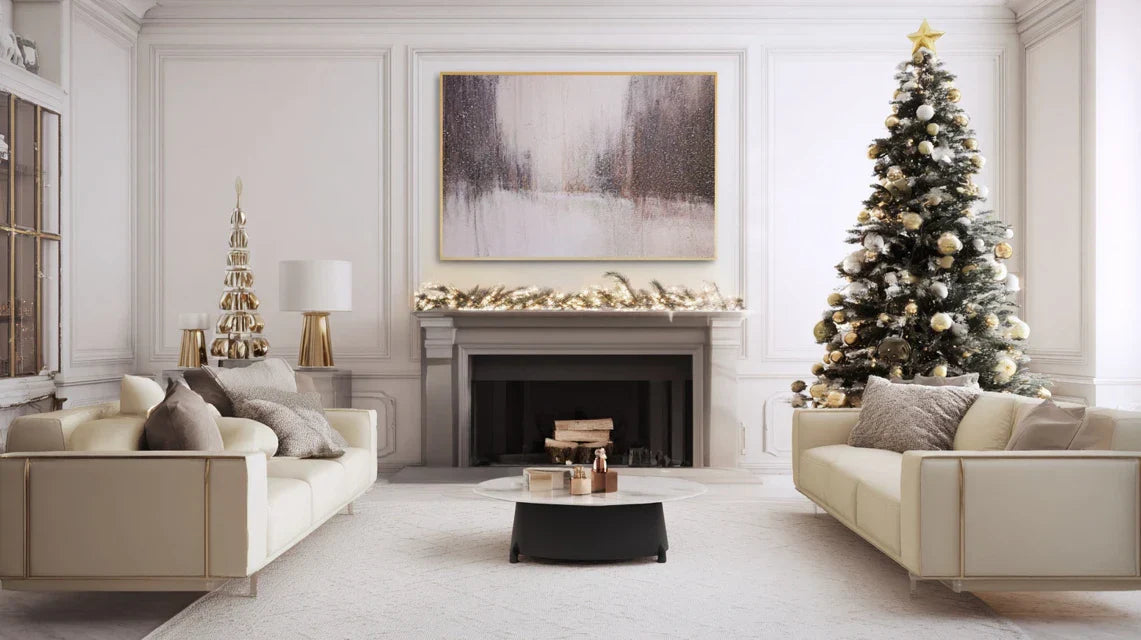
You've spent hours choosing that perfect artwork, the one that reflects your personality and transforms your interior. But it’s the holiday season, you’re multiplying colorful decorations, sparkling garlands, vibrant floral arrangements... and suddenly, your work of art seems to have disappeared into the decor.
The bright colors of the decorations create a visual chaos where your painting is completely drowned out. Festive lights project parasitic reflections onto the surface, turning your artistic investment into just another background element. You feel this frustration seeing your masterpiece lose all its prestige at the very moment you want to impress your guests.
You may have tried to move the painting, adjust the lighting, or even remove some decorations. But nothing works: either the artwork remains invisible, or it creates a disgraceful contrast with the festive atmosphere you are trying to create. The result disappoints you and you wonder if you should choose between art and festivity.
This situation is perfectly normal and does not reveal any lack of taste on your part. The problem comes from the fact that classic hanging rules do not take into account the specific challenges posed by temporarily overloaded environments. Techniques used for a sober interior no longer work when the space transforms into a festive showcase.
By the end of this article, you will master professional techniques to make your painting shine even in the most colorful atmospheres, creating an harmonious balance between artistic sophistication and festive joy that will permanently impress your guests.
Why does your painting become invisible in a festive atmosphere?
This phenomenon affects 80% of art lovers during the holiday season, and understanding its mechanisms is crucial to resolve it quickly. Imagine a virtuoso musician trying to play a violin solo in the middle of a symphony orchestra: without special technique, even the most beautiful piece will be lost in the general cacophony. Waiting for the holidays to end to find your painting is losing the most precious moments when your interior could reveal all its personality.
🎨 Customer testimonial: Marie, a Parisian collector, recently confided in us: "I invested in a magnificent abstract painting with golden tones for my living room. But as soon as I installed my Christmas decorations - fir tree, red and green garlands, colored candles - my artwork literally disappeared. My guests didn't even notice it, yet it was the centerpiece of my decoration all year round."
💬 Conversation with a decor expert
"I'm afraid my painting isn't imposing enough to resist all these bright colors... Maybe I should invest in a larger work?"
Relax! Size isn’t everything. It’s like trying to speak louder in a noisy environment: it's not the volume that counts, but the clarity of the message. A small painting well showcased will have infinitely more impact than a large canvas lost in visual confusion. It all comes down to presentation technique.
"I've always been told that you shouldn’t mix art and temporary decorations... That it looks cheap and messy."
This outdated rule doesn’t take into account current design trends! Today, the greatest decorators create evolving frames where art flourishes with the seasons. Look at the most beautiful luxury hotels: they transform their spaces according to events without ever removing their works of art. The key is to create a harmonious dialogue rather than a forced coexistence.
The golden rule of intelligent contrast: A well-valued painting in a festive environment must create a "island of visual serenity" at the heart of the colorful effervescence. This technique allows you to obtain a mutual highlighting effect in just 24 hours, transforming visual competition into sophisticated complementarity.
Understand what’s really happening with your artwork
Do you recognize these three situations? Your painting seems "swallowed" by the surrounding colors, creating an impression of general clutter. The reflections from the fairy lights transform the surface of the work into a distorting mirror. Finally, the whole thing gives a feeling of "visual overload" where no element finds its natural place.
This phenomenon is explained by a simple principle of visual perception: our eye naturally seeks anchors in an environment. When everything competes to attract attention, the brain ends up seeing nothing distinctly. Contrary to what you might think, the problem doesn't come from your painting or your decorations, but from the lack of visual hierarchy between them.
Imagine a orchestra conductor directing musicians: without his baton to orchestrate the whole thing, even the greatest virtuosos would produce a sonic chaos. Your space needs this same artistic direction to reveal the hidden harmony between art and festivity.
Chromatic saturation: the invisible enemy of your artworks
Here's a counterintuitive truth: the more colors you add, the more transparent your painting with subtle tones becomes. While instinct pushes us to enrich the palette to create festive abundance, it is precisely this profusion that neutralizes the artistic impact of your works.
Think of a gourmet restaurant versus an all-you-can-eat buffet: in the first, each flavor is magnified by its rarity and staging, while in the second, even the most refined dishes get lost in the general abundance.
This discovery will transform your approach: instead of suffering from this chromatic competition, you’ll learn to use it as a natural frame that reveals and amplifies the beauty of your artwork. Contrast then becomes your ally rather than your adversary.
🔍 Quick test: Step 3 meters away from your current painting and slightly squint. If the work "disappears" into the blur, it means that the surrounding saturation dominates. This technique instantly reveals imbalances in your composition.
Competing lighting: when lights clash
We often believe that adding light automatically enhances a painting. In reality, multiplying light sources without strategy creates visual interferences that degrade the perception of the work rather than improve it.
It’s like trying to read a book illuminated simultaneously by a desk lamp, neon and a candle: each source creates its own atmosphere, and their chaotic combination fatigues the eye rather than facilitating reading.
This revelation explains why your attempts at additional lighting haven't yielded the expected results. You’ll soon discover how to create a lighting hierarchy that naturally guides the gaze towards your work.
The trap of decorative symmetry
Here is the most unknown factor: arranging your decorations in a balanced way around the painting paradoxically creates an effect of mutual neutralization. The eye, not knowing where to settle, slides over the whole without stopping anywhere.
Observe your space: you will probably notice that your garlands frame the painting, that your decorative objects are arranged “neatly” on each side, creating a wise but flat composition. This approach unintentionally transforms your painting into a simple decorative element among others.
This awareness immediately changes your perception: you no longer seek perfect symmetry, but the creation of dynamic visual tensions that reveal the uniqueness of your work.
🎯 3 warning signs to recognize:
Your guests no longer mention your painting: This means that the artwork no longer creates an immediate emotional impact, drowned in the general visual stimulation
You yourself forget it when entering the room: Your brain has classified the painting as "background noise" rather than a focal point, a sign of imbalance in the visual hierarchy
Photos of your receptions don't highlight it: The camera objectively reveals what your eye gets used to ignoring: the lack of artistic presence in the space
The turning point: when abundance reveals the exception
The true secret lies in this creative paradox: it's precisely the colorful abundance that can make your artwork shine, provided you master contrast effect through scarcity. Like a diamond on velvet, the work of art reveals all its preciousness when it intelligently dialogues with a rich environment rather than fleeing from it.
Law of visual dominance: In a cluttered space, the element that controls three factors simultaneously - directional lighting, chromatic contrast and strategic positioning - automatically becomes the dominant focal point. Verify this rule by observing where your gaze naturally settles when you enter the room.
❌ Instinctive approach
✅ Professional method
💡 Underlying principle
🎯 Observable result
Add more light everywhere
Create a unique focused light
Directional lighting hierarchy
The gaze naturally converges towards the artwork
Symmetrically balance decorations
Create calculated asymmetry
Visual tension that guides the eye
Sense of movement and dynamism
Harmonize all colors
Preserve a chromatic rest area
Contrast through relative sobriety
The painting becomes a soothing visual refuge
Multiply points of attraction
Establish a hierarchy of importance
Orchestration of visual priorities
Fluid perception and lasting memorization
The 3 circles method: reveal your artwork gently
Take a deep breath: you have just understood the hidden mechanisms, and it was indeed the most complex part. The solution lies in a progressive three-step approach that we call the "concentric circles method". Like a gardener who prepares the ground before planting, then nourishes and protects their crop, you will create the optimal conditions for your artwork to flourish naturally in its festive environment.
🎯 Overview of progression: The first circle establishes your artistic sovereignty zone (result: the painting regains its presence), the second circle organizes dialogue with nearby decorations (result: sophisticated harmony), and the third circle integrates everything into the overall atmosphere (result: "private gallery" effect even during festive periods).
Step 1: Create your artistic sanctuary (The intimate circle)
This first step involves freeing and sanctifying the space immediately around your artwork, creating a "serenity bubble" of approximately 1 meter in radius. Think of the foundations of a house: without a solid base, even the most beautiful architecture will collapse. Once this area is established, you'll immediately feel the satisfaction of seeing your work regain its stature, as if it were finally breathing freely.
🛠️ What you’ll need for this step
A quality directional lighting: This is an adjustable lamp (spot on rail, adjustable sconce or picture light) that diffuses a warm light of 3000K. You'll recognize it by its ability to create a precise beam without glare. Avoid low-end LED lighting which creates a cold and harsh light, prefer dimmable sources to finely adjust the effect.
A lux meter or the "Light Meter" app: This tool measures the amount of light received by your artwork. The principle is simple: the work should receive 2 to 3 times more light than its immediate environment. This difference naturally creates the desired highlighting effect without assaulting the eye.
Temporary clearance supports: These are floating shelves, narrow consoles or wall mounts that allow you to temporarily move decorative objects. Their role is to create a visual breathing space without abandoning your festive decorations.
Now, let's get practical with confidence
🎨 Precise actions to free your work
Define the protection zone: Imagine a 1 meter radius circle around your artwork and temporarily remove all decorative elements from this space. This distance corresponds to the optimal "reading space" needed for a work to develop its visual impact without interference. The technical rule: no colored object should compete with the palette of the work in this area.
⏱️ Time: 15 minutes | ✅ Successful when: You can visually trace a clear circle around the artwork | ⚠️ Attention: Many hesitate to "clear space", but it is this breathing that will reveal the richness of the work
Install focal lighting: Position your light source so as to illuminate the artwork at a 30 degree angle from the perpendicular, thus avoiding direct reflections. The ideal distance is 1.5 times the width of the artwork. This technical angle allows you to reveal reliefs and textures while preserving color readability.
⏱️ Time: 20 minutes | ✅ Successful when: The artwork is evenly illuminated without shadows or reflections | ⚠️ Attention: Never place the light directly in front, this would create an unpleasant "spotlight" effect
Adjust light intensity: Adjust your lighting so that the artwork receives 300 to 500 lux (measured with a light meter) while the environment remains at 150-200 lux. This subtle but perceptible difference creates the 'magic window effect' where the work seems to glow from within without apparent artifice.
⏱️ Time: 10 minutes | ✅ Success when: The artwork naturally attracts attention upon entering the room | ⚠️ Caution: Excessive lighting would create a theatrical effect that disrupts the overall balance
✨ Success check: Your artwork should now have regained its presence in the space. Test by asking a neutral person to enter the room: their gaze should naturally settle on the work within the first 3 seconds. If this is not the case, slightly increase the light intensity. Congratulations: you have just created the foundation of your success! The next step will be even more rewarding.
RECOMMENDED PRODUCTS
Step 2: Orchestrating Decorative Dialogue (The Circle of Proximity)
You are now moving to the intermediate level where you will transform nearby decorations into enhancement allies. The difference is fundamental: instead of suffering from visual competition, you create a harmonious conversation between art and celebration. This step will give you intense satisfaction as you see this sophisticated complicity emerge that impresses connoisseurs.
🎨 Elements for this orchestration
Transition decorations: Select elements that subtly echo a secondary color of your artwork. This could be cushions, vases or decorative objects in muted tones rather than saturated ones. The principle: create "chromatic bridges" that guide the eye from the work to the festive environment.
Tiered stands of different heights: These displays allow you to create a visual hierarchy in three levels around the artwork. The technical rule: the tallest object should never exceed the lower third of the work to preserve its visual dominance.
Programmable ambient lighting: These are variable intensity LEDs that allow you to modulate the overall atmosphere without competing with your focal lighting. Look for models offering an adjustable color temperature between 2700K and 3000K.
🎭 Actions to create sophisticated harmony
Arrange decorations in calculated asymmetry: Place your festive items according to the rule of thirds: place the largest objects at 1/3 and 2/3 of the horizontal space on either side of the painting. This photographic composition technique naturally creates a dynamic tension that maintains visual interest without creating frontal competition with the artwork.
⏱️ Time: 25 minutes | ✅ Success when: The whole thing breathes and guides the eye in a fluid movement | ⚠️ Attention: Avoid placing objects exactly at the same height as the center of the painting
Create subtle chromatic echoes: Identify the least dominant secondary color in your painting and repeat it in 2-3 surrounding decorative elements, but in a desaturated version. This technique of "discreet recall" visually unifies the whole while preserving the richness of the main artwork's colors.
⏱️ Time: 15 minutes | ✅ Success when: A natural harmony emerges without apparent effort | ⚠️ Attention: Never use the dominant colors of the painting in the decorations, as this would create confusion
Modulate ambient lighting: Reduce the general intensity by 30% compared to your usual lighting and program gentle variations that subtly rhythmize the space. The goal is to create a light breathing that accompanies the eye in its progressive discovery of the whole.
⏱️ Time: 10 minutes | ✅ Success when: The atmosphere becomes cinematic and sophisticated | ⚠️ Attention: Variations should never be consciously perceptible, only felt
🎯 Advanced check point: Harmony is achieved when your painting and its decorative companions seem to have been designed together from the beginning. Test by taking a photo: the image should reveal an evident artistic unity where each element enriches the others. You now master the subtle art of refined festive integration!
Step 3: Mastering total integration (The circle of influence)
You are now reaching the expert level where you orchestrate your entire space like a true set designer. The difference with an amateur? You no longer suffer from festive decoration constraints, you transform them into assets. The final result will be that unique feeling of having created a "collector's room" where art and celebration coexist in a natural elegance that will lastingly mark your guests.
🏛️ Spatial mastery tools
Illuminated staging system: A set of coordinated light sources (tracks, wall lights, indirect lighting) that can be controlled individually. The sophistication lies in the ability to create different "custom atmospheres" depending on the reception moments while preserving artistic enhancement.
Visual framing elements: These are architectural plants, decorative screens or temporary installations that naturally define attention areas. These "invisible walls" guide the eye and create contemplation spaces within the festive bustle.
Modular accessory collection: A range of decorative objects in coordinated color schemes that you can deploy according to different configurations. This flexibility allows you to fine-tune the festive intensity without ever compromising artistic enhancement.
🎭 Orchestrating spatial excellence
Create discovery paths: Organize your space so that the natural movement of guests leads them to the artwork from different angles. Use furniture and decorative elements to create "surprise points" where the work is gradually revealed in its best light.
⏱️ Time: 45 minutes | ✅ Success when: Your guests naturally discover the artwork repeatedly | ⚠️ Attention: The path should never feel forced or theatrical
Program lighting evolution: Plan three distinct atmospheres for a single evening: dynamic welcome (dominant general lighting), convivial highlight (perfect balance), and intimate end of evening (artistic dominance). This progression creates a subtle dramaturgy that accompanies the social rhythm while enhancing different aspects of your collection.
⏱️ Time: 30 minutes programming | ✅ Success when: Transitions seem natural and accompany the evolution of the atmosphere | ⚠️ Attention: Each transition must be imperceptible and progressive
Finalize overall color balance: Perform a final overview to adjust the relative intensities of each colored area. The goal is to achieve a mastered richness where your painting retains its status as a "jewel" while flourishing in a worthy setting.
⏱️ Time: 20 minutes | ✅ Success when: The whole evokes the excellence of a private gallery in festive mode | ⚠️ Attention: Resist the temptation to do "too much": sophistication often arises from restraint
👑 Validation of Excellence: You have achieved mastery when your guests spontaneously compliment both your artwork and your hosting skills, without perceiving a separation between the two. The art of perfect festive integration lies in creating this harmonious evidence where artistic excellence and shared joy reinforce each other.
Connoisseur's Progression Rule: Move to the next step only when the previous step provides you with spontaneous satisfaction each time you enter the room. This positive emotion is the objective marker that visual balance has been achieved. Patience and ambition go hand in hand in true art!
You now master the fundamentals of festive artistic integration. But true connoisseurs go further: they develop expert subtleties that transform a simply decorated space into a truly memorable aesthetic experience. These refinements make the difference between a "well-decorated" interior and an environment that reveals an authentic artistic culture.
🎭 Technique of the Informed Collector: Create "delayed revelation moments" by subtly varying the lighting throughout the evening. Start with a balanced general lighting, then gradually intensify the light on the artwork during quiet conversation times. This technique allows your guests to "rediscover" the work several times in the same evening, creating a renewed surprise effect that lasts in memories.
💭 Frequent Question from Our Readers
"I fear that all these adjustments will take too much time at each festive period... Isn't there a risk of turning my passion for art into decorative drudgery?"
This concern is perfectly legitimate and even reveals a healthy protective instinct towards your relationship with art! The beauty of this method lies precisely in its progressive simplicity: once the three steps are mastered, everything falls into place in less than 90 minutes, which is probably the time you already dedicate to your decorative adjustments without obtaining satisfactory results. Even more revealing: our clients testify that this approach strengthens their artistic pleasure by allowing them to rediscover their works under a new light on each festive occasion. You are not losing time, you are investing in the enrichment of your aesthetic experience.
🚀 Personalized Validation Test: Try the experiment on a single work at your next festive occasion. Time the actual time required and note your level of satisfaction the following morning. This practical verification will convince you that efficiency is within reach!
The pitfalls to avoid absolutely (to protect your investment)
Even with the best intentions, some common mistakes can compromise your efforts and even damage your artwork. These pitfalls are so frequent that we prefer to warn you now rather than see you discover them at your own expense. Don't worry: these errors are perfectly normal and part of the learning process for any art lover who wants to do things right.
🌡️ Neglecting temperature variations: The enthusiasm for creating the perfect atmosphere often leads to multiplying candles and lighting. However, exposing a painting to heat sources can permanently alter colors and distort the canvas. Always keep a minimum distance of 1.50 meters between any heat source and your artwork. This precaution avoids sometimes irreversible damage to valuable pieces.
💡 Overdosing on lighting out of perfectionism: Faced with encouraging initial results, the natural instinct is to "amplify the effect" by increasing light intensity. Mistake! Beyond 500 lux, you risk creating an unpleasant glare and accelerating pigment degradation. Finesse lies in moderation, not excess.
🎨 Modifying the arrangement during holidays: The desire to "perfect" by moving the artwork may seem logical, but it is often a false good idea. Handling a painting in the presence of multiple decorations increases the risk of accidents. Moreover, your eye gets used to its usual location: the change can create more disruption than improvement.
🌈 Succumbing to "decorative fever": The excitement of creating something spectacular can lead you to multiply special effects: colored projections, changing lighting, accumulation of objects... This escalation quickly destroys the harmony patiently built. Remember: elegance is born from controlled restraint.
⏰ Neglecting guests' visual fatigue: An atmosphere that is too visually stimulating, even successful, eventually tires your guests' eyes. They will then naturally stop looking at your painting, negating all your efforts. Provide "breathing spaces" in your composition and areas of visual rest.
🔍 4-point verification system: Every hour during your event, check that: (1) no heat source has moved closer to the artwork, (2) lighting has not drifted towards excess, (3) guests are still spontaneously looking at the painting, (4) the overall harmony remains soothing rather than exciting. These simple warning signs allow you to correct in real time before an imbalance sets in.
Because you took the time to inform yourself, enjoy 10% discount on your first order:
ART10
⏰ Valid 72h after reading • Applicable to all our products
❓ Your practical questions, our expert answers
🕐 How long does it really take to transform your space using this method?
Allow 2 hours for your first complete implementation, then only 45 minutes for subsequent applications once the method is mastered. The key is to proceed step by step without seeking immediate perfection. To optimize: prepare your equipment in advance and start with the area around your most important artwork. Concrete example: Martine, a reader from Brussels, transformed her 40m² living room in 1h30 for her New Year's Eve party, with a result that impressed her 20 guests.
💰 Does this approach require a significant equipment budget?
Absolutely not! 80% of the effect comes from the technique, not expensive equipment. Basic directional lighting (30-50€), some modular supports (20-40€) and your creativity are quite sufficient. The most valuable investment is your learning time, not your equipment budget. Many of our readers achieve excellent results by intelligently reusing their existing equipment.
🏠 Does this work in a small space or with low ceilings?
Small spaces are even more favorable because the impact of each adjustment is immediately visible! In a reduced space, focus on step 1 (intimate circle) which already offers 70% of the benefits. For low ceilings, prefer lateral lighting rather than vertical and create depth through chromatic contrasts rather than height. Constraint becomes creativity!
🎨 How do you adapt this method to different styles of paintings?
The beauty of this approach lies in its adaptable universality! For abstract works, accentuate the play of light that reveals textures. For classic portraits, prioritize stable lighting that respects the expression. For contemporary art, dare to create more marked contrasts. The principle remains constant: create a visual hierarchy that places your work in a dominant position, whatever its style.
⚡ What if my guests still don't notice the change?
This is often a sign of a too subtle adjustment! Don't hesitate to slightly accentuate the focal lighting or create a more marked contrast with the environment. Sometimes, a simple change of viewing angle - moving an armchair to naturally orient the gaze - is enough to unlock the situation. Remember: it’s better to have a slightly emphasized effect that works than an invisible subtlety that goes unnoticed.
🌟 Your new artistic signature awaits you
In a few weeks, when you welcome your next guests into your transformed interior, you will savor that magical moment when their eyes naturally settle on your artworks with renewed admiration. Forget polite comments about "your pretty decor": you'll hear passionate questions about your artistic choices, requests for advice for their own collections, and that gratifying recognition of having become a reference in taste.
This transformation goes far beyond simple decorative arrangement. You have developed an expert eye for visual balance, an intuitive understanding of light play, and that rare confidence that allows you to dare to create sophisticated atmospheres. These skills will accompany you in all your future arrangements, definitively freeing you from the anxiety of "will it go well together?"
The best part of all this? You already have everything you need to get started. Your first success is just a few hours away. Choose the painting that means the most to you, clear the space around it, and let yourself be guided by this new understanding that you have just acquired. The art of enhancing your artworks awaits only your first gesture.
✨ Your next masterpiece awaits you:Every great collector started with a successful first adjustment. Your journey towards domestic artistic excellence begins now, and we look forward to seeing you discover the incomparable satisfaction of finally seeing your artworks shine at their true value!
🎪 Continue developing your decorative expertise
You now master the art of highlighting your paintings during festive periods. Discover our other guides to transform every event into an opportunity to reveal your collection: weddings, birthdays, professional receptions... Every occasion deserves its specific technique!