The first time I unfurled an Azilal rug on the clay floor of a weavers' cooperative in the Middle Atlas, I felt my hands tremble. It wasn't just a decorative object – it was a silent language, woven thread by thread by hands repeating gestures passed down through millennia. Berber geometric patterns didn't emerge in contemporary design studios. They rise from the Atlas Mountains, the Rif valleys, the Sahara oases, carrying within them an ancestral memory that few know how to decipher.
Here’s what Berber geometric patterns bring to your interior: an authentic connection with a culture preserved for over 3000 years, a protective symbolism woven into each rhombus and zigzag, and a timeless aesthetic that transcends fleeting trends. These patterns don't decorate – they tell stories, protect, transmit.
You admire these triangles, rhombuses, crosses that adorn rugs and textiles, but their origin remains vague, lost in superficial explanations. You are told about 'tradition' without being explained why these specific shapes, why this obsessive geometry, why this almost hypnotic repetition. Rest assured: behind each pattern lies a precise story, rooted in a geography, a spirituality, a way of life. I take you to the source of these symbols, where I spent months listening to weavers reveal their secret visual grammar to me.
The prehistoric roots: when geometry is born from the mountain
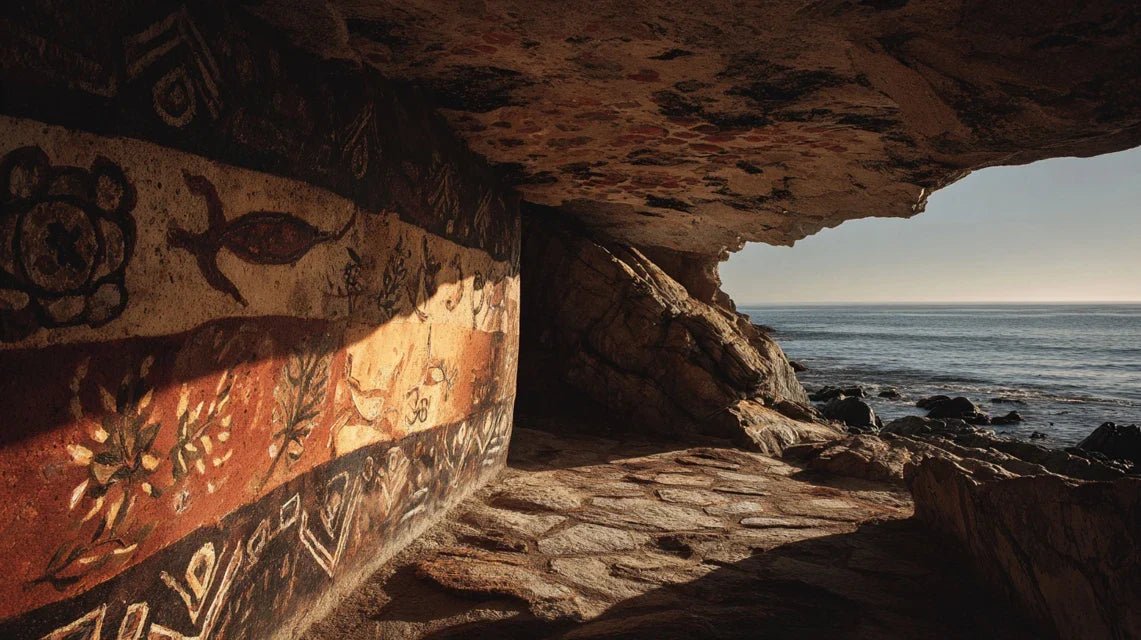
Berber geometric patterns trace their roots back to the North African Neolithic, long before the emergence of Numidian kingdoms. In the caves of Tassili n'Ajjer and the rock shelters of the Atlas Mountains, we already find this obsession with geometry: spirals, chevrons, grids engraved in stone over 5000 years ago. These first graphic expressions are not decorative – they map a territory, mark seasonal cycles, codify vital knowledge about water, animal migrations, mountain passes.
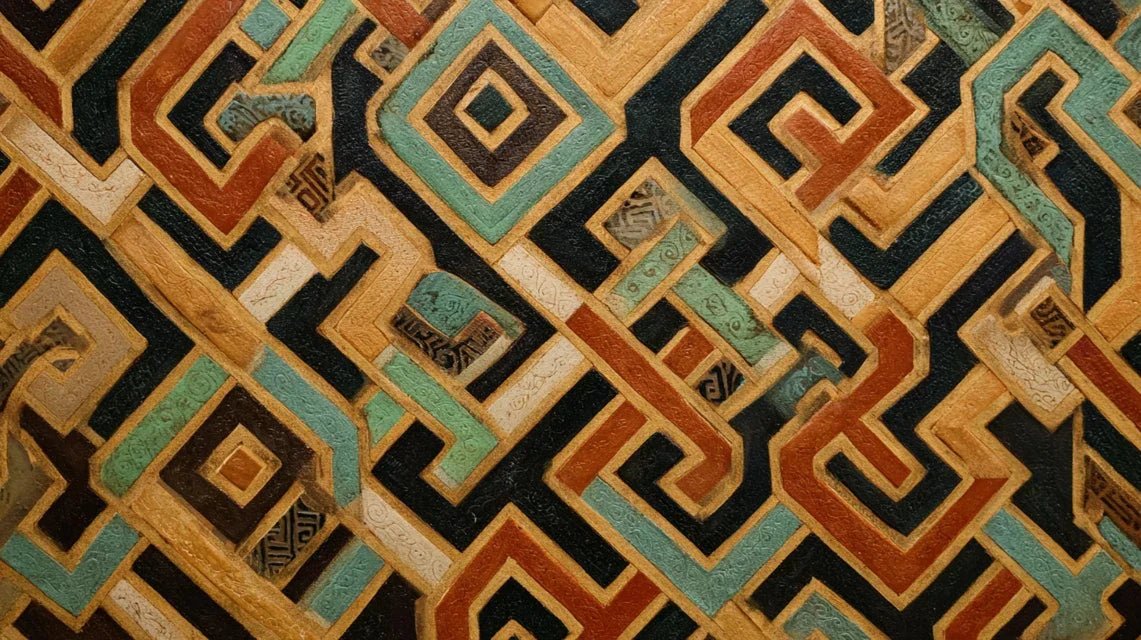
Unlike the figurative representations found in other cultures, the Berbers developed an abstract language deeply linked to their environment. The broken lines of zigzags evoke the mountain ridges of the Atlas. Repeated lozenges recall the natural patterns of snake scales – a creature respected and feared in the desert. Interlocking triangles reproduce the structure of nomadic tents or the teeth of traditional weaving combs.
The role of women weavers in transmission
What fundamentally distinguishes Berber geometric patterns is their exclusively female and oral transmission. No written pattern, no preparatory sketch. A mother passes on a repertoire of shapes to her daughter by teaching her their name in Tamazight: 'tazrart' (the twisted rope), 'timnzar' (the stars), 'aït n'wrgh' (the protective eye). Each weaver inherits a regional visual vocabulary, which she can then interpret according to her personal inspiration.
I have observed for weeks Fatima, a weaver of 67 years near Azilal, improvising on her vertical loom. She follows no predefined pattern. Her fingers know the exact tension of the wool, the rhythm of the knots, the balance between symmetry and disruption. The Berber geometric motif is thus born in a subtle balance between collective rule and individual expression.
The hidden symbolism: decoding the geometric language
Each geometric shape in Berber art functions as an ideogram carrying meaning. The central rhombus, omnipresent in beni ouarain rugs, represents the maternal womb, fertility, family continuity. It is often surrounded by cross or star motifs that symbolize divine protection, warding off the evil eye, blessing on the home.
Horizontal zigzags evoke water – a precious resource in arid territories – and by extension life, abundance, prosperity. Stacked chevrons represent the steps towards spiritual elevation or the stages of life. Small black triangles scattered on a light background depict tents in the camp or stars in the desert night sky.
This symbolic geometry transforms each rug into a textile talisman. Berber families did not choose their rugs for purely aesthetic reasons – they selected configurations of motifs believed to bring fertility to young brides, protection to newborns, prosperity to homes. An Azilal wedding rug never presents the same patterns as a funeral rug intended to wrap a deceased person.
Regional variations: a geography of shapes
Berber geometric motifs vary considerably according to the mountainous regions of the Maghreb. The beni ouarain rugs of the Middle Atlas are characterized by black diamonds on an immaculate white background – reflecting their origin at high altitude where white wool dominated. Azilal rugs, from more temperate valleys, explode in bright colors (fuchsia pink, violet, orange) with bold asymmetrical compositions.
Further south, the motifs of the boucherouite tribes incorporate horizontal bands and freer shapes, born from the recovery of colored textiles. In the Rif to the north, geometries become smaller, denser, forming mirror compositions of almost obsessive symmetry. In Tunisia, the mergoums feature stylized stepped motifs, influenced by exchanges with Punic and Roman cultures.

Discover this inspiring artwork
The influence of ancestral beliefs on forms
Long before the progressive Islamization of the Maghreb from the 7th century, the Berbers practiced animistic beliefs that profoundly marked their geometric iconography. The cult of fertility is reflected in the omnipresence of oval shapes, plump lozenges, seed motifs. The veneration of the stars is read in the eight-pointed stars, solar rosettes, stylized crescent moons.
The evil eye – a central concept in Berber spirituality – has generated a whole repertoire of protective motifs: geometric eyes (concentric circles with a central point), Fatima's hands stylized in the shape of a triangle with five branches, mirror configurations designed to send negative energies back to their sender.
Islam enriched this vocabulary without erasing it. Berber geometric patterns integrated some influences from Islamic art – notably the horror of emptiness that pushes to fill every space – while retaining their specificity. Unlike the fluid arabesques of Arabo-Andalusian art, Berber geometry remains angular, repetitive, almost tribal in its raw energy.
From the loom to your living room: rediscovered universality
Since the 1920s, Berber geometric motifs have fascinated Western artistic avant-gardes. Modernists like Le Corbusier, Paul Klee or Eileen Gray collected Berber carpets, recognizing a pure abstraction that resonated with their own formal research. This encounter is no coincidence: Berber geometry shares with modern art a rejection of figurative representation, a quest for essentiality, a expressive power of elementary forms.
Today, these motifs are experiencing a resurgence of interest in contemporary decoration. But be careful: their integration into our interiors should not be a simple aesthetic appropriation. Understanding the origin of Berber geometric patterns means honoring a living culture, supporting weavers' cooperatives that perpetuate an endangered know-how, preferring authentic pieces to industrial reproductions that strip these symbols of their soul.
A true Berber rug brings much more than just a visual accent. It introduces into your space a particular vibration – that of hundreds of hours of manual work, ritual gestures, songs hummed during weaving, protective intentions knotted in each thread. Customers regularly tell me that their Berber rug has become the energetic heart of their room, the anchor point towards which all eyes converge.
How to authenticate traditional motifs
Faced with the proliferation of imitations, a few clues can help recognize the authenticity of a Berber geometric motif. Genuine rugs always have irregularities : slight discrepancies in symmetry, subtle variations in shade (wool is never dyed in one go), variable thickness of lines. These 'imperfections' mark human work, the creative improvisation of the weaver.
Natural colors (cream white, brown, black, gray) generally indicate traditional rugs using wool in its original shades. Bright colors (pink, orange, purple) are obtained by dyeing, a common but more recent practice. Beware of overly perfect geometries, absolute symmetries, lines of mechanical regularity – they often betray industrial production.
Transform your space with the soul of the Atlas Mountains
Discover our exclusive collection of african art that captures the essence of Berber geometric motifs and infuses your interior with this millennial protective energy.

Discover this inspiring artwork
Berber geometric motifs possess the rare ability to dialogue harmoniously with various aesthetics. Their graphical minimalism naturally integrates into Scandinavian interiors, creating a warm contrast with the cold lines of Nordic furniture. Their symbolic richness brings depth to bohemian eclectic spaces. Their structured geometry balances industrial interiors with raw materials.
For a successful integration, prioritize the statement piece rather than multiplying elements. A large authentic Berber rug is enough to define the atmosphere of a living room. Accompany it with solid-colored cushions in shades that echo the colors of the rug – avoid accumulating geometric patterns that would create a visual cacophony.
Berber geometric motifs work wonderfully in texture contrast: combine the roughness of a thick wool rug with the softness of linen, the shine of leather, the transparency of glass. This approach respects the Berber spirit where woven textiles coexisted with raw natural materials – wood, clay, stone, hammered metal.
Close your eyes and imagine your living room transformed. This Berber rug that you have carefully chosen diffuses its benevolent presence. Its geometric motifs – these protective diamonds, these life-bearing zigzags – create a visual and energetic anchor. You no longer walk on a simple floor covering: you step on a woven work of art with intention, loaded with the millennial history of the Atlas Mountains. This connection to an authentic culture brings a dimension to your daily life that designer furniture can never offer.
Start simply: look for fair trade cooperatives, prioritize quality over quantity, take the time to understand the story behind each piece. Berber geometric motifs are not a trend – they are a living heritage that deserves our respect and commitment.
Frequently Asked Questions
What is the meaning of diamonds in Berber rugs?
The central diamond, an emblematic motif of Berber rugs, symbolizes the maternal womb, fertility and family continuity. In Berber culture, this geometric shape represents the source of life and the protection of the home. Weavers often place this diamond at the center of their compositions, surrounded by cross or star motifs that reinforce its protective function against the evil eye. Each weaver can interpret this motif according to her region and personal inspiration, but the fundamental symbolism remains linked to femininity, fertility and prosperity. It is never simply an aesthetic choice – it is an intention woven into the wool, a wish for protection and abundance for the family who will use the rug.
How to differentiate a real Berber rug from an imitation?
An authentic Berber rug always exhibits characteristic irregularities from handwork: slight misalignments in symmetry, subtle color variations (wool is never dyed perfectly uniformly), and varying thickness of the geometric lines. These 'imperfections' are not defects – they mark the creative improvisation of the weaver who follows no predetermined pattern. Natural colors (cream white, brown, black, gray) generally indicate traditional production. Also check the back of the rug: on an authentic one, you should clearly see the structure of the knots and find the motif in negative. Industrial imitations show too perfect geometries, absolute symmetry and a uniform back that betrays mechanical weaving. Prefer to buy from certified cooperatives.
Can Berber geometric patterns be mixed with a modern style?
Absolutely, and that's even one of the great strengths of these motifs! Berber geometry blends remarkably well into contemporary interiors thanks to its pure abstraction and graphic minimalism. To succeed in this association, prioritize the rule of the centerpiece: a large authentic Berber rug as a central element, accompanied by clean furniture and cushions in solid colors that pick up the colors of the rug. Berber geometric patterns dialogue particularly well with Scandinavian aesthetics, bringing warmth and texture to uncluttered spaces. Simply avoid overloading: too many different geometric patterns would create visual confusion. The Berber spirit values the balance between geometric structure and breathing space – a philosophy that perfectly aligns with the principles of contemporary design.