On the cliffs of Bandiagara, in Mali, a tiny seed traverses centuries through art. Millet, this golden cereal that nourishes the body, possesses within Dogon paintings a much deeper dimension: that of the spirit, creation and the sacred. Here's what the symbolism of millet in Dogon paintings reveals: a mystical link with the origins of humanity, a representation of universal fertility, and a key to understanding the cosmology of this fascinating people. You may have already contemplated these enigmatic works without understanding why these small seeds dot the compositions, why they surround ancestral figures, why they recur in geometric patterns. Rest assured: this symbolism of millet in Dogon paintings is offered to those who know how to observe it with patience. In this article, I invite you to decipher this millennial visual language that will transform your view of African art.
The grain that contains the universe: when millet tells the creation
In Dogon cosmology, everything begins with a seed. The founding myth tells how Amma, the creator god, shaped the universe from swirling millet grains in cosmic emptiness. This divine origin explains why the symbolism of millet in Dogon paintings occupies such a central place: each grain literally represents a fragment of primordial creation.
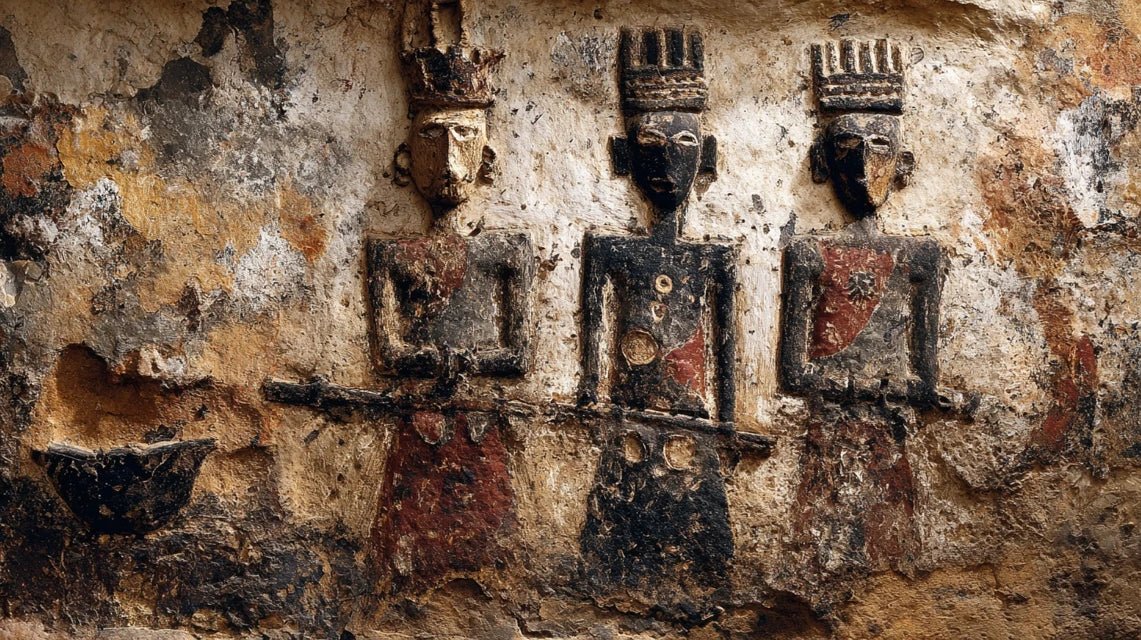
On the walls of sanctuaries and facades of toguna (meeting houses), Dogon artists draw millet in the form of dots, concentric circles or spirals. These motifs are never arbitrary. They materialize the 'world egg', this primordial principle from which all existence springs. When you observe a Dogon painting where seeds seem to float around an anthropomorphic figure, you are actually contemplating a representation of the moment when humanity emerged from the cosmic womb.
The eight original millet seeds, according to tradition, contained the eight prime ancestors of the Dogon. This symbolism of millet in Dogon paintings is found in compositions where eight points surround a central silhouette: it is humanity in its entirety that expresses itself through this seemingly simple motif.
Fertility and rebirth: millet as a promise of life
Beyond cosmic creation, millet embodies in Dogon art perpetual fertility. This cereal, which grows even in the most arid conditions of the Sahel, symbolizes the ability of life to triumph over adversity. Dogon paintings exploit it with remarkable visual intelligence.
In scenes depicting agricultural rituals, the symbolism of millet in Dogon paintings is manifested by cascades of seeds falling from the hands of ancestors or deities. These compositions simultaneously evoke beneficial rain, seed and divine blessing. Millet then becomes a bridge between heaven and earth, between invisible forces and the tangible world.
The sacred femininity of the grain
Dogon paintings frequently associate millet with the female figure. On the interior walls of dwellings, you can find compositions where silhouettes of women blend with ears of millet, their bodies extended by graceful stems. This visual fusion expresses the symbolism of millet in Dogon paintings as the very essence of female fertility.
The bellies of women, in these representations, often contain stylized millet seeds: a powerful metaphor that links human motherhood to the agricultural cycle. The continuity between plant germination and human generation structures all Dogon thought, and artists transcribe it with striking visual poetry.

Discover this inspiring artwork
The colors of millet: a palette rich in meaning
The symbolism of millet in Dogon paintings is considerably enriched by the choice of pigments. Dogon artists primarily use three colors to represent millet, each carrying its own significance.
White, obtained from kaolin, evokes green millet, original purity and connection with ancestors. In ritualistic paintings, white millet often appears around the figures of the Nommo, these water geniuses creators of cosmic order. The red ochre, extracted from laterite, represents ripe millet, gorged with sunshine, ready for harvest. It is the color of accomplishment, a promise kept. Finally, black, produced from charcoal mixed with organic binders, symbolizes transformed millet, cooked, which becomes food: the transmutation of raw material into vital energy.
These chromatic variations allow initiates to read Dogon paintings as a layered text. The symbolism of millet in Dogon paintings functions as a coded language where color modulates the spiritual message.
When seeds become stars: astronomy and agriculture
One of the most fascinating aspects of the symbolism of millet in Dogon paintings lies in the parallel between seeds and stars. The Dogon, famous for their sophisticated astronomical knowledge, have developed a system of correspondences where each type of seed corresponds to a celestial body.
In some mural paintings, particularly those adorning sanctuaries reserved for ceremonies of the Sigui (sixty-year cyclical celebration), millet appears arranged in configurations that reproduce constellations. These compositions directly link the agricultural calendar to celestial movements, inscribing the cultivation of millet within a cosmic choreography.
The symbolism of millet in Dogon paintings thus transcends the simple representation of agriculture to become a veritable treatise on agricultural astrology. The millet points on the walls function as a map of the sky, a painted almanac that guides planting and harvesting cycles.

Discover this inspiring artwork
Millet in painted masks: carrying creation on one's face
Dogon masks, veritable living sculptures during ritual dances, often bear millet motifs painted on their surface. This extension of the symbolism of millet in Dogon paintings to three-dimensional art illustrates the coherence of their aesthetic system.
The Kanaga mask, with its characteristic Lorraine cross, is frequently adorned with millet seeds painted along its branches. These seeds represent the souls of ancestors who accompany the dancer. The Sirigué mask, a huge structure that can reach six meters, features rows of painted millet symbolizing the celestial ladder allowing spirits to travel between worlds.
During funerals, the symbolism of millet in Dogon paintings takes on an eschatological dimension: the seeds painted on the masks guide the soul of the deceased to its next destination, marking the stages of its spiritual transmigration.
Let the ancestral wisdom of the Dogon illuminate your interior
Discover our exclusive collection of African paintings that capture the spiritual essence of this fascinating civilization and transform your walls into portals to millennial cosmologies.
Decoding compositions: how to read a Dogon painting
Now that you know the richness of the symbolism of millet in Dogon paintings, how can you identify it concretely? A few reading keys will allow you to decode these works with an initiated gaze.
Start by counting the seeds. The number is never random: four seeds evoke the cardinal points, seven represent the days of the week for the Dogon, eight refer to the primordial ancestors, and sixty symbolize the cycle of the Sigui. Spatial arrangement is just as important: spiral seeds suggest the original creative movement, while horizontal alignments evoke the fertile furrows of the fields.
Next, observe the relationship between the millet and the figures. When seeds surround a silhouette, they protect and sanctify it. When they emanate from a character, they manifest their generative power. The symbolism of millet in Dogon paintings functions as a visual grammar where position and number create meaning.
Finally, look at the overlapping layers. Dogon paintings are renewed during each important ceremony, creating a cultural stratigraphy. Older layers of painted millet sometimes appear beneath new ones, creating a palimpsest that materializes the temporal continuity between generations.
Integrating this wisdom into your space: Dogon art today
The symbolism of millet in Dogon paintings resonates surprisingly with our contemporary concerns. At a time when we are seeking meaning, connection with nature and narratives that transcend individualism, these works offer a rare spiritual depth.
Installing an authentic reproduction of a Dogon painting in your interior is inviting this cyclical wisdom into your daily life. These works work wonderfully in meditation spaces, libraries or bedrooms, where their soothing symbolism promotes introspection.
Prioritize artworks that faithfully reproduce natural pigments and traditional techniques. The symbolism of millet in Dogon paintings loses its power when distorted by industrial reproductions with garish colors. Instead, look for contemporary artists who perpetuate ancestral methods, creating an authentic bridge between tradition and modernity.
Imagine yourself every morning facing this golden seed which contains the entire universe. Imagine this daily reminder that every small gesture, like every grain of millet, participates in a larger cycle. The symbolism of millet in Dogon paintings offers you this cosmic perspective: you are not isolated, you are part of the great weaving of existence. Start today to cultivate this awareness by inviting this millennial art into your life. Observe, meditate, let these painted seeds re-seed your imagination.
Frequently asked questions about the symbolism of millet in Dogon paintings
How to recognize millet in a Dogon painting?
Millet generally appears in the form of small dots, circles or spirals in Dogon paintings. It is distinguished by its systematic repetition and geometric organization. Unlike other decorative motifs, the symbolism of millet in Dogon paintings is recognized by its association with human, animal figures or cosmic representations. The seeds are often painted white, ochre or black, according to their spiritual meaning. If you see dotted patterns arranged in significant numbers (4, 7, 8 or 60), you are probably facing a symbolic representation of millet. Don't hesitate to observe the overall composition: millet generally serves as a visual link between different elements, creating a cosmic unity in the work.
Why millet rather than another cereal in Dogon art?
Millet occupies this privileged place in the symbolism of Dogon paintings for reasons that are both practical and spiritual. Historically, millet has been a staple food of the Dogon people for millennia, perfectly adapted to the arid climate of Mali. But beyond this nutritional aspect, the symbolism of millet in Dogon paintings is rooted in the creation myth: it is precisely millet that Amma, the creator god, chooses to shape the universe. This cereal also possesses exceptional drought resistance, making it a natural symbol of resilience and triumphant life. Its tiny seeds nevertheless contain all the potential of a complete plant, a perfect metaphor for illustrating how the infinitely small contains the infinitely large. This botanical characteristic has profoundly marked Dogon philosophy and its artistic expression.
Can one collect authentic Dogon paintings?
The question of authenticity and ethics is essential regarding Dogon paintings. Traditional works painted directly on the walls of sanctuaries and homes are part of Mali's cultural heritage and cannot, of course, be collected. However, the symbolism of millet in Dogon paintings continues to inspire contemporary Malian artists who create works on portable supports (canvas, bark, wooden panels) while respecting iconographic traditions. These contemporary creations, made with natural pigments and according to ancestral techniques, offer an ethical and legal alternative. Always ensure that your acquisition comes from legitimate channels, directly supports artistic communities, and respects cultural heritage laws. Favor specialized galleries that can trace the origin of works and guarantee that artists are fairly compensated.