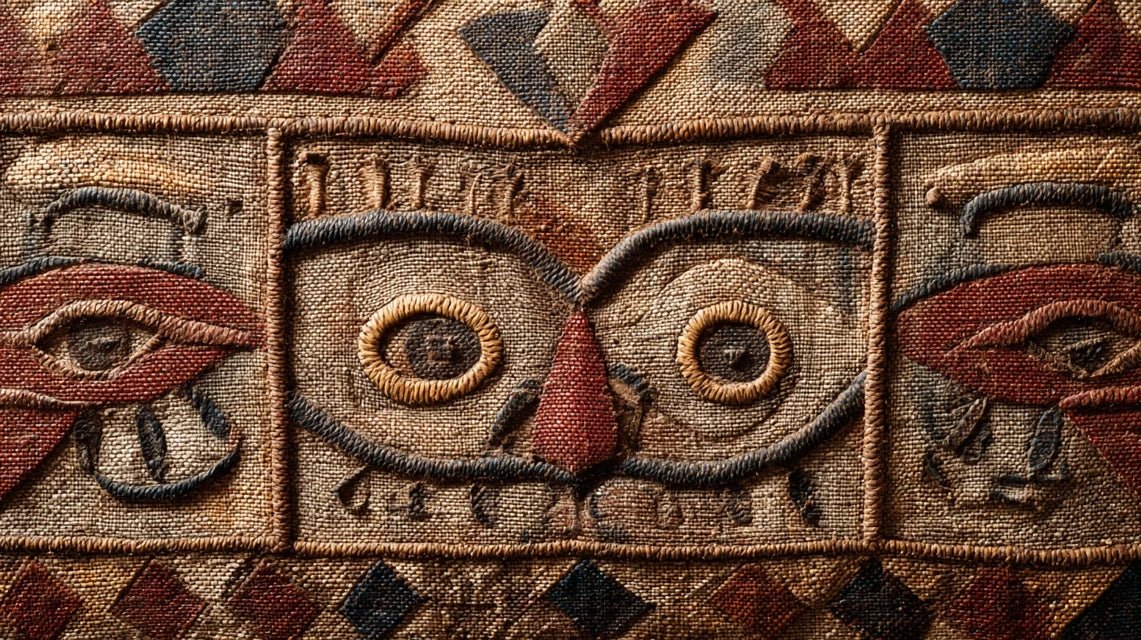
The first time my fingers brushed against an authentic Shoowa textile in the reserves of the Royal Museum for Central Africa in Tervuren, I felt an emotion that only textile archivists understand: this perfect geometry, these labyrinths of raffia woven with mathematical precision, told centuries of history without uttering a word. These fabrics are not mere decorations – they are the visual manuscripts of a civilization that transformed weaving into language.
Here's what the origin of Shoowa motifs from the Kuba kingdom reveals: the fascinating story of a people who codified their spiritual universe in every raffia fiber, created an aesthetic system of unparalleled sophistication in sub-Saharan Africa, and developed textile techniques that still challenge our modern production methods today.
You admire these hypnotic geometries in contemporary art galleries or decorating magazines, but you don't know anything about their deep meaning? You wonder why these Shoowa motifs exert such a powerful fascination on collectors and designers around the world? This lack of knowledge is perfectly normal – even specialists have taken decades to unravel the secrets of this textile tradition.
Rest assured: the origin of Shoowa motifs fits into a documented history that I will tell you, woven from archaeological discoveries, oral traditions, and remarkable technical innovations. After fifteen years spent cataloging African textiles and three research missions in the Kasaï region of the Democratic Republic of Congo, I will reveal how Shoowa women invented a unique visual language, how their motifs were passed down from generation to generation, and why these fabrics represent one of the peaks of African textile art.
The Kuba kingdom: cradle of an extraordinary textile civilization
To understand the origin of Shoowa motifs, it is first necessary to locate the Kuba kingdom in its exceptional historical context. Founded at the beginning of the 17th century in what is now the Kasaï region, this kingdom developed a culture of astonishing richness – wood sculpture, embroidery, weaving, forging – which made it one of the major creative centers of Central Africa.
The Shoowa constitute one of the eighteen ethnic groups forming the Kuba confederation. Located southwest of the territory, they specialized in creating ceremonial textiles from exceptional quality raffia. Unlike other Kuba groups who mainly practiced applied embroidery, Shoowa weavers developed a unique technique combining weaving, cutwork embroidery and vegetable dyeing.
Historian Jan Vansina, who devoted his career to studying Kuba oral traditions, dates the emergence of this distinct textile tradition to around the 18th century. Shoowa motifs as we know them today are the result of a long technical and aesthetic evolution, fruit of innovations transmitted exclusively between women, from mother to daughter, from aunt to niece, in a rigorous apprenticeship system that could last several years.
Raffia: The Sacred Material of Shoowa Textiles
The origin of Shoowa motifs is inseparable from their support: raffia, this fiber extracted from the leaves of the raphia palm. In the humid forests of Kasai, Shoowa men harvested these fronds according to a precise calendar, then transformed them into threads of remarkable fineness. This preparation of raffia was already an art in itself: the fibers had to be scraped, softened, sometimes dyed before even weaving.
The basic weaving was generally carried out by men on horizontal looms, creating rectangular panels of natural raffia with standardized dimensions. But it was then that Shoowa magic operated: women took over these blank supports to create their complex geometric patterns, using a cross-stitch embroidery technique that gave the textiles their characteristic velvety texture.
The Birth of Geometric Patterns: Mathematics and Symbolism
The origin of Shoowa motifs is as much about mathematics as it is about spirituality. Contrary to a widespread belief, these geometries are not abstract or decorative: they constitute a system of codified signs, a true visual language where each form has a precise meaning.
Shoowa weavers have developed a geometric vocabulary of great sophistication: interlaced lozenges, rectangular labyrinths, zigzag broken lines, concentric spirals. These shapes are never arbitrary. They represent cosmological elements (the sun, the moon, the stars), natural phenomena (rain, rivers, lightning), or social concepts (friendship, rivalry, community harmony).
In the archives I consulted in Tervuren, several Shoowa textiles collected at the beginning of the 20th century bore valuable annotations: collectors had noted the vernacular names of some motifs. A toothed lozenge was called mbal (the knife), evoking protection. Interlocking triangles formed mbolo (dog's teeth), symbolizing vigilance. These denominations reveal that the origin of Shoowa motifs draws from a careful observation of the environment and social relations.
Controlled Improvisation: Creativity within Tradition
A fascinating aspect of the origin of Shoowa motifs lies in the subtle balance between tradition and personal innovation. Unlike Kuba kasai textiles that followed strict patterns, Shoowa creations allowed – and even encouraged – a certain improvisation.
A Shoowa weaver would typically begin her work with an approximate mental composition, but the pattern would evolve as she wove. This creative freedom explains why you never find two Shoowa textiles that are exactly alike. Each piece bears the creative signature of its author, while respecting fundamental aesthetic conventions: symmetry, balance of masses, contrast between light and shadow.
This tradition of controlled improvisation makes Shoowa patterns authentically contemporary works: each textile is a unique creation, where the hand and mind of the artist dialogue with materials and technical constraints, just as modern textile artists do today.

Discover this inspiring work
Ancestral techniques: the art of cutwork and dyeing
The origin of Shoowa patterns cannot be understood without examining the manufacturing techniques that make them possible. Cutwork embroidery constitutes the major innovation of Shoowa weavers. This method consists of embroidering on a basic raffia fabric with a thicker raffia thread, then cutting this embroidered thread on the surface to create a short velvet effect.
The process requires extraordinary patience. To produce a Shoowa panel of average size (approximately 55 x 60 centimeters), an experienced artist would have to work between 80 and 120 hours. Each stitch had to be placed with millimeter precision for the overall pattern to emerge correctly. Errors were almost impossible to correct without undoing hours of work.
The dyeing added another dimension to these creations. Shoowa weavers mainly used two natural dyes: ngola, extracted from a red wood producing Sienna and ochre tones, and mbula, derived from the plant of the same name, giving deep blacks. Some exceptional pieces incorporated up to five different shades, obtained through successive applications and complex mordanting.
The social role of Shoowa textiles: prestige and exchange
The origin of Shoowa patterns is also set within a particular economic and social context. These textiles were not used for everyday clothing – their value and complexity reserved them for specific ceremonial and symbolic uses.
Shoowa panels functioned as prestige currency in significant transactions: marriage settlements, compensation in disputes, tributes to the king. The more complex and finely executed the motifs, the higher the value of the textile increased. This economic dimension stimulated innovation: weavers constantly sought to create original compositions that would increase the value of their work.
These textiles also served as ceremonial garments for the Kuba nobility. Dignitaries wore them during ritual dances, tied around the waist, where their geometric patterns created striking visual effects in motion. Some panels also served as shrouds for important figures, accompanying the deceased into the afterlife.
The evolution of Shoowa motifs: encounters and transformations
The origin of Shoowa motifs is not fixed in a mythical past – it continues to evolve. As early as the 19th century, the arrival of European explorers and the intensification of contacts with Arab traders introduced new materials and influences.
Anthropologist Emil Torday, who stayed in the Kuba kingdom in 1908, documented how some weavers began incorporating imported cotton threads into their creations, allowing for brighter colors – particularly scarlet reds impossible to obtain with local vegetable dyes. This innovation did not alter the essence of Shoowa motifs, but offered them new expressive possibilities.
In the 20th century, increasing demand from Western collectors also transformed production. Some artists began creating textiles specifically for the art market, sometimes increasing the dimensions of the panels or intensifying contrasts to appeal to foreign buyers. This evolution raises fascinating questions about authenticity and cultural adaptation.
The influence of Shoowa motifs in modern art
The origin of Shoowa motifs now extends far beyond the borders of Kasai. As early as the 1920s, European modernist artists – notably Paul Klee and Henri Matisse – were fascinated by these African geometries that resonated with their own abstract research.
More recently, contemporary designers have rediscovered the sophistication of Shoowa motifs. Creators such as Yinka Shonibare or Malick Sidibé have integrated these textile references into their work. In interior design, these patterns inspire wallpapers, upholstery fabrics and even tiles, proof of their aesthetic universality.
This global circulation raises an important ethical question: how to celebrate and disseminate the origin of Shoowa motifs without falling into cultural appropriation? The answer lies in recognition and fair remuneration: documenting the history of these creations, citing their precise origins, and supporting contemporary artists' communities who perpetuate these living traditions.
Transform your interior by celebrating these extraordinary textile heritages
Discover our exclusive collection of African paintings that pays homage to the artistic traditions of the continent, including faithful reproductions of authentic Shoowa motifs.

Discover this inspiring artwork
Preserving and transmitting: the future of Shoowa motifs
The origin of Shoowa motifs belongs to the past, but their future is being built today. In the Kasaï region, production conditions have radically changed. Conflicts, urbanization, and schooling have disrupted traditional transmission from mother to daughter. Few young Shoowa women are still learning these demanding techniques that take years of training.
Yet encouraging initiatives are emerging. Artists' cooperatives are being created, often with the support of cultural NGOs, to train a new generation and guarantee fair incomes. These contemporary structures allow weavers to perpetuate their art while adapting it to current economic realities.
Museums and cultural institutions also play a crucial role. Collections of Shoowa textiles preserved in Europe and America – sometimes controversial in their acquisition methods – now serve as references for young artists who wish to study ancient techniques. Several 3D digitization projects make it possible to document these fragile works with unprecedented precision.
The origin of Shoowa motifs teaches us a fundamental lesson: great artistic traditions do not arise from nothing, but from a rich cultural soil, progressive technical innovations, and patient transmission between generations. Preserving this heritage means not freezing it in an idealized past, but creating the conditions for it to continue to evolve and inspire.
Your perspective transformed on these millennial geometries
Now that you know the origin of Shoowa motifs, your perception of these textiles will never be the same. What appeared as simple decorative patterns reveals all its depth: hundreds of hours of patient work, knowledge passed down over centuries, a codified visual language linking everyday life to the sacred.
Each rhombus, each broken line, each play of symmetry holds within it this fascinating story of the Kuba kingdom and the creative genius of the Shoowa women. These textiles remind us that pre-colonial Africa produced works of art of equal – and sometimes superior – sophistication to European creations of the same era.
The next time you come across a Shoowa pattern – in a museum, gallery, or reinterpreted in contemporary design – take a moment to honor the hands that created it, the knowledge it embodies, and the extraordinary culture from which it emanates. And perhaps, inspired by this discovery, you will incorporate an element of this textile heritage into your own environment, creating a bridge between the forests of Kasai and your interior.
FAQ : Your questions about Shoowa patterns
How to recognize a genuine antique Shoowa textile?
Authenticating an antique Shoowa textile requires expert knowledge, but several clues can guide you. Authentic pieces always exhibit a subtle asymmetry – the geometric patterns, although visually balanced, are never perfectly symmetrical as would be industrial productions. Antique raffia has a characteristic earthy and vegetal smell, very different from cotton. The cutwork technique creates a unique velvety texture to the touch, with uneven thickness depending on the embroidered areas. Traditional vegetable dyes exhibit natural variations in tone, unlike uniform synthetic colorants. Finally, dimensions generally correspond to traditional Kuba standards: approximately 50-60 centimeters wide and 55-65 centimeters long. Pieces of very different sizes are often created for the Western market. If you are considering acquiring an antique Shoowa textile, always consult a specialist in African art who can examine its provenance, estimate its age, and verify that it has not been illegally exported.
Do all Shoowa patterns have a precise symbolic meaning?
This question divides specialists, and the answer is nuanced. Some Shoowa motifs do indeed have documented symbolic meanings: specific shapes represented cosmological concepts, natural phenomena, or social values. However, the exact symbolic interpretation varied according to family lineages and villages. The same geometric form could have slightly different meanings from one weaver to another. Moreover, pure aesthetic dimension played an important role: Shoowa artists also created for visual beauty, balance of forms, and harmony of contrasts, without necessarily loading each element with symbolism. One must be wary of overly systematic interpretations proposed by some merchants who attribute precise meanings to each motif – this approach often relates more to marketing than rigorous ethnography. What is certain is that these textiles functioned as a visual language within Kuba society, even if we no longer possess all the keys to reading them today.
Can we still find contemporary Shoowa textiles traditionally made?
Yes, but with important nuances. The production of Shoowa textiles according to traditional methods has never completely disappeared, although it has considerably decreased since the 1960s. Today, artists' cooperatives in the Kasaï region perpetuate these ancestral techniques, often with the support of international cultural organizations. These contemporary creations generally still use raffia as a raw material and traditional weaving and embroidery techniques, but can incorporate innovations: synthetic dyes to expand the color palette, dimensions adapted to the Western market, motifs reinterpreting classic canons. These contemporary textiles possess real cultural and artistic value, even if they cannot be considered antiques. To acquire them ethically, prioritize galleries specializing in contemporary African art that work directly with cooperatives and guarantee fair remuneration for artists. Organizations such as the Kuba Foundation or projects supported by UNESCO maintain catalogs of active artists. Acquiring these contemporary pieces helps to economically support communities that keep this extraordinary textile tradition alive while enriching your collection with an authentic and ethical piece.
Frequently Asked Questions
How to recognize a genuine antique Shoowa textile?
Authenticating an antique Shoowa textile requires specialized expertise, but several clues can guide you. Authentic pieces always exhibit a subtle asymmetry – the geometric patterns, while visually balanced, are never perfectly symmetrical as would be industrial productions. Antique raffia has a characteristic earthy and vegetal scent, very different from cotton. The cut-pile technique creates a unique velvety texture to the touch, with uneven thickness depending on the embroidered areas. Traditional vegetable dyes exhibit natural variations in tone, unlike uniform synthetic colorants. Finally, dimensions generally correspond to traditional Kuba standards: approximately 50-60 centimeters wide and 55-65 centimeters long.
Do all Shoowa patterns have a precise symbolic meaning?
This question divides specialists, and the answer is nuanced. Some Shoowa patterns do indeed possess documented symbolic meanings: specific shapes represented cosmological concepts, natural phenomena or social values. However, the exact symbolic interpretation varied according to family lineages and villages. Furthermore, pure aesthetic dimension played an important role: Shoowa artists also created for visual beauty, balance of forms and harmony of contrasts, without necessarily loading each element with symbolism. Be wary of overly systematic interpretations proposed by some merchants.
Can we still find contemporary Shoowa textiles traditionally made?
Yes, but with important nuances. The production of Shoowa textiles according to traditional methods has never completely disappeared, even if it has considerably reduced since the 1960s. Today, artists' cooperatives in the Kasaï region perpetuate these ancestral techniques, often with the support of international cultural organizations. These contemporary creations generally still use raffia as a raw material and traditional weaving and embroidery techniques, but may incorporate innovations. To acquire them ethically, prioritize galleries specializing in contemporary African art that work directly with cooperatives and guarantee fair remuneration to artists.