During an acquisition mission in Kasai in 2003, I held in my hands a raffia panel centuries old. The fibers, incredibly soft despite the passage of time, told the story of a sophisticated textile civilization that the West has long ignored. This moment changed my perception of African arts forever.
Here's what Congolese raffia textiles reveal: ancestral know-how passed down since the 16th century, weaving techniques of fascinating complexity, and a geometric aesthetic that inspires today's greatest contemporary creators.
Many think that African textile art is limited to wax prints or colorful boubous. This reductive vision obscures one of the most refined textile traditions on the continent: Congolese raffia work. For decades, collectors and museums have sought to understand the mysterious origins of these exceptional fabrics.
The good news? Ethnographic research and oral accounts now provide us with a fascinating account of the birth and evolution of this unique craft. Prepare to discover how a simple palm has been transformed into one of the most prized textiles in African history.
The Kuba Kingdom: Cradle of a Textile Revolution
The origin of Congolese raffia textiles takes us back to the heart of the Kuba kingdom, in present-day Kasai province. According to oral tradition, it was in the 16th century that King Shyaam aMbul aNgoong introduced raffia weaving after discovering it from neighboring peoples.
This visionary sovereign understood the extraordinary potential of this vegetable fiber. The raphia palm, abundant in the Congolese equatorial forests, offered a free and renewable raw material. Its leaves, once dried and treated, produced fibers of remarkable fineness.
Kuba women then developed weaving techniques of unparalleled sophistication. They invented a portable loom to create fabrics with complex geometric patterns. Each clan, each village developed its own distinctive motifs, transforming the textile into a true visual language.
The production of Congolese raffia quickly became more than just a utilitarian craft. These fabrics served as a medium of exchange, dowry, and social prestige insignia. Wearing finely embroidered raffia clothing immediately signaled your rank in Kuba society.
From Palm to Fabric: A Natural Alchemy
The manufacture of raffia textiles is a meticulous process that I was fortunate enough to observe during my stays in Congo. It all starts with the harvesting of young raphia palm leaves, picked before their complete maturation to guarantee the suppleness of the fibers.
Artisans delicately section the external membrane of the leaves to extract long strips. These fibers are then dried in the sun for several days, acquiring that natural ivory or ochre hue characteristic of natural raffia.
Next comes the fascinating step of vegetable dyeing. Kuba women master an impressive palette obtained from roots, barks and leaves: the deep red of tukula wood, the intense black of iron sludge, the bright yellow of gardenia roots. These colors, far from being innocuous, carry precise symbolic meanings.
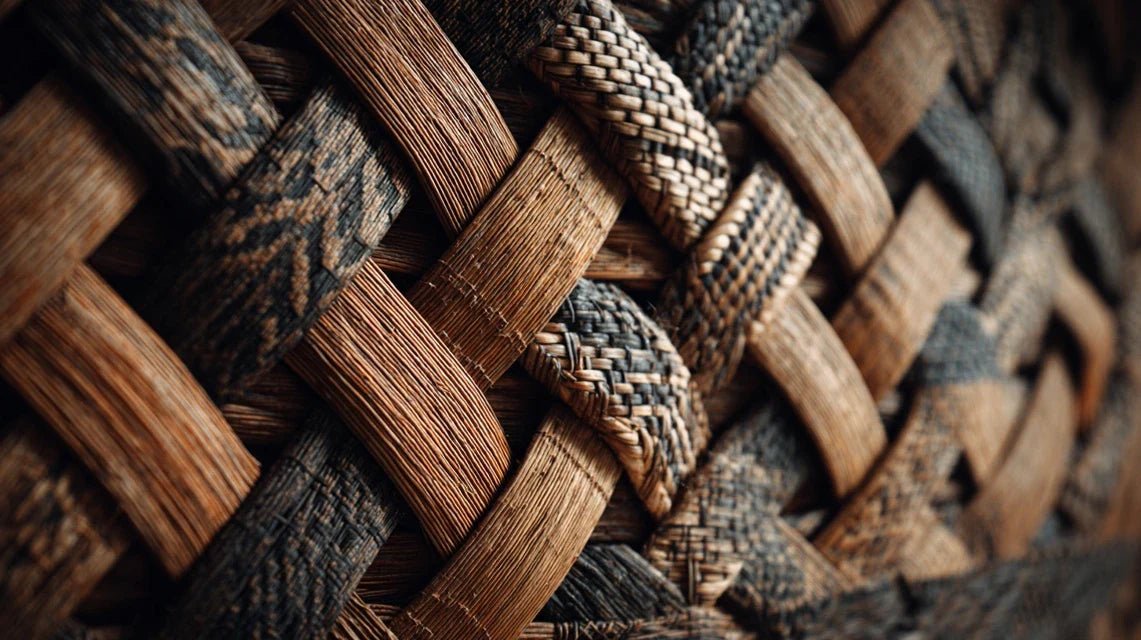
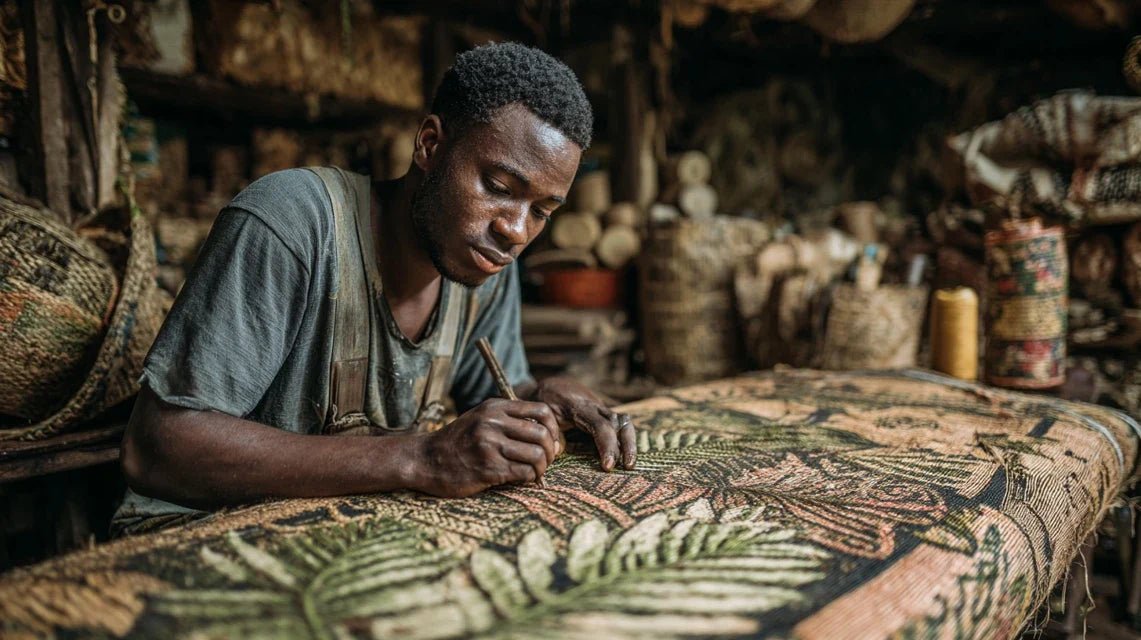
The weaving itself requires patience and precision. On their rudimentary but ingenious looms, the weavers interweave fibers according to geometric patterns passed down from mother to daughter. A single panel of Kuba textile can take several weeks of meticulous work.
Decoration techniques: excellence in detail
What truly distinguishes Congo raffia textiles are the decorative techniques applied after weaving. Flat stitch embroidery creates hypnotic geometric reliefs. Appliqué superimposes pieces of dyed raffia to form complex compositions.
The technique of plushing remains my favorite: artisans pull certain threads to create a luxurious velvet effect. When you caress these textured surfaces, you understand why European explorers compared them to the most refined Italian velvets.

Discover this inspiring artwork
When Europe discovers the Congolese textile genius
The history of raffia textiles takes a major turn in the 19th century with the arrival of the first European explorers in the Kuba kingdom. Emil Torday, a Hungarian ethnographer, brought back a spectacular collection to the British Museum in London in 1908.
The revelation is immediate: these Congolese fabrics defy all colonial prejudices about African art. Their technical sophistication rivals that of the best Eastern textiles. European artists, particularly Cubists and Expressionists, draw inspiration from them to renew their formal research.
Picasso himself owned several pieces of Kuba raffia in his Parisian studio. The geometric patterns of these textiles strangely resonate with the research on decomposition of forms that characterizes nascent Cubism. Coincidence? I don't think so.
Unfortunately, this belated recognition does not protect traditional craftsmanship. Belgian colonization disrupts the social structures of the Kuba kingdom. The introduction of cheap industrial fabrics threatens the transmission of ancestral raffia working techniques.
The different types of Congolese raffia: a universe of variations
Talking about Congolese raffia textiles in the plural is essential, as there is an extraordinary diversity of styles and functions. Kasai velvets feature this plush texture obtained by plushing that we mentioned, creating surfaces of exceptional softness.
The shoowa, produced by women from the ethnic group of the same name, are distinguished by their bold geometric compositions playing on contrasts between embroidered and unembroidered areas. Each shoowa piece is a unique abstract work of art, never two identical motifs.
The ntshak are ceremonial skirts composed of multiple panels sewn together, adorned with fringes and tassels. Worn during ritual dances, they produce a characteristic rustling that punctuates the movements. The sound is an integral part of the textile experience.
The mbala, funerary panels, serve to wrap high-ranking deceased individuals. Their motifs, generally more subdued, evoke the passage to the afterlife. Possessing beautiful funeral fabrics ensured a honorable transition to the world of ancestors.
The secret language of motifs
Each geometric motif engraved in raffia has a name and meaning. The imbol represents the dog, symbol of loyalty. The bomfila evokes bird footprints, recalling freedom. The dibongo depicts the brain, celebrating human intelligence.
This complex symbolism transforms each textile into a visual narrative. Offering a raffia fabric was never trivial: the chosen motifs conveyed specific messages that only initiates could fully decode.

Discover this inspiring artwork
Contemporary renaissance and new perspective
After decades of decline, Congolese raffia textiles have experienced an extraordinary resurgence since the 2000s. Avant-garde fashion designers such as Duro Olowu or Laduma Ngxokolo incorporate vintage raffia panels into their haute couture collections.
Interior designers, particularly sensitive to natural materials and objects steeped in history, frame pieces of antique raffia as abstract paintings. In sleek contemporary interiors, these textiles bring texture, depth, and a tangible connection with a centuries-old tradition.
In the Congo itself, initiatives for artisan revitalization are emerging. Women's cooperatives are reforming around raffia weaving, passing techniques on to younger generations. Cultural tourism, still timid, is creating new economic opportunities for these talented artisans.
Museums are also reevaluating their collections. The Metropolitan Museum of New York, the Musée du Quai Branly in Paris, or the Africa Museum in Brussels now present Kuba textiles not as ethnographic curiosities, but as fully-fledged textile masterpieces.
Let the spirit of Congo sublimate your spaces
Discover our exclusive collection of African paintings that capture the geometric richness and energy of ancestral textile traditions to transform your interior into a living art gallery.
Integrating the heritage of raffia into your world
Today, you don't need to embark on an expedition to the Kasai to enjoy the beauty of raffia textiles. Authentic pieces circulate on the African art market, accessible to passionate collectors and demanding decorators.
When choosing a raffia panel, look for the regularity of the weave, the fineness of the embroidery, the harmony of natural colors. Antique pieces often have a patina that adds to their character, but beware of crude imitations produced for mass tourism.
In a contemporary interior, a framed Kuba textile creates a striking focal point. Its artisanal nature contrasts beautifully with sleek designer furniture. Combine it with natural materials such as linen, rattan or terracotta to create a warm and sophisticated atmosphere.
Some daring decorators even use fragments of antique raffia to cover cushions or stretch wall panels. This approach requires caution and respect: these fragile textiles must be handled with the care given to works of art.
Imagine yourself in your living room, contemplating the hypnotic geometries of a textile centuries old. You are connected to generations of women artists whose patient hands have transformed vegetable fibers into visual poetry. It is this human connection, beyond aesthetics, that makes Congo raffia textiles so precious.
The heritage of Congolese raffia reminds us of an essential truth: artisanal excellence knows no borders or hierarchy. The Kuba weavers have created, with simple means and exceptional mastery, works that cross the centuries and still inspire today. By welcoming these textiles into our lives, we honor their genius and participate in the preservation of irreplaceable know-how.
Start by visiting ethnographic museums near you. Observe closely the texture, density, and sophistication of the patterns. Let yourself be touched by these creations. Then, when you are ready, treat yourself to an authentic piece that will tell the fascinating story of the Kuba kingdom in your interior.
Frequently Asked Questions about Congolese Raffia Textiles
What is the difference between Congolese raffia and other African raffias?
The Congolese raffia, particularly that of the Kuba kingdom, is distinguished by its exceptional technical sophistication. While other regions of Africa use raffia for utilitarian objects (baskets, hats, ropes), the Kuba artisans have developed weaving, embroidery, and plushing techniques of unparalleled complexity. The density of the weave, the fineness of the fibers, and above all the elaborate geometric patterns make Kuba textile a category apart. Moreover, the symbolic system attached to the motifs and the ceremonial use of these fabrics (currency, dowry, funerals) give them a unique cultural dimension. Malagasy or West African raffia textiles, although beautiful, generally remain more rustic and functional.
How to authenticate a genuine antique Congolese raffia textile?
Authenticating antique raffia textiles requires careful observation of several criteria. First, examine the regularity of the weave: authentic pieces have an impressive density, with sometimes more than 100 threads per centimeter. Natural dyes develop over time a characteristic patina, subtle nuances impossible to reproduce artificially. Also observe the wear: it must be consistent and natural, not simulated. The patterns should be complex and asymmetrical - industrial geometric perfection betrays modern manufacturing. Finally, antique pieces often have a slight distinctive vegetal smell. If in doubt, consult an expert or a reputable African art dealer. Museum pieces generally have documented provenance that guarantees their authenticity.
How to maintain and preserve a Congolese raffia textile?
The preservation of raffia textiles requires precautions similar to those for European antique textiles. Absolutely avoid direct exposure to sunlight, which discolors vegetable dyes and weakens the fibers. Excessive humidity promotes mold, while extreme dryness makes the fibers brittle: aim for 50-60% relative humidity. For dusting, use a soft brush or a vacuum cleaner set to minimum with protective gauze. Never wash an antique raffia textile with water: the plant fibers would be irreparably deformed. If you frame it, use anti-UV glass and leave space between the textile and the glass to allow for air circulation. Always handle these pieces with clean, dry hands. For particularly fragile or valuable textiles, consult a restorer specializing in ethnographic textiles.