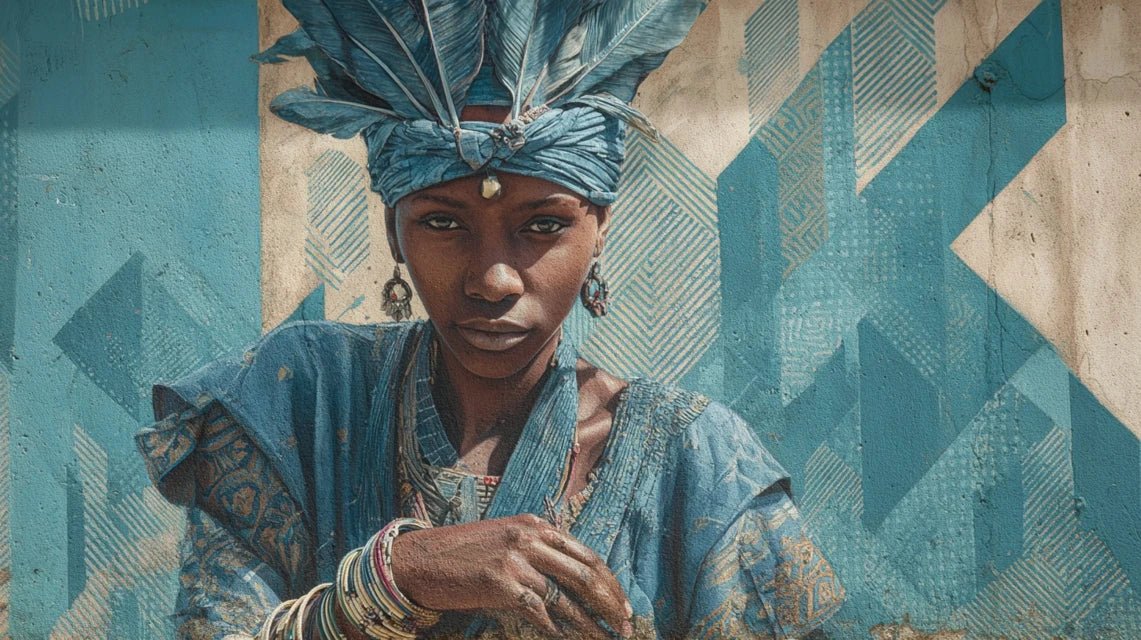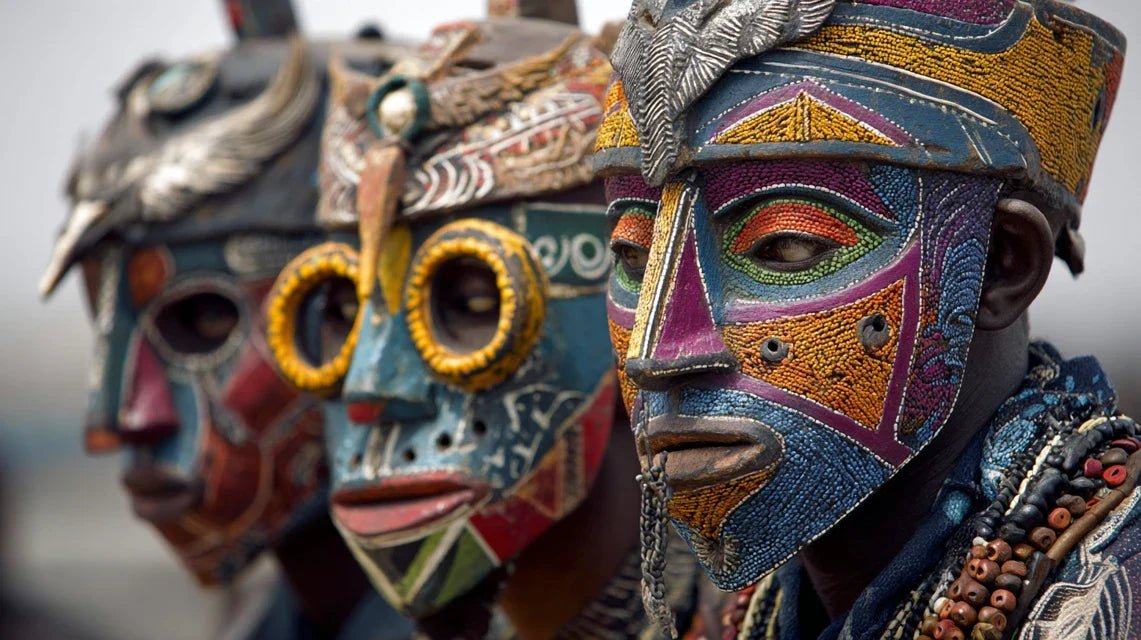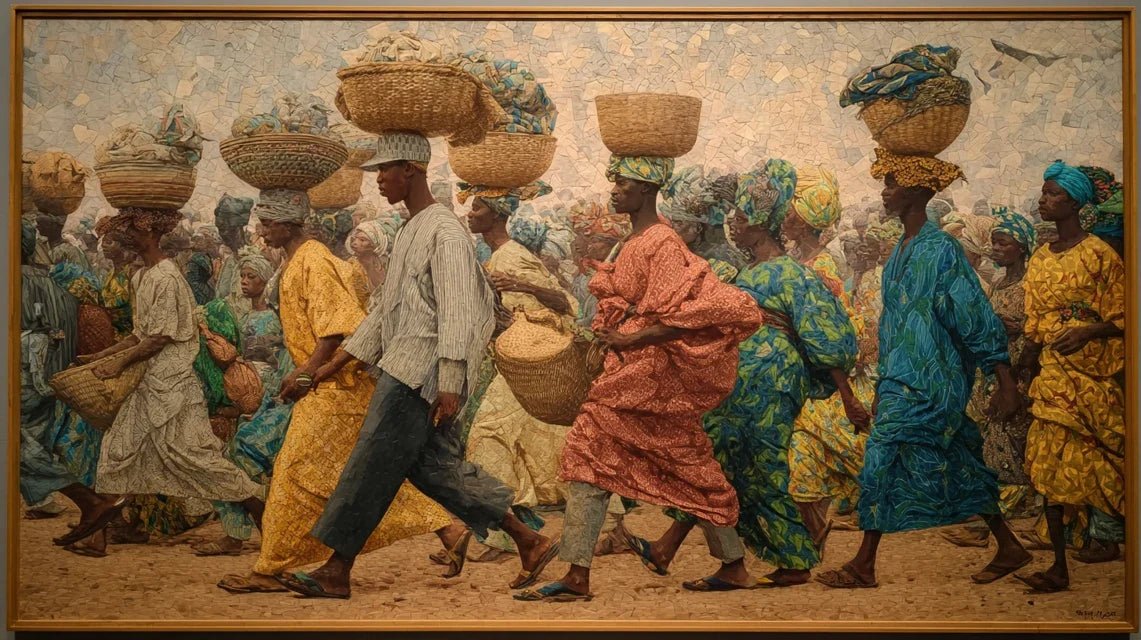
Faced with this African art painting, you are fascinated by these small white shells arranged in hypnotic patterns. These cowrie shells, much more than simple ornaments, tell a millennial story of wealth, spirituality and power. When a contemporary artist from Lagos or Dakar incorporates these pearlescent shells into their compositions, they awaken an entire symbolic universe that only initiates truly know how to decode.
Here's what cowrie shells bring to West African paintings: authentic cultural depth that transforms your wall into a portal to ancestral Africa, a symbolism of prosperity that attracts positive energy into your interior, and an artistic conversation between tradition and modernity that fascinates your guests.
You are drawn to these works that blend textures and African symbols, but you hesitate. Do these cowrie shells really have a precise meaning? Will you commit a cultural blunder by hanging this painting in your living room? This fear of missing the deep significance holds you back from investing in these magnetic pieces that have been calling to you for weeks.
Rest assured: understanding the symbolism of cowrie shells enriches your aesthetic experience without requiring years of ethnographic study. Contemporary artists from West Africa are creating precisely to transmit this heritage to the world. Deciphering these cultural codes allows you to fully appreciate the depth of your collection and share these captivating stories.
In this article, we explore together the fascinating meaning of cowrie shells in West African art: their history as sacred currency, their spiritual role in rituals, and how contemporary artists are reinventing these ancestral symbols to create works that dialogue with our modern interiors.
The currency that crosses the oceans: when cowrie shells were worth gold
Before banknotes and credit cards dominated our exchanges, cowrie shells reigned over West African economies. These small shells of the genus Cypraea moneta, native to the warm waters of the Indian Ocean and the Maldives, traveled for centuries to the African coasts to become the most widespread currency on the continent.
From the 13th to the early 20th century, cowrie shells circulated from Senegal to Nigeria, facilitating all commercial exchanges. A bag of cowrie shells represented a tangible fortune, measurable by weight. In the markets of Abomey, Timbuktu or Kumasi, these pearlescent shells were meticulously counted to buy precious fabrics, rare spices or livestock.
This economic value still permeates contemporary paintings today. When a Beninese artist composes a work scattered with cowrie shells, they summon this collective memory of prosperity and abundance. Each shell becomes a micro-promise of wealth, a wish for material fortune passed down through generations. Arrangements in spirals or lines evoke these ancestral counts, these commercial rituals where each cowrie counted.
The symbolic weight in contemporary art
Artists from West Africa brilliantly play with this economic dimension. On a canvas, cowrie shells arranged in concentric circles can represent the accumulation of wealth, while a single shell at the center of a minimalist composition questions our relationship to value and scarcity. This ambiguity is fascinating: the cowrie is both ordinary and precious, small and powerful.
Beyond Commerce: Cowries as Spiritual Portal
But reducing cowries to their monetary function would be missing out on their most captivating dimension. In Yoruba, Akan, and Bamana cosmologies, these shells are intermediaries between the visible and invisible worlds. Their ovoid shape, their toothed opening, their milky whiteness: all evoke fertility, sacred femininity, the mystery of creation.
Voodoo priestesses in Benin traditionally use cowrie shells for divination, casting these shells on woven mats to read the future and communicate with ancestors. This millennial practice of fa or ifa transforms each cowrie into a letter of a cosmic alphabet. Their position, their orientation reveal encoded messages that only initiates decipher.
In contemporary paintings, this spiritual charge manifests in almost mystical compositions. Cowrie shells arranged in geometric patterns recall the voodoo veves, symbols drawn to invoke spirits. Other artists create shell mandalas, inviting meditation and connection with something beyond us. Hanging such a work is introducing into one's home a window onto African sacredness, a daily reminder that the material world constantly dialogues with the invisible.

Discover this inspiring artwork
When Shells Tell of Femininity and Power
The shape of the cowrie irresistibly evokes female anatomy, and this resemblance has never escaped the peoples of West Africa. The shell becomes a symbol of fertility, motherhood, feminine creative force. Women traditionally wore cowrie adornments during important ceremonies: weddings, births, initiations.
This association with sacred femininity deeply permeates contemporary art. Artists like those working in Cotonou or Accra create portraits of African women whose jewelry, hairstyles, or clothing incorporate real cowrie shells glued to the canvas. These compositions celebrate African feminine power, this quiet strength that has sustained societies through colonial and postcolonial trials.
Cowrie shells also evoke royal power. The rulers of the Kingdom of Dahomey adorned their thrones, scepters, and ceremonial garments with thousands of these shells. The more cowries a monarch possessed, the more incontestable their authority. This dimension of prestige and social status is reflected in Afro-contemporary inspired paintings: majestic compositions where cowrie shells form crowns, halos, coats of arms that reinvent the codes of royalty for our time.
How contemporary artists are reinventing the language of cowries
Contemporary West African art is experiencing an absolutely fascinating period. Artists from Lagos, Dakar, Abidjan or Ouagadougou do not simply reproduce ancestral motifs: they deconstruct them, question them, and fuse them with globalized aesthetic codes. Cowrie shells then become bridges between tradition and modernity.
Some creators mix real cowrie shells and mixed media: acrylic, ink, collage, recycled materials. The shell literally emerges from the canvas, creating tactile reliefs that invite touch. Others prefer pictorial representation, painting hyper-realistic cowrie shells in abstract compositions that play with scales and perspectives.
Symbols in the service of contemporary messages
The genius of this generation of artists lies in their ability to load cowrie shells with new meanings while preserving their historical depth. A painting can use these shells to evoke the African diaspora, cowries becoming a metaphor for Africans scattered across the oceans by trade. Other works question globalization, cowrie shells symbolizing the economic flows that continue to exploit Africa's resources.
This polysemy makes each painting unique in its discourse. Two compositions using cowrie shells can convey radically different messages depending on the color context, the density of the shells, and their spatial organization. It is this interpretative richness that fascinates collectors of contemporary African art.

Discover this inspiring work
Integrating cowrie shells into your decor: beyond aesthetics
Choosing a shell-adorned painting for your interior transcends simple decoration. You welcome a work imbued with collective memory, an object that carries centuries of history, spirituality and cultural resilience. This depth radically transforms the atmosphere of a space.
In a contemporary living room with clean lines, a large painting with shells creates a magnetic focal point. Visitors instinctively approach, intrigued by these unusual textures. It's an opportunity to share the stories you have discovered, to pass on knowledge of African symbolism. Your wall becomes a support for conversation, cultural transmission.
Shells work particularly well in spaces dedicated to reflection: offices, libraries, meditation corners. Their spiritual charge invites inner calm, connection with something greater. The natural tones of the shells – cream white, golden beige – harmonize with neutral palettes while bringing that touch of cultural authenticity lacking in overly standardized interiors.
Create a dialogue between African pieces
If you already collect African art objects – masks, sculptures, textiles – a painting with shells orchestrates a coherent visual dialogue. The different pieces respond to each other, creating a spatial narrative that celebrates the diversity of artistic expressions on the continent. Shells, a transversal symbol recognized from the Atlantic to inland areas, unifies these different aesthetic traditions.
Transform your interior into a living cultural gallery
Discover our exclusive collection of African paintings that celebrate the symbolic richness of shells and West African traditions.
Shells as a manifesto: choosing cultural authenticity
In a decorative world saturated with industrial reproductions and symbols devoid of meaning, opting for a painting that truly integrates the symbolism of shells is a committed choice. You reject surface decoration to embrace cultural authenticity and historical depth.
This approach is part of a broader movement to value contemporary African arts. For too long, the art of the continent has been relegated to ethnographic categories, denied its ability to dialogue with global artistic trends. Contemporary artists who work with shells demonstrate the contrary: they create works that speak simultaneously to international aesthetic codes and specific cultural heritage.
Collecting these pieces is participating in this recognition, supporting creators who are reinventing African visual languages. Each acquisition becomes a vote for cultural diversity, for the circulation of imaginations beyond dominant Western artistic circuits. Your walls bear witness to this openness, this curiosity for artistic expressions that carry different stories.
Preserving and transmitting: your painting as heritage
A West African painting adorned with cowrie shells does not depreciate over time: it is enriched by your own story with it. Contemporary African artworks often gain cultural and financial value over the years, particularly when artists acquire international recognition.
But beyond the patrimonial dimension, these paintings become family heirloom objects. Imagine telling your children or grandchildren the meanings of cowrie shells, explaining to them these journeys of seashells from the Indian Ocean, divination rituals, ancestral markets. You are passing on more than just a decorative object: you are bequeathing knowledge, intercultural sensitivity, an openness to the world.
Cowrie shells, which have served for centuries to transmit wealth and knowledge from generation to generation, continue their mission in your home. They carry this ancestral function of temporal link, connecting past, present and future in a powerful symbolic continuity.
Choosing a painting with cowrie shells is ultimately choosing depth over superficiality, storytelling over empty decoration, cultural connection over globalized uniformity. It's inviting into your home these little white messengers who, for millennia, have been telling the story of Africa in all its complexity, spirituality and splendor.
Frequently asked questions about cowrie shells in African art
Are the cowrie shells on the paintings authentic or painted?
Both approaches coexist in contemporary West African art, and each has its artistic legitimacy. Some creators prefer to use real cowrie shells that they glue onto the canvas, creating fascinating tactile reliefs and direct material authenticity. These mixed media works play on three-dimensionality and almost invite touch. Other artists choose to paint the cowrie shells with striking realism, integrating these symbols into purely pictorial compositions. This approach allows for impossible scales with real shells – imagine giant or microscopic cowrie shells – and facilitates techniques such as transparent superimpositions. Both methods respect the deep symbolism of cowrie shells while offering different visual experiences. When making your choice, let yourself be guided by your sensitivity: do you prefer the physical presence of the shell or the artist's pictorial interpretation?
Can I hang a cowrie shell artwork in any room?
Absolutely, and it's even encouraged! Unlike some African ritual objects that have specific placement rules in their traditional context, contemporary artworks incorporating cowries are created precisely to adapt to modern interiors, whatever they may be. Their positive symbolism – prosperity, protection, fertility – lends itself to all living spaces. In a living room, they create a remarkable conversational focal point. In a bedroom, their spiritual dimension soothes and promotes serenity. An office benefits from their association with financial abundance, inherited from their ancestral monetary function. Even in a bathroom or kitchen, if the style allows, these works bring a touch of sophisticated culture. The only real question concerns the preservation of the work: avoid excessive humidity if the artwork contains genuine cowrie shells glued on, as the shells, although resistant, could detach over time under extreme conditions.
How to know if an artwork authentically represents West African culture?
This question reveals admirable cultural sensitivity! Authenticity in contemporary African art is not measured by a rigid specification, but by several subtle indicators. Prioritize artists from West Africa or the African diaspora directly connected to these cultural heritages – their work naturally carries intimate knowledge of symbolism. Find out about the artist's approach: does he use cowries as a simple exotic decorative motif, or does his practice involve deeper reflection on identity, memory, and African spirituality? Galleries and shops specializing in contemporary African art, like serious themed collections, generally work with creators whose cultural legitimacy is established. Be wary of works that accumulate stereotypes and clichés – masks, wild animals, cowrie shells – in a decorative escalation without coherence. Cultural authenticity often manifests itself through a certain sobriety, a thoughtful composition where each element carries meaning. Finally, trust your feeling: authentic artworks generally exude a presence, a depth that transcends the simple visual impact.