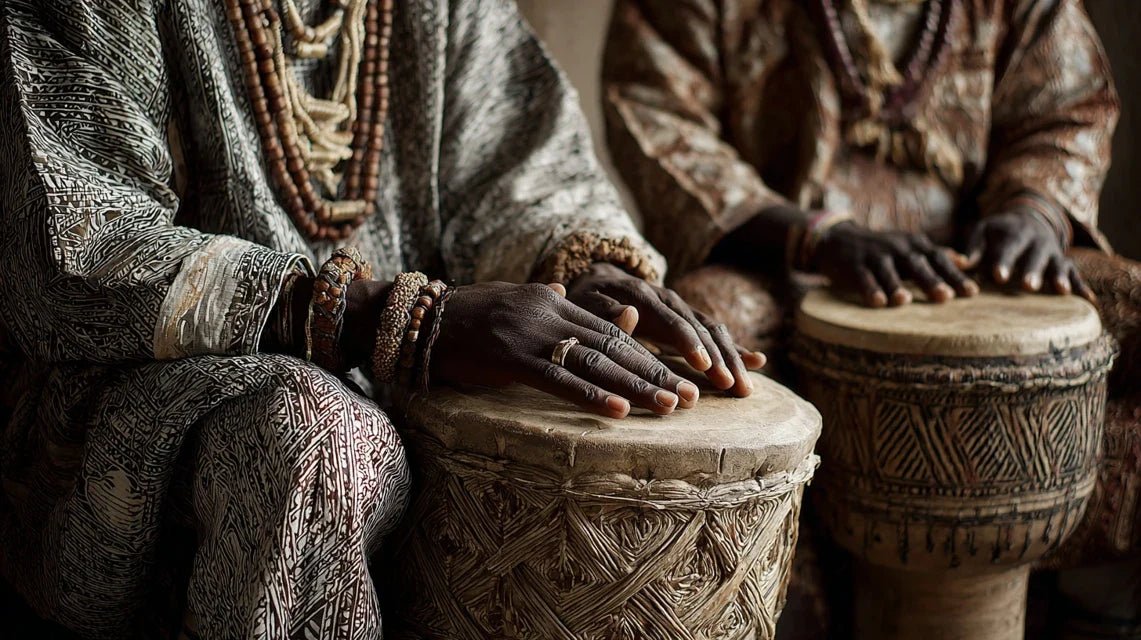
The first time I contemplated an Akan drum in a private collection in Abidjan, I realized that I was not simply looking at a musical instrument. Its engraved patterns told stories of generations of power, its curves echoed the history of a kingdom, and its silent presence commanded respect as few decorative objects can. The drum in coastal African kingdoms is not just a decorative element – it's a sculpted language, a symbol of legitimacy, a work of art that transforms every space into sacred territory.
Here's what the symbolism of the drum in the decorative art of coastal African kingdoms brings to your interior: an authentic connection with millennial traditions, unparalleled visual sophistication that dialogues with contemporary art, and a narrative depth that transcends simple decoration to create a true cultural conversation starter.
Many lovers of African art hesitate in front of these pieces, intimidated by their symbolic charge, fearing making a cultural blunder or reducing a sacred object to a mere decorative accessory. This apprehension is understandable but should never deprive you of the richness these works bring. Understanding the symbolism of the drum means honoring its heritage while integrating it with respect into a contemporary universe. I promise that at the end of this article, you will know exactly how these drums function as historically charged decorative elements, and how their presence can transform your space.
The royal drum: much more than an instrument, a sonic scepter
In the coastal kingdoms of West Africa – from Ghana to Benin, passing through Côte d'Ivoire – the royal drum literally embodies the voice of power. The Akan, the Fon, and the Ewe have developed a tradition where certain drums can only be struck in the presence of the king or during state ceremonies. Their very form, often anthropomorphic with a silhouette reminiscent of the human torso, evokes the person of the sovereign.
The atumpan drums of the Ashanti, for example, are always presented in pairs – male and female – creating a visual and symbolic dialogue. Their sculpted decoration incorporates royal proverbs: a crocodile holding a fish symbolizes undeniable authority, while interlocking geometric patterns represent the unity of the kingdom. Each decorative element is an ideogram, transforming the surface of the drum into a three-dimensional manuscript.
In a contemporary interior, an authentic royal drum or a respectful reproduction instantly becomes a focal point. Its sculpted verticality dialogues beautifully with modern lighting fixtures, while its natural patinas – tweneboa wood aged by time, amber-toned stretched leather – bring an organic warmth that industrial materials cannot match.
The visual codes engraved in the wood: deciphering the art of sculptors
The symbolism of the drum unfolds in a vocabulary of remarkable visual precision. The sculptors of coastal kingdoms never adorn haphazardly: each motif belongs to a system of signs understood by all. Ascending spirals evoke growth and prosperity, broken lines represent obstacles overcome by ancestors, while checkerboards symbolize duality – life and death, earth and sky, visible and invisible.
I spent hours documenting the Adinkra motifs engraved on the ceremonial drums of the Akan people. The symbol Sankofa – this mythical bird that turns its head backward – appears frequently on the bodies of the drums, reminding us that we must look to the past to build the future. The Gye Nyame, this complex pictogram meaning 'except God', often adorns the base of royal drums, anchoring temporal authority in spiritual legitimacy.
These symbols are never simply decorative – they constitute a visual writing that transforms the drum into a historical document. In your living space, a drum bearing these signs becomes an object of visual meditation, revealing new layers of meaning with each contemplation. Its dialogue with modern art is fascinating: the geometric abstractions favored by a Mondrian find their precedents in these centuries-old drums.

Discover this inspiring work
When the skin speaks: materials and tactile symbolism
The membrane of the drum – usually made of antelope, goat or cowhide – also carries a symbolic charge. In coastal kingdoms, the choice of animal is never arbitrary. Antelope hide, thin and nervous, produces high-pitched sounds reserved for warning messages or joyful celebrations. Beef leather, thicker and deeper, accompanies funeral ceremonies and ancestor rituals.
Traditional tanning techniques use decoctions of tree bark that create chromatic variations ranging from light honey to deep brown. These natural nuances, impossible to reproduce industrially, give each drum a unique visual signature. Over time, the skin patinates, cracks delicately, telling its own story of use and respect.
For a collector or design enthusiast, this organic materiality offers a striking contrast with the smooth and impersonal surfaces of modern interiors. An authentic coastal drum introduces a vibrant texture, an almost sensual presence that humanizes the space. Placed near a natural linen sofa or a raw wood table, it creates a material conversation where each surface dialogues with the other.
The sacred geometry of coastal realms: proportions and harmony
One of the most fascinating aspects of the symbolism of the drum lies in its mathematical proportions. The master sculptors of the coastal kingdoms followed precise canons, passed down orally from generation to generation. The ratio between the height of the barrel and its diameter is never arbitrary – it follows harmonic rules that recall the golden number of European architects.
The Bata drums of the Yoruba kingdoms, although technically originating from more eastern regions, have profoundly influenced coastal traditions. Their bi-conical shape – two truncated cones joined by their base – creates a sculptural silhouette that fascinates contemporary designers. This geometry is not accidental: it symbolizes the meeting between the celestial world and the terrestrial world, the drum serving as a sonic bridge between dimensions.
In a clean Scandinavian or minimalist Japanese interior, a coastal drum naturally finds its place thanks to this rigorous geometry. Its pure lines dialogue with modern architecture, while its sculptural verticality animates the space without cluttering it. Placed in a strategic corner, illuminated by grazing light that accentuates the sculpted reliefs, it becomes a living sculpture.

Discover this inspiring artwork
Colors and pigments: the symbolic palette of coastal artisans
While natural wood often dominates, some ceremonial drums of the coastal kingdoms receive applications of natural pigments charged with meaning. Red obtained from camwood or laterite is evocative of blood, vital force, war, and fertility. Kaolin white represents spiritual purity, connection to ancestors, wisdom. Charcoal black symbolizes maturity, completion, mystery.
The Egun drums used in the voodoo cults of Benin often feature white pigment applications forming eye motifs – these 'eyes' allow the drum to 'see' spirits and facilitate their communication with the living world. This decorative tradition transforms the instrument into a quasi-living being, endowed with perception and agency.
For lovers of contemporary tribal art, these colorful applications create powerful visual accents in a neutral interior. A drum with touches of red ochre and kaolin white brings exactly the necessary color notes without falling into chromatic overload. It is a discreet sophistication that reveals its richness upon careful observation.
Integrating the symbolism of the drum into your decorative universe
The question that all my clients ask: how to respect the symbolic charge of these objects while integrating them harmoniously into a contemporary interior? The answer lies in intentionality. A royal drum is not a trinket to be carelessly placed on a cluttered shelf. It deserves a location that honors its original function as a ceremonial focal point.
Privilege places of contemplation: a niche lit by indirect light, a pedestal near a window where natural light dances with the shadows of sculpted reliefs, a corner of the room where the drum dialogues with a few carefully selected art books. Absolutely avoid framing it with disparate decorative objects – the symbolism of the drum requires space to breathe.
The association with contemporary art works wonderfully: an Akan drum near an abstract lithograph, a Fon drum facing a black and white photograph by Seydou Keïta. These intercultural dialogues create visually rich spaces without falling into ethnographic pastiche. You are not recreating an African village in your living room – you are creating a sophisticated aesthetic conversation between tradition and modernity.
Transform your interior into a gallery of visual narratives
Discover our exclusive collection of African paintings that perfectly dialogue with the symbolic richness of coastal traditions and create spaces full of history and beauty.
The living heritage: the drum in contemporary creation
The symbolism of the drums from the coastal kingdoms does not belong to the past – it inspires today a generation of African artists and designers who reinterpret these ancestral codes. Creators such as El Anatsui in Ghana or Romuald Hazoumé in Benin integrate visual elements borrowed from traditional drums into monumental installations that circulate in the world's leading art institutions.
This creative continuity fully legitimizes the integration of these forms into our contemporary interiors. You are not freezing a dead tradition in museum formaldehyde – you are participating in a living dialogue between past and present. An authentic drum or a contemporary work inspired by this tradition then becomes a temporal bridge, linking the workshop of an 18th-century sculptor to the designer of the 21st century.
Some contemporary furniture designers draw directly on the proportions and motifs of coastal drums to create side tables, luminaires or decorative sculptures. These hybrid creations offer an alternative for those who want to integrate this symbolism without acquiring antique objects, while supporting a living artistic creation rooted in African cultural heritage.
Visualize your space transformed
Imagine your living room in the golden light of dusk. In the corner you never knew how to dress, an Akan drum stands with dignity, its Adinkra motifs capturing the last rays that make the wooden reliefs sing. Your guests approach, intrigued by this sculptural presence. You tell the story of the Sankofa symbol, this look back at the past that illuminates the future. The conversation deepens, exceeding the usual banalities. Your space is no longer simply elegant – it is a carrier of narrative and cultural depth.
This transformation is within your reach. Start by documenting yourself on the different traditions of the coastal kingdoms, visit galleries specializing in African art, learn to recognize the main symbols. A single drum, chosen with discernment and placed with intention, is enough to transform the atmosphere of an entire room. You do not accumulate – you select a piece that authentically dialogues with your aesthetic sensitivity and cultural curiosity.
The symbolism of the drum in the decorative art of African coastal kingdoms reminds us that the most powerful objects are those that carry stories. In a world saturated with ephemeral decoration and interchangeable trends, these drums offer something rare: temporal depth, beauty sculpted by generations of artisans, a presence that never goes out of style because it transcends fashion. It is this timelessness that you invite into your home – and it will transform your view of what an interior can truly be.
Frequently asked questions about the symbolism of the drum
Is it disrespectful to use an African drum as a decorative element?
This concern is a testament to commendable cultural sensitivity, and I encounter it constantly. The answer depends entirely on your approach. Using a drum as a mere exotic trinket without understanding its significance would indeed be reductive. On the other hand, acquiring it after you have educated yourself about its symbolism, placing it with intention in a space where it can be contemplated and admired, sharing its story with your guests – this constitutes a form of cultural respect and preservation. The African contemporary artisans and artists I know appreciate that their traditions find enlightened admirers beyond their communities of origin. The key lies in education: learn the history of your piece, understand its symbols, honor its heritage through your knowledge. A drum in your interior can become a cultural ambassador that sparks curiosity and learning – it is anything but disrespectful.
How to distinguish an authentic drum from a tourist reproduction?
This question is crucial because the market is full of reproductions of varying quality. Authentic drums from coastal kingdoms have several distinctive characteristics. First, the patina of the wood: an ancient drum shows consistent wear, with darker areas where hands have handled it for decades. Tourist reproductions often have a uniform and artificial finish. Next, examine the precision of the carved motifs: traditional symbols follow codified proportions and are executed with obvious technical skill. Cheap copies feature approximate patterns, sometimes mixed in a way that is inconsistent. The membrane itself reveals a lot: authentic leather shows natural irregularities and tension achieved through a complex system of cords, while reproductions often use synthetic skins or simplified fixings. My advice: always buy from specialized galleries or reputable dealers who can provide documented provenance. An authentic drum represents an investment, but it is a piece that retains its value and will accompany you throughout your life.
With which interior styles do African drums harmonize best?
This is where the symbolism of the drum reveals its surprising versatility. Contrary to what one might think, these objects do not work solely in ethnic or tribal style interiors. Their sculpted geometry and harmonious proportions dialogue beautifully with contemporary minimalism – think of an Akan drum in a loft with white walls and a few sleek Scandinavian pieces, creating a focal point of remarkable power. Industrial style, with its raw materials and high ceilings, perfectly welcomes the sculptural verticality of drums. Even in a classic or Haussmannian interior, a well-chosen drum brings a note of sophisticated eclecticism that avoids the monotony of all antique. The mistake to avoid: ethnographic overload. A masterful drum loses its impact if it is drowned in a pile of masks, kente fabrics and figurines. Treat it as the contemporary art sculpture it fundamentally is – give it space, light, a few carefully selected visual neighbors. The golden rule: fewer objects, more impact. Your drum does not decorate your interior – it structures it, gives it meaning, creates a spatial narrative around which everything else harmoniously organizes.