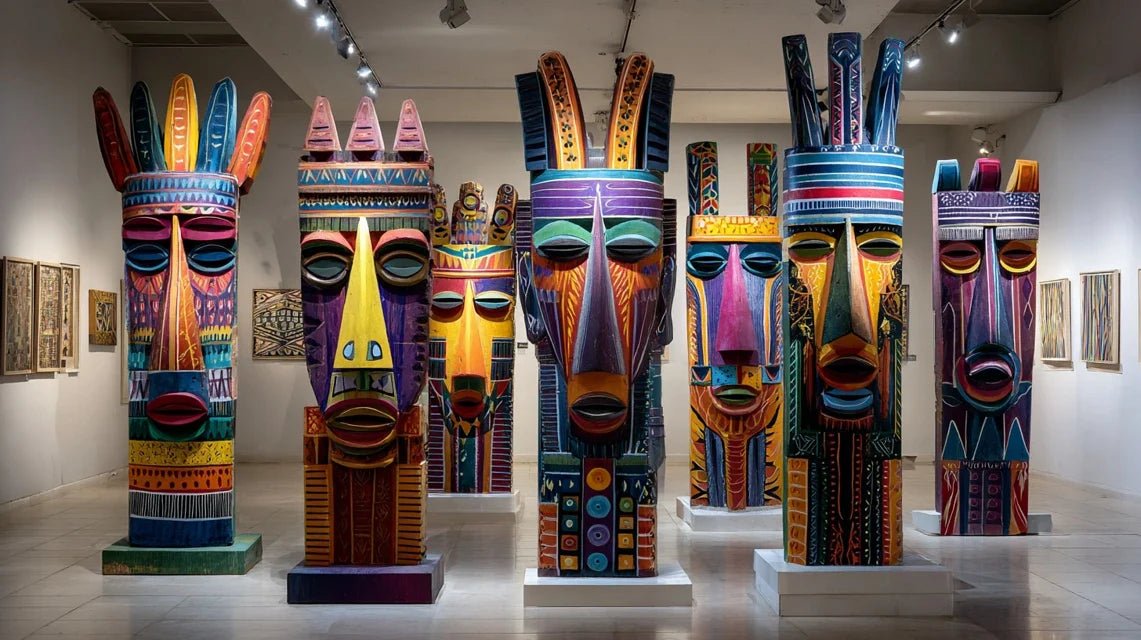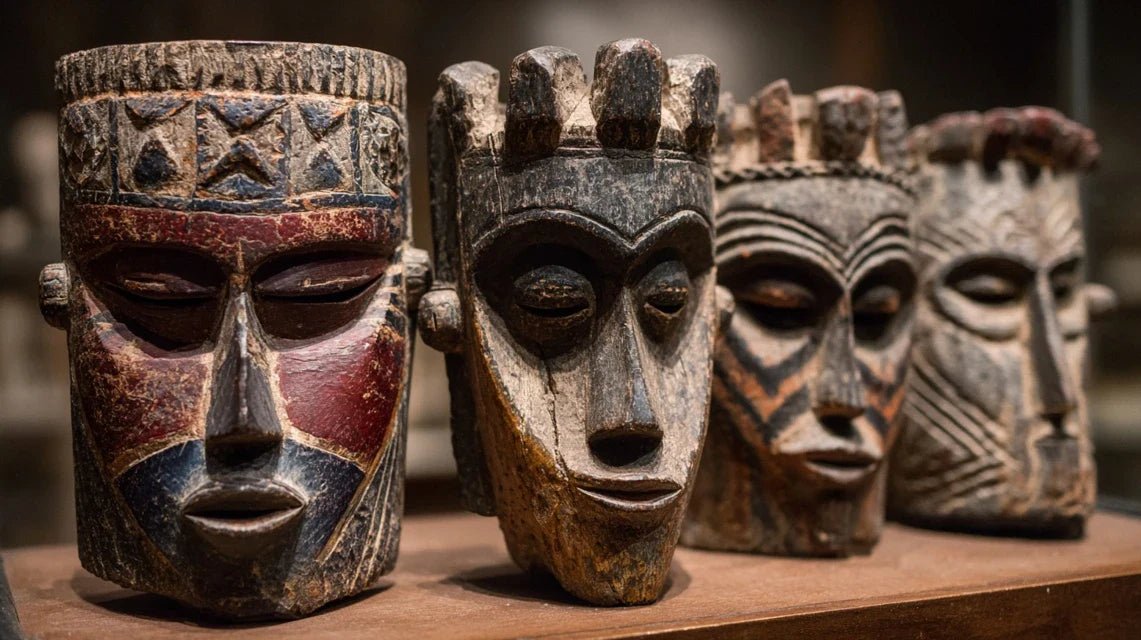
I discovered my first multi-headed Bamiléké mask in the workshop of a Cameroonian collector, in Foumban. Suspended above a dark wood buffet, this triple face seemed to tell three stories simultaneously. Its eyes followed me, no matter the angle from which I observed it. That day, I understood that an object could transcend its decorative function to become a spiritual guardian and a conversation starter.
Here's what multi-headed Bamiléké masks bring to your interior: a deep connection with the royal traditions of West Africa, a unique sculptural presence that instantly transforms the atmosphere of a room, and a powerful symbol of collective wisdom that enriches your space with meaning and positive energy.
Many hesitate to incorporate African masks into their decor, fearing an overly ethnic, disconnected or culturally inappropriate result. These majestic pieces remain confined to galleries or museums, when they could enhance a living room, library or contemporary office.
However, understanding the deep meaning of these multi-headed masks changes everything. They are not mere decorative objects: they are living archives, works of art charged with history and symbolism. Once you grasp their essence, you no longer look at them in the same way. You create a dialogue between tradition and modernity that elevates your interior.
I will reveal the symbolic secrets of these extraordinary masks, how they functioned in Bamiléké royal ceremonies, and above all how to integrate them with justness and elegance into your contemporary decoration. You will discover that these multiple heads do not represent monstrosity, but the multiplicity of wisdom.
The three faces of royalty: understanding the sacred origin
In the Bamiléké kingdoms of Western Cameroon, multi-headed masks were never mere accessories. They embodied the trinity of power: the visible king, the invisible ancestors, and the protective spirits of the kingdom. Each sculpted head represented a dimension of royal authority, a different gaze on the world.
The traditional sculptor worked the wood for weeks, often fromager or iroko, under the direction of secret societies. He did not create a face multiplied by three, but three distinct personalities coexisting within the same structure. One looked to the past and ancestors, another scrutinized the present and the living, the last contemplated the future and future generations.
These ceremonial masks appeared at major royal celebrations, notable funerals or fertility rituals. The mask wearer, completely covered in a raffia costume, literally became an intermediary being between worlds. His voice changed, his movements followed a precise ancestral choreography.
The symbolism of materials and colors
Natural pigments used on these masks tell a parallel story. White kaolin evokes purity and connection with ancestors, charcoal black represents the nourishing earth and depth, while red clay symbolizes blood, life and power. Some Bamiléké masks also incorporate cowrie shells, which served as currency and signified spiritual wealth.
The geometric scarifications engraved on the cheeks are never random. They indicate the clan, social status, sometimes even visual proverbs that only initiates can decipher. An inverted triangle may represent femininity and fertility, parallel lines evoke the multiple paths of wisdom.
Why three heads rather than one: the philosophy of multiplicity
In Bamiléké cosmology, unity is a dangerous illusion. True wisdom requires several simultaneous perspectives, hence the capital importance of polycephalous masks. A leader who consults only one vision is considered blind, even if he has two eyes.
This philosophy of multiplicity is found throughout Bamiléké social architecture. Important decisions always require the advice of several notables representing different secret societies. The three-headed mask materializes this principle: no truth is monolithic.
Some exceptional masks have four or even five heads, generally reserved for the most sacred ceremonies. The more the number of heads increases, the more the spiritual power of the mask is considered intense. I saw a four-headed mask in a private collection in Yaoundé: its physical presence was absolutely hypnotic, as if several consciences were watching you simultaneously.
The African Janus: a circular vision of time
Unlike the Roman Janus who looks to the past and future with two opposite faces, multicephalous Bamiléké masks offer a circular, panoramic view. Arranged in a triangle or square, these heads create an omnidirectional gaze that symbolizes the leader's vigilance, unable to be surprised by the enemy or misfortune.
This spatial configuration is never asymmetrical by chance. The subtle asymmetry between the faces recalls that each perspective brings a unique nuance, a different tone to the overall understanding. It is a lesson in tolerance and collective intelligence sculpted in wood.

Discover this inspiring artwork
Transform Your Space with a Multi-Headed Mask: A Practical Guide
Integrating a Bamiléké multi-headed mask into your decor requires understanding its visual and symbolic weight. It's not an object to be casually placed on a cluttered shelf. It deserves a dedicated space, a territory where it can breathe and project its energy.
In a minimalist contemporary interior, the mask becomes the focal point par excellence. Hang it on a white or pearl gray wall, with indirect lighting that dances shadows between the different heads. This surrounding simplicity allows the sculptural mask to reveal all its formal complexity.
For more eclectic atmospheres, combine your mask with African textiles, woven baskets, or even contemporary artworks. I recently composed a wall for a client by combining a Bamiléké mask with Victorian botanical engravings and a raw metal shelf: the contrast created a fascinating visual conversation between eras and cultures.
The Importance of Lighting on Multiple Volumes
Masks with multiple heads possess a complex three-dimensionality that reacts beautifully to light. Frontal lighting flattens the shapes, while lateral or grazing lighting reveals each curve, each scarification, each subtle expression differentiating the faces.
Install a track spotlight or an adjustable wall lamp at approximately 45 degrees from the mask. The light will create zones of shadow and light that change according to the time and intensity, almost bringing the three heads to life. In the evening, with softer lighting, the mask gains mystery and spiritual presence.
Beyond Decoration: Honoring Cultural Heritage
Owning a multi-headed Bamiléké mask implies a cultural responsibility. These objects are not just decorative pieces; they carry the history, prayers and ceremonies of generations. Before acquiring such a mask, find out about its provenance and authenticity.
Authentic antique masks from real ceremonies often have traces of wear, dried sacrificial blood residue, or embedded raffia fibers. These marks are a testament to their past ritual life. A mask that is too perfect, too clean, is probably a recent tourist creation, which does not diminish its beauty but alters its historical and symbolic value.
Favor galleries specializing in African art, reputable auction houses, or contemporary artisans who perpetuate traditional techniques while creating new pieces. Some current Cameroonian sculptors produce extraordinary multi-headed masks, true modern works of art rooted in tradition.
Create a personal connection with your mask
In the Bamiléké tradition, a mask is never an inert object. It houses a vital force, a presence. Without falling into awkward cultural appropriation, you can develop your own welcome ritual when you install your mask.
Take the time to observe it from different angles, respectfully touch the wood, understand how the sculptor solved the technical challenges of sculpting multiple heads in one piece. Give it a place of honor in your home, not hidden in a corner, but where you will see it regularly. Some of my clients have developed the habit of greeting their mask when they return home, creating a daily anchor with this meaningful object.

Discover this inspiring artwork
Bamiléké masks in international contemporary decoration
The influence of African masks on modern art is undeniable. Picasso, Matisse and the Cubists revolutionized their approach to form after discovering African ritual masks. Today, these pieces are experiencing a revival in high-end international decor.
The most avant-garde interior designers use Bamiléké multi-headed masks as a counterpoint to the clean lines of Scandinavian furniture or the coldness of industrial concrete. This juxtaposition creates a creative tension that humanizes overly minimalist spaces, injecting warmth, history and spirituality.
I recently visited a Parisian penthouse where a magnificent three-headed mask reigned above a state-of-the-art bioethanol fireplace. The architect had created a backlit niche that transformed the mask into a light sculpture at night. This installation perfectly demonstrated how to honor a traditional object while integrating it into a resolutely contemporary aesthetic.
Compose a gallery wall around your mask
A multi-headed mask can become the visual anchor of a larger wall composition. Surround it with black and white photographs from Cameroon, framed indigo ndop fabrics, or traditional pottery arranged on floating shelves. This contextual staging enriches the understanding of the mask without reducing it to a mere exotic trophy.
Be sure to maintain a clear visual hierarchy: the mask must remain the dominant element, with other pieces playing a supporting role. Use thin and discreet frames for secondary elements, so that the three sculpted heads naturally capture the eye first.
Want to create an interior that tells an authentic story?
Discover our exclusive collection of African paintings that perfectly complement traditional masks to compose a space rich in meaning and beauty.
Maintain and preserve your mask for future generations
Ancient African wood requires special attention. Avoid direct sunlight, which dries and cracks, as well as overly humid environments that promote mold. A Bamiléké mask thrives in a stable atmosphere with humidity around 50-60%.
For dusting, use a soft natural silk brush, never a damp cloth that could alter the traditional pigments. If your mask has weakened areas, consult a specialist art restorer rather than attempting an amateur repair that could irreparably damage the work.
Some collectors apply a thin layer of natural linseed oil annually to nourish the wood, particularly on antique masks whose surface begins to dry out. This practice, inherited from museum conservators, extends the life of these sculpted works while subtly reviving their chromatic nuances.
Your space awaits its spiritual transformation
Imagine each morning, greeted by the three benevolent gazes of your Bamiléké mask. This ancestral presence does not judge; it accompanies you. It reminds you that wisdom comes from the multiplicity of perspectives, that your interior can be much more than an assembly of trendy furniture.
By integrating a multi-headed mask into your decor, you are not following a fleeting trend. You create a historical continuity, a bridge between the kingdoms of Western Cameroon and your contemporary living room. You offer these ritual sculptures a new life, respectful of their past while projecting them into your present.
Start by defining the ideal location, that wall which calls for a strong presence. Prepare the lighting, clear the space. Then, when you find the Bamiléké mask that really speaks to you, you will know exactly how to welcome it. That day, your interior will cross a threshold, moving from decorated to truly inhabited by meaning.
Frequently Asked Questions about Bamiléké Multi-Headed Masks
Can a Bamiléké mask bring bad luck in a modern home?
This fear is understandable but stems from a cultural misunderstanding. Bamiléké masks with multiple heads were traditionally considered protectors, not vectors of curses. Their primary function was to ward off evil spirits and attract prosperity to the kingdom. In a contemporary context, they retain this positive symbolism of protection and wisdom. If you feel a respectful connection with your mask, if it comes from an ethical source, and if you honor it as a work of art steeped in history, there is no reason to fear a negative influence. On the contrary, many owners testify to a soothing atmosphere in rooms where these masks reign, as if their ancestral presence stabilized the energy of the space. The key is to avoid disrespectful appropriation and to recognize the cultural depth of the object you welcome into your home.
How to distinguish an authentic mask from a tourist reproduction?
Authentic masks exhibit several distinctive characteristics that modern reproductions struggle to imitate. First, observe the natural patina: an ancient mask used in ceremonies displays consistent wear, darker areas where hands held it, sometimes residues of ritual substances embedded in the recesses. The wood itself should show signs of natural aging, with slight cracks due to gradual drying. Tourist reproductions are often too uniform, with a finish that is too perfect and colors applied industrially. Also examine the details of the sculpture: traditional masks show irregular adze marks, the manual work of an artisan, while cheap copies exhibit a suspiciously mechanical regularity. Finally, the weight and density of the wood are revealing: Bamiléké sculptors used noble woods such as iroko, noticeably heavier than the softwoods of mass productions. If in doubt, consult an expert in African art who can authenticate your piece based on its style, proportions and materials.
Where is the ideal place to put a multi-headed mask in my interior?
The optimal placement depends as much on aesthetic considerations as on respect for the object. Traditionally, these masks occupied positions of authority and visibility in Bamiléké royal houses, never relegated to secondary spaces. Translate this principle by choosing a focal wall: above a console in the entrance to welcome your guests, facing the main sofa in the living room, or as a focal point in an office where its symbolism of multiple wisdom will resonate particularly well. Avoid bedrooms, not out of superstition, but because these intimate rooms generally call for a more soothing decoration, while multi-headed masks have a powerful presence better suited to social spaces. Ensure that the chosen wall offers sufficient empty space around the mask: allow at least 40-50 cm of clearance on each side so that the sculpture can breathe visually. The ideal height places the center of the mask approximately 1.60 m from the floor, at natural eye level. Finally, consider natural light: if the wall receives direct sunlight, install filtering curtains to protect the ancient wood while maintaining a beautiful luminosity that will reveal the sculpted volumes of the three heads.