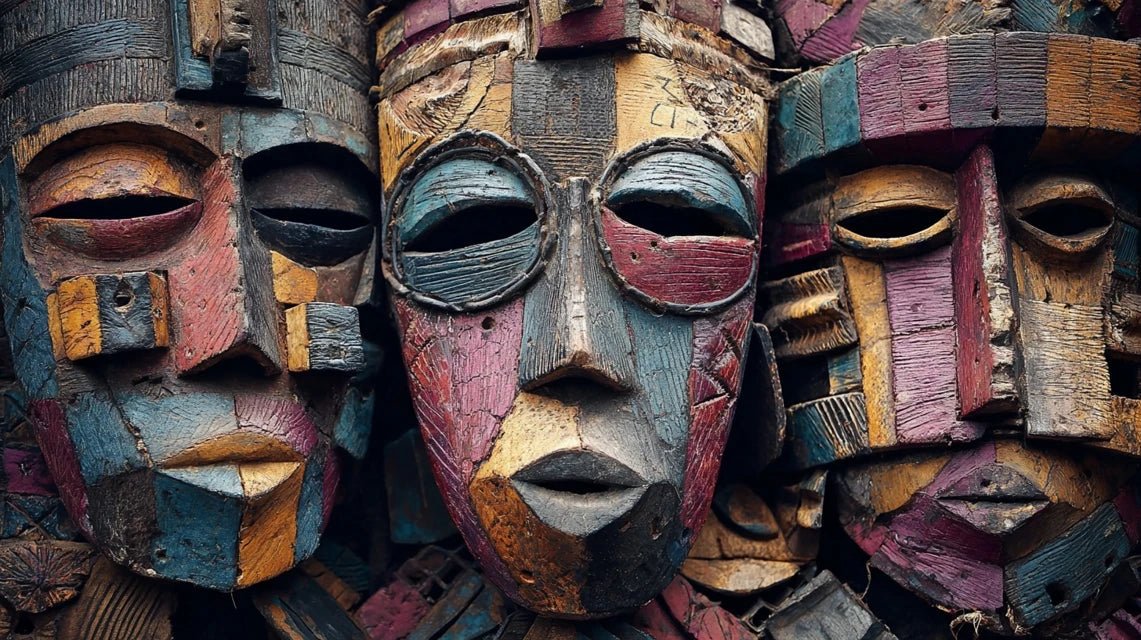
I visited my first Sénoufo village in 1998, during an acquisition mission for the museum. That day, I understood that these masks were not mere decorative objects, but guardians of memory suspended between two worlds. Today, I find them on the walls of Parisian lofts and Brussels apartments, magnificent but often misunderstood.
Here's what Sénoufo masks truly bring to your interior: an authentic connection with ancestral African art, a sculptural presence that transforms any wall into a living gallery, and that cultural depth sought by those who want to go beyond simple decoration.
The problem? We fall for their striking aesthetics without knowing their history. We hang them without understanding their language. And this unresolved mystery creates a disconnect between the object and its owner.
The good news: knowing the origin of these masks does not diminish their beauty, it multiplies it. Each curve, each animal form, each patina tells a story that your wall can now carry.
In this article, I'll take you to the heart of Sénoufo country, to meet the sculptors and rituals that gave birth to these fascinating works. You will discover why these masks captivate collectors as much as design enthusiasts.
The land of masks: welcome to Sénoufo country
Sénoufo masks do not come from a single place, but from a vast territory that extends between three borders. The Sénoufo people have occupied the north of Côte d'Ivoire, the south of Mali and the west of Burkina Faso for centuries. This region, marked by wooded savannah and agricultural traditions, is the cradle of one of the most recognizable sculptural styles in West Africa.
Contrary to popular belief, the Sénoufo are not a homogeneous group. They bring together several ethnic subgroups sharing common cultural practices but each developing their own stylistic variations. The Nafana, the Djimini, the Tagbana: as many communities that sculpt their own interpretations of the sacred mask.
This geographical diversity explains why you will never find two identical Sénoufo masks. A mask sculpted in Korhogo in Côte d'Ivoire will have different features than one created in Sikasso in Mali. Forms evolve, symbols transform, but the spiritual essence remains.
A land of hereditary sculptors
Among the Sénoufo, sculpture is not a profession that one chooses: it is passed down. The Kpéléblé, these sculptor artisans, belong to a specific caste that perpetuates know-how from generation to generation. A young sculptor learns for years with his father or uncle, gradually mastering ancestral gestures.
The wood itself reveals an intimate knowledge of the environment. Cheesewood, kapok, sometimes iroko: each essence possesses its properties, its density, its soul. Sénoufo sculptors work green wood, still moist, which allows for sculptures with fluid and expressive forms that stabilize as they dry.
Poro masks: when decoration was ritual
Here is the key to understanding Sénoufo masks: they were never designed to decorate walls. These masks are born at the heart of Poro, the male initiation society that structures all Sénoufo social life. For seven years, divided into three cycles of three years, young men go through an initiatory journey where masks play a central role.
Each type of mask intervenes at a specific moment in the ritual. The Kpélié, recognizable by its rectangular shape topped with a zoomorphic figure, appears during the funerals of former initiates. The Kponiugo, this extraordinary mask-helmet combining several animals on the same structure, dances during the closing ceremonies of initiation.
These masks do not simply represent animals. They embody spiritual forces, ancestors, protective entities. The chameleon symbolizes wisdom and patience. The antelope evokes grace and connection with the bush. The hornbill represents fertility and the link between earth and sky.
The transformation of the sacred into decorative
How did these ritual objects migrate to our interiors? The story begins at the beginning of the 20th century, when explorers and colonial administrators discover Sénoufo art. Fascinated by the formal power of these masks, they begin to acquire them, often without understanding their sacred function.
The 1950s-1960s mark a turning point. European collectors snatch up authentic Sénoufo masks, recognizing their artistic value. Museums exhibit them alongside Western works. This international recognition gradually transforms the status of these objects: from purely ritualistic, they also become works of art.
Today, most Sénoufo masks available for decoration are contemporary creations, sculpted according to traditional techniques but intended for the art market. Truly ancient masks, bearing ritual patina and initiatory history, are found in private collections and museum institutions.

Discover this inspiring artwork
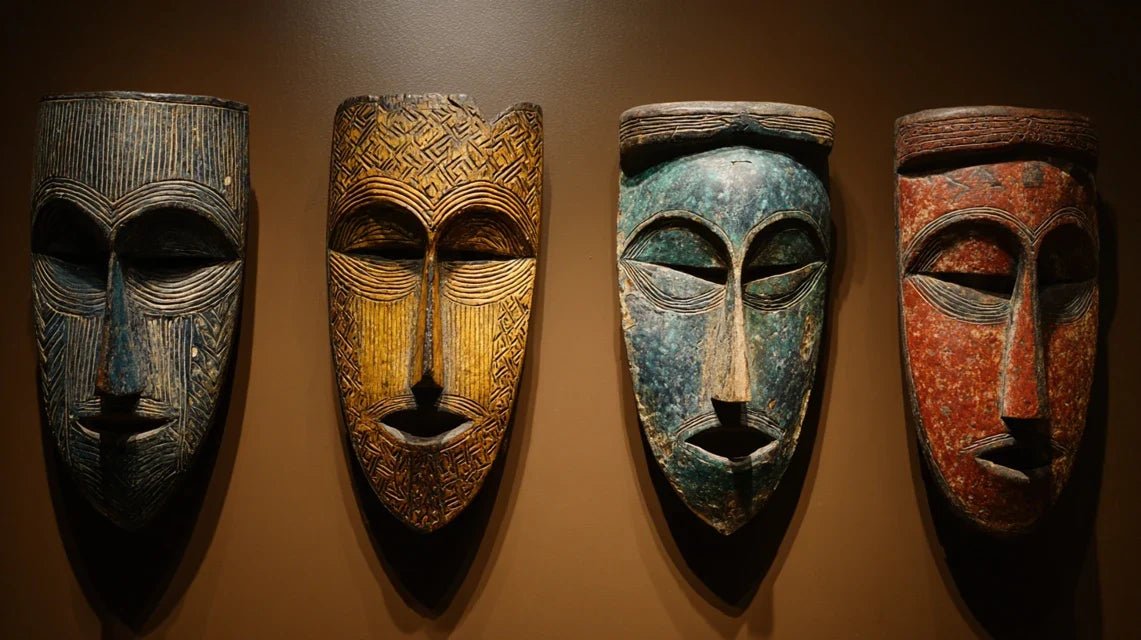
After twenty years of handling these sculptures, I can identify a Sénoufo mask in seconds. Some details never deceive. First, the vertical composition: Sénoufo masks stretch upwards, stacking symbols like a spiritual architecture.
Observe the animal forms. They never seek naturalist realism. A Sénoufo chameleon resembles a geometric abstraction more than a photographed reptile. Legs transform into rectangles, the body becomes a trapezoid, and the stylized head is reduced to its essence. This economy of means creates an incomparable visual force.
The geometric motifs constitute another signature: triangles, diamonds, parallel lines engraved in wood. These decorations are not arbitrary. They encode messages, affiliations, statuses. A Sénoufo initiate knows how to read these signs as we read a text.
The Revealing Patina
The patina of an ancient Sénoufo mask tells its story. Authentic ritual masks bear traces of libations: palm oil, sacrificial blood, millet beer. These substances impregnate the wood, creating a shiny crust with varying reflections. Some areas darken, while others develop reddish or ocher hues.
Contemporary decorative masks often have a more uniform finish. Contemporary sculptors use waxes and oils to recreate the appearance of an old patina, but the trained eye detects the difference. This is not a defect: these modern creations possess their own legitimacy and intrinsic beauty.
Integrating a Sénoufo Mask into Your Contemporary Décor
The question invariably arises: how to hang these objects charged with symbols without falling into folklore or a personal museum? The answer lies in one word: breathing. A Sénoufo mask requires space around it to deploy its sculptural presence.
Avoid accumulating ethnic objects on the same wall. A single Sénoufo mask, judiciously placed, transforms an entire room. Prefer a neutral background: off-white, pearl gray, polished concrete. These clean surfaces create the necessary contrast for the complex forms of the mask to fully express themselves.
Lighting plays a crucial role. A directional spotlight placed slightly above sculpts the reliefs, deepens the shadows, and reveals the engraved details. Avoid frontal lighting that flattens volumes. Sénoufo masks are three-dimensional sculptures: treat them as such.
Stylistic Associations That Work
Contrary to popular belief, Sénoufo masks dialogue beautifully with contemporary design. Their geometry blends perfectly with minimalist Scandinavian furniture. I have seen Kpélié masks enhanced in entirely white interiors with clean lines.
They also find their place in industrial settings: the raw wood of the masks resonates with patinated metal, exposed concrete, and exposed beams. This encounter between ancestral craftsmanship and urban aesthetics creates a stimulating visual tension.
However, avoid mixing tribal arts from different origins on the same wall. A Sénoufo mask does not require the company of a Polynesian statue or a Peruvian weaving. Each culture deserves its own space to breathe.
Transform your walls into an authentic African art gallery
Discover our exclusive collection of African paintings that capture the essence of Sénoufo traditions in carefully selected contemporary creations.

Discover this inspiring work
Hanging a Sénoufo mask in your home implies a cultural responsibility. These objects carry with them centuries of beliefs, rituals, and know-how. Treating them as simple decorative accessories is to erase this memory.
Take the time to learn about your mask. What animal does it represent? From which region does it come? Who created it if the information is available? This knowledge transforms your relationship with the object: it ceases to be a decorative element to become a cultural bridge, a window open onto a distant civilization.
Tell its story to your guests. Explain the meaning of the shapes, the original function of the mask, the context of the Poro. These conversations enrich your interior with a narrative dimension that no standard design object possesses.
Supporting contemporary Sénoufo craftsmanship
By choosing a Sénoufo mask for your decoration, you are ideally participating in the perpetuation of a know-how. Contemporary Sénoufo sculptors keep ancestral techniques alive while adapting their production to modern tastes.
Prioritize transparent supply chains. Specialized galleries, artisan cooperatives, importers who work directly with villages: these intermediaries guarantee fair compensation for artisans and traceability of artworks.
Beware of mass-produced industrial copies from outside the Sénoufo territory. These mechanical reproductions have neither the soul nor the shaping quality of authentic pieces. The price may seem attractive, but you lose the essence: a connection with a living tradition.
Imagine your wall transformed
Visualize your interior in six months. This white wall that you find bland now welcomes a Sénoufo Kpélié mask. Its slender silhouette catches the eye as soon as you enter. Its geometric shapes dialogue with your Scandinavian bookcase. Its brown patinas warm up the whole.
Your guests never fail to ask the question: where does this extraordinary sculpture come from? And you can now tell the story. Talk about the Sénoufo country, initiation rituals, animal symbolism, the lineage of sculptors who have perpetuated this know-how for generations.
Your interior gains that depth which distinguishes truly lived spaces from impersonal catalogs. Sénoufo masks do not decorate: they inhabit. They carry enough history and beauty to transform any wall into a permanent conversation between tradition and modernity.
Start by identifying the ideal location. Measure the available space. Imagine the lighting. Then start looking for your mask, one whose shapes will resonate with your sensitivity. Somewhere out there, it is waiting to cross your door to begin its new life on your wall.
Frequently Asked Questions about Sénoufo Masks
How can I tell if my Sénoufo mask is authentic or a modern reproduction?
The authenticity of a Sénoufo mask is read in several convergent details. First, examine the patina: an ancient ritual mask has an uneven surface with darker areas where libations have accumulated, often shiny and slightly sticky to the touch. Modern reproductions show a more uniform finish. Next, observe consistent signs of wear: a truly worn mask bears scratches on the inside, where it rubbed against the dancer's face. Ancient sculptures also reveal traces of traditional tools, irregularities in the surface that testify to complete manual shaping. Finally, the weight and density of the wood give clues: traditional woods such as fromager or kapok have a specific density. That said, a contemporary mask sculpted using traditional techniques by a Sénoufo artisan has legitimate artistic and decorative value, even if it has never participated in a ritual. The important thing is to buy with knowledge of the cause, from sellers transparent about the origin and age of their pieces.
Is it respectful to use a Sénoufo mask as wall decor?
This question touches on the heart of the debate about cultural appropriation and respect for sacred objects. My position, forged through years of dialogue with the Sénoufo communities, nuances extreme positions. Yes, it is respectful to display a Sénoufo mask in your home, provided that several fundamental principles are respected. First, know and transmit the history and meaning of the object: a mask accompanied by its cultural context becomes an ambassador for Sénoufo civilization rather than an exotic trophy. Second, prioritize ethical acquisition channels that fairly compensate artisans and communities. Absolutely avoid acquiring ritual masks still active, torn from their sacred context: only masks created for the art market or old pieces removed from the ritual circuit long ago should circulate. Finally, treat the object with dignity: a Sénoufo mask deserves a thoughtful location, careful lighting, a presentation that honors its status as a work of art. Contemporary Sénoufo sculptors I have met generally appreciate their creations traveling and reaching an international audience, provided this dissemination is accompanied by respect and knowledge.
How to maintain and preserve a Sénoufo wooden mask?
The wood of Sénoufo masks requires minimal but regular maintenance to last for decades without damage. The main enemy remains excessive humidity or, conversely, too dry air which causes cracks. Maintain your mask in a stable environment, ideally between 40 and 60% relative humidity, away from direct sources of heat such as radiators or fireplaces. Avoid prolonged exposure to direct sunlight, which discolors patinas and dries out the wood. For dusting, use a soft brush with natural bristles, gently following the reliefs and recesses. Once or twice a year, you can nourish the wood with a thin layer of natural oil: linseed oil or diluted beeswax are perfect. Apply with a soft cloth, let it soak in for fifteen minutes, then wipe off the excess. This operation revives patinas and protects the wood from drying out. If your mask shows signs of insect infestation (small fresh holes with fine sawdust), isolate it immediately and consult a specialist restorer in African arts. With these simple precautions, your Sénoufo mask will pass down through generations, carrying its history and beauty intact.