The first time I laid eyes on the walls of Manhyia Palace, I understood that these ochre surfaces told a story far older than the buildings themselves. These Ashanti palace frescoes are not mere wall decorations – they are the living memory of an empire that defied time, the coded language of a civilization where every motif possesses its soul.
Here's what Ashanti palace frescoes in Ghana reveal to you: a sophisticated system of visual communication that transformed architecture into an open book, a unique artistic testimony that influences contemporary design today, and an inexhaustible source of inspiration for creating interiors full of meaning and history.
You admire African wall art but don't know how to decipher these geometric symbols? You dream of integrating this powerful aesthetic into your decor without falling into pastiche? The apparent complexity of these Ashanti frescoes can seem intimidating, their mysterious codes, their dense historical context.
Yet, understanding these frescoes requires no academic training. It just takes knowing a few essential keys, learning to read the motifs like a language, and above all feeling the unique vibration of this art that has crossed the centuries. In this article, I'll take you to discover the fascinating world of Ashanti palace frescoes, their ancestral techniques, their profound symbolism, and how they continue to inspire creators around the world.
The Ashanti Empire: when architecture becomes narrative
In the heart of present-day Ghana, the Ashanti empire reigned for more than three centuries with a sophistication that impressed European visitors. Contrary to popular belief, these palaces were not mere royal residences – they constituted true political, spiritual and cultural institutions.
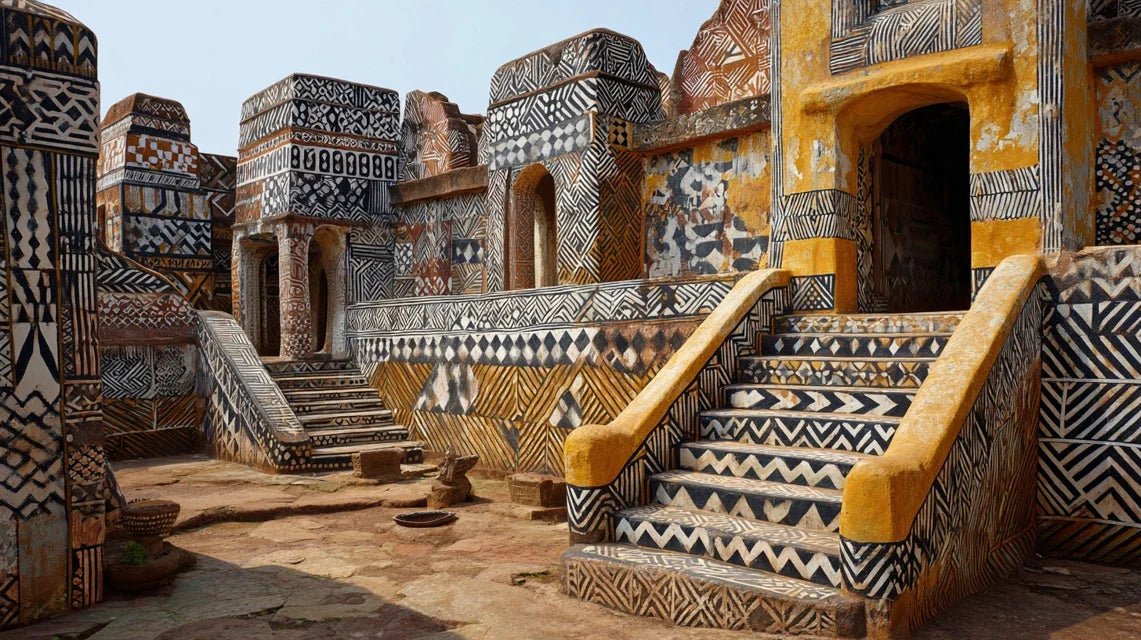
The Ashanti palace frescoes covered the exterior and interior walls of these remarkable buildings, transforming every surface into a communication medium. Imagine entire buildings telling the story of military victories, philosophical proverbs, sacred prohibitions and dynastic alliances. These walls spoke to those who knew how to read them.
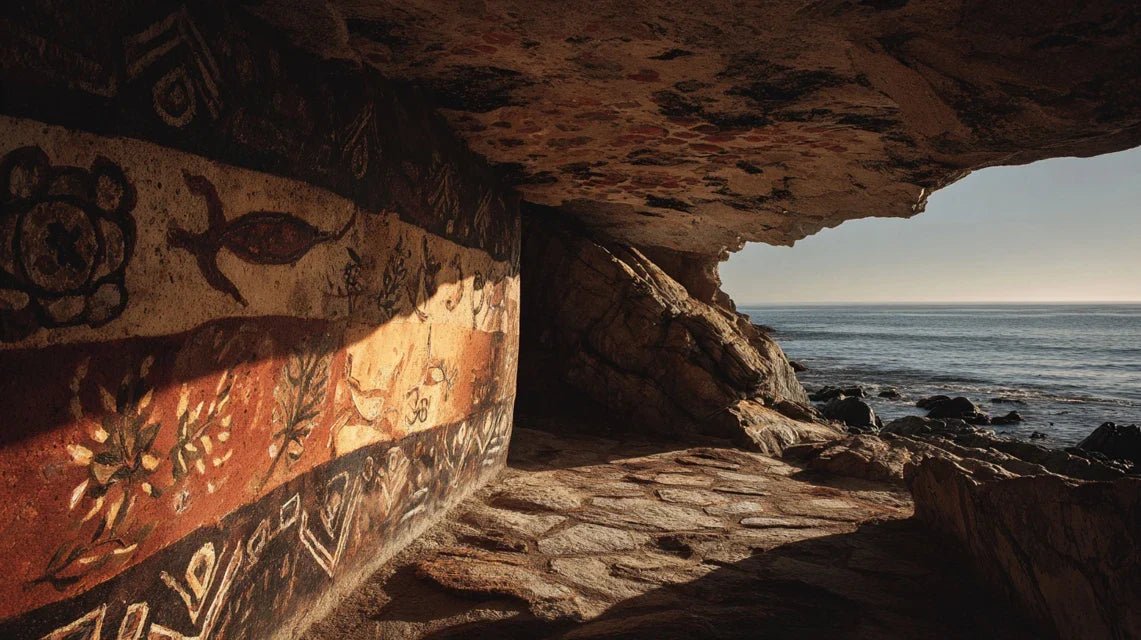
The traditional technique used natural pigments extracted from ochre earth, white kaolin, black charcoal, and sometimes animal blood mixed with resin to fix the colors. Artists, often specialized women, applied these materials directly to the smoothed clay plaster, creating geometric patterns of astonishing precision without measuring instruments.
The colors and their profound meaning
In Ashanti frescoes, nothing is left to chance. Black evokes spiritual maturity, intensity, and connection with ancestors. White symbolizes purity, purification ceremonies, and victory. Red ochre represents the blood shed, the nourishing earth, and necessary sacrifices. Yellow, rarer still, was reserved for royal symbols and gold which formed the Ashanti’s wealth.
This restricted palette created a remarkable visual harmony, where every wall surface vibrated with contained but powerful energy. Ashanti palaces did not seek to dazzle through excess – they captivated by the accuracy of their proportions and the strength of their symbols.
Decoding the Language of Adinkra Symbols
At the heart of frescoes in Ashanti palaces, you constantly find Adinkra symbols – this extraordinary graphic system that functions as a conceptual writing. Each motif embodies an idea, a proverb, a moral value.
The Gye Nyame (the supremacy of God) appears frequently on the walls of audience halls, reminding us that even royal power bows before a higher authority. The Sankofa (the bird looking backward) adorns the spaces dedicated to educating princes, symbolizing the importance of learning from the past.
The Dwennimmen (ram’s horns) decorates the quarters of warriors, evoking strength and humility. The Fihankra (the house with a square courtyard) often structures wall compositions, representing safety and forgiveness. These Ashanti frescoes thus created an environment where every gaze encountered a lesson, every journey through the palace became a meditation.
The Sacred Geometry of Compositions
The spatial organization of frescoes in Ashanti palaces obeys sophisticated mathematical principles. Motifs repeat according to precise rhythms, creating a harmony that soothes the eye while maintaining attention. Artists divided walls into square or rectangular sections, then inscribed the symbols according to complex axes of symmetry.
This geometric approach was not only aesthetic – it reflected the Ashanti vision of an ordered universe, where each element finds its place in a coherent whole. The frescoes literally materialized this cosmological philosophy.

Discover this inspiring artwork
Ancient Techniques Confronting Time
The creation of Ashanti palace frescoes followed a rigorous process passed down from generation to generation. First, the rammed earth walls received several layers of plaster made from fine clay mixed with plant fibers to prevent cracks. Once dried and polished, this support received a uniform background layer.
Artists then traced the outlines of the motifs with charcoal before applying pigments zone by zone. Some Ashanti frescoes used the stencil technique to ensure the regularity of repetitive patterns. Others preferred freehand drawing for more open compositions.
The finishing included frequent application of a protective coating based on gum arabic or vegetable resin, which fixed the colors and created a slight sheen. This step explains why some Ashanti palace frescoes have survived decades despite tropical rains and intense heat.
Restoration: A Contemporary Challenge
Today, efforts to preserve the Ashanti palaces and their frescoes involve historians, artists, and scientists. The site of Kumasi, historic capital of the empire, has seen several restoration projects aimed at restoring the original brilliance of these walls steeped in history.
The major challenge lies in authenticity: how to restore these Ashanti frescoes without distorting them? Specialists rely on traditional techniques, seek the same natural pigments, consult the elders who still hold the memory of the original motifs. This meticulous work makes it possible to preserve an irreplaceable heritage.
When Ashanti Frescoes Inspire Modern Design
The influence of Ashanti palace frescoes extends far beyond the borders of Ghana. In contemporary design studios, these geometric patterns are experiencing a spectacular renaissance. Textile designers, interior architects, wallpaper creators draw on this visual repertoire to create sophisticated and meaningful atmospheres.
The strength of Ashanti frescoes lies in their ability to adapt to current aesthetics without losing their essence. An accent wall adorned with Adinkra symbols in a minimalist loft creates a powerful focal point. A textile inspired by the mural compositions of the Ashanti palaces instantly brings depth and character to a neutral space.
High-end decoration brands have understood this: they now offer entire collections inspired by these frescoes, declining their patterns on various supports – from tiles to wallpaper, cushions to screens. This contemporary appropriation, when done with respect and knowledge, allows this artistic heritage to live on.
Integrate the Spirit of Frescoes into Your Interior
You don't need to reproduce the exact frescoes of the Ashanti palaces to capture their essence. Start by identifying the symbols that speak to you – research their meaning, let them resonate with your own values. A single Adinkra motif well placed can transform the atmosphere of a room.
Prioritize authentic colors: these deep ochres, these intense blacks, these creamy whites that characterize the Ashanti frescoes. Avoid overly bright or flashy versions that betray the original spirit. Sobriety is your ally – these ancestral wall artworks draw their power from their restraint, not their exuberance.
Also think about materials: natural linen, terracotta, raw wood dialogue wonderfully with the aesthetics of the Ashanti palaces. These materials create a bridge between traditional craftsmanship and contemporary comfort.
Transform your interior with the heritage of the great African palaces
Discover our exclusive collection of African wall art that captures the essence of ancestral frescoes and brings depth, character and spirituality to your living spaces.

Discover this inspiring artwork
The frescoes of the Ashanti palaces are not relics frozen in the past – they continue to evolve thanks to contemporary artists who perpetuate and reinvent these traditions. In Ghana, a new generation of creators is embracing this heritage, bringing it into dialogue with current concerns.
Some artists use traditional symbols to comment on contemporary social issues. Others experiment with new mediums – acrylic paint, spray, digital installations – while respecting the compositional principles of the original Ashanti frescoes. This creative vitality proves that this wall art has a remarkable ability to adapt.
Training workshops are also multiplying, where elders pass on to young people the ancestral techniques for preparing pigments, tracing motifs, reading symbols. This living transmission ensures that the frescoes of the Ashanti palaces never become mere museum curiosities, but remain an active and relevant artistic language.
Visiting the palaces: a transformative experience
If you have the opportunity, nothing replaces direct contact with the frescoes of the Ashanti palaces. The Manhyia Palace Museum in Kumasi offers an immersive dive into this universe. You will discover not only the decorated walls, but also the complete architectural context, ritual objects, kente textiles that complement the visual environment.
Local guides, often from royal families, share interpretations you won't find in any book. They explain how one fresco commemorates a military victory, how one motif recalls a proverb taught to children, how one combination of colors indicates the function of a room.
This direct experience transforms your perception: you understand that these Ashanti frescoes are not decorative images, but a materialized system of thought, a philosophy embodied in matter and color.
Live with the spirit of the Ashanti palaces
Imagine yourself in your redesigned space, where every morning your gaze meets an Adinkra symbol that reminds you of your essential values. Where the ochre and black colors of the frescoes of the Ashanti palaces create a both soothing and stimulating atmosphere. Where your guests stop, intrigued, before this mysterious geometry that tells stories spanning millennia.
You don't need to transform your interior into an ethnographic museum. A few well-thought-out touches are enough: a wall panel inspired by the Ashanti frescoes, cushions with Adinkra motifs, a color palette evoking the lands of Ghana. Start small, let this aesthetic gradually permeate your space.
The most important thing remains the authentic connection with this artistic heritage. Take the time to understand the symbols, to feel the wisdom they convey. The frescoes of the Ashanti palaces offer you much more than decorative inspiration – they invite you to inhabit your space with intention and depth.
Frequently asked questions about the frescoes of the Ashanti palaces
Can we still see original frescoes in the Ashanti palaces today?
Yes, several sites in Ghana preserve original frescoes from the Ashanti palaces, notably at the Manhyia Palace Museum in Kumasi. Some have been carefully restored using traditional techniques, while others show the marks of time, giving them an authentic patina. Several of these buildings have been designated by UNESCO's World Heritage Centre, ensuring their protection. During your visit, you will also discover educational reconstructions that explain the creation techniques. Local guides will show you how to distinguish original sections from restored parts, enriching your understanding of these remarkable works. Don't hesitate to also visit the surrounding traditional villages where some family homes still preserve fragments of ancestral frescoes, moving testimonies of an art that extended far beyond royal palaces.
How to integrate the aesthetics of Ashanti frescoes into a contemporary decoration without being kitsch?
The key lies in selectivity and authenticity. Prioritize one or two significant Adinkra symbols rather than an accumulation of motifs. Opt for quality reproductions that respect the proportions and original colors of the Ashanti frescoes – avoid overly commercial versions with garish colors. Integrate these elements into a clean environment: a white wall beautifully highlights a panel inspired by the palace frescoes. Combine them with natural materials such as linen, raw wood or terracotta which echo traditional materials. Also consider textiles: a cushion with Adinkra motifs on a simple sofa creates an interesting point without clutter. A minimalist approach works particularly well with this visual heritage – Ashanti frescoes were themselves characterized by understated geometry, never exuberance.
What is the difference between Adinkra symbols and Kente motifs often associated with Ashanti culture?
Excellent question that reveals the richness of Ashanti art. Adinkra symbols, which you find on Ashanti palace frescoes, constitute a system of philosophical pictograms – each motif represents a concept, a proverb, a moral value. They were mainly used in architecture, funeral cloths and some ritual objects. Kente, for its part, is a woven textile with colorful geometric patterns, created by interlacing threads. While some kente motifs may evoke Adinkra symbols, their primary function is different: kente indicates social status, occasion, sometimes clan affiliation. Palace frescoes favored Adinkra for their ability to transmit precise and lasting messages. In your decoration, you can harmoniously combine these two traditions – for example, a kente textile as a colored accent and an Adinkra fresco as a structuring element – to create a rich atmosphere that honors the complexity of this extraordinary culture.