Sam Francis (1923-1994) perfectly embodies Californian abstraction, this unique artistic movement that emerged on the American West Coast in the 1950s. Born in San Mateo, California, this revolutionary artist developed a singular approach to light and color which defines the very essence of Californian abstract art. His work constitutes an essential bridge between American expressionist abstraction and European chromatic innovations.
Sam Francis and Californian abstraction: origins of pictorial light
Californian abstraction finds its roots in Sam Francis’s traumatic experience in the military hospital. Immobilized for several years after a plane crash in 1944, he discovered painting by observing the variations of light on his room's white ceiling. This Californian natural light becomes the foundation of his revolutionary plastic language.
Sam Francis gradually develops a unique vision of Californian abstraction, deeply influenced by the particular quality of California’s light. Unlike New York expressionist abstract artists, his work is characterized by a more fluid and organic color, directly inspired by the Californian luminous environment.
- 1944-1947 hospitalization: birth of his artistic vision
- Training with David Park at the California School of Fine Arts
- Influence of Clyfford Still in Berkeley (1948-1950)
This formative period establishes the foundations of his distinctive chromatic approach, where gestural spontaneity meets the contemplative luminosity characteristic of Californian art.
Color and light techniques in Sam Francis’s Californian abstraction
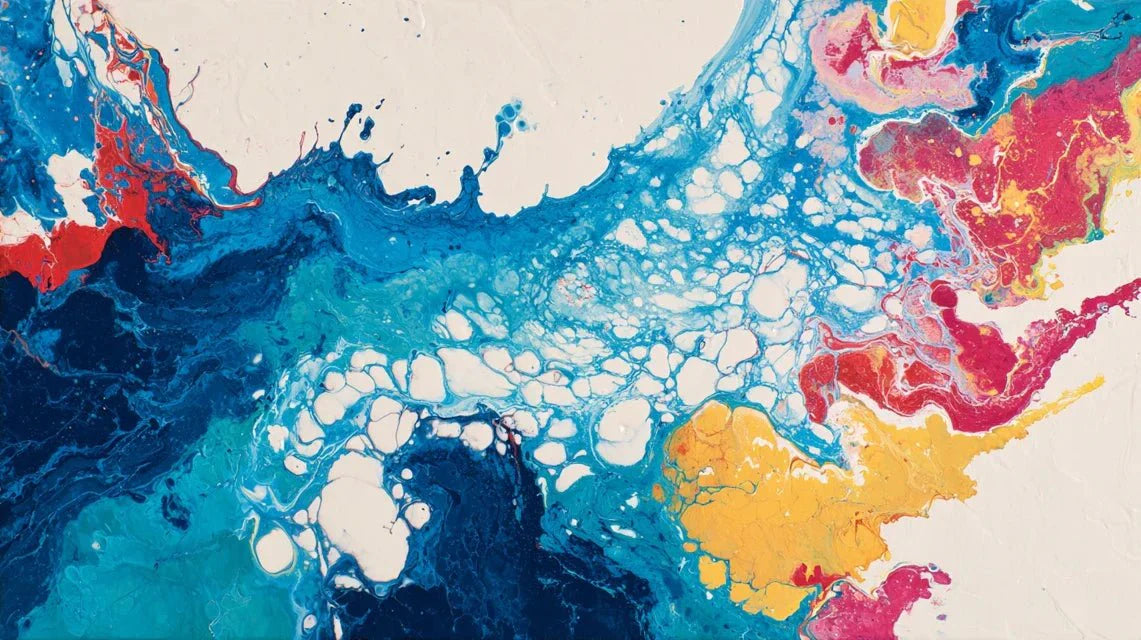
Sam Francis revolutionizes the pictorial techniques of Californian abstraction through his innovative mastery of color and light. His dripping technique, inspired by Jackson Pollock, transforms under the Californian climate into a more contemplative and meditative pictorial language.
The artist specifically develops the technique of superimposed “color veils,” allowing to attenuate the luminous intensity while preserving chromatic brilliance. Sam Francis uses pure colors - scarlet red, ultramarine blue, electric green - which he applies in thin layers on canvases often left partially blank, creating a dialogue between full and empty spaces.
His iconic works such as “Big Red” (1953) or “Deep Orange and Black” (1955) perfectly illustrate this revolutionary technical mastery. Color seems to organically emanate from the canvas, creating an effect of inner light that directly evokes the Californian luminous environment.
Sam Francis: color in motion and fluid Californian abstraction
The California abstraction of Sam Francis is fundamentally distinguished by its exceptional chromatic fluidity. His colors are never static but suggest perpetual movement, as if the light of California were captured in its natural dynamism and transformed into pure pictorial energy.
This fluidity is particularly evident in his series from the 1950s-1960s. The influence of the California maritime light shines through in his most daring compositions. The dominant blues of his "Blue Balls" series (1960-1963) evoke the infinite nuances of the Pacific Ocean, a central element of the California landscape that constantly nourishes the California abstraction.
To discover contemporary abstract works that explore these same games of color and light, abstract paintings offer a modern approach to this Californian tradition inherited from Sam Francis.
California light and color in the abstract work of Sam Francis
The California light possesses unique atmospheric qualities that Sam Francis masterfully translates into his abstraction. This particular luminosity, filtered by the atmosphere of the Pacific, directly influences his color palette and spatial conception of painting.
Sam Francis theorizes this fundamental relationship: "An increase in light provokes an increase in darkness." This aesthetic philosophy guides his approach to California abstraction, where contrasts of light create unprecedented spatial depths and striking visual effects.
His Parisian travels (1950-1961) considerably enrich his understanding of color, but it is his definitive return to California in 1962 that marks the peak of his California abstraction. Sales statistics confirm the crucial importance of this period: "Middle Blue" (1957) sold for $6.3 million in 2010 (Source: Christie's).
Concrete applications of California abstraction: Sam Francis and light effects
The California abstraction of Sam Francis finds its most spectacular applications in monumental and architectural art. His murals for the Kunsthalle in Basel (1956-1958) and the Chase Manhattan Bank (1959) demonstrate how his mastery of color and light adapts to large contemporary architectural spaces.
The lasting influence of Sam Francis on contemporary California abstraction remains scientifically measurable. More than 1,850 cataloged paintings testify to his prolific production (Source: Sam Francis Foundation), establishing an essential reference corpus for subsequent generations of Californian and international artists.