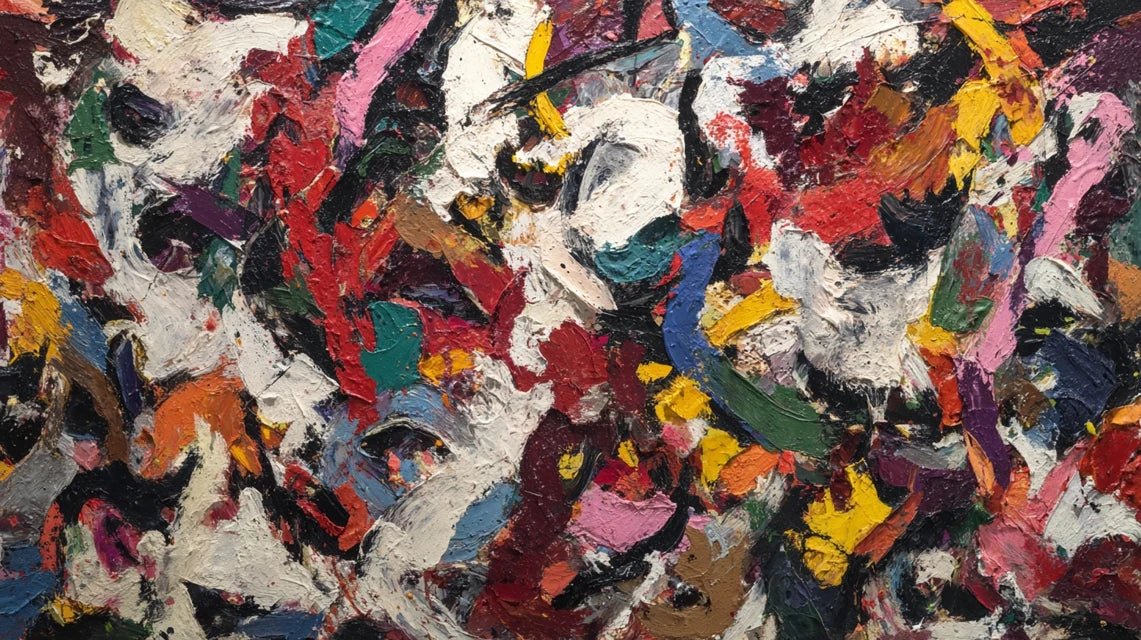
Lee Krasner, a Major Artist Before Pollock: The Journey of a Pioneer
Born Lena Krassner in 1908 in Brooklyn to a family of Ukrainian Jewish immigrants, Lee Krasner established herself as a major artist on the New York scene as early as the 1930s, long before meeting Jackson Pollock. Trained at the Cooper Union and the National Academy of Design, she quickly developed a personal style influenced by Synthetic Cubism and Lyrical Abstraction.
Her artistic journey was enriched by her training with Hans Hofmann between 1937 and 1940, a pivotal figure in the New York School. This crucial period allowed her to master geometric abstraction techniques and develop a unique approach combining European influences and American sensibilities. An active member of the American Abstract Artists from 1940 onwards, Krasner exhibited regularly and became a respected figure in the burgeoning Abstract Expressionist movement.
- Complete artistic training at the best New York schools
- Technically recognized mastery by her male peers
- Active participation in the Federal Art Project (1935-1943)
- Development of a distinctive personal plastic language
Her early recognition is reflected in her participation in major group exhibitions. In 1941, at the crucial exhibition "French and American Painting," she appeared as the only established female artist in the group.
Lee Krasner in Pollock's Shadow: Systematic Artistic Erasure
The meeting between Lee Krasner and Jackson Pollock in 1942 paradoxically marked the beginning of a gradual erasure of her artistic recognition. Their marriage in 1945 transformed the critical perception of her work: she became "Mrs. Jackson Pollock" rather than the major artist she was.
This systematic erasure is reflected in art criticism. Journalists minimized her creative contributions, as evidenced by this revealing 1949 review: "Lee Krasner (Mrs. Jackson Pollock) takes her husband's paint and enamels and changes his unrestrained, sweeping lines into neat little squares and triangles." This reception reveals the pervasive institutional sexism that reduces her work to a mere adaptation of Pollock’s.
The artistic couple dynamic created an artificial and unfair hierarchy. Paradoxically, it was Krasner who introduced Pollock to major collectors and influential critics, including Clement Greenberg. Her role as an artistic mentor and her superior technical training remained obscured by the dominant masculine narrative.
- Critical reduction to the status of artist's wife
- Minimization of her influence on Pollock’s development
- Signature sometimes anonymized (“L.K.” instead of Lee Krasner)
- Unfounded rumors about stopping her production during the Pollock years
This period of critical invisibility contrasts with the reality of her production: she continues to create her revolutionary "Little Images" (1946-1950) and develops her unique approach to abstract expressionist painting.
Rehabilitating Lee Krasner: posthumous recognition techniques
The rehabilitation of Lee Krasner as a major artist began in the 1970s-1980s with the emergence of feminist art studies. This late recognition relies on several innovative museum and critical strategies.
The revolutionary exhibition "Krasner/Pollock: A Working Relationship" (1981) marks a decisive turning point. For the first time, it presents Krasner as an equal artistic partner rather than simply a wife. This approach reveals authentic mutual influence and technical sophistication.
The MoMA retrospective (1983) marks the culmination of this rehabilitation. Following her death in 1984, critic Robert Hughes described her as "the Mother Courage of Abstract Expressionism", recognizing her status as a founding pioneer of the movement.
Contemporary rehabilitation strategies include:
- Critical re-examination of archives and correspondence
- International monographic exhibitions ("Lee Krasner: Living Color")
- Reassessment of the art market (record of $11.7 million in 2019)
- Integration into artistic study programs
Lee Krasner, major artist: emblematic works and lasting impact
The masterful work of Lee Krasner reveals a major artist whose aesthetic impact far exceeds her association with Pollock. Her catalog, with 599 listed works (Source: Abrams raisonné catalogue 1995), testifies to constant artistic research and remarkable technical innovation.
Her emblematic series mark revolutionary evolutions. The "Little Images" (1946-1950) anticipate action painting and demonstrate her mastery of gestural abstraction. The monumental "Umber Paintings" (1959-1962), created after Pollock's death, reveal a raw expressiveness and unprecedented monumentality.
The collage-painting technique becomes her distinctive signature. Krasner cuts up her own works to reassemble them, creating dynamic compositions that anticipate contemporary artistic recycling practices.
- "Prophecy" (1956): masterful synthesis between figuration and abstraction
- "Combat" (1965): expressive monumentality post-Pollock
- "Earth Green" series (1957-1959): exploration of giant formats
- "The Seasons" (1957): a 5-meter wide masterpiece
His lasting impact is measured by his presence in major international collections and his record price on the contemporary art market. The Pollock-Krasner Foundation, created according to his wishes, perpetuates his commitment to supporting emerging artists.