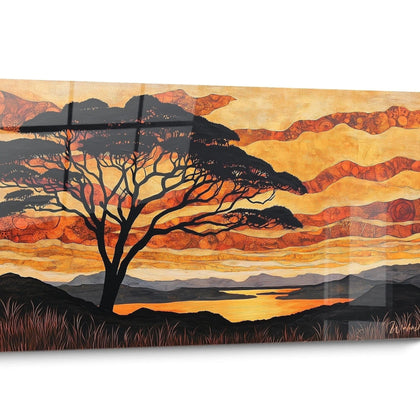
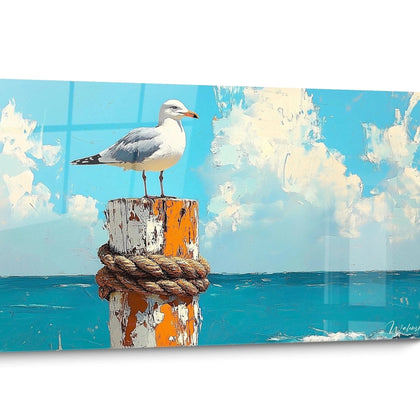
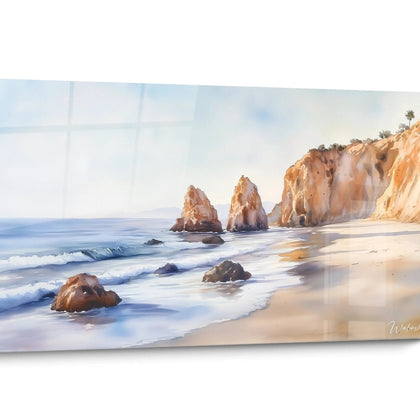
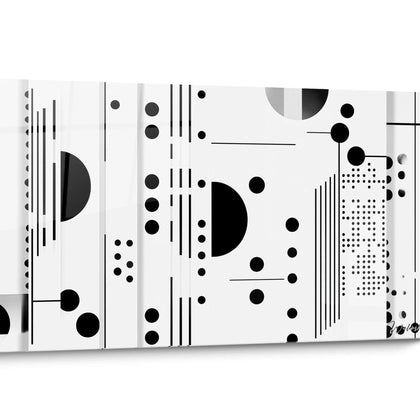
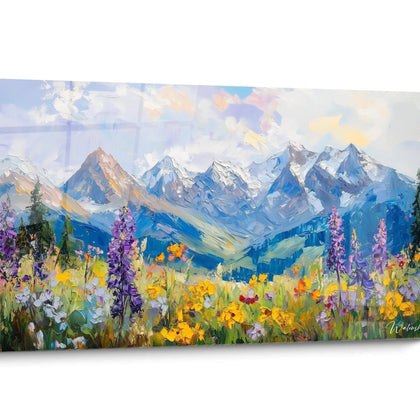
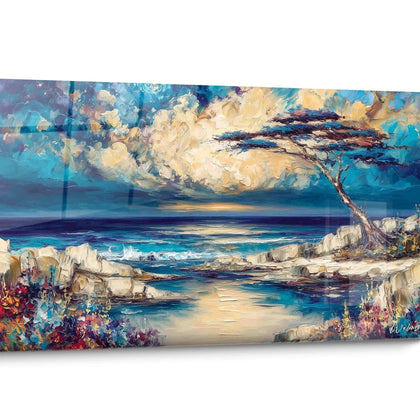
The landscape artwork for real estate agency radically transforms the visual environment of real estate transaction spaces by establishing an atmosphere conducive to clients projecting themselves into their future home. These large-format works oriented horizontally create natural visual continuity with storefront windows and presentation screens, amplifying the spatial openness sensation characteristic of prestigious properties.
Strategic positioning of landscape artwork for real estate agency in transactional space
The commercial architecture of real estate agencies requires specific visual optimization where the landscape artwork for real estate agency plays a determining role in guiding visual circulation. Unlike vertical formats that fragment perception, horizontal orientation naturally extends the architectural lines of negotiation offices and reception areas, creating geometric harmony with work surfaces and property presentation screens.
How to maximize the commercial impact of a panoramic visual in a waiting area?
The waiting areas of real estate agencies constitute crucial psychological territories where potential clients develop their first qualitative impression of professional expertise. A large-format real estate landscape artwork installed facing visitor seating establishes a soothing visual horizon that neutralizes transactional anxiety inherent in real estate purchase decisions. Representations of verdant valleys, maritime coastlines, or mountain panoramas activate cognitive mechanisms of residential desirability, emotionally preparing the client to view presented properties positively.
Visual synergies between real estate documentation and mural artistic expression
Integrating landscape artwork for a real estate agency in an environment saturated with promotional materials creates essential aesthetic breathing room. Real estate advisors observe a significant decrease in information overload when a mural work visually balances multiple property posters, brochures, and digital screens. This contrast strategy simultaneously valorizes commercial documentation and artistic expression, establishing a visual hierarchy that naturally guides visitor attention toward transactional materials after a moment of relaxing contemplation.
What dimensional criteria for a real estate negotiation room?
Negotiation rooms require specific visual proportions where the professional landscape artwork must respect a dimensional ratio with the conference table surface. For a standard 180 cm table, a horizontal format of 120 to 150 cm establishes proportional coherence without excessive visual dominance. This configuration allows the real estate advisor to maintain eye contact with clients while benefiting from a valorizing background that subtly reinforces professional authority. Representations of architecturally designed gardens or ordered natural spaces communicate environmental mastery that metaphorically extends to perceived transactional competence.
Chromatic and emotional psychology of landscape artwork for real estate agency
The chromatic selection of landscape artwork for a real estate agency directly influences the decision-making dispositions of potential buyers by modulating their emotional state during the transactional process. Green tones neurobiologically activate brain centers associated with territorial security and patrimonial stability, two fundamental psychological parameters in real estate acquisition. This subcortical activation favorably prepares cognitive terrain to accept commercial proposals with increased emotional openness.
Influence of visual horizons on real estate value perception
The panoramic mural representations installed in agencies create a mental association between the spatial amplitude represented and the quality of proposed properties. Behavioral studies in commercial environments demonstrate that clients exposed to open views for 8 to 12 minutes manifest budget tolerance superior by 12 to 18% compared to visually confined environments. This perceptual elevation of acceptable value is explained by symbolic transfer between artistic spatial generosity and anticipation of advantageous living surfaces.
How does natural imagery reduce transactional resistance?
Landscape artwork for a real estate agency functions as an emotional regulation device during negotiation tension phases. When contractual discussions reach friction points concerning price or conditions, the advisor can strategically orient visual attention toward the mural work while reformulating their proposal, allowing the client a micro-moment of cognitive disconnection. This relational technique exploits the soothing power of natural compositions to lower defensive reactivity and restore collaborative disposition. Horizontal formats particularly facilitate this attentional redirection through their compatibility with natural lateral eye movement.
Sensory differentiation against digital competition
In a real estate sector dominated by digital platforms, the large-format physical landscape artwork constitutes a tangible sensory differentiation marker. Unlike virtual experiences, the material presence of a quality mural work communicates an investment in client environment that implicitly signals a premium relational approach. This artistic materiality creates distinctive experiential memory that significantly improves brand recall during final decision-making between competing agencies. To deepen your professional visual strategy, also explore abstract artwork for real estate agency options that offer a complementary approach to diversify aesthetic impact according to functional zones.
Visual architecture and brand identity coherence with landscape artwork for real estate agency
Integrating landscape artwork for a real estate agency into the global visual identity of a real estate commercial structure requires strategic reflection on geographic territorialization of activity. An agency specialized in coastal properties optimizes its sectoral credibility by selecting maritime representations that resonate with the property portfolio, creating narrative coherence between the commercial environment and transactional offer. This thematic congruence reinforces perceived expertise by visually materializing claimed geographic specialization.
Seasonal rotation of landscape visuals to invigorate client experience
Innovative real estate agencies adopt a seasonal rotation strategy for professional landscape artworks to maintain the perceptual freshness of their commercial environment. This dynamic approach addresses repeated client attendance during extended transactional cycles, avoiding visual saturation that diminishes emotional impact. A golden autumn landscape in September-November can be replaced by a luminous winter scene, then by a regenerative spring composition, synchronizing spatial ambiance with natural rhythms that unconsciously influence buyer decision dispositions.
What role in valorizing storefront street-marketing spaces?
Real estate agency storefronts constitute strategic interfaces where landscape artwork for real estate agency visible from outside functions as pedestrian attractivity amplifier. An imposing horizontal format installed in visual depth creates a focal point that captures passer attention beyond simple real estate announcements, instantly communicating superior quality positioning. This visual stratification transforms the storefront into three-dimensional aesthetic experience where the mural work metaphorically suggests exceptional quality of properties represented in promotional materials at the foreground.
Coordination with architectural lighting of commercial spaces
The effectiveness of real estate landscape artwork directly depends on its integration within the global lighting system of the agency. Reception areas benefit from directional lighting that valorizes and creates visual depth accentuating perspectives represented in landscape compositions. This strategic lighting transforms the work into an active architectural element rather than simple passive decoration, modulating spatial ambiance according to daytime moments and reinforcing the impression of environmental sophistication that positively influences professional competence perception.
Which landscape artwork for real estate agency to choose according to target clientele?
Selection of landscape artwork for a real estate agency must correspond to the dominant sociodemographic profile of clientele. For corporate clientele seeking investment properties, prioritize sophisticated urban compositions with architectural horizons. For families seeking primary residences, opt for reassuring natural scenes evoking residential quality of life. For senior clientele, select Mediterranean or rural landscapes conveying serenity and heritage.
How to position multiple landscape artworks in a multi-space agency?
In compartmented real estate agencies, create visual narrative progression by installing primary landscape artwork for real estate agency in the reception zone establishing general aesthetic tone, then complementary works of slightly smaller formats in individual negotiation rooms. This dimensional hierarchy naturally guides client journey while diversifying ambiances according to spatial functions, with more dynamic compositions in collective zones and more contemplative works in transaction spaces.
Does landscape artwork really influence real estate commercial performance?
Behavioral analyses in commercial environment demonstrate that aesthetic optimization of real estate agencies, including strategically positioned landscape artworks for real estate agency, correlates with a 15 to 23% increase in average visitor presence time and improvement of 8 to 14% in consultation-to-mandate conversion rates. These impacts are explained by reduced transactional stress and improved positive memorization of relational experience, two determining factors in real estate decisions involving significant financial amounts.


 In the Shadow of Giants Painting - Mountain Landscape Edition233,90 €
 Generational Memory Tree Wall Art - African Landscape Edition233,90 €
 Acacia Aureolate with Ardent Copper - African Landscape Edition233,90 €
 Acacia Roots of Time - African Landscape Edition233,90 €
 Acacia Secret Oasis Painting - African Landscape Edition233,90 €
 Acacia Master of Saffron Horizons Painting - African Landscape Edition233,90 €
 Acacia Painting Silhouettes in the Blaze - African Landscape Edition233,90 €
 Dancing Tree Painting Under the Golden Moon - African Landscape Edition233,90 €
 Tree Wall Art Guardian of the Village - African Landscape Edition233,90 €
 Acacia Wall Art Witness of Golden Centuries - African Landscape Edition233,90 €
 Acacia Red Lands Guardian Painting - African Landscape Edition233,90 €
 Acacia Baobab Sunlight Painting - African Landscape Edition233,90 €
 Acacia Sentinel of the Golden Bush Painting - African Landscape Edition213,90 €
 Acacia Tree Roots of the Red Continent Painting - African Landscape Edition213,90 €
 Acacia Bridge between Earth and Clouds Painting - African Landscape Edition213,90 €
 Ancestral Baobab Tree Painting - African Landscape Edition213,90 €
 Solitary Baobab Tree Painting under Stormy Sky - African Landscape Edition213,90 €
 Tree Winter Peace Painting - Winter Edition213,90 €
 Solitary Acacia Painting - savanna edition233,90 €
 Cosmic Tree Wall Art - Starry Sky Edition233,90 €
 Altitude Blooming Canvas - mountain edition233,90 €
 Scottish Soul Wall Art - Waterfall Edition233,90 €
 Alps Canvas No. 1 - France Around the World Edition233,90 €
 Natural Alignment Canvas - Forest Landscape Edition233,90 €