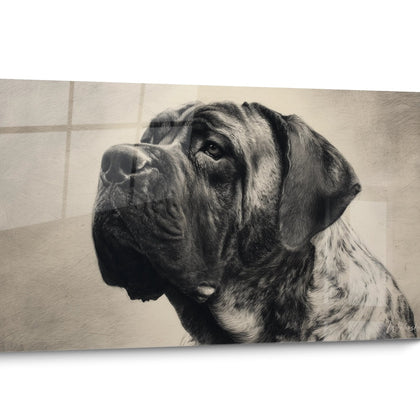
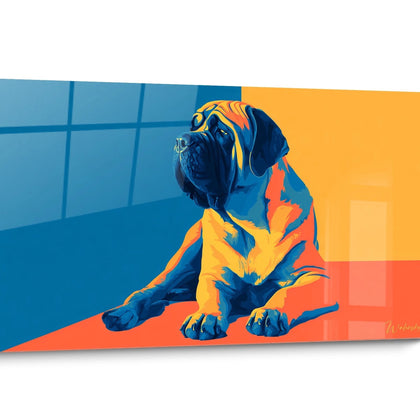
A realistic English Mastiff dog painting captures the very essence of this monumental British breed through striking photographic rendering. This wall representation transforms the natural power and ancestral nobility of the Mastiff into an imposing decorative presence for contemporary residential spaces. Mastiff owners and admirers of this legendary breed seek iconography that honors the exceptional stature and peaceful temperament of this canine giant, creating a compelling focal point in their interior.
Dimensional Amplitude at the Service of Canine Majesty
A realistic English Mastiff dog painting demands monumental dimensions that respect the natural proportions of one of the world's largest breeds. Unlike miniaturized representations that betray the very essence of the Mastiff, a large-format composition of 120 to 180 centimeters restores the characteristic intimidating presence of this British mastiff. The imposing scale allows faithful reproduction of every morphological detail: the deep facial wrinkles, the powerful square jaw, and that penetrating gaze imbued with ancient wisdom.
How does realistic photography restore the texture of the fawn coat?
The high-definition photographic technique employed for these paintings captures the subtle nuances of the English Mastiff's short, dense coat. Color variations between golden apricot, silvery fawn, and dark brindle appear with microscopic precision, revealing the velvety texture characteristic of this breed. This color fidelity proves particularly crucial for owners wishing to immortalize their companion or enthusiasts seeking authentic representation without artistic compromise. The three-dimensional rendering almost suggests the tactile sensation of this characteristic coat.
Capturing the emblematic facial expression of the Mastiff
Photographic realism excels at restoring the contradictory facial expression of the English Mastiff: that of a formidable guardian with paradoxically gentle temperament. Dark eyes with slightly drooping eyelids convey this legendary good nature despite the imposing stature. For admirers of this ancient breed descending from Roman arenas, this visual duality constitutes the very essence of the Mastiff – a redoubtable protector capable of surprising tenderness toward family. Dramatic lighting accentuates the muscular reliefs of the massive neck and monumental head.
Why choose realistic rendering over artistic stylization?
Buyers of Mastiff English paintings overwhelmingly favor realistic rendering because this breed embodies a canine history spanning over 2000 years that no abstract interpretation could convey. Unlike modern breeds, the Mastiff possesses an ancestral morphology unchanged since medieval times, deserving faithful documentary representation. This photographic approach particularly suits British classical interiors, wood-paneled libraries, and spaces dedicated to hunting heritage where historical authenticity takes precedence over contemporary stylistic experimentation.
The Morphological Specificities of the Mastiff in Wall Representation
Athletic constitution beneath apparent mass
A quality realistic English Mastiff dog painting reveals the musculature concealed beneath this breed's massive appearance, which can reach 100 kilograms. Front-facing or three-quarter photography unveils exceptional skeletal architecture: the broad, deep chest, the thick neck supporting a voluminous head representing a quarter of body weight alone. For professional breeders and show judges, these anatomical details constitute essential evaluation criteria. The realistic representation functions as a morphological reference, illustrating the breed standards defined by the British Kennel Club since 1883.
The characteristic black facial mask in close-up
Close compositions of the English Mastiff's face highlight the dark mask covering the muzzle, ears, and eye contours – a mandatory genetic marking according to breed standards. This contrasting pigmentation naturally creates a dramatic visual effect that animal photographers exploit to generate powerful graphic compositions. Art canine collectors particularly seek these tight framings that transform facial anatomy into a study of textures and contrasts. For installation in a narrow hallway or limited vertical space, this framing option concentrates visual impact.
Which posture captures the essence of Mastiff temperament?
Realistic English Mastiff paintings typically favor three emblematic postures: the majestic sitting position that emphasizes the impressive height at withers, the side-standing stance revealing dorsal length and thoracic depth, or restful reclining evoking the natural serenity of this calm breed. Unlike dynamic breed representations captured in motion, the Mastiff ideally suits contemplative static poses reflecting its composed temperament. This photographic stillness paradoxically suggests power in reserve rather than passivity, creating compelling visual tension.
Enthusiasts of this ancestral British lineage also appreciate compositions including historical contextual references: English paving stones, Victorian wrought iron gates, or manor interiors evoking the Mastiff's traditional role as guardian of aristocratic properties. If you seek a sophisticated monochromatic approach, discover our collection of black and white English Mastiff dog paintings that accentuate dramatic contrasts and the facial structure of this monumental breed.
Decorative Valorization of Monumental Canine Presence
Adequacy with generous architectural spaces
A realistic English Mastiff dog painting naturally finds its place in proportioned architectural volumes: cathedral-like entry halls, high-ceilinged living rooms, monumental stairways, or double-height libraries. This breed requiring considerable living spaces itself, its wall representation logically harmonizes with residences featuring generous surfaces. Owners of rural properties, renovated manors, or industrial lofts with open walls constitute the privileged audience for these imposing compositions. The sought visual effect consists of creating a permanent canine presence without the logistical constraints of a 90-kilogram animal.
How does this representation strengthen the canine identity of an interior?
For professional Mastiff breeders, veterinarians specializing in giant breeds, or collectors of British canine objects, this wall iconography immediately asserts residential expertise and passion. Installed in a professional waiting room, consultation office, or breeding facility entrance, the painting functions as an instant identity marker. Realistic photography avoids the pitfall of caricature or anthropomorphism, maintaining respectful dignity toward this historic working breed. This serious approach particularly appeals to purist enthusiasts rejecting fantastical representations.
Association with traditional British decorative elements
The English Mastiff painting aesthetic integrates harmoniously within an environment inspired by British heritage: aged leather Chesterfield furniture, dark oak paneling, Persian rugs in terracotta tones, patinated brass fixtures. This stylistic coherence creates a visual narrative around British canine heritage where the Mastiff occupies a central place since medieval times. The natural tones of the fawn coat particularly harmonize with characteristic classical interior color palettes: beiges, browns, hunting greens, and deep burgundies characteristic of English country estates.
Which spaces benefit most from this imposing visual presence?
Beyond reception areas, the realistic English Mastiff dog painting finds strategic decorative applications in transitional spaces: stairwell landings where its natural verticality valorizes wall height, spacious hallways requiring a magnetic focal point, or even backdrops for professional video conferences for cynologists and canine consultants. Veterinary clinics specializing in giant breeds, high-end kennels, and canine training centers also use these representations to create a reassuring atmosphere demonstrating their specific expertise.
Is a realistic English Mastiff dog painting suitable for small spaces?
Given that this breed embodies canine monumentality, realistic representations perform optimally in generous volumes permitting visual distance of at least three meters. In restricted spaces, the effect may seem oppressive rather than majestic, contradicting the Mastiff's peaceful temperament.
How to durably maintain a large-format realistic English Mastiff dog painting?
High-definition photographic prints on rigid supports naturally resist sagging thanks to integrated dorsal reinforcements. Monthly dusting with antistatic microfiber generally suffices, avoiding liquid products susceptible to altering professional pigment inks guaranteeing color stability spanning several decades.
What is the optimal viewing distance to appreciate details of a realistic English Mastiff dog painting?
For formats exceeding 120 centimeters, observation distance of 2.5 to 4 meters allows simultaneous apprehension of overall composition and photographic details like coat texture or eye expression. This distance naturally corresponds to spacious living rooms and entry halls where these works find ideal placement.


 Dog Portrait with Amber Eyes Wall Art - Intense Gaze - English Mastiff Edition233,90 €
 Realistic Black and White English Mastiff Portrait Wall Art - Noble Gaze - English Mastiff Edition233,90 €
 English Mastiff Portrait Canvas in Beige and Black Tones - Noble Gaze - English Mastiff Edition233,90 €
 English Mastiff Portrait Wall Art Amber Eyes - Thoughtful Gaze - English Mastiff Edition213,90 €