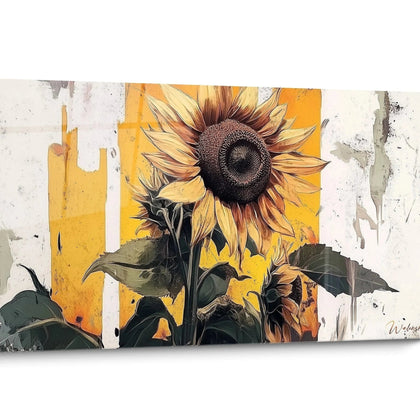
The colorful expressionist sunflower painting transcends naturalistic approaches to magnify the emotional intensity of helianthus through an assumed chromatic explosion. This artistic interpretation privileges the exaltation of saturated pigments and audacious contrasts, transforming the traditional floral motif into a vibrant visual manifesto. Intended for collectors seeking imposing wall presence, this type of large-scale artwork particularly addresses contemporary environments and urban lofts requiring a dynamic focal point capable of structurally organizing space while establishing an energizing atmosphere.
Chromatic Intensity of Saturated Expressionist Sunflowers
The colorful expressionist sunflower painting pushes conventional floral representation boundaries through exacerbated pigmentation evoking the fauvism and neo-expressionism heritage. This radical approach amplifies the natural hues of golden petals to maximalist saturation, integrating brilliant vermillions, deep purples, and electric turquoises within the composition to create a striking visual symphony.
How do chromatic contrasts reinforce emotional impact?
Juxtapositions of opposing complementary colors—incandescent oranges against cosmic violets, lemon yellows confronted with cobalt blues—generate intentional optical tension that immediately captures the viewer's attention. This chromatic strategy, characteristic of colorful expressionist sunflower painting, transforms passive contemplation into immersive sensory experience, particularly effective in minimalist spaces where the artwork becomes a dynamizing architectural element.
Exploitation of dissonant harmonies in floral compositions
Beyond traditional palettes associated with helianthus, these creations incorporate unexpected chromatic associations: saturated magenta backgrounds, pistils rendered in acid green, or floral centers treated in purple monochromatic variations. These audacious choices embody an anti-naturalist approach privileging raw emotional expression over descriptive fidelity, creating decorative pieces perfectly suited to design interiors seeking strong visual personality.
Transparency effects and pigmentary layering
The expressionist technique applied to sunflowers frequently exploits superimposed colored glazes, creating complex chromatic depths where multiple vibrant hue layers interact optically. This approach generates subtle tonal variations enriching the artwork's interpretation according to viewing angle and lighting conditions, conferring on each painting an evolutionary dimension particularly appreciated on large wall surfaces exposed to natural lighting variations throughout the day.
Expressive Gesturality and Visual Dynamism of Stylized Helianthus
The expressionist approach of the colorful expressionist sunflower painting is characterized by energetic gesturality infusing movement and vitality into floral compositions. Impetuous brushstrokes, textured impastos, and controlled splatters translate creative spontaneity radically contrasting with smooth, academic botanical representations.
What dynamism do gestural treatments of petals create?
Petals are often rendered through vigorous directional touches suggesting organic whirling, as if flowers were animated by perpetual circular movement. This visual kinetics, obtained through repeated curved strokes and radiating striations, confers on compositions a centrifugal energy literally radiating from the artwork's center, creating a hypnotic effect particularly effective in living spaces or entryways requiring captivating artistic presence.
Impasto textures and their sculptural impact
The accumulation of pictorial material in pronounced reliefs transforms the two-dimensional surface into quasi-sculptural wall installation. These textured thicknesses capture lateral light, generating micro-shadows accentuating the composition's three-dimensional character. For collectors privileging imposing formats, these surface variations create an evolving visual spectacle according to daily hours, each lighting modification revealing new artwork facets.
How does gestural spontaneity reinforce expressive authenticity?
Controlled drips, pigmentary projections, and unretouched strokes testify to immediate execution preserving the artist's initial emotional intensity. This gestural authenticity, visible in every assumed creative accident, establishes direct connection between original creative energy and the contemporary viewer. For buyers seeking characterful artwork capable of structuring residential or professional environments, this expressive frankness constitutes a major differentiating criterion against standardized mechanical reproductions.
Are expressionist sunflower paintings suitable for professional spaces?
Absolutely, these artworks bring chromatic vitality and positive energy particularly appreciated in coworking spaces, creative studios, design showrooms, and innovative company receptions seeking to project audacious and contemporary visual identity.
Spatial Enhancement through Monumental Floral Expressionism
Successful integration of a large-scale colorful expressionist sunflower painting radically transforms interior volumetric perception and chromatic ambiance. These imposing artworks function as genuine visual architectures capable of redefining spatial hierarchies and establishing strategic focal attraction zones.
Which environments maximize expressionist floral compositions impact?
Generous volumes with neutral walls—industrial lofts with exposed brick, minimalist contemporary living rooms, double-height spaces—constitute ideal settings for these vibrant creations. Extended wall surface allows chromatic explosion to fully express itself without visual competition, while contrast with raw materials (polished concrete, raw wood, steel) intensifies by opposition the artwork's pigmentary richness.
Decorative associations amplifying stylistic coherence
To optimize decorative harmony, prioritize furniture with refined lines in sober tonalities letting the floral composition visually dominate. Design seats in velvet recalling a secondary painting hue, metal accessories with brass or copper finishes evoking petal golds, or textiles with organic textures create subtle echoes unifying everything without diluting the artwork's central impact.
How does monumental scale influence emotional perception?
An imposing format—typically exceeding 120x80 cm—generates immersive presence literally enveloping the viewer in the artist's chromatic universe. This ambitious scale particularly suits collectors wishing to create gallery effects in their residential space, transforming a simple wall into genuine artistic installation rivaling contemporary museum presentations.
Frequently asked questions about colorful expressionist sunflower paintings
Are colorful expressionist sunflower paintings suitable for bedrooms?
While dynamizing, such artwork perfectly suits a spacious bedroom if one privileges compositions with slightly attenuated tonalities or positions the artwork on a lateral wall rather than facing the bed, thus creating an energizing point of interest without disturbing nighttime tranquility.
How to maintain a large colorful expressionist sunflower painting?
Gentle dusting with an antistatic brush every two months generally suffices. Absolutely avoid direct sun exposure which could alter saturated pigments, and maintain stable humidity between 40-60% to preserve materials' integrity over time.
What is the decorative value of a colorful expressionist sunflower painting in eclectic decoration?
These artworks function remarkably as unifying pieces in eclectic interiors, their chromatic richness allowing visual bridges between different furniture styles. They harmoniously unify disparate elements by creating coherence through color rather than style.


 Sunflower Painting No. 6 - Nature Edition233,90 €
 Sunflower Painting No.4 - Nature Edition233,90 €
 Sunflower Painting No.3 - Nature Edition233,90 €
 Sunflower Wall Art No. 2 - Nature Edition233,90 €