You watch your guests admire your artwork, but you feel this dull frustration: your decorative vision lacks sensory depth. The emotion you wanted to convey remains on the surface, incomplete.
You may have tried a few random scented candles, or opted for a diffuser with generic fragrances. But these solutions create no artistic coherence with your carefully considered decorative universe.
It's normal that you feel disoriented: no one has ever explained to you that olfactory identity is an integral part of the artistic expression of an interior. Classic ambient fragrances are designed to please everyone, not to extend your creative vision.
By the end of this article, you will know how to create a unique olfactory signature that will transform your interior into a true multisensory work of art - and your guests will immediately feel the artistic atmosphere you imagined.
Why does your artistic decoration need an olfactory dimension?
Imagine entering a contemporary art gallery: the subtle scent of precious wood and old paper instantly transports you to a creative universe. This sensory alchemy is not accidental - it reveals the transformative power of fragrance on our artistic perception. If you are still waiting to associate an olfactory identity with your decorative style, you are missing out on a unique opportunity to create a total immersive experience in your interior.
🎨 Testimonial from an art collector: "I have long collected minimalist works without understanding why my guests didn't feel the peace I was looking for. The click happened when I discovered a fragrance with notes of white cedar and iris - suddenly, my Rothkos took on a whole new contemplative dimension."
💬 Conversation with a decor expert
The golden rule of sensory harmony: Your signature fragrance should complement the emotion of your artistic style, not mask it. Observable result: your guests will instantly identify your creative "touch" as soon as they cross the threshold - usually in less than 30 seconds.
What's really behind your decorative frustration
Do you recognize yourself in these situations? You admire your art collection but the atmosphere lacks personality, your guests appreciate it without being marked, or you feel a disconnect between your creative vision and the actual experience of your interior.
What you are experiencing is not a problem of taste or budget - it's simply that your decorative approach remains mono-sensory. Your creative brain needs olfactory stimulation to complete the artistic picture you have imagined.
Imagine a Michelin-starred chef who only works with flavors without caring about aromas: the experience would remain incomplete despite all their technique. That's exactly what happens with your artistic decoration.
The first hidden cause: the confusion between fragrance and olfactory identity
Contrary to what many think, choosing a room fragrance is not just about "smelling good". The true creation of an artistic olfactory identity follows the same codes as composing a work of art: rhythm, contrast, harmony.
Think about the difference between wearing ready-to-wear and going to a tailor: the bespoke approach completely transforms the experience. Your signature fragrance should be tailored to your specific artistic universe.
This revelation changes everything in your approach to decoration: you go from being a consumer to a creator of atmospheres. Your interior becomes a total work of art, not just an assemblage of beautiful objects.
🔍 Artistic coherence test: Close your eyes in your favorite room and take a deep breath. Does the current smell evoke the same emotional universe as your works of art? If the answer is no, you have just confirmed the diagnosis.
Many people think that an artistic interior should remain "neutral" in terms of smells to not compete with visual works. In reality, the absence of an olfactory signature creates a sensory void that weakens the overall artistic impact.
It's like trying to create a musical atmosphere by cutting the sound: silence is not neutral, it lacks dimension. Your nose is constantly picking up olfactory information, even when you are not consciously aware of it.
Result: your guests leave with a strong visual impression but no deep emotional memorability. They remember your artworks, but not the emotion felt in your space.
The third cause: lack of knowledge of artistic olfactory families
Few people realize that each art movement has its own natural olfactory palette. Abstract art calls for clean notes, expressionism demands powerful olfactory contrasts, minimalism sublimates pure essences.
Observe your collection: the dominant colors, the materials, the energy that emanates... All these elements translate sensory preferences which can be declined into fragrance. You've already done half the work without knowing it!
This lack of knowledge prevents you from seeing an obvious creative coherence: your visual artistic style already holds the keys to your ideal olfactory signature.
🎯 3 signals that reveal your olfactory potential:
- Your artworks favor certain textures: Smooth surfaces = crystalline notes, raw materials = woody or earthy essences
- Your favorite colors recur: Warm tones = spices and resins, cool tones = aquatic or mineral notes
- The sought-after emotion is constant: Calm = lavender and cedarwood, energy = citrus fruits and aromatic herbs
The trigger element: understanding your "creative fingerprint"
The click happens when you realize that your artistic style is not just a visual preference - it's the expression of a global sensitivity that touches all your senses. Like a musician who instantly recognizes his favorite scale, your nose has a natural olfactory signature that corresponds to your creative universe. You just need to reveal it for everything to harmonize.
The rule of sensory alignment: The more your signature fragrance matches your natural creative fingerprint, the more immediate and authentic the effect will be. Test this theory by smelling different essences near your favorite artwork.
| ❌ Classic fragrance approach | ✅ Artistic olfactory signature | 💡 Why it changes everything | 🎯 Immediate benefit |
|---|---|---|---|
| Choosing according to personal tastes | Harmonizing with your decorative style | Creates total sensory coherence | Immersive atmosphere from the entrance |
| Seeking to "smell good" universally | Expressing a unique creative identity | Differentiates your interior from others | Strong emotional memorability |
| Using commercial fragrances | Composing your own signature | Allows infinite personalization | Signature recognizable among thousands |
| Staying in your comfort zone | Exploring unexpected accords | Reveals new creative facets | Stimulating artistic evolution |
How to create your artistic olfactory signature in 3 steps
Rassurez-vous, creating a unique scent identity doesn't require becoming a professional perfumer. Like a gardener who composes their flowerbeds according to their tastes, you will simply learn to cultivate your olfactory palette in harmony with your artistic vision. The progression follows a natural logic: identify your style, explore sensory correspondences, then refine your signature. At each step, you will feel a growing sense of creative satisfaction.
Your creative journey in 3 steps: Deciphering your current artistic footprint → Exploring corresponding olfactory families → Composing your personalized signature. Each step reveals a new facet of your creativity and brings you closer to the ideal atmosphere.
🔍 Step 1: Decipher Your Artistic DNA
Before choosing fragrances, you must understand the secret language of your current decor. Like a detective analyzing clues, you will reveal the hidden sensory preferences in your artistic choices. This step is fundamental because it avoids costly mistakes. Once completed, you will have a precise map of your creative style and its natural olfactory translations.
🧰 Tools for Analysis
- Creative notebook: Choose a beautiful notebook that inspires you, A5 format is ideal for noting sensory discoveries. Favor thick paper that doesn't bleed through with ink - your observations deserve a quality support. Avoid digital notebooks which break the tactile connection necessary for artistic analysis.
- Camera or smartphone: To capture details of your artworks under different lighting conditions. Light reveals nuances that your accustomed eye no longer notices - these subtleties are crucial to identify your olfactory palette. Take several shots at different times of the day.
- Reference samples: A few natural materials (wood, stone, fabric) that recall the universe of your artworks. Touching these textures awakens unconscious olfactory associations that you can then reproduce in perfume.
Now, let's move on to the practical analysis of your style
📊 Sensory Analysis Method
Emotional inventory of your artworks: Sit in front of your favorite artwork and note 5 words that describe the emotion felt. Avoid technical terms ("abstract", "modern") and favor sensations (“soothing”, “energizing”, “mysterious”). This emotion will be the guiding thread of your olfactory signature.
Time: 15 minutes | ✅ Completed when: You have identified the dominant emotion and 2-3 secondary emotions | Attention: Do not mix what you should feel with what you really feel - authenticity is key.
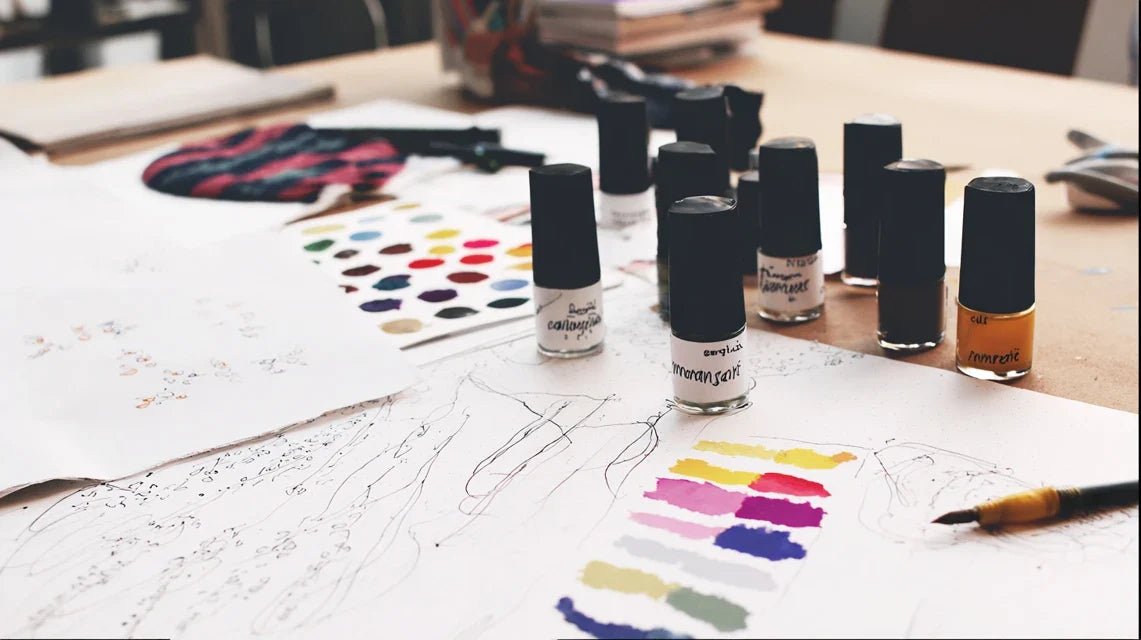
Color and material mapping: Photograph your artworks and note the 3 dominant colors and the 2 main materials. Each color evokes a natural olfactory family (red = spices, blue = freshness, ocher = wood...). Materials reveal the sought-after olfactory texture.
⏱️ Time: 20 minutes | ✅ Successful when: You have a clear chromatic palette and identified recurring materials | ⚠️ Attention: Observe under natural lighting - artificial lighting distorts color perception.
Spatial coherence test: Close your eyes in your artistic room and breathe deeply for 2 minutes. Note all the smells perceived and assess whether they correspond to the desired visual atmosphere. This step reveals the gap between your vision and olfactory reality.
⏱️ Time: 10 minutes | ✅ Successful when: You have identified current odors and their suitability with your style | ⚠️ Attention: Perform this test at different times (morning, evening) as your perception varies.
✅ Validation of step 1: You must have identified your dominant artistic emotion, your chromatic palette, and the current olfactory gap. If you are still hesitating about the main emotion, redo the exercise with a different artwork - the constant that appears is your creative signature. You are ready to explore olfactory correspondences!