Imagine a moment in early 18th-century Paris. In the salons of the aristocracy, a young painter named Watteau overturns all conventions. His landscapes are unlike anything known: neither raw nature nor conventional decor, but something entirely new that captivates the hearts of his contemporaries.
Landscapes in Watteau's festive gatherings: a staged nature
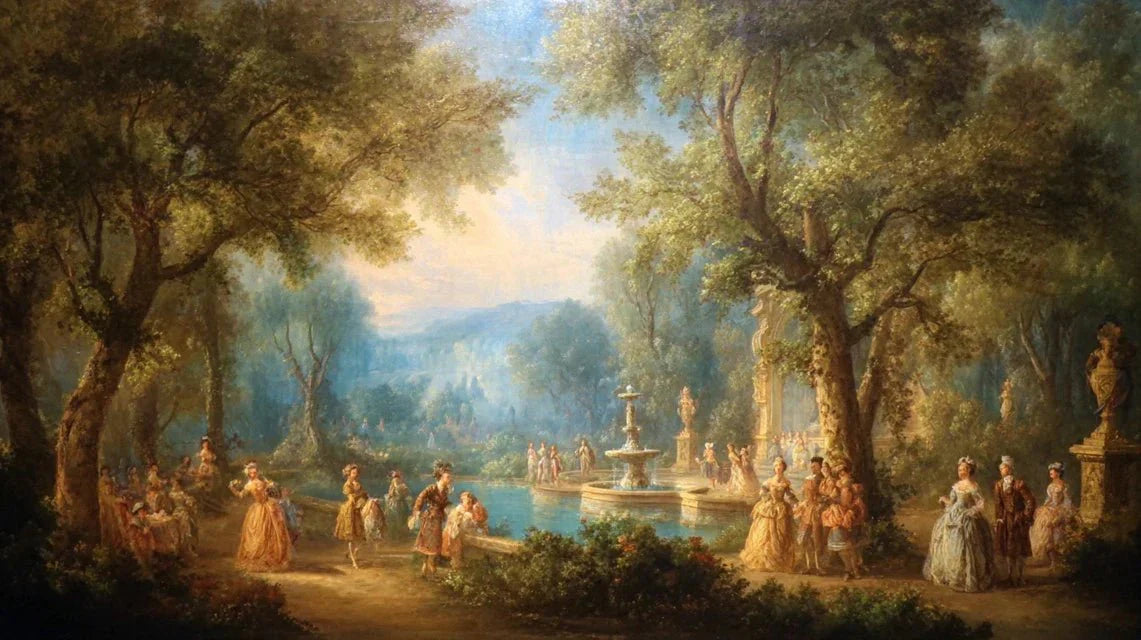
Watteau invents a magical formula: transforming nature into a living theater. Take The Pilgrimage to Cythera (1717), his masterpiece that opens the doors of the Royal Academy for him. In this painting, theatrical nature becomes the main character. Majestic trees form natural alcoves. Lush vegetation envelops elegant couples. Every element of the landscape seems placed by a brilliant stage director.
The Academy, moreover, doesn't know how to classify this extraordinary talent. In 1717, it created a new genre altogether: the fête galante. Never before seen in French art history. Watteauesque landscapes are distinguished by specific elements that create their particular magic:
- Trees with generous foliage creating intimate refuges
- Bluish distances merging into the horizon like a dream
- Sculptures and fountains reminiscent of aristocratic parks
- A golden light caressing every leaf, every face
Techniques of composition of theatrical landscapes in Watteau
How does Watteau create this visual alchemy? By fusing two seemingly irreconcilable pictorial traditions. On one side, the Venetian heritage with its vaporous atmospheres inherited from Titian. On the other, Flemish precision in rendering details. The result? Landscapes in festive gatherings that seem to float between dream and reality.
His technique reveals an obsessive perfectionist. Watteau draws relentlessly, accumulating entire notebooks of sketches. A tree seen during a walk. A statue crossed in a garden. Every element is captured, studied, then reused in his compositions. His brush then works with light touches, suggesting more than asserting. This theatrical nature is born from this unique approach where nothing is left to chance.
Luxuriant vegetation as decor for festive gatherings
In Watteau's universe, trees become accomplices of lovers. Their dense foliage creates green rooms where romantic intrigues unfold. This theatrical nature offers this seductive paradox: intimacy in the open air, spontaneity in sophistication.
Look carefully at his landscapes. You will never find a wild forest or a desolate countryside there. Everything evokes French gardens with their scientific geometry, their trimmed groves, their calculated perspectives. Even the color palette participates in this staging. Greens range from tender to deep, creating a soothing visual symphony.
A revealing detail: the light. Watteau excels at showing how it filters through the leaves, creating those golden patches that dance on silk robes. To capture this enchanting atmosphere of classic landscapes in your interior, explore a selection of landscape paintings inspired by this refined pictorial tradition.
Landscapes by Watteau: between reality and theatrical artifice
Here is the watteauesque genius in all its splendor: these landscapes exist nowhere else but on canvas. They borrow from the gardens of Versailles their elegance, from the Flemish countryside their authenticity, from Italian theater sets their fantasy. The result? A purely imaginary geography where time seems suspended.
The fetes galantes take place in these unlikely places where everything conspires to happiness. Social constraints evaporate. Conventions soften. Only remain the pleasure of conversation, the game of seduction, harmony with a benevolent nature. The characters themselves, in their shimmering costumes, prolong this theatricality to the end.
Observe these significant details: a statue of Venus watching over lovers, a fountain whose water murmurs secrets, an ancient temple half-ruined. Each element transforms the landscape into a skillfully orchestrated scenery. We are witnessing a spectacle where nature and culture become one.
The influence of Italianate landscapes on the fêtes galantes
History becomes fascinating when you discover Watteau's sources of inspiration. At the Luxembourg Palace, the young artist spends hours in front of Rubens' paintings. He studies how the Flemish master represented the nature luxuriant, how he created these sensual and luminous atmospheres. This lesson marks his pictorial vision forever.
But Watteau never slavishly copies. He adapts the Italian heritage to French sensitivity. The typically Venetian mountainous distances become softer, more welcoming. The palette brightens slightly. The result enchants all of Europe.
His successors, Lancret and Pater in particular, will try to perpetuate this vision. But none will equal the original magic. The landscapes in the fêtes galantes by Watteau embody the spirit of an era, the Regency, which sought lightness after decades of austerity. This theatrical nature becomes much more than a pictorial style: the emblem of French taste radiating throughout the continent, permanently influencing landscape art and inspiring generations of artists up to us.
FAQ : The Landscapes of Watteau
Q1 : What is a fête galante by Watteau?
A fête galante designates a pictorial genre invented specifically for Watteau in 1717. It refers to elegant rural scenes where aristocratic characters engage in amorous amusements in theatrical landscapes, mixing lush nature and refined decorative elements.
Q2 : Why is the term "theatrical nature" used for Watteau's landscapes?
Watteau’s landscapes are described as theatrical because they do not faithfully reproduce reality but create imaginary sets composed like stage designs. Trees, fountains and statues are arranged as a director would arrange the elements of a play, creating a dreamlike atmosphere conducive to gallant scenes.
Q3 : What are the main influences on Watteau's landscapes?
Watteau is mainly inspired by two traditions: Venetian painting (Titian, Giorgione) for vaporous atmospheres and bluish distances, and the Flemish tradition (especially Rubens) for the treatment of lush vegetation and the sensuality of rural settings. He combines these influences to create a uniquely French style.