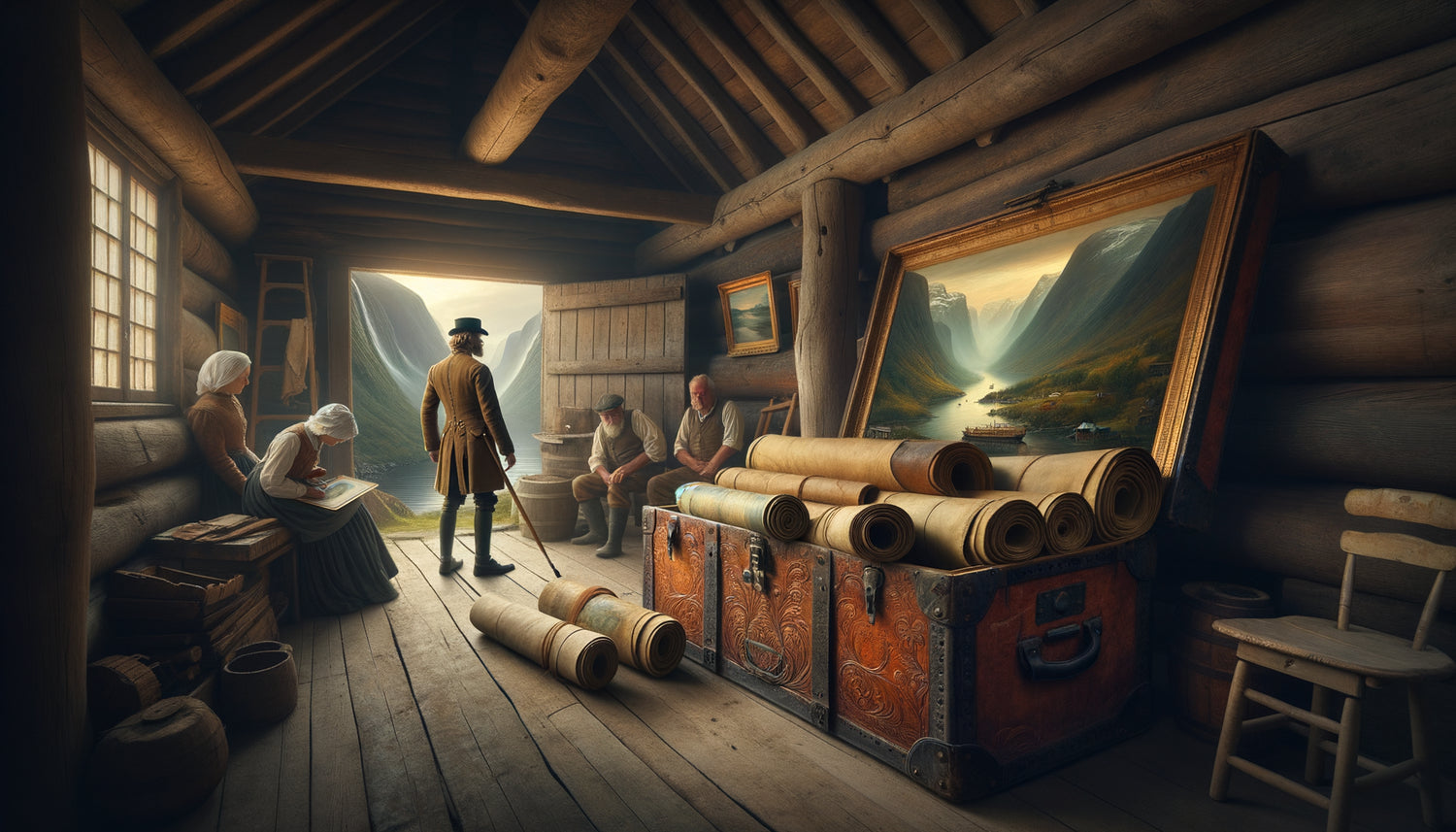
Imagine a man carrying on his back a wooden chest containing dozens of rolled canvases, walking from village to village along the Norwegian coasts. These itinerant artists of the 19th century did not merely paint the fjords: they carried them with them, transforming every isolated farm, every port inn, every bourgeois living room into an ephemeral gallery. Their mission? To introduce the majesty of the Nordic landscapes at a time when traveling remained an inaccessible luxury.
Here's what these Scandinavian itinerant painters accomplished: they democratized access to fjord views by physically transporting them to homes, created a decentralized art market before the era of modern galleries, and forged the romantic visual identity of Scandinavia that endures today. Without cameras or mechanical reproductions, these nomadic artists invented a distribution system of remarkable ingenuity.
Today, as we order artwork with a few clicks, we forget an era when seeing a faithful representation of a distant fjord was an event. How did these painters manage to disseminate their creations in such vast and isolated territories? What was their commercial and artistic strategy? Let's dive into the fascinating world of these merchants of horizons.
The painter's trunk: a portable studio between pragmatism and poetry
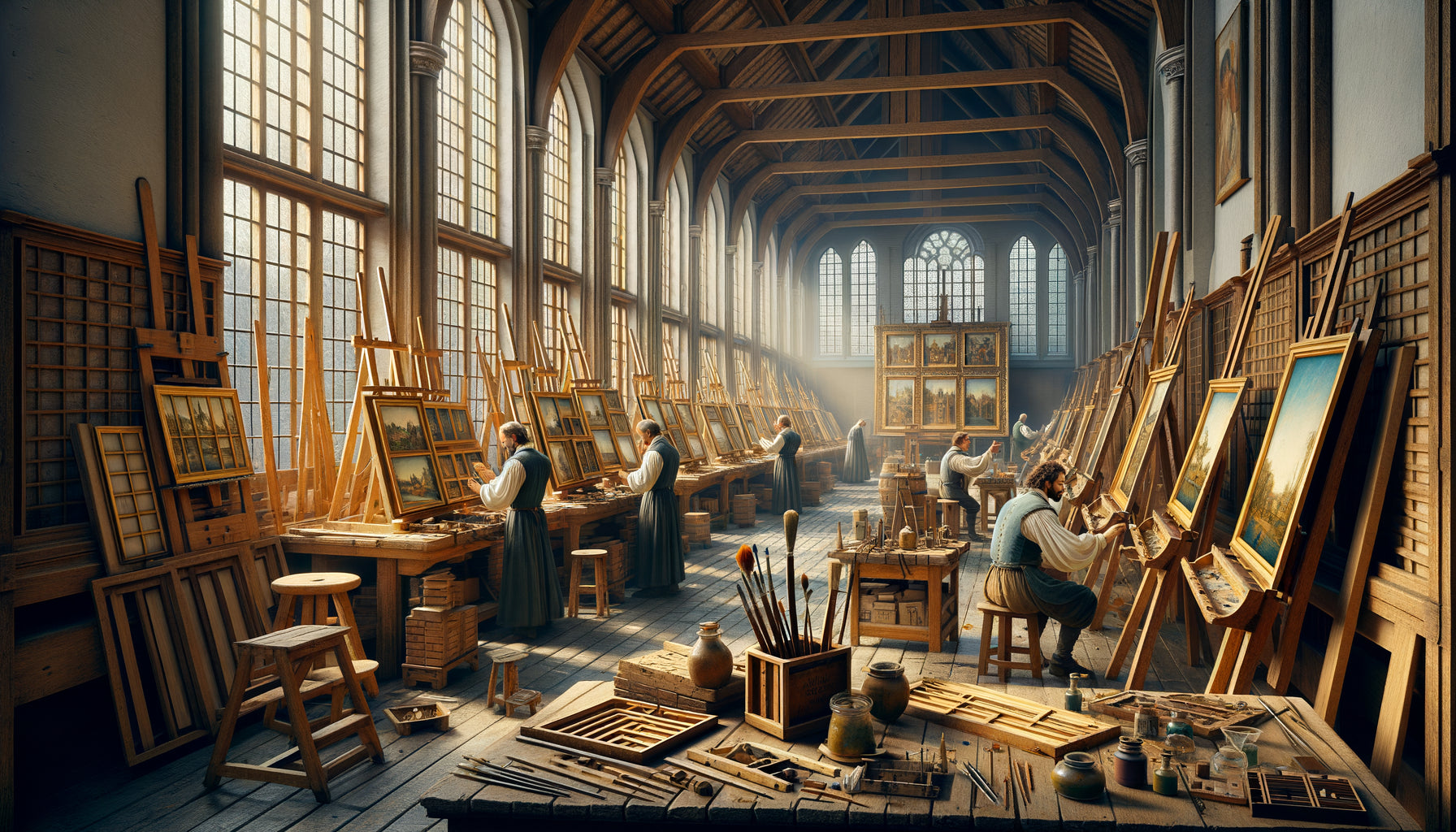
Scandinavian itinerant painters of the 19th century traveled with carefully considered equipment. Their travel trunks contained rolled canvases of various sizes, newly invented tubes of oil paint (a revolution!), brushes wrapped in oiled cloth, and above all sketchbooks filled with sketches of fjords.
These nomadic artists favored panoramic views of the most iconic fjords: Geirangerfjord with its vertiginous waterfalls, majestic Sognefjord, flowering Hardangerfjord in spring. They generally painted en plein air during the Scandinavian summer, capturing the particular light of the long Nordic days, then spent the winter traveling through populated areas to sell their works.
The technique was adapted for travel: medium formats (rarely more than 70 centimeters), simple wooden pine frames that they could make themselves, and above all a color palette immediately recognizable: deep blues for icy waters, emerald greens for steep slopes, pearlescent white for waterfalls and eternal snowfields.
The circuit of isolated farms: when art came to your door
The dissemination strategy of these itinerant painters relied on a network of contacts meticulously built year after year. They followed established circuits, visiting the same prosperous farms, the same rectories, the same merchants' houses at regular intervals.
The arrival of a traveling painter was a social event in isolated communities. He brought not only his fjord paintings but also news from other regions, travel stories, and artistic trends from the cities. The living room would transform into a temporary gallery: canvases were unrolled, hung provisionally on the walls, and the family could choose one that suited their tastes and budget.
These Scandinavian painters practiced a form of custom sales ahead of its time. If a farmer wanted a particular view of a fjord he had visited in his youth, the artist would take an order and return the following year with the requested work. This personalized relationship created remarkable loyalty and guaranteed recurring income.
Prices adapted to each social class
The commercial ingenuity of these itinerant artists lay in their product range. For modest farms: small format watercolors or ink sketches of fjords, affordable but authentic. For the emerging bourgeoisie of ports: medium-sized oils, carefully framed. For wealthy families: imposing panoramas or thematic series following the seasons.
Some Scandinavian painters also produced engraved reproductions of their most popular fjord views, which they sold in lots. This democratization foreshadowed modern art editions, allowing almost every household to access a representation of Nordic landscapes.

Port cities: hubs for artistic diffusion
Bergen, Trondheim, Stavanger: these Scandinavian port cities were the strategic rear bases of itinerant painters. They rented storage space for their paintings there, established partnerships with local framers, and above all organized temporary exhibitions in inns, abandoned warehouses or communal halls.
These urban exhibitions worked differently from the rural circuit. They attracted foreign travelers, particularly British and German tourists fascinated by Scandinavian landscapes after reading fashionable romantic accounts. These visitors bought fjord views as tangible souvenirs of their Nordic trip, contributing to the dissemination of the Scandinavian imaginary throughout Europe.
Traveling painters also established relationships with shipowners and ship captains. Some fjord paintings decorated boat cabins, while others were transported to Copenhagen, Stockholm, or even London, creating an international distribution network before the existence of modern galleries.
Building a visual signature: recognizing a fjord at first glance
Traveling Scandinavian painters developed their own distinctive styles, allowing collectors to immediately recognize their work. Some favored dramatic views with stormy skies and powerful waves, while others preferred serene atmospheres with mirror waters and golden lights.
This visual signature served as a guarantee of authenticity at a time when copies and forgeries began to circulate. A farmer who had purchased a view of the Sognefjord from a traveling painter would recognize his style the following year and become a loyal customer. This relationship of trust was crucial in a market without galleries or experts to authenticate works.
The most skilled artists created variations on their successful compositions. A popular view of the Geirangerfjord could be declined at different times of day, under various weather conditions, offering collectors the opportunity to acquire multiple interpretations of the same iconic site.
The influence of national romanticism on compositions
The fjord views of these traveling painters participated in the Scandinavian national romantic movement. Their compositions magnified Nordic nature, creating an iconography that defined Norwegian cultural identity under construction. The fjords were not simply landscapes: they became symbols of grandeur, purity, and spiritual connection with nature.
This sense of identity explains why Scandinavian families invested in these works despite limited resources. Owning a fjord view meant affirming one's belonging to a territory and culture. Traveling painters did not just sell paintings: they offered fragments of the Nordic soul.

The forgotten legacy: when itinerants shaped the modern gaze
These Scandinavian itinerant painters shaped our contemporary perception of fjords. The compositions they popularized – the high-angle viewpoint overlooking the fjord, the inclusion of modest human elements against the immensity of nature, the contrasting color palette – are now found in tourist photography, promotional posters, and even travel app interfaces.
Their distribution method also foreshadowed modern experience marketing. By bringing their paintings directly to potential buyers, telling the stories behind each view, and creating an event around their visits, they practiced what we call relationship selling today.
Many of these works still adorn the walls of centuries-old Scandinavian farms, often without their current owners knowing the fascinating history of these nomadic artists. Some fjord canvases await in attics, silent witnesses to an era when art circulated with the rhythm of the seasons and human footsteps.
Let the majesty of Nordic landscapes enter your daily life
Discover our exclusive collection of nature paintings that captures the same emotion as the Scandinavian itinerant painters shared from village to village.
Bringing the spirit of the fjords home
The story of these Scandinavian itinerant painters reminds us that art has this unique power to transport distant horizons to our intimate space. In our often standardized contemporary interiors, a fjord view does not simply decorate a wall: it opens a window to elsewhere, invites contemplation, and slows down our gaze.
You don't need to wait for an artist to knock on your door with their canvases. But you can choose to integrate this same connection with majestic nature that Scandinavian families of the 19th century sought. Imagine your living room transformed by the serenity of deep waters, your office inspired by the verticality of cliffs, your bedroom soothed by the blue-green tones of Nordic landscapes.
Start simply: identify the wall that deserves an opening to the horizon. Let yourself be guided by the emotion you are seeking – contemplation, escape, tranquility. And like those Scandinavian collectors who awaited the annual return of their itinerant painter, allow yourself time to live with a fjord view that will imperceptibly transform your daily life.
FAQ : Everything you need to know about Scandinavian itinerant painters
Why did Scandinavian painters choose to be itinerant rather than settle in a city?
The reasons were both economic and artistic. 19th-century Scandinavia had few large cities capable of supporting a permanent gallery, and the population was scattered across vast territories. By becoming itinerant, these painters gained access to a much larger and more diverse market. Moreover, this nomadic lifestyle allowed them to paint directly on site in the fjords during the summer, capturing the light and authentic atmospheres, then sell their works during the winter. It was also a matter of artistic survival: royal and aristocratic commissions were rare, and the emerging bourgeois clientele was precisely found in these prosperous farms and port cities that they visited methodically.
How can one recognize an authentic canvas by a Scandinavian itinerant painter today?
Several clues help to identify these works. Firstly, the dimensions: rarely very large as they had to be transportable, generally between 40 and 70 centimeters. Secondly, the signature often accompanied by a date and sometimes the precise location of the fjord depicted. Thirdly, the support: canvases of average quality mounted on simple frames, sometimes traces of folding or rolling. Fourthly, the style: balanced compositions favoring the readability of the landscape, characteristic color palette of the pigments available at the time. Finally, the provenance: many of these canvases remain in Scandinavian families for generations. If you discover one in an attic or flea market, look for these elements before consulting a Scandinavian 19th-century art expert.
What impact did these painters have on the international perception of Scandinavian landscapes?
The influence of these itinerant artists was considerable and still persists today. By massively disseminating their views of fjords throughout Scandinavia and then to the rest of Europe, they created a visual iconography that defines our Nordic imagination. 19th-century British and German tourists formed their travel expectations from these canvases, seeking the same viewpoints, the same lights. This imagery fueled the European romantic movement and helped position Norway as a destination for sublime nature. More deeply, these itinerant painters participated in the construction of Scandinavian national identity by making visible and desirable a natural heritage that was previously poorly documented. Even today, promotional tourist photographs unconsciously reproduce compositions established by these nomadic artists almost two centuries ago.