I've experienced that embarrassing moment at an exhibition in Milan: lavishly complimenting what I thought was a splendid hot metallized print on a fashion artwork, only to discover it was a simple glossy digital print. Since this revealing incident, I’ve learned to distinguish the true gems from clever imitations. Because yes, authentic hot metallized printing possesses an inimitable signature that every wall art enthusiast should recognize. It brings three unsuspected dimensions to your interior: a tactile relief that naturally captures light, a visual depth that transforms the artwork depending on the viewing angle, and this luxurious presence that instantly elevates a room. You've probably already been seduced by the shine of a fashion artwork, but how to distinguish the authentic from the fake without looking like a novice? Rest assured, I’m going to reveal the clues that only initiates know. After reading this, you will be able to authenticate a hot metallized print in seconds, with the assurance of an experienced collector.
The revealing touch: when your fingers become experts
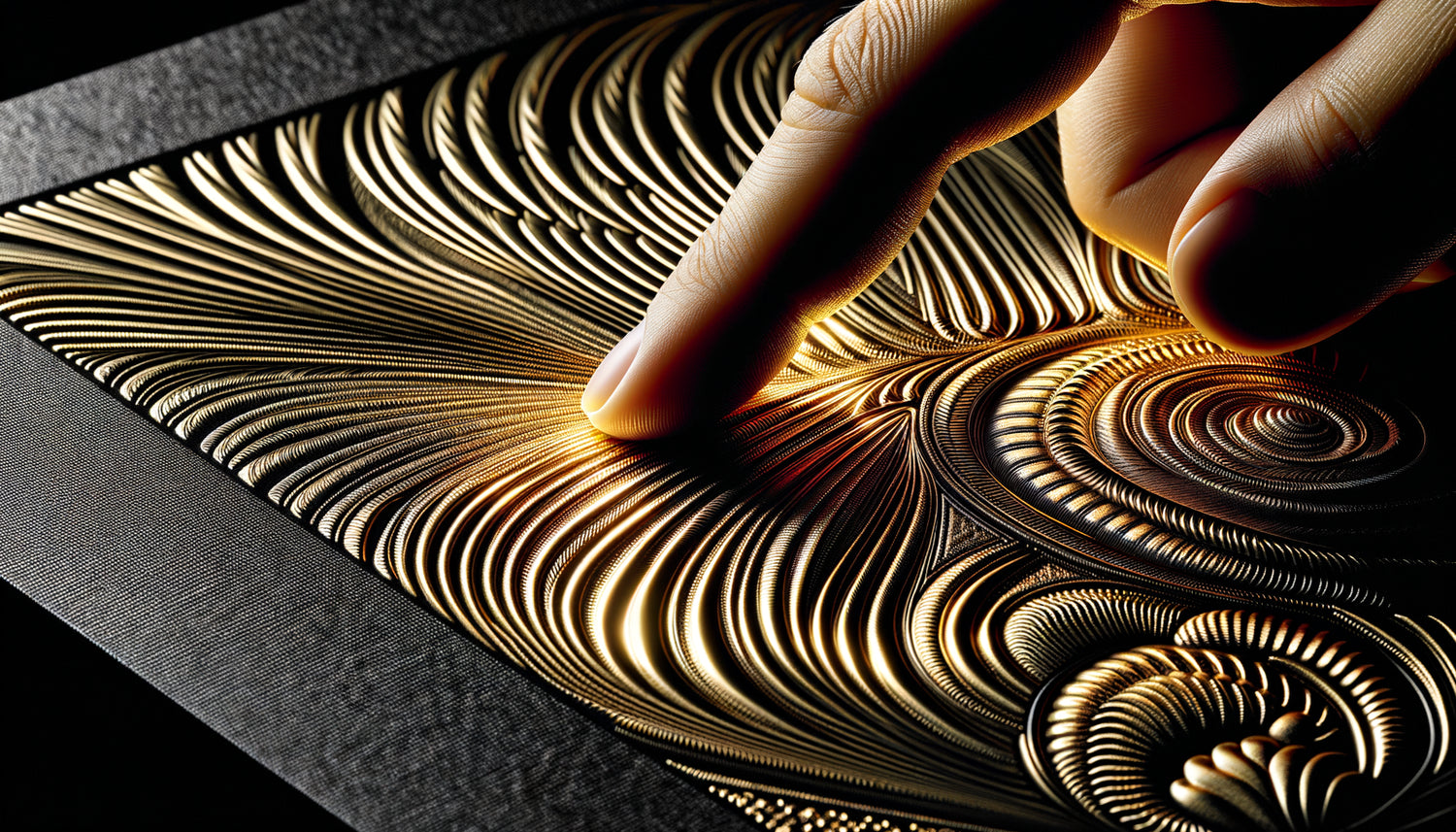
The first truth I learned in Parisian printing workshops: an authentic hot metallized print is felt before it is seen. Gently run your fingers over the surface of the fashion artwork. The authentic creates a distinctive tactile sensation, as if the metallic elements floated slightly above the canvas. This relief is not uniform – it follows the contours of the pattern with precision.
Unlike digital imitations which remain desperately flat, hot printing deposits a thin layer of material under high temperature and pressure. This ancestral technique, modernized for contemporary art, leaves a measurable physical imprint. By tilting the artwork under a grazing light source, you will literally see the metallic areas create tiny shadows on the edges.
The metal film used in hot printing has a perceptible thickness. The decorated areas appear slightly raised, creating a miniature topography on your artwork. This characteristic is impossible to reproduce with classic metallic inks, however sophisticated they may be. Your fingers never lie: if it's perfectly smooth, it’s not a true hot metallized print.
The clues revealed by the viewing angle
Move in front of your fashion artwork. An authentic hot metallized print dialogues with light spectacularly. It doesn't shine uniformly like a cheap chrome surface. On the contrary, it fragments and reflects light along precise axes, creating a changing mirror play.
True metallic foils used in hot printing possess a microscopic crystalline structure. As you move, some areas glow intensely while others darken – an optical phenomenon called directional holographic effect. Digital imitations attempt to simulate this effect, but they produce a static, monotonous sheen.
The raking light technique: the infallible test
Here is my preferred authentication ritual. Position yourself next to the fashion artwork so that ambient light strikes the surface almost horizontally. A genuine metallized hot print will then reveal its deepest secrets: sharp outlines of the pattern, a precise demarcation between metallized and non-metallized areas, and above all, this three-dimensional brilliance impossible to confuse.
The edges of the metallic pattern are a crucial indicator. In an authentic hot print, they are perfectly defined, as if cut with a scalpel. The metallic film stops abruptly where the pressure and heat stop. Even sophisticated imitations often show a slight halo or blurred transition – the signature of ink that has microscopically bled.
Also observe the density of metallization. A hot print creates an opaque and homogeneous layer. You should not be able to see through the metallized area. If you can distinguish the texture of the canvas beneath the shiny area, it is probably a metallic ink, not a true hot print. This total opacity is the hallmark of a complete metallic film transfer.

Chromatic analysis: when true gold tells its story
Authentic metallized hot prints use genuine metallic films – gold, silver, copper, bronze. These metals possess specific chromatic signatures. True gold in a hot print has complex warm nuances: touches of ochre in the dark areas, almost white flashes in direct reflections.
I have observed hundreds of fashion artworks in European showrooms. Digital imitations produce a gold that is too yellow, too uniform, almost garish. True hot printing gold has chromatic depth – it seems to contain several superimposed layers of color. This is particularly visible on complex patterns: feathers, textures of luxurious fabrics, fashion accessories.
Authentic silver behaves differently as well. It subtly shifts towards blue at certain angles, never a dull gray. This characteristic comes from the crystalline structure of the aluminum used in quality hot-foil stamping. Economical versions or digital simulations produce silver that looks more like flat metallic gray.
The micro-details that never deceive
Grab a magnifying glass or use the zoom on your smartphone. Genuine hot foil stamped impressions reveal, under magnification, a perfectly smooth and continuous surface in the metallized areas. No printing dots, no visible texture – just a pure metallic layer.
Digital prints, even high definition, always show a microscopic dot structure. This is inherent to the inkjet or laser printing process. Hot foil stamping physically transfers a solid metal film. The difference is as striking as between a photograph and reality.
Durability as ultimate proof
A remarkable characteristic of authentic hot foil stamped impressions: their exceptional resistance to time. Once transferred, the metal film literally becomes one with the support. It does not flake off, peel off, or tarnish over the years. I have seen fashion artworks fifteen years old whose metallized parts shone as brightly as on the first day.
Metallic inks and digital simulations, on the other hand, gradually oxidize. Silver turns yellowish, gold loses its luster, colors fade. If you examine a supposedly antique artwork with a hot foil that looks new, it is probably authentic. True metals resist oxidation remarkably well thanks to protective varnishes.
Also test resistance to a slightly damp cloth on a discreet area. A genuine hot foil impression will not move a millimeter. Metallic inks, even fixed, may show microscopic transfer traces on the fabric. Warning: this test should remain very light so as not to damage the artwork.

Decoding the creator's information
Serious artists and publishers who use genuine hot foil stamping mention it explicitly. Look for terms like "hot foil stamping," "hot stamping," "gold foiling" or "heat transfer metallization" in the descriptions. These technical expressions signal an assumed quality approach.
Be wary of vague descriptions such as "metallized finishes," "golden effects" or "shiny touches." These evasive formulations often conceal less noble techniques. A genuine fashion artwork with authentic hot foil stamping is a craft investment – creators are proud of it and communicate this clearly.
Find out about the manufacturing process. Hot foil stamping requires specialized equipment: thermal presses, engraved clichés, premium metallic films. Workshops that master this technique are relatively rare. If the price seems surprisingly low for a piece supposedly adorned with hot foil stamping, your intuition is probably right.
You deserve the authenticity of a genuine hot foil stamping
Discover our exclusive collection of fashion artworks that capture the light with the elegance of genuine hot foil stamping techniques.
Your gaze transformed forever
Now, you have the keys to identify an authentic hot foil stamping on any fashion artwork. This knowledge transforms your experience as an art lover: each visit to a gallery becomes a fascinating investigation, each acquisition an informed decision. You will never look at a metallic shimmer in the same way again.
Start with your own collection. Re-examine your current artworks with these new criteria. Feel the relief, observe the grazing light, analyze the chromatic depth. This practice will sharpen your eye until authentication becomes instinctive. And next time you indulge in an ornate fashion artwork, you will know exactly what you are buying – and why it is worth the price.
FAQ : Your questions about hot foil stamping
Can we find authentic hot foil stampings at an affordable price ?
Absolutely, but with realistic expectations. A true hot foil metallized print necessarily costs more than a classic print due to the handcrafted process, noble materials, and specialized equipment required. However, smaller formats or limited editions make this technique accessible. Typically expect an additional cost of 30 to 50% compared to a standard print of equivalent quality. This supplement is largely offset: exceptional durability means your artwork will retain its luster for decades, where an imitation will tarnish in a few years. Favor creators who are transparent about their techniques and don't hesitate to ask for details on the printing process. True artisans are always happy to explain their know-how. A fashion artwork with authentic hot foil remains a lasting decorative investment that will enhance your interior much longer than an economical alternative.
Is hot foil metallized printing suitable for all decoration styles?
This is one of the unsuspected strengths of hot foil metallized printing: its remarkable stylistic versatility. In a clean contemporary interior, it brings that touch of luxurious sophistication without overwhelming. Minimalist patterns with touches of gold or silver create subtle but powerful focal points. In a more classic or Haussmannian universe, hot foil echoes ancient gilding and traditional ornaments, establishing an elegant dialogue between eras. Even industrial interiors benefit from the striking contrasts between raw materials and refined metallic highlights. The key is to choose the pattern and metallic color: gold suits warm atmospheres, silver suits fresh and modern spaces, copper suits bohemian or vintage decorations. A fashion artwork with hot foil adapts to your style rather than imposing it. It is precisely this chameleon ability that explains why this technique crosses trends without ever going out of style.
How to maintain a hot foil metallized artwork to preserve its luster?
Good news: authentic metallized hot impressions require minimal maintenance thanks to their inherent robustness. Simply avoid direct exposure to intense sunlight, which over the long term could affect the non-metallized colors of the artwork. For dusting, use a dry or very slightly damp microfiber cloth, never rubbing vigorously. The metallic areas are remarkably resistant, but gentleness preserves the entire work. Contrary to popular belief, you don't need special products: clear water is sufficient for any dirt. Absolutely avoid abrasive cleaners, alcohol or solvents that could attack the protective varnish. If your artwork is in a humid room like a bathroom, ensure proper ventilation to prevent prolonged condensation. With these basic precautions, your fashion artwork will retain its metallic luster intact for decades. The quality of a true hot impression is also measured by how easy it is to maintain: what is firmly anchored fears almost nothing.