In Viennese haute couture workshops, a work has obsessed creators for over a century. A painting where gold is not used to embellish, but to sublimate the flesh, to transform women into sacred icons. This hypnotic canvas gave birth to a lineage of golden dresses that cross catwalks like divine apparitions. The Portrait of Adele Bloch-Bauer I, painted by Gustav Klimt in 1907, is not only a masterpiece of the Viennese Secession: it is the matrix of a dress language where luxury meets transcendence.
Here's what this iconic work brings to contemporary fashion: a visual grammar where gold structures clothing like a precious armor, a philosophy of jewelry-clothing that transforms the body into a living sculpture, and a modern reinterpretation of luxury where ornamentation becomes identity. Each creator who draws inspiration from Klimt does not copy: he dialogues with a timeless language.
You admire these golden dresses on the catwalks, these embroideries that capture light like Byzantine mosaics, but you don't know where this fascinating aesthetic comes from. How can a 1907 canvas still dictate the codes of contemporary glamour? Why do the greatest couturiers keep returning to this golden source?
Good news: understanding this link between Klimt and haute couture is discovering how art and fashion converse across time. It's learning to decode shows, recognize references, develop a trained eye on what makes a dress iconic.
In this article, I take you behind the scenes of this golden fascination. You will discover how the Portrait of Adele Bloch-Bauer I has shaped Viennese clothing imagination, which creators have translated its magic into fabrics, and how this inspiration continues to irrigate today's fashion.
The Portrait of Adele Bloch-Bauer I: when the woman becomes a golden icon
The painting that changed everything is called the Portrait of Adele Bloch-Bauer I, nicknamed The Lady in Gold. Klimt worked on it for three years, using real gold leaf according to a technique inherited from Byzantine mosaics. Adele Bloch-Bauer, Viennese patron and intellectual, does not pose: she reigns. Her face emerges from an ocean of golden geometric patterns — triangles, spirals, Egyptian eyes — which transform her body into sacred architecture.
What fascinates about this work is the relationship between flesh and ornamentation. The face and hands remain realistically sensual, while the body disappears under a decorative armor. The dress is no longer clothing: it is a system of signs, a symbolic cartography where each motif tells a story. The gold rectangles create a tactile texture, almost textile, which gives the impression that the painting could unfold into a sumptuous gown.
Klimt revolutionized the representation of women by rejecting academic naturalism. In the Portrait of Adele Bloch-Bauer I, the woman is neither idealized nor objectified: she is transformed. This approach resonates powerfully with haute couture, where clothing does not merely dress but creates a new identity. Klimt's gold is not decorative: it is structural, architectural, essential.
A master craftsman's technique at the service of painting
Klimt was not only a painter: he was an artisan. He applied 24-carat gold leaf directly to the canvas, creating reliefs that capture light differently depending on the viewing angle. This tactile and changing dimension fascinates fashion designers, who are precisely looking for this effect in embroideries, sequins, metallized fabrics. A dress inspired by Klimt should not only shine: it must vibrate, breathe, transform light into movement.
How Viennese haute couture translated Klimt's gold into legendary dresses
From the 1900s, Viennese couturiers understood the clothing potential of Klimt's works. The Wiener Werkstätte (Viennese Workshops), founded in 1903, created a direct bridge between decorative arts and fashion. Émilie Flöge, Klimt’s companion and visionary fashion designer, designed reformist dresses that abolished the corset in favor of flowing lines adorned with Klimtian geometric motifs.
These Viennese golden dresses carried a revolution: they liberated the body while adorning it with a new symbolic richness. Golden embroideries no longer followed natural curves but created their own geographies, as in the Portrait of Adele Bloch-Bauer I. Clothing became living architecture, textile sculpture, aesthetic manifesto.
The influence continued throughout the 20th century. In the 1920s, Art Deco dresses echoed Klimt's golden geometry. In the 1980s, the New Wave of Austrian designers such as Helmut Lang and Arthur Arbesser reinterpreted this heritage with minimalist cuts enhanced with precious details. But it was in the 21st century that Klimt’s inspiration truly exploded on international catwalks.
Dress codes born from the Portrait of Adele
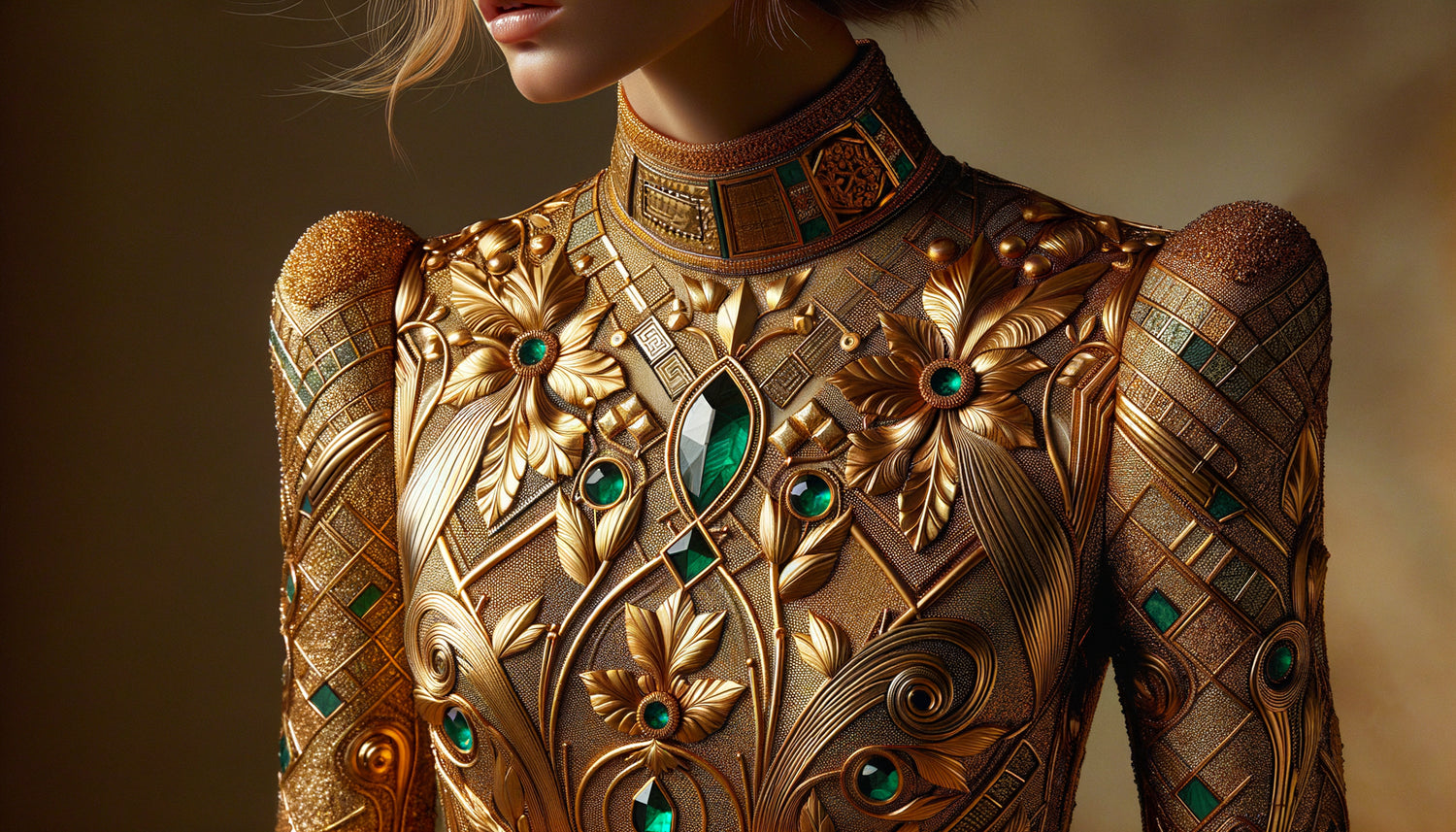
Several stylistic signatures are directly derived from this painting: golden embroideries on dark backgrounds that create a dramatic contrast, repetitive geometric motifs that transform textiles into mosaics, the alliance of rich ornamentation and simplicity of lines, and above all, the idea that clothing can be a total work of art, where every square centimeter carries an aesthetic intention.

Contemporary creators perpetuating Klimt’s golden magic
The most spectacular tribute remains that of John Galliano for Christian Dior during the Autumn-Winter 2007 Haute Couture collection. For the centennial of Portrait of Adele Bloch-Bauer I, Galliano created dresses entirely covered in gold embroidery reproducing Klimt’s motifs with millimeter accuracy. These pieces required up to 800 hours of manual work in Lesage workshops, Parisian temples of art embroidery.
But Galliano didn't simply copy: he translated the frontality of the painting into three-dimensional volume. The golden patterns follow the movements of the body, creating impossible cascading light effects in paint. The models were not wearing dresses: they embodied living Adele, mobile icons where gold seemed liquid.
Alexander McQueen also drew on Klimt’s universe for his Plato's Atlantis (2010) collection, combining Byzantine gold with digital technologies to create futuristic prints. Dolce & Gabbana regularly revisits the golden mosaics in their Sicilian Haute Couture collections, fusing Klimt with Palermo’s Byzantine art. Valentino, under the direction of Pierpaolo Piccioli, created a dress entirely embroidered with gold thread that took up the rectangular structure of Portrait of Adele in 2019.
Gustav Klimt on red carpets around the world
Dresses inspired by Portrait of Adele Bloch-Bauer I populate prestigious ceremonies. At the Oscars, Golden Globes, and Cannes, these golden creations capture flashes like modern reliquaries. Cate Blanchett, Nicole Kidman, or Helen Mirren have worn Klimtian interpretations that transform their appearance into a moment of living art. Red becomes a gallery, the body becomes a canvas.
Why Klimt’s gold still resonates with our time
This lasting fascination can be explained by several factors. First, Klimt anticipated our contemporary relationship to luxury : not as accumulation but as symbolic intensity. His works are not rich because they use gold, but because they transform gold into language. That is exactly what current haute couture seeks, which favors storytelling over ostentation.
Next, the Portrait of Adele Bloch-Bauer I embodies a powerful and complex femininity that resonates with current debates. Adele is neither submissive nor provocative: she is sovereign. The dresses inspired by her convey this same presence, this ability to occupy space with authority without aggression. In a world where fashion constantly rethinks the codes of femininity, Klimt offers an alternative beyond clichés.
Finally, the Klimt aesthetic works wonderfully on social networks. These golden gowns are hyperphotogenic: they create memorable images, instantly recognizable, which circulate like contemporary icons. In the economy of attention, a dress inspired by Klimt possesses this rare quality: it stops the scroll, it asserts its visual presence with the force of a universal symbol.

How to recognize a true Klimt inspiration from a simple golden dress
Not all golden dresses are Klimtian. A genuine lineage with the Portrait of Adele Bloch-Bauer I presents specific characteristics. First, geometric structure takes precedence over naturalism: motifs create their own logic, independent of body shapes. Then, there is this tension between figuration and abstraction, between realistic areas (face, hands, shoulders) and ornamental zones that dissolve the body.
A true Klimt dress also plays with stratification: several levels of motifs overlap, creating a visual depth comparable to the multiple layers of paint and gold in the original painting. Finally, it possesses this particular quality: it transforms light. Like Klimt's gold leaf that changes appearance depending on the lighting, a dress truly inspired by the painter dialogues with light, does not simply reflect it.
Pastiches are content to plate gold. True heirs understand that Klimt proposed a philosophy of clothing where ornamentation becomes structure, where decoration becomes essence. That is the difference between a dress that shines and a dress that radiates.
Transform your interior into a personal gallery
Discover our exclusive collection of fashion paintings that captures this timeless elegance where art meets style.
From museum to wardrobe: embracing the Klimt spirit in everyday life
You don't need a six-figure haute couture dress to incorporate this aesthetic into your life. The spirit of Portrait of Adele Bloch-Bauer I can be embodied in more accessible but equally intentional choices. Look for pieces where ornamentation structures the garment: an embroidered jacket with geometric gold motifs, a kimono playing with mosaics, a blouse where metallic details create a graphic composition.
Accessories also offer magnificent opportunities. A scarf printed with Klimtian patterns can transform a simple outfit into a subtle tribute. Jewelry inspired by the shapes of the painting — golden rectangular earrings, structured necklaces — evokes this universe without literal quotation. Even in interior decoration, a careful reproduction of Portrait of Adele dialogues wonderfully with a contemporary interior, creating this bridge between history and modernity that characterizes the best of Viennese design.
The key is to understand that wearing Klimt means adopting a posture: that of someone who embraces visual richness, who is not afraid of aesthetic intensity, who considers clothing as a language and not just a social code. It's choosing presence over discretion, affirmation over neutrality, without falling into gratuitous extravagance.
Pairing Klimt's gold with your personal style
The secret lies in balance. If you wear a piece heavily inspired by Klimt, let it dominate the composition: clean lines for the rest of the outfit, neutral colors that highlight the gold. Think like Klimt thought his canvas: an intense focal point (Adele's face, or in your case the golden piece) and a setting that sublimates it without visual competition.
Conversely, you can scatter the Klimt spirit with subtle touches: a golden detail here, a geometric pattern there, creating a composition where the eye gradually discovers the reference. This more discreet approach is particularly suitable for everyday professional life, where the intensity of a haute couture dress would be excessive but where cultured winks enrich your presentation.
The living legacy: when Vienna continues to inspire the runways
Each season brings its share of reinterpretations. Vienna Fashion Week, less publicized than Paris or Milan, remains a laboratory where Austrian designers explore their Klimt heritage with a freedom that major houses cannot always afford. We see fascinating experiments: gold mixed with high-tech materials, geometric patterns translated into laser cuts, the frontality of Portrait of Adele revisited in asymmetrical clothing.
This vitality proves that the Klimtian inspiration is not nostalgic but prospective. Creators do not look back: they use the Portrait of Adele Bloch-Bauer I as a springboard to new possibilities. What happens when his ornamental logic is applied to smart fabrics? How do his colors work in augmented reality? Can we create interactive dresses where golden patterns react to movement?
These questions show that Klimt does not belong to the past but to the future of fashion. His radically decorative approach, long considered excessive or kitsch by minimalism purists, regains all its relevance in an era that rehabilitates ornamentation, color, visual intensity. After decades of normcore sobriety, fashion reconnects with maximalism, and Klimt is its unwitting prophet.
The Portrait of Adele Bloch-Bauer I has crossed more than a century without losing its power of inspiration. It survived the Nazis who looted it, American exile, its spectacular repurchase for 135 million dollars in 2006. Today exhibited at the Neue Galerie in New York, it continues to hypnotize visitors and irrigate the imagination of creators. This longevity is no accident: Klimt created not a fashion but a vestimentary archetype, a platonic form of the golden dress of which all subsequent interpretations are only projected shadows.
Your own version of the Lady in gold
You are now initiated into this centuries-old dialogue between a painting and thousands of dresses. You know how to recognize a true Klimtian lineage, understand what makes a golden dress become iconic, identify the codes that transform clothing into an artwork. This knowledge changes your perspective on fashion shows, red carpets, the windows of major couturiers.
But beyond knowledge, there is experience. Wear a piece that dialogues with this heritage, even modestly. Feel how gold near your face captures light differently. Observe how a geometric pattern restructures your silhouette. Experience this particular presence conferred by clothing that assumes itself as complete aesthetic objects.
Adele Bloch-Bauer never wore the dress Klimt painted: he invented it for her, creating an idealized version that transcended reality. This is exactly what haute couture does, and what you can do on your scale: create your own golden icon, your personal version of this timeless elegance where art and life merge.
The Portrait of Adele Bloch-Bauer I is not only a painting: it is an invitation to consider your appearance as a composition, your presence as an artistic performance, your style as a personal manifesto. A century after its creation, it reminds us that clothing can be much more than protection or social signaling: it can be visual poetry, living architecture, conversation with the history of art.
Now that you know this story, every golden dress you encounter will carry this memory. You'll see Adele in the folds of a Valentino creation, recognize Klimt’s rectangles in a Dior embroidery, understand why some dresses stop time. Welcome to the circle of those who see beyond the fabric, who read clothes as texts, who know that fashion is never just fashion.
Frequently Asked Questions
Can I wear Klimt inspirations without looking like a costume?
Absolutely, and that's even the most elegant approach! The mistake would be to seek an exact replica of Portrait of Adele Bloch-Bauer I, which could indeed veer into costume. Instead, opt for subtle translations: a jacket with some golden geometric embroideries on the shoulders, a shirt where discreet metallic patterns create a mosaic effect, or even simply a color palette (gold, copper, bronze on a black or emerald background) that evokes Klimt’s universe without literally quoting it. The Klimtian spirit works wonderfully through accumulation of refined details rather than a shattering statement. Think about how contemporary Viennese creators proceed: they capture an ambiance, a texture, a philosophy of ornamentation rather than an image. Pair your Klimt piece with timeless basics: perfectly cut jeans, a sleek black trousers, a simple pencil skirt. This tension between the extraordinary and the ordinary is what creates this modern elegance that characterizes the best use of artistic references in everyday fashion.
Does Klimt’s gold work for all body types?
Excellent question, and the answer is reassuring: yes, but with strategic adaptations. What makes the Klimtian aesthetic universally wearable is that it doesn't follow the natural curves of the body but creates its own architecture. In Portrait of Adele, it’s impossible to guess the real silhouette under the golden armor: the garment becomes an autonomous sculpture. For an A-shaped figure (hips wider than shoulders), prioritize gold patterns concentrated on the upper body, creating a visual balance. For a V-shaped figure (broad shoulders), Klimtian details work beautifully on a skirt or trousers, drawing attention downwards. For an H-shaped figure, vertical geometric patterns create structuring lines. The advantage of Klimt inspirations is that they direct attention to the richness of decoration rather than body proportions. The eye focuses on the complexity of the patterns, the vibration of gold, the sophistication of the composition. That’s exactly what Klimt sought: to transcend the real body to create an idealized presence. Simply adapt the scale and placement of golden details according to your comfort zones, and let the magic happen.
How to care for clothing with gold embroidery without damaging it?
Klimt-inspired pieces, with their precious details, certainly deserve special attention. For authentic metallic embroideries (genuine or plated gold thread), professional dry cleaning is essential: always specify the nature of the embellishments to your dry cleaner. Between cleanings, simply air out the piece on a padded hanger, away from direct light that could tarnish the metals. For golden sequins, turn the garment inside out before a very delicate hand wash in lukewarm water, without twisting or rubbing the embellished areas. Dry flat on a sponge towel. Absolutely avoid direct ironing on the embroidery: use a pressing cloth (intermediate fabric) or iron on the reverse side at minimum temperature. For storage, prefer to hang these pieces rather than fold them, which could break the metal threads or crush the reliefs. If you must fold them, insert tissue paper between the layers. A museum curator's secret: metallized fabrics are afraid of humidity, which causes oxidation. Add silica sachets to your wardrobe if you live in a humid area. With these simple precautions, your Klimt pieces will last through the years while retaining their luster, becoming those heirloom pieces that are passed down rather than ephemeral purchases. After all, Adele's Portrait is over 115 years old and its gold still shines: your clothes deserve the same longevity.