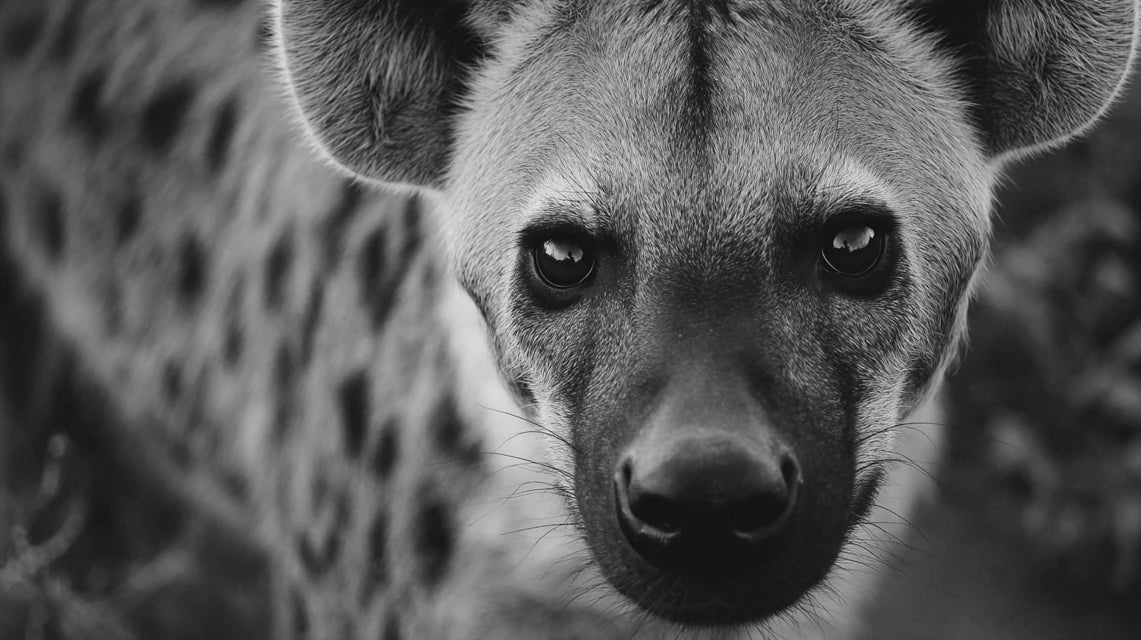
During my last stay in a Dogon village in Mali, I observed a disturbing scene: a hyena roamed near the dwellings at dusk, and the villagers' reactions ranged from sacred respect to visceral fear. This duality deeply marked me. Some murmured protective prayers, while others deliberately left offerings in its path. This ambiguity was not accidental; it revealed the complexity of the symbolism that the hyena embodies in African cultures for millennia.
Here's what the symbolism of the hyena reveals to us: a fascinating duality between the sacred and the profane, a mirror of ancestral fears and traditional wisdom, and an inexhaustible source of inspiration for understanding the richness of African cultures. This ambiguity speaks to transformation, invisible boundaries, and nocturnal mysteries that nourish the collective imagination.
You may be intrigued by this ill-regarded creature, often demonized in Western culture, but whose place in Africa is infinitely more nuanced. Why does it evoke both veneration and repulsion? How can we explain that one animal is considered a divine messenger in some regions and an incarnation of evil in others?
Rest assured: this ambiguity is not a contradiction, but the manifestation of profound symbolic thought. By exploring the multiple facets of the hyena in African traditions, we will discover how this nocturnal animal has become the guardian of thresholds, the witness of passages between worlds, and why its presence continues to inspire contemporary artists and decorators.
I invite you to dive into this fascinating symbolic universe, where each belief reveals a part of ancestral wisdom and where the hyena becomes much more than just a predator: a true cultural symbol with infinite resonances.
The hyena, guardian of the boundaries between worlds
In many African cosmologies, the hyena occupies an exceptional liminal position. It is the animal of the threshold, one that evolves in intermediate spaces: between day and night, between the village and the bush, between the living and the dead. This position largely explains its symbolic ambiguity.
Among the Bambara of Mali, the hyena is considered a psychopomp animal, guiding the souls of the deceased to the afterlife. Its strident laughter, which many find unsettling, is interpreted as communication with the spirit world. This sacred function confers on it a respected, almost venerable status. The elders say that seeing a hyena after a death means that the soul of the deceased has found its way.
Paradoxically, this very proximity to death also engenders fear and distrust. The hyena frequents burial places, feeds on carrion, and its necrophagous behavior intimately links it to decomposition. In several traditions, it thus becomes a symbol of impurity and spiritual danger. The Maasai consider it an impure animal to be avoided, while some Nilotic groups see it as a malevolent being capable of casting curses.
The laughter that disturbs African nights
The vocalizations of the hyena, particularly its characteristic laugh, have fueled countless legends. This unique sound, which can carry for miles across the nocturnal savanna, is interpreted in diametrically opposed ways depending on cultures. For some, it announces the presence of ancestral spirits. For others, it predicts death or bad luck. This sound polysomy reinforces the ambiguity of the animal in the collective imagination.
Sorcery and metamorphoses: when the hyena becomes human
One of the most widespread beliefs about the hyena is its supposed ability to serve as a mount for sorcerers. Throughout West and East Africa, stories abound describing sorcerers riding hyenas at night to attend their nefarious gatherings. This association with witchcraft deeply anchors the hyena in the register of spiritual danger.
Even more disturbing, many cultures evoke transformations between humans and hyenas. The Borana of Ethiopia speak of buda, blacksmiths possessing the power to transform into hyenas to attack their enemies. This belief is so vivid that some communities still ostracize metalworkers today, suspected of having a double nature.
These myths of metamorphosis reveal a deep anxiety: that of unstable identity, of the porous boundary between humanity and animality. The hyena, with its particular gait and androgynous appearance (long considered hermaphrodite), perfectly embodies this concern. It represents what cannot be clearly categorized, what escapes reassuring classifications.
In societies where community cohesion is paramount, the hyena also symbolizes the marginal individual, one who lives on the periphery, who does not respect social norms. Its carrion-eating, opportunistic and solitary behavior (although it lives in a clan) makes it the perfect emblem of social deviance. The Hausa people of Niger use the expression kura (hyena) to describe someone greedy or morally questionable.

Discover this inspiring artwork
When the hyena becomes wisdom and trickster
But the story doesn't end there. In many African tales, the hyena plays a role of a trickster, that cunning but clumsy character who, through his failures, teaches moral lessons. He joins the pantheon of pedagogical figures of African oral tradition, alongside the hare, the spider Anansi or the jackal.
These stories often depict a stupid, gluttonous and easily deceived hyena, completely inverting its threatening figure. In Swahili tales, it is constantly tricked by smaller but more intelligent animals. This comic and moral dimension transforms the hyena into an educational tool, allowing children to learn about the dangers of greed, arrogance and recklessness.
In some peoples like the Konso of Ethiopia, the hyena even enjoys a protective status. It is considered a sacred cleaner, maintaining ecological balance by eliminating carcasses and controlling populations of small harmful animals. Rituals are dedicated to it, and intentionally feeding hyenas is a practice intended to maintain harmony between the human community and the wild world.
An animal of necessary disorder
This multiplicity of perceptions reveals a profound wisdom: the hyena symbolizes necessary disorder, those chaotic forces that, although disturbing, are an integral part of cosmic balance. It reminds us that life is not only order and beauty, but also decomposition, transformation and perpetual cycle. In this perspective, its ambiguity is no longer a contradiction but an essential complementarity.
The hyena in contemporary art and decoration
This symbolic richness inspires many contemporary African artists who rehabilitate the image of the hyena. Painters like Chéri Samba or Beninese sculptors revisit this animal to question themes of marginalization, hybrid identity and resilience. The hyena becomes a metaphor for survival in a hostile world, adaptation to adversity.
In African-inspired interior decoration, representations of hyenas bring a mysterious and profound dimension. Unlike majestic elephants or royal lions, the hyena introduces a touch of ambiguity that stimulates reflection and conversation. It reminds us that African beauty is not limited to idealized images, but embraces shadows, paradoxes, complexity.
Motifs incorporating hyenas work particularly well in spaces where you want to create an intriguing, slightly mysterious atmosphere conducive to contemplation. A painting depicting a hyena under the moon can become the focal point of a living room, inviting visitors to question its multilayered symbolism. Combined with earthy colors, raw textures and natural elements, it anchors the space in authentically African aesthetics, far from tourist clichés.
Embrace the fascinating duality of African symbolism
Discover our exclusive collection of African paintings that celebrate the richness and complexity of ancestral symbols from the continent.

Discover this inspiring artwork
The ambivalence of the hyena in Africa teaches us a valuable lesson about symbolic thinking itself. Unlike Western binary logic, which tends to classify things as good or bad, beautiful or ugly, traditional African cultures accept and value the coexistence of opposites. The hyena is simultaneously sacred and impure, wise and stupid, protective and dangerous.
This ability to maintain tension between opposing meanings reflects a profound philosophical wisdom: the recognition that reality is complex, that beings and things cannot be reduced to a single dimension. In a contemporary world that constantly seeks simplification and categorization, the ambiguous symbolism of the hyena invites us to embrace nuance, to accept the discomfort of uncertainty.
For enthusiasts of African culture and authentic decoration, integrating this understanding radically transforms the aesthetic approach. It is no longer simply about collecting beautiful objects, but about composing a narrative space where each element carries a story, a question, a symbolic depth. The hyena, with all its ambiguity, then becomes a true catalyst for meaning and reflection.
A Mirror of Our Own Contradictions
Ultimately, the hyena reflects our own human contradictions. We too oscillate between light and shadow, between our noble aspirations and our less avowable instincts. The fascination it exerts, even tinged with apprehension, may reveal our unconscious need to recognize and integrate those parts of ourselves that we usually prefer to ignore. In this perspective, welcoming the image of the hyena into our environment becomes an act of inner reconciliation, an acceptance of our complex nature.
The symbolism of the hyena in Africa reminds us that cultural richness does not lie in the simplicity of meanings, but in their stratification, their ability to generate multiple interpretations according to contexts, eras and individual experiences. It is this depth that makes African art and symbolism an inexhaustible source of inspiration for our contemporary interiors.
Integrating symbolic power into your daily life
Now that you understand the richness of this ambiguous symbolism, how can you authentically integrate it into your environment? It's not simply about adding a hyena image to a wall, but creating a visual dialogue that honors the complexity of its meanings.
Consider the hyena as an element of intentional contrast in your decoration. In a space dominated by symbols of power and nobility (lions, elephants, eagles), introducing a representation of a hyena creates a fertile tension, a questioning that prevents the space from falling into superficial decorativeness. It adds a note of authenticity, reminding us that the real Africa is much more than photogenic safaris and postcard landscapes.
Favor works that capture the dual essence of the animal: nocturnal representations where it appears mysterious rather than threatening, compositions showing it in its actual ecological role, or artistic interpretations playing on visual ambiguity. Chiaroscuro techniques work particularly well, creating atmospheres where the hyena seems to emerge from the shadows, a visual metaphor for its liminal position in the African imagination.
Combine these representations with raw and authentic materials: driftwood, hand-woven textiles, terracotta, patinated metals. These textures reinforce the connection with the earthly and natural dimension of hyena symbolism, its anchoring in the cycles of nature and the material realities of African existence. Avoid overly smooth finishes or clinical presentations that would betray the complex and organic spirit of this symbol.
As you explore decorative options, you will discover that the ambiguous symbolism of the hyena offers a rare narrative depth. It transforms your space into a place of questioning and contemplation, inviting visitors to go beyond first impressions to discover the multiple layers of meaning. This is what distinguishes a truly inspired African-inspired decoration from a simple accumulation of exotic objects. The hyena, guardian of thresholds and messenger between worlds, reminds you every day that authentic beauty lies in assumed complexity, in the acceptance of paradoxes that enrich any living culture.