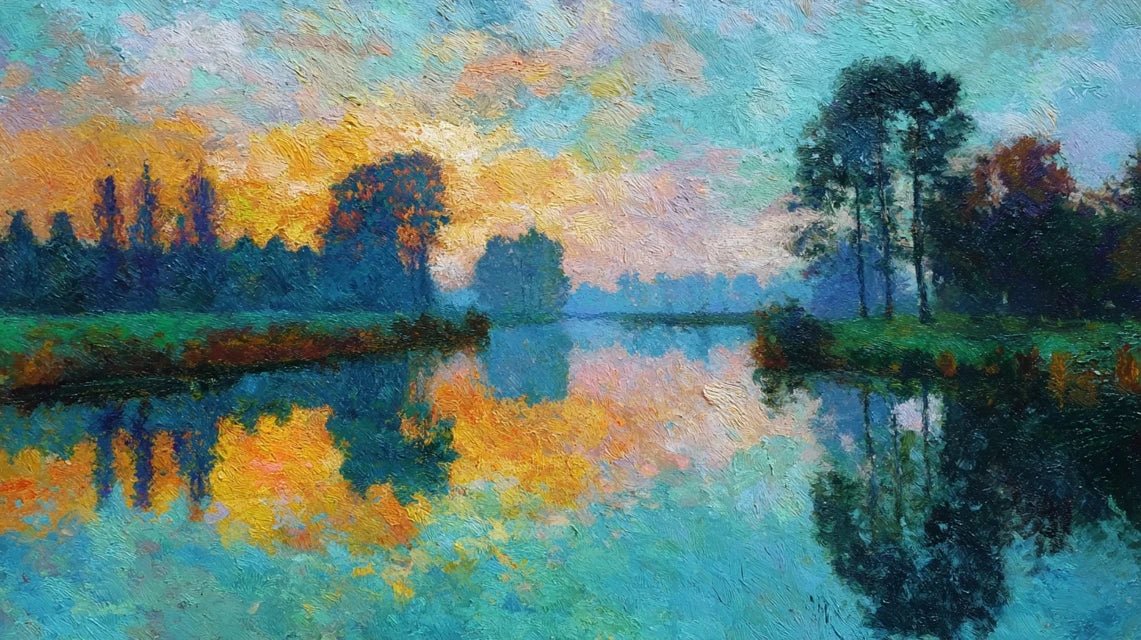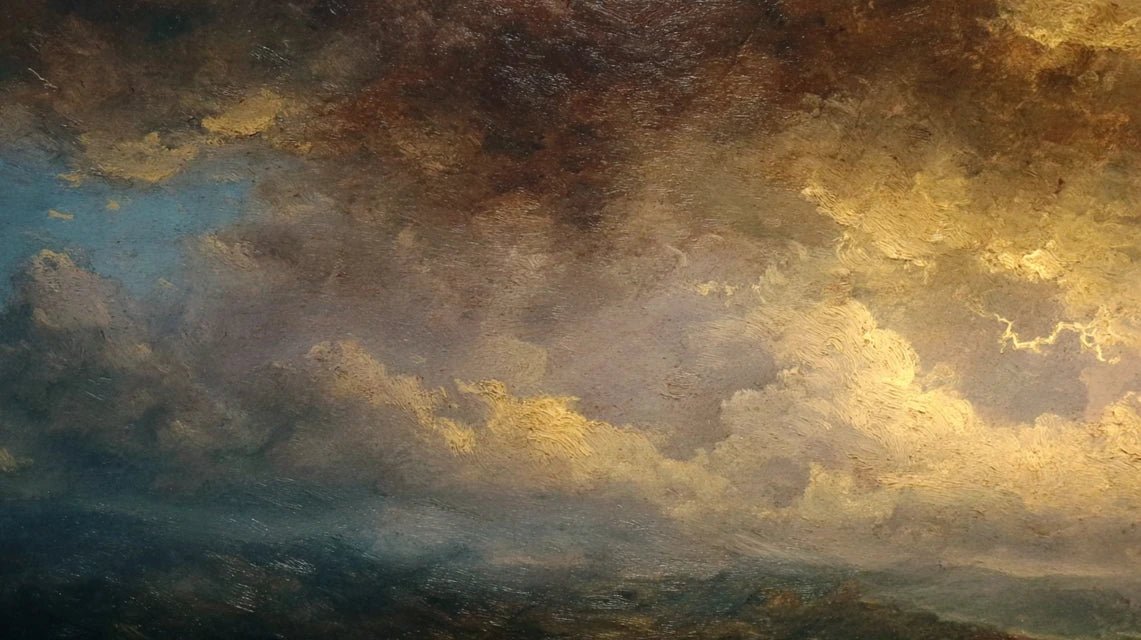
Stormy skies transform 19th-century art like never before. Imagine a romantic painter facing his easel, capturing the dark clouds rolling above him. This scene perfectly summarizes the revolution shaking landscape paintings.
The symbolic codes of stormy skies in Romantic landscape paintings
Forget the blue and serene skies of classical art! Romantic artists discover in storms a revolutionary visual language. Each dark cloud tells a story, each lightning bolt expresses an emotion.
Take Caspar David Friedrich and his melancholic landscapes. His cloudy skies don't just describe the weather. They reveal the era’s tormented soul. After the upheavals of the French Revolution, artists seek new forms of expression.
Romantic painters then create a veritable visual alphabet:
- Dark clouds translate existential anguish
- Lightning bolts symbolize divine inspiration
- Torn skies express political divisions
- Massive cloud formations embody the infinity of nature
This transformation marks a fundamental break with three centuries of pictorial tradition.
Pictorial techniques of stormy skies in 19th-century landscape paintings
How to paint the intangible? Turner solves this challenge through a revolutionary technique. He mixes colors directly on the canvas, creating striking fusion effects. As a result: his storms seem alive, ready to burst out of the frame.
Constable adopts a different but equally innovative approach. His sky studies at Hampstead Heath reveal an unprecedented scientific precision. He observes, notes, analyzes each cloud formation. This method even influences the meteorologists of the time!
Innovations multiply rapidly:
- Impasto gives relief to the clouds
- Glazes create plays of transparency
- Rapid touches capture atmospheric movement
- Luminous contrasts dramatize the whole
These landscape paintings testify to this technical revolution where art and science meet.
Evolution of the symbolism of stormy skies in landscape paintings (1800-1850)
The history of stormy skies in the 19th century reads like a three-act novel. Each period brings its innovations and specific symbolic codes.
1800-1820: The Birth of the Sublime
The storm first expresses divine grandeur. Girodet paves the way with his "Flood Scene". His message is clear: man facing the infinity of creation. This pre-romantic approach lays the foundations for the artistic revolution to come.
1820-1835: The Romantic Zenith
The storm becomes a mirror of the soul. Friedrich transforms each cloud into a personal confidence. Turner makes the tempest a colorist symphony. This period produces 75% of masterpieces relating to century's stormy skies (Source: Musée d'Orsay - Catalogue of Romantic Landscape Paintings).
1835-1850: Towards Naturalism
Scientific discoveries influence art. The Barbizon School favors direct observation. The storm democratizes, losing its mystical dimension in favor of natural truth.
Expressive Applications of Stormy Skies in Late 19th Century Landscape Paintings
The second half of the century sees the birth of spectacular expressive innovations. The Barbizon School revolutionizes everything: Rousseau and Diaz de la Peña now paint on site. They confront the elements directly, parasol in one hand, brush in the other.
This plein air technique transforms the artistic approach. The storm is no longer recreated in a studio but captured on the spot. Subtle nuances replace the dramatic contrasts of nascent romanticism.
Boudin pushes innovation even further. His quick studies capture the meteorological moment. Monet will remember it for his Impressionist series. The storm thus becomes a pretext for experimentation rather than a symbolic support.
Masters of the Symbolism of Stormy Skies in 19th Century Landscape Paintings
Four giants dominate the art of stormy skies in the 19th century. Each brings their unique vision, creating together an exceptional artistic heritage.
Turner revolutionizes technique. His "Snow Storms" dissolve reality into pure color sensation. He anticipates abstract art for an entire century.
Friedrich spiritualizes the storm. His contemplative landscapes transform each viewer into a pilgrim of art. "The Abbey in a Wood" remains the perfect embodiment of this meditative aesthetic.
Constable scientificizes observation. His Hampstead studies establish the naturalistic foundations of the genre. Art and meteorology meet in his brushes.
Delacroix and Géricault embody French fervor. Their tormented skies express their era's political commitment and romantic passion.
These masters together create an artistic language that still influences contemporary art.
FAQ: The symbolism of stormy skies in 19th-century landscape paintings
Q1: Why did 19th-century painters favor stormy skies?
R: Stormy skies responded to the need for emotional expression within the Romantic movement. Unlike the serene skies of classical art, which symbolized order and reason, storms allowed for the expression of human passions, post-revolutionary political instability, and the spiritual quest of the time.
Q2: What technical innovations made it possible to better represent storms?
R: Painters developed several revolutionary techniques: impasto to create the relief of clouds, transparent glazes for lighting effects, and especially Turner's color mixing technique which dissolved the boundaries between sky and earth. Scientific observation inspired by the work of Luke Howard also made a more authentic representation possible.
Q3: How did the Barbizon School transform the painting of stormy skies?
R: The Barbizon School revolutionized the approach by prioritizing plein air technique and direct observation. This aesthetic of the instant replaced studio reconstruction, allowing for the capture of subtle nuances of storm phenomena and preparing the advent of Impressionism.