I noticed something fascinating during my last expedition to Kenya: in every village I passed through, from the Masai Mara to the shores of Lake Turkana, the cheetah appeared everywhere. Engraved on gourds, painted on walls, woven into fabrics. Not the lion. Not the elephant. The cheetah. This feline elegance inhabited the collective imagination with a disturbing persistence.
Here's what the symbolism of the cheetah in the art of the African savanna reveals: an incarnation of sacred speed, a spiritual guide between worlds, and a symbol of adaptation that crosses the centuries without ever losing its power. In both traditional and contemporary art, this animal occupies a unique place that goes far beyond its simple physical beauty.
Many people think that African art is reduced to generic representations of wildlife. One buys a decorative painting without understanding that each animal carries specific meanings, passed down through generations. This lack of awareness deprives us of an extraordinary symbolic richness.
Yet, understanding the symbolism of the cheetah completely transforms our relationship with these works. Each line, each motif, each color tells a millennial story. And this story deserves to be explored, because it connects us to an ancestral wisdom of unsuspected depth.
I invite you on a journey into the heart of this fascinating symbolism, where art meets spirituality, where the savanna has inspired creators since time immemorial.
The cheetah, messenger of the gods of speed
In the art of the African savanna, the cheetah is never represented at rest. This characteristic is not insignificant. The Maasai, Samburu and Turkana artists I met all explained the same thing to me: the cheetah embodies perpetual movement of life, this energy that cannot be contained.
The rock paintings of the Tassili n'Ajjer, dating back several millennia, already show cheetahs in full race, their bodies stretched in that characteristic posture where all four paws simultaneously leave the ground. This representation crosses the ages to contemporary paintings, creating a remarkable artistic thread.
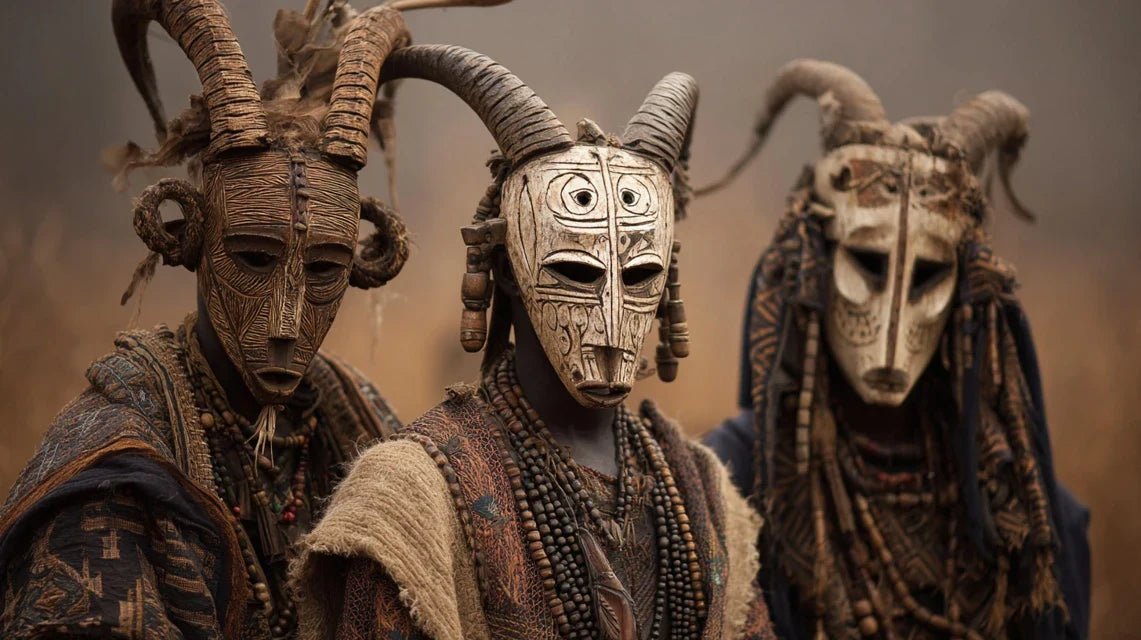
The symbolism of the cheetah in the art of the African savanna is inseparable from the notion of divine speed. Among the Dogon people of Mali, the cheetah is associated with Amma, the creator god, whose word moves at the speed of this animal. Ceremonial masks often incorporate stylized leopard patterns representing this connection to the sacred.
Black tears: spiritual marks
Carefully observe traditional depictions of the cheetah: the two black lines descending from the eyes to the lips are always exaggerated, emphasized. These cheetah tears carry a profound meaning in African art.
According to oral tradition that I gathered from an elder Samburu, these marks tell the story of a cheetah who wept so much at the suffering of the world that his tears drew these permanent furrows. In contemporary African art, these lines become powerful graphic elements, sometimes gilded or silvered, symbolizing compassion within strength.
Guardian of the secrets of the savannah
The symbolism of the cheetah in the art of the African savanna also reveals its role as a guardian of ancestral knowledge. Unlike the lion, a social and noisy animal, the cheetah hunts silently, observes from heights, masters the art of invisibility.
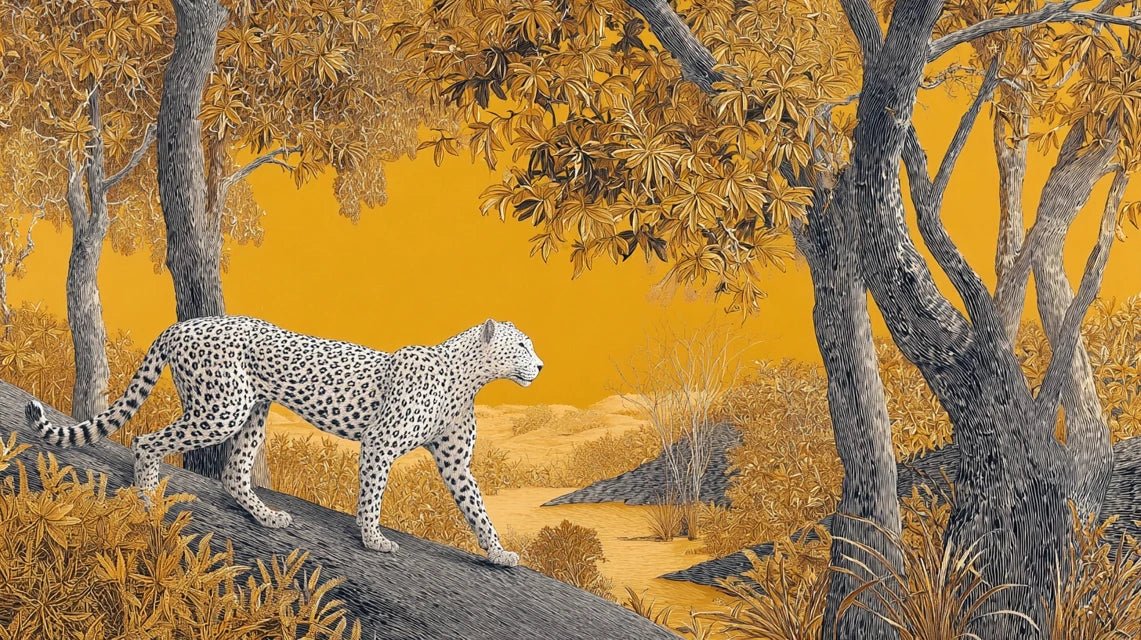
This discretion is reflected in art through representations where the feline seems to blend into the tall grass, where its spotted fur dialogues with the patterns of vegetation. The ebony wood sculptors of Zimbabwe create pieces where the contours of the cheetah merge with branches, illustrating this ability to exist between two worlds: the visible and the invisible.
I was fortunate enough to attend a Maasai initiation ceremony where a young warrior received a shield adorned with a stylized cheetah. The elder who presided over the ceremony explained that this symbol would remind him to know when to pounce and when to observe, a wisdom that only this animal masters perfectly.
The fur: a map of the cosmos
The spots of the cheetah have fascinated African artists for centuries. In traditional art, each spot is not placed randomly. The Kuba weavers of Congo showed me how they reproduce these patterns according to precise mathematics, creating textiles where the cheetah becomes an earthly constellation.
This symbolism of the cheetah in the art of the African savanna establishes a bridge between earth and sky. Dogon astronomers have identified correspondences between certain stars and the fur patterns, making the cheetah a living cosmic book. Contemporary paintings exploit this idea by superimposing star charts onto feline silhouettes.

Discover this inspiring artwork
Adaptation as a philosophy of life
Here’s what struck me most during my research: the cheetah is the only large African feline that has fundamentally altered its anatomy to survive. Non-retractable claws, a hyper-specialized body, a unique hunting strategy. This radical ability to adapt resonates deeply within contemporary African art.
Urban artists in Johannesburg and Dakar use cheetah symbolism to talk about resilience in the face of modernity. Monumental murals show cheetahs whose spots become pixels, whose limbs lengthen into lines of code, illustrating this necessary metamorphosis without loss of identity.
In galleries in Lagos and Nairobi, I saw installations where sculptures of cheetahs made from recycled materials question our own ability to adapt. The message is clear: just as this animal has transformed its body to thrive, we must transform our lifestyles without denying our essence.
The female cheetah: matriarchy and independence
An often overlooked aspect of the symbolism of the cheetah in African savanna art concerns the central role of females. Unlike lions where the male dominates, cheetahs raise their young alone, hunt alone, survive alone.
Contemporary African women artists have embraced this symbolism. Photographers like Zanele Muholi or painters like Wangechi Mutu integrate the female cheetah into their works as an icon of female autonomy. The spots become ritual scarifications, the slender silhouette evokes graceful strength.
Between fragility and power: the paradox of the hunter
What makes the symbolism of the cheetah so rich is its fundamental paradox. It's the fastest land animal, capable of reaching 68 mph, yet it’s the most fragile of Africa’s large predators. This duality runs through all of savanna art.
The stone sculptures of Zimbabwean artist Tapfuma Gutsa capture this tension: cheetahs with bulging muscles but vulnerable gazes, bodies stretched towards action but frozen in hesitation. This assumed vulnerability at the heart of strength speaks to our own human contradictions.
In Malian Bogolan textiles, the cheetah often appears alongside symbols of protection, as if the artist recognizes that even the fastest needs spiritual guardianship. This humility, this recognition that power is not enough, is an integral part of the wisdom conveyed by this animal.
The cheetah in rites of passage
I documented several ceremonies where the symbolism of the cheetah in African savanna art takes on an initiatory dimension. Among the Turkana in northern Kenya, young men must create a work of art representing a cheetah before reaching adulthood.
This artwork is not decorative: it's an exercise in understanding. By sculpting, painting or engraving the animal, the initiate must meditate on the qualities they wish to embody: patience before the race, the precision of a decisive gesture, the acceptance of vulnerability.

Discover this inspiring artwork
The contemporary cheetah: a symbol of conservation
In African art of the 21st century, the symbolism of the cheetah evolves to integrate an ecological dimension. With only 7000 individuals remaining in the wild, the cheetah becomes in contemporary art a symbol of environmental urgency.
Artistic projects like those of the Art of Conservation organization use representations of cheetahs to fund their protection. Works created by artists such as Collin Sekajugo or Esther Mahlangu transform the cheetah into a visual ambassador for African biodiversity.
This evolution of symbolism does not betray ancestral meanings, it extends them. The cheetah has always represented adaptation and survival: today, it asks us to adapt ourselves in order to ensure its survival and that of the ecosystems on which we all depend.
Let the symbolic power of the cheetah transform your interior
Discover our exclusive collection of African paintings that capture the spiritual and artistic essence of the savannah, where each artwork tells a millennial story of wisdom and beauty.
Integrating this symbolism into your living space
Understanding the symbolism of the cheetah in the art of the African savanna transforms the way you choose and arrange these works in your home. It's no longer simply a decorative element, but a bearer of meaning that influences the energy of your space.
In an office, a cheetah in full race recalls the need for a decisive moment, concentration before action. In a living room, a cheetah at rest with its cubs evokes family protection and transmission. In an entrance hall, a watchful cheetah symbolizes awareness of opportunities.
Contemporary creators who understand these nuances create works where ancestral symbolism dialogues with modern aesthetics. The clean lines of Scandinavian design can welcome the symbolic power of the African cheetah, creating harmonious cultural bridges.
I encourage my clients not to choose a cheetah representation solely for its visual impact, but for what it evokes in them. What quality of this animal resonates with your current journey? Adaptation, speed, patience, assumed vulnerability, independence?
Conclusion : the eternal race towards light
The symbolism of the cheetah in the art of the African savanna ultimately teaches us a universal lesson: beauty lies in movement, not stagnation. This feline reminds us that we are all beings in transition, constantly adapting our speed to the terrains we cross.
When you now contemplate a work representing a cheetah, you will no longer see just a magnificent animal. You will see an age-old messenger inviting you to find your own rhythm, to recognize your vulnerability as part of your strength, to know when to leap and when to observe.
Start simply: find a work whose symbolism resonates with your current intention. Place it where your eyes will rest each day. Let the wisdom of the cheetah gently infuse your daily life. The transformation may not be as fast as its legendary race, but it will be just as powerful.