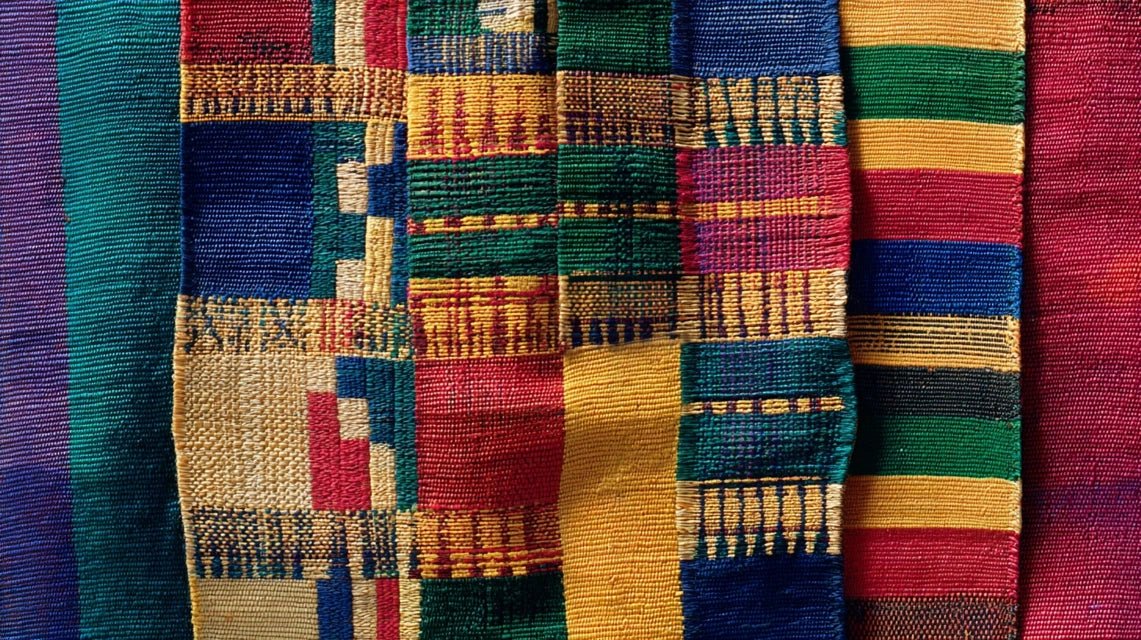
The rhythmic clatter of the loom has resonated in the workshop since dawn. Vibrant silk threads – saffron yellow, vermilion red, emerald green – pass through my hands as I guide them with the precision passed down through three generations of weavers. Each strip of fabric tells a story, encodes a message, perpetuates millennia-old wisdom. We don't create simple textiles here in Bonwire: we create woven memory, philosophy transformed into patterns.
Here’s what Kente textiles bring to your world: exceptional historical depth, a rich symbolism that transforms every space into a place of conversation, and timeless beauty that transcends eras without ever becoming outdated. These Ghanaian royal fabrics embody much more than an aesthetic – they are the vehicle for an entire culture.
Many admire these hypnotic geometric fabrics in museums or high-end boutiques but feel lost facing their complexity. How do you decode these patterns? What is their true history? How can they be integrated with respect and authenticity into a contemporary interior? These legitimate questions often curb initial enthusiasm.
Let me guide you through the fascinating world of Kente. After fifteen years handling the shuttle on these traditional looms, after weaving for heads of state and collectors around the world, I will reveal the secrets of these extraordinary textiles. You will discover their legendary origin, understand the hidden language of their patterns, and know how their presence radically transforms the atmosphere of a place.
The legend of the spider weaver: origins of Kente
The history of Kente begins with a tale my grandfather used to tell me as a child, sitting near the loom. Two Ashanti hunters, Kurugu and Ameyaw, observed a spider – Ananse in our language – weaving its web with prodigious skill. Fascinated by the complexity of the patterns and the delicacy of the work, they decided to imitate this divine technique. They returned to the village with their first strip of fabric, which they presented to the Asantehene, the Ashanti king.
This first textile, called Kente (from kenten, meaning “basket”), was reserved exclusively for royalty. Only the king could wear these extraordinary fabrics during sacred ceremonies. This exclusivity shaped the very identity of Kente: a prestigious textile, charged with symbolic power, each thread of which tells the grandeur of a nation.
In Bonwire, the village considered the cradle of Kente in the Ashanti region, this tradition has persisted since the 17th century. Family workshops pass down ancestral techniques, secret patterns, and color combinations that distinguish a master weaver from an apprentice. Kente weaving is not simply an artisanal activity – it's a sacred art form, a moving meditation.
The anatomy of a masterpiece: understanding the structure of Kente
Unlike what many think, Kente is not woven in one piece. Our technique relies on creating narrow bands of about 10 centimeters wide, individually woven on traditional horizontal looms. These bands are then sewn together to form large rectangular pieces – the famous ntoma – which can measure up to two meters by three.
Every morning, I set up my loom with a precise ritual. The warp threads are tensioned to perfection, the weft threads – silk, cotton or rayon – are prepared in their spools. Kente weaving requires perfect coordination between hands, feet and mind. The pedals operate the heddles that separate the warp threads, creating the space where the shuttle passes with its weft thread. It is a mechanical ballet of watch precision.
The geometric motifs that characterize Kente are born from the calculated alternation of colors and the density of the weaving. Some simple patterns can be made in a few hours, but complex compositions – those once reserved for royalty – take several weeks of concentrated work. A single misplaced thread, and the entire visual balance collapses.

Discover this inspiring work
The chromatic dictionary: when colors speak
In the universe of Kente, each color has a deep symbolic meaning, inherited from our Akan cosmology. It is never by chance that such a yellow borders such a green, that red emerges in this precise place in the pattern. Weavers compose with colors as poets do with words.
Yellow and gold embody wealth, royalty, the fertility of our land. This is the color of the sun which ripens corn and yam, the color of gold dust which made the fortune of the Ashanti kingdom. When you see these warm tones dominate a Kente textile, you contemplate material and spiritual abundance.
Green symbolizes growth, vitality, renewal. It is the color of our lush forests, the hope that is reborn with each rainy season. In compositions, it brings freshness and promise for the future.
Red carries an intense emotional charge: it is the blood of ancestors, the sacrifices made, but also political and spiritual passion. Kente textiles dominated by red are reserved for solemn occasions, ceremonies where we invoke the memory of the deceased.
Blue evokes peace, harmony, love. It is the color of serene skies, soothing water. In a Kente composition, its presence tempers more aggressive colors, creates visual breathing spaces.
Black and white represent spiritual maturity and purity, respectively, the joy of rites of passage. Their alternation creates the graphic contrasts that give Kente its distinctive visual power.
The motifs that tell stories
Beyond the colors, it is the traditional motifs that constitute the true language of Kente. Each configuration has a name, a story, a coded message that only initiates fully understand.
Emaa Da («this has never happened before») celebrates innovation, originality, the creation of something entirely new. This complex motif, with its sophisticated interweaving, symbolizes artistic excellence pushed to its paroxysm.
Sika Futuro («gold and gold dust») was once reserved exclusively for the royal family. Its genuine golden threads shone during major ceremonies, affirming the power and prosperity of the Ashanti kingdom.
Nyankonton («God's rainbow») represents divine grace, the beauty of creation. Its multicolored bands evoke the alliance between heaven and earth, between the divine and the human.
Adwinasa («my talent is exhausted») paradoxically expresses the supreme mastery of the weaver: this extremely difficult motif demonstrates that he has reached the limits of technical complexity, pushing the boundaries of weaving art.
Kente and Ewe: the two Ghanaian traditions
An important nuance that many ignore: there are actually two main Kente weaving traditions in Ghana. That of the Ashanti, centered in Bonwire in the Kumasi region, and that of the Ewe, in the Volta region, notably in Agotime-Kpetoe.
The Ashanti Kente, which I practice, favors abstract geometric motifs with bright and contrasting colors. Our compositions are more structured, with rhythmic repetitions that create a sense of perpetual movement. Emphasis is placed on royal symbolism and technical complexity.
The Ewe Kente, on the other hand, integrates more figurative motifs – human silhouettes, animals, everyday objects. The colors are sometimes softer, the compositions more narrative. This tradition emphasizes the transmission of moral messages and popular proverbs through textiles.
Both approaches are equally valuable, equally rich. They testify to the creative diversity of Ghana and the ability of our peoples to transform weaving into a form of sophisticated cultural expression.

Discover this inspiring artwork
Long confined to traditional ceremonies and museum collections, Kente has experienced an extraordinary democratization in the 20th century. Historical events – such as the wearing of Kente by leaders of the American civil rights movement in the 1960s – propelled these Ghanaian textiles onto the international stage.
Today, Kente inspires fashion designers, interior decorators, contemporary artists worldwide. But this popularity raises important ethical questions. How to appreciate these textiles without falling into cultural appropriation? How to respect their symbolic charge while integrating them into new contexts?
My answer, forged by years of dialogue with international clients: knowledge breeds respect. When you understand that a specific pattern was reserved for the king, you do not use it lightly. When you grasp the meaning of a color combination, you integrate it with intention and reverence.
In a contemporary interior, an authentic Kente textile can be presented as a work of art – framed, carefully illuminated, accompanied by a plaque explaining its origin and significance. It can also become an exceptional cushion, a table runner for special occasions, a focal element that attracts the eye and sparks conversation.
The essential thing is to treat these pieces with the dignity they deserve. An authentic Kente is not a generic decorative accessory – it is the result of dozens of hours of artisanal work, the guardian of centuries of tradition, a tangible fragment of the Ghanaian soul.
Recognizing a true Kente: guide for the enlightened collector
Faced with the growing popularity of Kente patterns, the market has been flooded with imitations – digital prints on cheap cotton, soulless machine weaves, approximate reproductions that have only the superficial appearance of Kente.
An authentic Kente is first recognized by touch. The texture is slightly uneven, a testament to manual work. The threads have a density, a weight, a tactile presence that imitations never manage to reproduce. Run your hand over the surface: you should feel the structure of the weave, the slight reliefs created by the interlacing of the threads.
Examine the edges of the strips sewn together. In a true Kente, you will see these seams – sometimes slightly uneven – that join the individual bands. Printed imitations feature a continuous pattern without these structural articulations.
Observe the complexity of the patterns. An authentic traditional Kente follows precise compositional rules, with rhythmic repetitions and calculated symmetries. Imitations often show random irregularities, patterns that do not respect the visual grammar of Kente.
Finally, inquire about the origin. A serious seller should be able to tell you the village of origin, ideally the name of the weaver, and explain the meaning of the motifs and colors. This traceability ensures not only authenticity, but also that your purchase directly supports Ghanaian artisan communities.
Transform your interior into a space for cultural dialogue
Discover our exclusive collection of African art that captures the visual and symbolic richness of Ghanaian textile traditions, transforming each wall into a window onto a millennial culture.
Preserving and transmitting : the future of Kente
Each morning, as I set up my loom, I ask myself the same question: in fifty years, will there still be young Ghanaians to perpetuate this art? Rapid modernization, the appeal of urban trades, competition from industrial textiles threaten the transmission of our ancestral know-how.
Yet, I remain optimistic. More and more young people are rediscovering the pride of our textile traditions. Training initiatives, artisan cooperatives, partnerships with ethical international brands create new economic opportunities for weavers.
Kente also adapts to contemporary tastes without betraying its essence. Some weavers experiment with softer color palettes for minimalist interiors, create innovative formats, collaborate with designers to imagine new uses. This creative evolution, as long as it remains rooted in traditional technical mastery, enriches our heritage rather than diluting it.
Your role, as an informed enthusiast, is crucial. By choosing to acquire authentic Kente textiles, by learning their history, by sharing their meaning with those around you, you actively participate in this preservation. Each piece purchased directly from artisans or their legitimate representatives supports a family, finances the training of a young weaver, keeps a millennial tradition alive.
Kente is not an artifact frozen in the past – it's a living, evolving tradition that has managed to traverse centuries while retaining its relevance. Ghanaian textiles continue to inspire, fascinate, and provoke admiration because they embody universal values: artisanal excellence, symbolic depth, beauty that elevates the spirit.
When thread becomes philosophy
After all these years of weaving Kente, I realized that we are not simply creating decorative textiles. We weave collective memory, encode philosophical values, create bridges between generations and cultures.
Whenever you gaze upon an authentic Ghanaian Kente, you are invited to slow down, contemplate, and question. These hypnotic geometric patterns are African mandalas, meditation supports that reconnect us with the essential. In our world saturated with disposable images and mass production, Kente offers a valuable antidote: beauty that required time, patience, and mastery.
Integrating a Kente textile into your daily life means affirming that you value authenticity, that you respect cultures around the world, that you choose depth over superficiality. It's an aesthetic act, certainly, but also ethical and political in the noble sense of the term.
Whether this textile becomes a cushion on your sofa, a framed artwork in your office, or an accent piece in your bedroom, it will subtly transform the atmosphere of the place. Visitors will be intrigued, ask questions, and you will have the opportunity to share this fascinating story – that of a spider weaver, curious hunters, generations of artisans who dedicated their lives to perfecting a sacred art.
Kente reminds us that true beauty requires time, that excellence is the fruit of patient learning, that the most valuable objects are those that carry authentic human stories. In your home as in your life, choose pieces that tell something true, deep, and moving.
The clatter of the loom still resonates in my workshop. It will resonate, I hope, for many more generations. And each time you admire a Kente textile, wherever you are in the world, you may hear this distant echo – the millennial rhythm of our tradition, the heartbeat of Ghanaian culture, the permanent invitation to conscious and respectful beauty.
Frequently Asked Questions about Kente Textiles
What is the difference between Kente and other African fabrics?
Kente stands out due to its specific weaving technique: narrow bands woven individually and then sewn together, unlike printed fabrics like wax or single-piece woven textiles. This method creates a unique texture and allows for extremely complex geometric patterns. Furthermore, each motif and color combination of the Kente possesses a codified symbolic meaning, inherited from Akan cosmology. It is not simply a decorative textile, but a complete visual language that communicates messages about social status, moral values, specific occasions. Finally, the royal history of Kente – its origin as a textile exclusively reserved for the Asantehene – confers a particular prestige within the hierarchy of African textiles. Owning an authentic Kente is holding a fragment of Ghanaian royal heritage.
How to care for an authentic Kente textile?
An authentic Kente textile requires delicate care to preserve its vibrant colors and woven structure. For valuable pieces, opt for professional dry cleaning, clearly informing the cleaner that it is a valuable artisanal textile. If you must wash it yourself, use only cold water with a mild detergent without bleaching agents, and hand wash avoiding vigorous rubbing. Never wring out the fabric – gently press it between two absorbent towels. Dry it flat in the shade, never in direct sunlight which could fade the dyes. For ironing, use a medium temperature and always place a protective cloth between the iron and the Kente. If you display it as framed artwork, avoid direct sunlight and consider UV-protective glass to protect colors over time.
Is it appropriate to use Kente in decoration if I am not Ghanaian?
This is an important question that demonstrates your cultural sensitivity. Yes, it is perfectly appropriate to incorporate Kente textiles into your decor, provided you do so with respect and knowledge. The key lies in the intention and approach: learn the history of the textile, understand the meaning of its motifs, and treat it as the cultural artwork it represents rather than a simple exotic accessory. Prioritize acquiring authentic pieces from ethical sources that fairly compensate Ghanaian artisans – this transforms your purchase into an act of cultural support rather than appropriation. When you have guests, share the history of Kente, explain its origin and meaning - this creates an enriching cultural dialogue. Avoid relegating it to purely decorative use without recognition of its depth: a Kente deserves to be displayed with the dignity one would accord a masterpiece painting or a precious sculpture. Your informed appreciation honors Ghanaian tradition and contributes to its preservation.