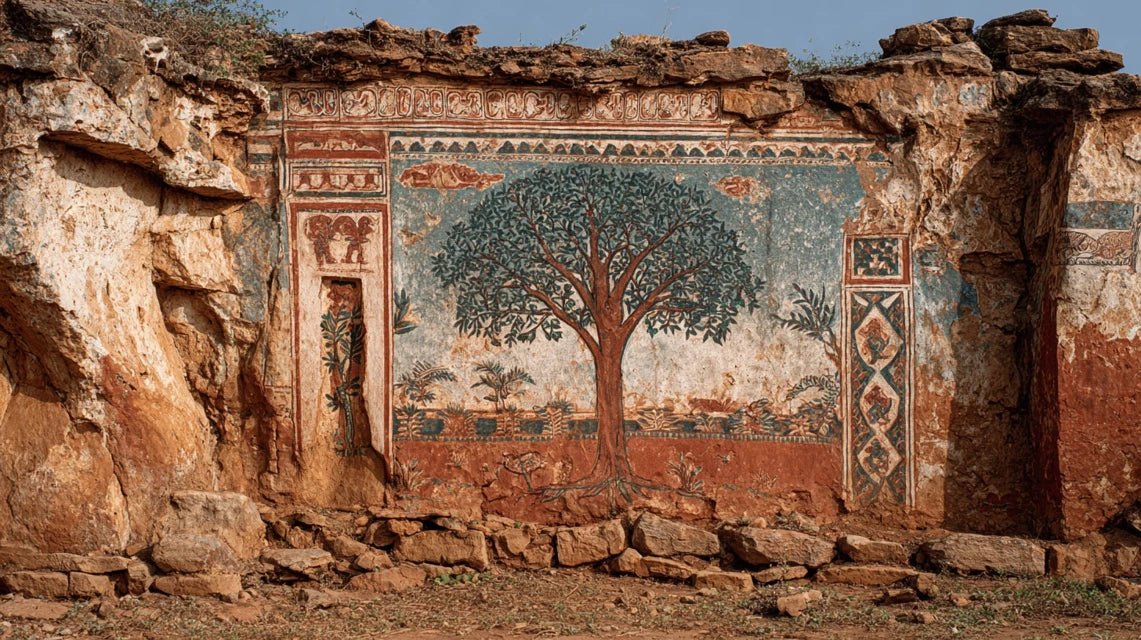
I unpacked my bags in the village of Tiébélé for the first time in 2007, as an ethnologist specializing in the decorative traditions of West Africa. Faced with murals Gurunsi murals, I knew that my professional life had just changed. These walls transformed into giant canvases tell a millennial story of resistance, femininity and architectural harmony. The murals of Burkina Faso represent much more than a decorative tradition: they embody a symbolic language passed down from mother to daughter for centuries, a spiritual map traced by hand on clay facades. Here's what this ancestral tradition brings: a sophisticated visual communication system that protects and identifies each family, an ecological construction technique that naturally regulates temperature, and a feminine ritual that perpetuates intergenerational ties. Many think these decorations are part of tourist folklore, that they have lost their authentic meaning. The reality is quite different. Each stroke, each geometric pattern obeys ancestral rules mastered by the Kassena women since childhood. I take you into this fascinating story, from pre-colonial origins to contemporary challenges, to understand why these painted walls fascinate designers and architects around the world.
Ancestral roots: when architecture becomes language
The Gurunsi are not a single ethnic group, but a collection of peoples in southern Burkina Faso, mainly the Kassena, Nankana and Nunuma. Their architectural history dates back to the 15th century, a period when they built soukhalas, these fortified earth enclosures that brought together several generations under one roof. The first Gurunsi murals did not respond to an aesthetic need, but to a practical necessity: to identify the different sections of the same family courtyard.
In these labyrinths of clay, each space had its function: millet granaries, bridal chambers, kitchens, sanctuaries. Women gradually developed a visual marking system to distinguish these areas. A triangle pointing downwards indicated a storage area, wavy lines indicated proximity to water, checkerboard patterns symbolically protected the bedrooms. This murals tradition was part of a precise cosmology where each sign dialogued with protective spirits.
The technique passed down from generation to generation
I spent three rainy seasons observing the Kassena women preparing their plasters. The technique has not changed for centuries. They collect laterite, this reddish-ferruginous earth characteristic of the region, which they mix with dried and crushed cow dung. This organic binder gives the plaster exceptional resistance to weathering. Application is exclusively during the dry season, between November and April, when the walls have dried after the rains.
Natural pigments come from carefully selected local sources: white kaolin extracted from riverbanks, charcoal powder for deep black, red ochre from laterite, and sometimes baobab leaf decoction to obtain a pale yellow. The tools remain rudimentary but terribly effective: polished pebbles for smoothing, guinea fowl feathers for tracing fine lines, pieces of calabash cut into combs for creating repetitive patterns.
The hidden symbolism behind each pattern
The patterns of Gurunsi murals are never random. Each geometric shape belongs to a symbolic vocabulary that women learn from adolescence. The diamond, omnipresent, represents the python, a sacred animal associated with fertility and protection. The chevrons evoke the traces left by caimans in the mud, symbols of strength and longevity. Concentric circles embody stacked gourds, a metaphor for abundance and women's work.
In the village of Tiébélé, the cradle of this tradition, I have recorded more than forty distinct patterns. Some belong to specific family lineages and can only be reproduced by their descendants. Others, more universal, adorn common areas. The murals of Burkina Faso function as a non-verbal writing, readable by all members of the community. An initiated visitor can identify a woman's marital status, the number of children in the family, and even marriage alliances simply by observing the facade.
The colors and their spiritual meaning
The limited color palette of the Gurunsi murals obeys spiritual constraints as much as material ones. White, the color of ancestors, is only used on the upper parts of the walls, where the gaze rises to the sky. Black marks openings and thresholds, spaces of transition between the visible and invisible worlds. Red covers the main surfaces, anchoring the dwelling in the nourishing earth.
This chromatic trilogy creates a striking visual harmony under the Sahelian sun. Variations in texture reinforce the effect: smooth and shiny surfaces for white areas, matte and deep aspect for charcoal blacks. Women sometimes spend several weeks polishing certain sections with pebbles, obtaining a rendering close to stucco that subtly reflects the grazing morning light.

Discover this inspiring artwork
An exclusively female ritual
The creation of wall paintings is a domain strictly reserved for Kassena women. Men build the banco structure, but never intervene in the decoration. This division of labor reflects a cosmology where masculinity shapes the container and femininity infuses the soul. Young girls begin their apprenticeship around twelve years old, accompanying their mothers and grandmothers during decorating sessions.
Initiation follows a precise path. Apprentices start by polishing surfaces, then learn to prepare pigments, and practice simple patterns on inconspicuous sections. It is only after several years that they access the complex compositions adorning the main facades. Elderly women, holders of the most sophisticated knowledge, supervise the entire process and intervene in the most symbolic areas: the frontispiece of the main entrance, the walls of the family sanctuary, the decorations surrounding the sacred jars.
The ritual calendar of renovation
Wall paintings from Burkina Faso are not permanent. Every year, after the winter season, women must restore damaged sections due to torrential rains. This maintenance obligation perpetuates the transmission of knowledge. The complete renovation of a family courtyard mobilizes all the women of the lineage for two to three weeks. It is a moment of intense socialization where stories, marriage advice and village news circulate.
I was privileged enough to witness a post-winter restoration in the Tiendrebéogo family concession. Fifteen women, from the eighty-year-old grandmother to the thirteen-year-old granddaughter, were working in a perfectly coordinated choreography. The youngest prepared the plasters, middle-aged women applied the base layers, and elders traced the final patterns. This organization reflects the social and spiritual hierarchy of the Kassena community.
Adaptation to modernity
Gurunsi murals are currently experiencing a critical period. Rural exodus empties villages of their young people, and with them disappears part of the know-how. Modern materials are seducing: cement, industrial paints, corrugated sheets gradually replace earth architecture. In Tiébélé, cultural tourism has paradoxically saved the tradition by giving it an economic value.
But this heritage status raises questions. Are Burkina Faso murals at risk of becoming a frozen spectacle for tourists, devoid of their spiritual substance? Several associations are working on authentic transmission. Workshops bring together teenagers and grandmothers to perpetuate techniques. Burkinabé architects integrate these motifs into contemporary constructions, proving that tradition and modernity can dialogue.
Growing international influence
Gurunsi motifs inspire designers and decorators worldwide. I have seen their geometries reinterpreted on high-end textiles in Milan, Parisian wallpapers, artisanal ceramics in California. This international diffusion values the Kassena aesthetic, but raises issues of cultural appropriation. Who economically benefits from this popularity? The original creators often remain invisible in this value chain.
Several initiatives are trying to correct this imbalance. Kassena women's cooperatives now produce terracotta decorative panels reproducing traditional motifs. These creations, exported to Europe and America, generate income while valuing ancestral knowledge. Dialogue is gradually established between a millennial tradition and the global decoration market.
Be inspired by this millennial aesthetic
Discover our exclusive collection of African art that celebrates the richness of West African decorative traditions and will transform your spaces into true cultural art galleries.

Discover this inspiring artwork
Preserving a Living Heritage
The Gurunsi wall paintings remind us that a home can be much more than just shelter. They embody a philosophy where architecture dialogues with the cosmos, where decoration transmits family history, and where feminine creative gesture structures social space. In our contemporary interiors saturated with standardized objects, this millennial tradition offers a valuable lesson: beauty is born from the connection between local materials, transmitted know-how, and shared symbolism.
The future of Burkina Faso's wall paintings depends on a delicate balance. Neither frozen museumification nor abandonment in favor of modernity, but an organic evolution where younger generations embrace heritage by reinventing it. Some Kassena women are now developing new motifs inspired by their contemporary reality, while respecting ancestral codes. This creativity proves that tradition is not synonymous with repetition, but with living transmission.
Imagine your gaze transformed after discovering these clay walls. You will never see wall surfaces the same way again. Each wall becomes an opportunity to tell a story, create connections, and celebrate craftsmanship. Start simply: integrate a geometric motif inspired by this tradition into a corner of your interior, choose natural pigments, let your hands dialogue with the material. The Gurunsi wall paintings teach us that decorating is living fully.
Frequently Asked Questions about Gurunsi Wall Paintings
How long do Gurunsi wall paintings last?
Gurunsi wall paintings require annual maintenance because the rains of winter gradually damage the plaster. Unlike our industrial paints designed to last for years without intervention, this tradition relies on a perpetual cycle of regeneration. It is precisely this impermanence that guarantees the transmission of know-how: each generation must relearn the gestures, update the motifs, perpetuate the chain of knowledge. In areas well protected from the weather, some sections can remain intact for two to three years. But the very idea of permanence goes against the Kassena philosophy, which values the repeated creative process rather than the definitive work. This approach invites us to rethink our relationship with decoration: what if beauty lay as much in the act of creation as in the final result?
Can we be inspired by Gurunsi motifs in a contemporary decoration?
Absolutely, and it is even desirable if done with respect and cultural awareness. The motifs of Gurunsi murals adapt wonderfully to contemporary interiors thanks to their clean geometry and natural palette. Favor an inspired approach rather than literal copying: incorporate these shapes into a stencil for a wall panel, choose textiles printed with similar motifs, or work with artisans who collaborate directly with the Kassena communities. The essential thing is to understand that each motif carries a meaning. Research the symbolism before integrating these elements into your home, thus creating an authentic connection with the culture that generated them. The most innovative interior designers are now using these references by combining them with sustainable materials and ecological techniques, in the spirit of the Gurunsi tradition which values local resources and transmitted know-how.
Where can we see authentic Gurunsi murals?
The village of Tiébélé, about 170 kilometers southeast of Ouagadougou, is the most emblematic and accessible site to admire the authentic Gurunsi murals. Several family concessions can be visited with respect for traditions, often accompanied by a local guide who explains the symbolism of the motifs. The village of Tangassogo also offers magnificent examples, in an atmosphere that is sometimes less touristy. If you are traveling to Burkina Faso, prefer the dry season between November and March, when decorations are freshly renovated and visiting conditions are optimal. Find out about local cultural associations that organize fair visits, guaranteeing direct remuneration for families. Some ethnographic museums in Europe and America exhibit authentic decorative panels, but nothing replaces the experience of seeing these walls in their original context, inhabited by the families who perpetuate this millennial tradition.